
Do these 3 things before closing this tab:
1Repair Windows errors before they cause bigger problems2Fix the driver behind crashes, sound loss and screen glitches3Clear out junk files and repair common Windows errorsiTechGuides is reader-supported. When you buy through links on our site, we may earn an affiliate commission. As an Amazon Associate I earn from qualifying purchases. Learn more
Monitor an AI agent as a complete, auditable execution trace—not just as a final answer or HTTP status. Capture every model generation, tool call and argument, handoff, guardrail result, retry, error, latency measurement, token count, estimated charge, and verified business outcome. Then operate four views of that data: reliability, safety, performance, and economics.
This approach reveals soft failures such as selecting the wrong tool, passing incomplete results between agents, looping through retries, or claiming an action succeeded when the external system did not change. It also lets you block dangerous operations with least-privilege tools, validation, approvals, loop limits, and budgets before they become incidents.
What should an AI-agent monitoring system capture?
A useful trace follows one run from the initial request through every model turn, tool invocation, handoff, and state change. Preserve the same trace and session identifiers when work moves between services or subagents; otherwise a failure can look like several unrelated events.
The Tool Desk
Outbyte PC Repair FREEClear out junk files and repair common Windows errorsFree Scan →Outbyte Driver Updater FREEScan for outdated or missing drivers - takes under a minuteDriver Scan →| Trace field | What to record | Why it matters |
|---|---|---|
| Identity and context | Run ID, session ID, workflow, tenant, user or service principal, parent-run ID, model, deployment region, and prompt or policy version | Lets you group incidents, enforce per-tenant controls, and reproduce the exact execution context. |
| Model activity | Generation start and end, model name and version, input and output token counts, cached and reasoning-token details when available, stop reason, and safety result | Explains latency, quality changes, and cost; a model change can otherwise appear to be a random regression. |
| Tool activity | Tool name, read/write classification, argument hash or redacted arguments, schema-validation result, start and end times, response status, and a bounded result summary | Shows whether the agent chose the right capability, supplied safe parameters, and received usable data without storing unnecessary secrets. |
| Control events | Guardrail decisions, approval requests and responses, prompt-injection findings, policy violations, rate-limit events, loop counters, and termination reason | Provides an audit trail for blocked or allowed actions and distinguishes a deliberate stop from a crash. |
| Outcome and accounting | Retries, exceptions, timeout type, queue time, end-to-end latency, token totals, estimated provider charge, and verified task outcome | Connects technical behavior to what the user or business system actually experienced. |
Keep raw prompts, tool arguments, and results behind access controls. Hash or redact credentials, payment data, personal information, and other secrets at ingestion, while retaining enough structured information to diagnose behavior. Store an immutable event record for approvals, rejections, and state-changing calls; ordinary application logs can be edited or rotated without preserving an audit history.
Popular on Amazon
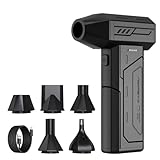
- Powerful Turbo Fan:CAGIWIRU Electric Air Duster have reached speed up to 130000RPM,Can efficient remove dust and debris.With LED light and Three Adjustable Speed to meet with different cleaning tasks.
- With Attached USB C Fasting Charging cable.Charing 3 hours,Enjoy up to 240 minutes of use on the lowest setting, For third speed can use for 25mins.with four charging options to meet with your needs.
- Wide Application: attached 5 different nozzles,making it suitable for a variety of scenes, such as car,pet, pc, keyboards, and other electronic devices. It also serves for office and home clean duster.
- Handy Design & Portable:Cordless air duster electric nozzle is Light weight and small size, design and comfortable to hold and space saving, convenient to carry around. You can put it in your room or inside the car without taking up space.
- Economical &Reusable: Built durable materials with a long-lasting battery,our CAGIWIRU air duster it's a sustainable alternative to disposable air cans.
Why a final answer is not a success signal
An agent can return a polished answer while selecting an incorrect tool, receiving an empty result, handing off to the wrong specialist, or exhausting retries. A successful HTTP response only proves that your application returned a response. Add an explicit outcome check in the system where the action occurred: query whether a ticket has the expected status, confirm that a payment processor returned a settled transaction, or verify that a deployment health check passed. Record that check as a separate event linked to the run.
How do I detect agent failures that do not throw exceptions?
Combine hard-error telemetry with semantic checks and trace-level evaluations. Treat a run as failed when its intended outcome is not verified, even if every function returned a syntactically valid response.
Measure reliability at run and step level
- Task success rate: percentage of runs that pass the business outcome check, segmented by workflow, model, tenant, and tool.
- Tool error rate: validation failures, permission denials, provider errors, malformed responses, and application exceptions for each tool.
- Timeout and termination rate: model, network, queue, and overall-run timeouts, plus runs stopped by a loop or budget limit.
- Retry behavior: retry count, backoff duration, final status, and the original error that triggered each retry.
- Handoff quality: whether the receiving agent had the required context and whether the handoff produced a useful result rather than a bounce between agents.
- Incomplete-result rate: responses missing required fields, truncated records, stale data, or empty results that the next step treated as authoritative.
Report these metrics both as rates and as counts. A low percentage can still represent a serious incident in a high-volume workflow, while a high percentage from a tiny sample may not justify a model rollback.
What’s actually slowing this PC down?
Pick the symptom - the matching free tool is one click away.
Use evaluations on sampled traces
Sample complete traces for human review or automated graders that check tool choice, argument correctness, policy compliance, factual grounding, and outcome verification. Keep the original trace, evaluator version, score, and evidence used for the score. Re-run the same evaluation set after changing a model, prompt, tool schema, retrieval index, or routing rule; a change that improves answer quality can still increase unsafe calls or cost.
OpenAI’s Agents SDK tracing model creates spans for runner operations, model turns, agent execution, function tools, guardrails, handoffs, and custom events, and records token usage for runs. Use those native spans when the runtime already uses the SDK, then add application-specific outcome events around the systems that the agent changes.
How can I tell when an agent calls the wrong tool?
Inspect the decision immediately before each tool call and compare it with the workflow’s allowed capabilities. Wrong-tool selection is a semantic failure, so a normal tool response does not make the call correct.
Also popular on Amazon

- Screen Cleaner is Your Screen’s New Bestfriend! - EVEO is proud to present a screen cleaner that’s perfectly suited for your TV. Meet your new screen cleaner, computer screen cleaner, laptop cleaner, iPad cleaner, Macbook,tv cleaner or any other electronic device. Our screen cleaner spray and wipe along with the included plush microfiber cloth, easily removes dust, fingerprints & other smudges on the screen’s surface. Clean effectively for a streak-free screen
- Gentle on your Screens - Our screen cleaner spray and wipes is compatible to be used even for the most sensitive LCD, LED, CRT, and OLED screens in proper use. Be at ease knowing that this product is compatible with all the major brands: LG, SONY, Samsung, Sharp, iPad, iPhone, Android screens, Kindle, PC monitors - we’ve got you covered! Can be used as LCD screen cleaner, tv cleaner, smart tv screen cleaner, and more
- Premium Super Soft Plush Microfiber Cloth - Included in this efficient screen cleaning kit. This screen cleaner spray and wipe has our signature plush microfiber cloth specially designed to comply with screens and monitors and leave them streak-free. Has been shown to effectively absorbs stubborn stains, zero streaks, and no fiber shedding. Always use this together with our screen cleaner for the best results
- Easy-to-Use Screen Cleaner Kit + microfiber cleaning cloth - The EVEO Screen Cleaning Kit will easily be your new favorite tool when it comes to taking care of the things you love most, quick and easy solution for a streak-free screen. Simply screw on the sprayer gun on the screen cleaner bottle. Spray the cleaning liquid onto the microfiber cloth, then wipe the screen until desired cleanliness & shine is achieved.
- Quality Screen Care Kit Worth Purchasing - Enjoy a convenient Screen Cleaner anytime, anywhere you need it. Your satisfaction is our top priority. We stand behind the quality of our products and that’s why, you shouldn’t be worrying at all. We manufacture the Best Screen Cleaner. and can be used for laptop cleaning kit, laptop screen cleaner, tv screen cleaner for smart tv. MacBook screen cleaner, monitor cleaner or screen cleaner spray for electronic devices with microfiber cleaning cloth
Define an expected tool policy
For each workflow state, declare which tools are allowed, which are read-only, and what information must be present before a call. For example, a support agent may search a customer record before drafting a response, but it should not close a case until the customer identifier, resolution code, and approval state are present. Emit a policy-check event containing the allowed set, selected tool, and reason for any denial.
Detect suspicious sequences
- A write call occurs before the required read or approval.
- The same tool is called repeatedly with unchanged arguments.
- An agent alternates between two tools without making progress.
- A handoff sends a task to an agent that lacks the required capability.
- A tool result is empty, stale, or schema-invalid but is passed onward as if complete.
- The selected tool is outside the workflow’s normal sequence or tenant policy.
Sequence rules should generate a review event rather than silently rewriting the agent’s decision. Automatic correction can hide a prompt or routing defect and make later investigation harder.
How do I monitor and prevent unsafe agent actions?
Detection alone is insufficient for destructive, financial, legal, privacy-sensitive, or externally visible operations. Combine least privilege, strict validation, human approval, bounded execution, and an immutable audit trail.
Separate read and write capabilities
Expose separate tools for reading data and changing it. Give each tool only the permissions required for its workflow and tenant. A reporting agent should receive a read-only database role; an agent that drafts an email should not receive a send permission. Keep credentials outside prompts and tool arguments, and issue short-lived credentials where the surrounding system supports them.
Validate inputs before execution
Define strict schemas with enumerated actions, bounded quantities, approved destinations, and explicit required fields. Reject unknown fields rather than ignoring them. Validate authorization, tenant ownership, time windows, and business constraints in application code immediately before the side effect, because a value that was safe when generated may be unsafe after a handoff or state change.
Validate outputs before the next step
Parse tool responses against a schema and mark missing, contradictory, or stale data as unusable. Do not let an untrusted web page or retrieved document supply executable instructions to the next tool. Preserve the original result and the validation decision so an evaluator can distinguish a bad upstream source from a model interpretation error.
Also popular on Amazon

- 【Large size】:Measuring 800 x 300 mm/ 31. 5×12 inches, which is wider and taller than others. Large mouse pad can perfectly fit your keyboard and mouse of any size, and there is also ample space for peripherals such as phones, tablets, etc.
- 【LED backlight mouse pad】:Blade Hawks RGB mouse pad provides 7 static modes and 7 dynamic modes will give you the options you are looking for. Power-off memory function remembers the last lighting mode you selected. The super glow fiber Chroma will give you a colorful gaming setup that you want.
- 【Anti-slip rubber base】:Made from Natural rubber, this gaming mousepad will firmly grip your desktop, allowing you to enjoy the ultimate precision in the games you are most passionate about. It also comes with a texture that enhances this ability even further.
- 【Smooth and waterproof surface】: Micro-textured cloth surface, for extremely precise mouse control and a smooth movement. When liquid splashes on the gaming mouse pad, it forms water droplets and slides down. Will not delay your work or gameplay.
- 【Plug and play】: This mouse and keyboard pad is powered by USB, plug and play, no driver required. One button control light modes. Press one time to change the lighting mode, press twice to change the brightness, press and hold about 3 seconds turn ON/OFF.
Add approval gates for irreversible actions
Pause the run before sending money, deleting records, changing access, publishing externally, signing a legal document, or making another action that cannot be readily reversed. Show the approver the proposed operation, target, parameters, evidence, requesting identity, and estimated cost. Log who approved or rejected it, when, and whether the executed call exactly matched the approved payload. Expire an approval if the payload, target, or relevant state changes.
Bound autonomy
- Set a maximum number of model turns and tool calls per run.
- Apply per-tool rate limits and concurrency limits.
- Stop on repeated identical calls, oscillating tool sequences, or unchanged state.
- Use deadlines that include queue, model, tool, and approval time.
- Provide a deterministic emergency stop that operators can apply to a workflow, tenant, or credential.
Datadog’s agent observability features include safety and quality evaluations, prompt-injection detection, sensitive-data redaction signals, and traces that expose each agent step and its error context. Arize’s agent tracing approach connects tool activity, handoffs, retrieved context, and state changes, which helps locate the point where execution diverged. Treat those signals as inputs to your own authorization and approval controls, not as a replacement for them.
How can I control runaway LLM costs?
Attribute usage and estimated spend to individual runs and workflows, then enforce limits before a trace can consume an unbounded number of model calls. A monthly invoice is too late to identify which loop or tenant caused the increase.
Track the cost drivers
- Request count and model-call count per run.
- Input, output, cached, and reasoning-token counts when the provider exposes them.
- Tool-call count, retrieval volume, and handoff count.
- Queue and execution latency, because long waits can trigger duplicate client requests.
- Estimated provider charge using the price and currency in effect for the selected model and region.
Store the pricing version used for every estimate. If a provider changes rates or a model alias moves to a new version, historical estimates remain interpretable. Aggregate spend by run, user, tenant, workflow, model, tool, and deployment so an organization-wide total does not conceal one expensive customer or automation.
Set budgets and enforcement points
Define a maximum estimated spend and token allowance per run. Add separate daily or rolling budgets per user, tenant, and workflow. Before each model call, calculate the remaining allowance; after the call, update it atomically. When the allowance is exhausted, stop gracefully, return a clear partial-result status, and record the budget event rather than silently switching to an unapproved model.
Alert on deviations, not only totals
- Token growth relative to the workflow’s recent baseline.
- Repeated retries or unusually long traces.
- An unexpected model, region, or routing path.
- A sudden increase in handoffs, retrieval volume, or tool calls.
- Spend that exceeds a per-run, per-user, per-workflow, or daily threshold.
Use warning and blocking thresholds. A warning can route a trace for review; a hard limit should stop additional calls. Datadog provides dashboards for usage trends, cost, latency, performance, and reliability, while the OpenAI Agents SDK exposes per-run request and token usage, including model calls aggregated across tool calls and handoffs.
Also popular on Amazon

- 【Softer and More Comfortable】Vaydeer wrist rest has unique diamond pattern, which is the combination of softness and aesthetics. The materials of wrist rest are improved into higher quality memory foam and covered with silky smooth lycra. The computer wrist rest makes you as comfortable and cushiony as like rest your wrists on clouds.
- 【Ergonomic Wrist Saver】The wrist rests for keyboard and mouse comes with a 17.32×3.15×0.83 inch keyboard wrist pad and a 5.94×3.15×0.83 inch mouse wrist support. Based on ergonomic design, the unique concave shape is the perfect fit for your wrist joints. The wrist rest pad fits most computer keyboards and laptops, improve hand and wrist posture, release your wrist and arm stress.
- 【Non-Slip Rubber Bottom】Featuring an anti-skid silicone base on the bottom, this wrist keyboard support stays firmly in place on your desk, preventing the padding from sliding around, ensuring stable and consistent wrist support during extended computer sessions.
- 【Better Experience & Pain Relief】Our keyboard arm rest is beneficial to alleviate the soreness caused by direct contact and friction between your arm and a hard desk surface, reducing the risk of wrist fatigue or carpal tunnel. The soft texture of memory foam can evenly distribute the pressure around your wrists and provide good support with just enough give.
- 【Helpful in Multiple Scenarios】Whether you're working, studying, writing, typing, gaming, this keyboard and mouse rest combo is an essential accessory to add comfort and support to your hands and wrists. It’s also a great gift for men, women, family, friend, coworker, gamer, teacher, etc.
Which observability approach should I use?
Choose based on runtime, deployment, trace depth, evaluation needs, data-residency requirements, and how much cost attribution you need. Vendor features, retention, and pricing change, so verify current plan details before committing.
| Approach | Strengths | Best fit | Questions to verify |
|---|---|---|---|
| OpenAI Agents SDK tracing | Native spans for runner operations, model generations, agent execution, function tools, guardrails, handoffs, and custom events; token usage is tracked per run. | Teams whose runtime already uses the SDK and want low-friction instrumentation. | How traces are exported, retained, redacted, accessed, and joined with non-SDK services; whether your required alerts and evaluations are available. |
| Datadog Agent Observability | Hosted end-to-end traces, operational dashboards, safety and quality evaluations, prompt-injection and privacy signals, and cost monitoring. | Organizations standardizing on a hosted operations platform across services. | Data residency, retention, access controls, integration coverage, evaluation limits, and the total cost at your trace volume. |
| Arize Phoenix and agent observability | Tracing and evaluation that connect model calls, retrieved context, tool activity, handoffs, and state changes; supports open-source or self-managed deployments. | Teams that need flexible evaluation workflows or control over deployment and data. | Operational ownership, scaling, alerting integrations, retention configuration, and the engineering effort to run and secure it. |
Regardless of platform, require a stable trace schema and export path. A beautiful dashboard that cannot show the final business outcome, approval payload, or cross-service handoff is not sufficient for incident response.
How do I implement monitoring step by step?
Build the smallest complete trace first, then add controls and evaluations. The following sequence avoids the common mistake of collecting expensive token data without knowing whether the task actually succeeded.
- Define the outcome. Write the observable condition that means the workflow succeeded, such as a record with a specific status, a settled transaction identifier, or a passing deployment check.
- Create a trace context. Generate a run ID at ingress and propagate it, along with session ID, tenant, workflow, and parent-run ID, through every model call, tool service, queue, and subagent.
- Instrument model and tool spans. Record timestamps, model, token counts, arguments or argument hashes, result status, retries, and errors. Bound payload size and redact secrets before export.
- Add control events. Emit guardrail, schema-validation, policy, approval, rate-limit, loop-limit, and termination events with the decision and reason.
- Record the real-world outcome. Query the changed system after a write and link the verification result to the run. Distinguish not-found, denied, pending, and confirmed states.
- Set budgets and deadlines. Enforce per-run token, call, time, and spend limits before each model or tool invocation. Add tenant and workflow budgets for aggregate protection.
- Build the four operational views. Create reliability, safety, performance, and economics dashboards with filters for model, workflow, tenant, tool, and deployment.
- Create alerts with owners. Define warning and blocking thresholds, escalation destinations, runbooks, and an emergency-stop procedure. Test each alert with a controlled failure.
- Evaluate representative traces. Sample normal, failed, blocked, and expensive runs. Re-run the set after model, prompt, tool, retrieval, or routing changes and compare both quality and safety scores.
- Review retention and access. Keep only the sensitive payloads and duration required by your legal, security, and debugging needs. Restrict raw content more tightly than aggregate metrics and audit every privileged trace access.
What should the four monitoring dashboards show?
Reliability dashboard
Show verified task success, failed outcomes, tool errors, timeout classes, retries, termination reasons, handoff failures, and incomplete-result rates. Include a drill-down from each metric to the complete trace and the external outcome check.
Safety dashboard
Show blocked calls, approval requests and decisions, policy violations, prompt-injection findings, sensitive-data events, denied permissions, anomalous sequences, loop-limit stops, and emergency-stop activity. Break results down by tool, workflow, tenant, and requesting identity.
Quick wins for a faster PC:
Scan for outdated or missing drivers - takes under a minuteDriver Scan →Clear out junk files and repair common Windows errorsFree Scan →Fix the driver behind crashes, sound loss and screen glitchesFind Drivers →Performance dashboard
Show end-to-end latency alongside queue, model, tool, approval, and handoff latency. Percentiles are more useful than averages for interactive systems; keep enough trace detail to explain a slow tail rather than merely reporting it.
Also popular on Amazon

- 【No Drill Mounted】Cable management tray can be assembled in as little as 3 minutes or less-simply. Side clips easily clampe the edge of desk, pass through the holes on the sides, and secure excess cables with baskets. Desk cable management supports inward or outward installation to meet your needs in different scenarios, and provides you with great convenience when collecting and organizing wires.
- 【Rubber Pad Protects Desk】Wire organizer under desk built-in soft rubber pads on the clamp protect your desk from scratches, so you will not damage your furniture or office.
- 【Sturdy and Beautiful】Cord management under desk is made of high-quality carbon steel and holds about 15 lbs. The wire basket has 2 holes on each side of the tray to enable your cables to pass freely. Cable baskets are suitable for desk thickness use from 0.4" to 2.4".
- 【Space Saving & Keep Organized】Desk cable management tray holds all your power cords, outlet strips, USB hubs and computer transformers hidden from your feet, and the data cables will not enter the vacuum cleaner to keep your desk clean and tidy. Desk wire organizer is also suitable for use in the kitchen and outdoors.
- 【Reduce Safety Risks】Cable tray under desk keeps all plugs away from your kids, no more worry about tripping. Using 2 holes wire tray saves extra space, helps you easily cabling and wire protection. The mesh design is not easy to accumulate dust, but avoids safety accidents caused by messy wires.
Economics dashboard
Show requests, tokens, cached and reasoning tokens where available, estimated spend, and cost per successful outcome. Attribute each measure to run, user, workflow, model, and tool, and display budget consumption before a limit is reached.
How should I investigate an agent incident?
Start with the run ID and preserve the original trace before changing prompts, tools, or policies. Then follow the decision and state transitions in order.
- Confirm the user request, workflow version, model version, and tenant context.
- Locate the first divergence from the expected tool policy or state machine.
- Inspect the preceding model generation, retrieved context, tool arguments, validation result, and returned data.
- Check whether a handoff lost context, a retry duplicated a side effect, or a timeout caused a client to submit the request again.
- Verify the external system’s state independently of the agent’s final message.
- Contain the issue by disabling a tool, workflow, credential, tenant, or model route as appropriate.
- Reproduce the trace with a non-destructive fixture, add an evaluation or policy rule that would catch it, and document the remediation.
For safety incidents, preserve approval records and immutable audit events before rotating credentials or deleting data. For cost incidents, identify the first abnormal token or call increase and calculate the avoided spend that the new budget would have provided.
Recommended Free Tools
What common monitoring mistakes should I avoid?
- Logging only final messages: you lose the tool choice, arguments, retries, and failed handoffs that explain behavior.
- Treating syntax as correctness: a schema-valid response can still be empty, stale, unauthorized, or semantically wrong.
- Recording raw secrets: traces become a second data-leak surface. Redact at collection and protect access to residual content.
- Giving every tool write access: broad credentials turn a prompt mistake into a production incident.
- Alerting on volume without attribution: aggregate spend cannot identify the workflow or tenant that needs remediation.
- Retrying non-idempotent calls blindly: a timeout may hide a completed side effect. Use idempotency keys and verify state before retrying.
- Ignoring evaluator drift: an automated grader can change behavior when its model or rubric changes. Version evaluators and retain evidence for each score.
- Relying on a single platform signal: combine provider usage, application outcomes, authorization decisions, and independent system checks.
Frequently Asked Questions
Can I monitor an agent without changing the model or prompt?
Yes. Add middleware around model requests and tool adapters that creates a trace context, records metadata, and emits outcome events. This gives you baseline visibility without changing generation behavior, although semantic evaluations and safer routing may later require workflow changes.
How long should I retain complete agent traces?
Set retention from the sensitivity of the payload, regulatory obligations, incident-response needs, and storage cost rather than choosing one universal period. Keep aggregate reliability, safety, latency, and cost metrics longer than raw prompts and tool results, and provide a documented deletion process.
How can I redact secrets while keeping traces useful?
Redact credentials and personal data before data leaves the process that received them, using deterministic placeholders so repeated references remain linkable within one trace. Preserve hashes, field names, lengths, and validation outcomes when they help diagnose behavior, and test the redactor with deliberately injected secrets.
Should every tool error page an on-call engineer?
Usually not. Page on-call for an error rate, impact, or pattern that threatens a business outcome—such as repeated failures on a critical workflow, a safety-control bypass, or rapid budget consumption—and send isolated, recoverable errors to a review queue with the full trace attached.
Free tools Windows power users keep installed
One-click scans. No signup required.
The Bottom Line
Reliable agent operations require end-to-end traces, verified outcomes, enforced safety boundaries, and budgets that stop runaway execution. Instrument those controls before increasing autonomy, and use evaluations to prove that model or tool changes improve the workflow without hiding new failures.
Quick Recap
Product prices and availability are accurate as of the date/time indicated and are subject to change. Any price and availability information displayed on Amazon at the time of purchase will apply.

