
Measure light where the plant’s leaves will be, not at the window glass: place a lux or foot-candle meter at foliage height in the spot the plant will occupy. A handheld digital meter gives a practical household reading; a phone app can help compare places, but its number is only an estimate. Record the unit, time, weather, and whether direct sun reaches the spot, because a single reading is just a snapshot.
What you need to measure window light
For a straightforward comparison between indoor locations, use a handheld digital light meter that displays foot-candles or lux. UF/IFAS says a research-grade or photography meter is not necessary for houseplants; a meter accurate to one foot-candle is adequate for this purpose. A smartphone light-meter app is an optional, low-effort alternative when you mainly want to compare spots rather than rely on a calibrated measurement. UF/IFAS explains the meter and app options.
Lux and foot-candles measure illuminance as human vision perceives it. One foot-candle equals 10.76 lux, according to Iowa State University Extension and Outreach (page reviewed December 2023). Either unit works for comparing window locations; write down which one your meter uses and use it consistently.
How to take a useful reading
- Choose the plant’s real position. Hold the meter sensor at the height and location where the foliage will sit. A reading at the glass or across the room does not represent the light reaching the plant.
- Orient the sensor as directed. Follow the meter’s instructions for facing its sensing surface toward the window or light source. Keep your body from casting a shadow on the sensor.
- Record the conditions. Note the reading and unit, time of day, weather, and whether direct sun is falling on the spot. These details help explain why readings differ.
- Repeat when the placement decision matters. Take readings at more than one time of day if possible. When comparing two locations, measure them under the same conditions and keep the sensor position and orientation consistent.
- Check again after meaningful changes. Re-measure in another season, after moving the plant, or when shade, curtains, screens, or other conditions change.
Phone apps can be useful for spotting relative differences, but do not treat their output as an exact or calibrated value. UF/IFAS cautions that “The accuracy of these measurements varies based on the specific device and calculation method.”
Do these 3 things before closing this tab:
1Fix the driver behind crashes, sound loss and screen glitches2Clear out junk files and repair common Windows errors3Scan for outdated or missing drivers - takes under a minute#1 Best Overall
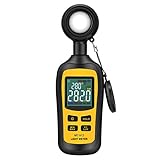
- Measures luminosity from 0 to 200,000 Lux and ambient temperature
- High accuracy of ±3% rdg ± 8 dgts (10,000 Lux)
- 4 digital color LCD screen, MIN/Max readings, data hold, auto power off, and low battery indication
- Wide range of application, use lux light meter for set design, factory, office or home use
- lightweight and compact, 2 years long period warranty
How to interpret the reading
Extension guides use broad categories to describe indoor light, not universal cutoffs for every plant. Their ranges overlap and differ, so use them as orientation rather than a prescription. Match the result against the care guidance for the plant species you have.
| Guide | Low | Medium | High or bright | Direct sunlight |
|---|---|---|---|---|
| University of Maryland Extension | 25–100 foot-candles | 100–500 foot-candles | 500–1,000 foot-candles | Over 1,000 foot-candles |
| University of Illinois Extension | About 75 foot-candles | About 150 foot-candles | About 300 foot-candles | About 1,500 foot-candles |
The University of Maryland values are its broad categories for indoor plant light; the Illinois values are illustrative placement levels, not a competing universal standard. See Maryland Extension’s lighting guidance and Illinois Extension’s houseplant lighting guide. Because these guides describe generalizations and examples, a reading near a category boundary should not be treated as a precise verdict about whether a particular plant will thrive.
Rank #2
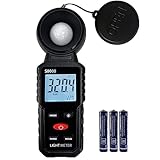
- 【Widely used】S8608 is a digital illuminometer, used for measuring visible brightness, large screen display, wide measuring range, up to 200000LUX, automatic conversion range. Can be widely used in such as schools, hospitals, factories, airports, families and other occasions of brightness measurement.
- Measurement visible brightness, measurement range is wide
- lluminance unit switch,Unit of illuminance:LUX、FC
- Measurement time: S
- MAX/ MIN,Data HOLD,Backlight function
Why the same window can give different readings
Window light changes with more than compass direction. Distance from the window, curtains, insect screening, weather, season, nearby trees or buildings, and the window’s cleanliness and type can all affect the light reaching a plant, according to Maryland Extension. Sun angle changes through the year, and surrounding trees may provide different shade as their leaves change, notes Illinois Extension. That is why a measurement describes one place under one set of conditions—not a permanent property of the window.
Independent reader supportYour contribution helps us test, update, and keep practical guides available for everyone.When lux or foot-candles are not enough
Lux and foot-candles describe brightness for human vision; they do not directly measure the photons plants use for photosynthesis. For supplemental grow lights, a meter that reports photosynthetic photon flux density (PPFD) is more directly useful. Converting lux or foot-candles to PPFD depends on the light source, so there is no universal conversion that works for every lamp. Iowa State Extension outlines this distinction. For a practical comparison of ordinary window locations, however, a basic lux or foot-candle reading remains useful.
Free tools Windows power users keep installed
One-click scans. No signup required.
Quick Recap
Best Value

- Lighting accuracy: plus or minus 3% plus or minus 10 dgts (10000 LUX)
- EXTRA LARGE RANGE Our digital illuminance meter has a wide measuring range of up to 200,000 LUX. The highly sensitive illuminance sensor ensures accurate and fast response with a sampling frequency of up to 2 times per second.
- User-friendly design: Easily switch between the two main units of illumination intensity - LUX and FC - as needed. The LCD display ensures clear vision, the backlight ensures the readability of the meter even in dark environments.
- Multifunctional: With our meter, you can not only measure the current brightness, but also the maximum and minimum values. With the data hold function, you can freeze the reading on the display, which can be useful when you need to record the measurement.
- ENERGY EFFICIENT The meter has an automatic shut-off function which helps to save battery when not in use. A low battery indicator lets you know when it's time to change the battery so that the meter is always ready to use.
Rank #4

- 180° Rotating Probe and 2.25" Backlit LCD: TopTes TS-710 Light meter with 180-degree rotating sensor ensures precise light measurements from multiple angles. The fast-responding sensor samples every 0.5 seconds, providing continuous measurement data. The backlit 2.25-inch LCD screen allows easy reading even in low-light conditions
- LUX/FC Measurement Units: TopTes TS-710 Luxmeter with Wide range: 0.1 to 200,000 lux and 0.1 to 20,000 foot candles, 3%rdg+5dgt accuracy. Optimize your plant's growth with our light meter for plants to find the suitable lighting area
- Versatile Applications: TS-710 lumen meter measures various visible light sources like LED grow room lighting, fluorescent lamps, metal halides, high-pressure sodium lamps, and incandescent bulbs. Ideal for homes, schools, offices, workshops, stages, farms, and factories. With the light meter foot candles, you can easily diagnose and fix issues such as dim car headlights or uneven LED bulbs in your home
- Multi-Functional Design: TS-710 foot candle light meter measures ambient ℃/℉ temperature and humidity, with the temperature sensor adapting to new environments over time. Features MAX/MIN value recording and data-hold for extensive data logging. Auto shut-off after 10 minutes of inactivity. Low-battery indicator for timely battery replacement
- Package Contents: A TS-710 digital light meter with sensor cover, a soft case, three AAA batteries, and a user manual
Rank #3

- High Precision & Fast Response: This high-precision illuminance meter delivers lightning-fast readings 2 times per second, ensuring you get accurate light intensity data—perfect for creating the ideal growing environment for your plants.
- FC/LUX Conversion: FC or LUX? The Power is in Your Hands! Effortlessly toggle between FC and LUX to measure light intensity in the unit that suits your gardening needs—precision made simple.
- PEAK Data Recording: Instantly lock in and display the highest light pulse value with a single press of the PEAK button—perfect for measuring lightning, laser beams, and other brief high-intensity sources.
- Low Battery Alert: Stay powered, stay prepared! A handy + - symbol appears when the battery runs low, so you’ll always know when it’s time to swap out the 9V battery and keep your light measurements going strong.
- Versatile Usage: Ready for any setting! Whether indoors or outdoors, this meter is perfect for homes, offices, factories, or measuring sunlight intensity to create the perfect environment for your plants to thrive.
Product prices and availability are accurate as of the date/time indicated and are subject to change. Any price and availability information displayed on Amazon at the time of purchase will apply.

