
Manage open-source vulnerabilities as an application-risk process: map each component and version to the services that use it, connect that inventory to vulnerability and supplier advisories, confirm whether the issue applies in your configuration, prioritize it in business context, and track remediation or a documented mitigation through deployment. An SBOM helps establish what is present; it does not, by itself, establish whether an application is secure or vulnerable.
How do we know which open-source components are in our applications?
Start with an inventory that connects software components to the applications and deployed artifacts that contain them. It should cover direct dependencies that teams select and transitive dependencies brought in by those dependencies. Record enough detail to distinguish component identity and version, and to trace a finding to an application, service, owner, and environment.


NIST describes a software bill of materials (SBOM) as a record of software components and their supply-chain relationships, including open-source and third-party dependencies. NIST names CycloneDX, SPDX, and SWID as machine-readable formats. Generate or update the inventory for releases and deployed artifacts, rather than treating a one-time scan as a lasting picture of production.
For each in-scope application, keep the inventory tied to operational context: accountable owner, deployment environment, business criticality, and the teams responsible for assessment and remediation. Without that mapping, a vulnerability alert may identify a package but not who must decide what to do about it.
Recommended Free Tools
#1 Best Overall
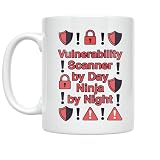
- BOLD CYBERSECURITY DESIGN: Features the phrase 'Vulnerability Scanner by Day Ninja by Night' with striking alert icons and exclamation marks printed on both sides of the mug.
- HIGH-QUALITY CERAMIC: Crafted from durable white ceramic material, this 11 oz mug is built to withstand daily use at home or in the office.
- MICROWAVE & DISHWASHER SAFE: Designed for convenience, this lightweight mug is both microwave and dishwasher safe for easy cleaning and reheating.
- PERFECT GIFT FOR TECH PROFESSIONALS: An ideal gift for cybersecurity analysts, IT professionals, or any tech enthusiast who takes pride in their work.
- COMPACT SIZE: Measures 3.8 inches tall and 3.3 inches wide, making it a great fit for standard cup holders, desks, and kitchen cabinets.
Does an SBOM tell us whether we are vulnerable?
No. An SBOM is visibility into component composition, not a security verdict. It can help match a reported vulnerability to a component and version, but it does not establish whether vulnerable code is present, reachable, enabled, or used in the affected configuration. It may also become stale as software changes.
Pair SBOM data with vulnerability databases, supplier notifications, and project advisories. NIST recommends integrating SBOMs with vulnerability databases and reporting mechanisms to receive recent vulnerability notifications, and discusses machine-readable advisories such as Vulnerability Exploitability eXchange (VEX). These inputs help with triage; the application team still needs to assess applicability and preserve the reasoning behind its decision.
How should we run the vulnerability-management process?
A useful process gives each finding a traceable path from notification to a tested disposition. The sequence below can be applied across application teams while tailoring response times and escalation to the institution’s risk framework.
Rank #2
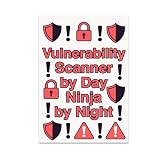
- BOLD CYBERSECURITY DESIGN: Features the phrase 'Vulnerability Scanner by Day Ninja by Night' surrounded by striking alert icons and exclamation marks.
- HIGH-QUALITY GLOSSY PRINT: Printed on durable glossy photo paper with vibrant reds and blacks, delivering fade-resistant colors and sharp, lasting details.
- GENEROUS 13x19 SIZE: This large rectangular poster makes a strong visual statement and is easily readable from across any room.
- VERSATILE DECOR FIT: Complements modern decor styles and suits a variety of spaces including home offices, bedrooms, kitchens, and family rooms.
- PERFECT GIFT FOR CYBERSECURITY ENTHUSIASTS: An ideal choice for IT professionals, security analysts, or anyone who values vigilance and dedication in the cybersecurity field.
- Set scope and ownership. Identify the applications and services in scope, their owners, environments, business criticality, and the teams accountable for remediation.
- Build component visibility. Generate and maintain SBOMs or equivalent inventories for releases and deployed artifacts. Track component name, version, dependency relationship, and application mapping.
- Connect alert sources. Ingest vulnerability database records, supplier notices, and project advisories. Prefer machine-readable feeds when they are available and reliable; retain enough source and date information to understand what triggered the finding.
- Validate applicability. Confirm the component identity and version, determine whether the vulnerable code is present, and check whether the affected behavior applies to the actual product configuration. Treat a supplier’s VEX statement as an advisory input, not a substitute for checking your own deployment context.
- Prioritize in context. Assess the likely business impact and urgency using application and component context, not a severity score alone.
- Choose and track a response. Upgrade or replace the component where feasible. If that is not immediately possible, apply a defensible mitigation and record an owner, target date, any exception approval, and residual risk.
- Coordinate and close. Engage maintainers or suppliers through their disclosure processes when needed. Track the fix through testing and deployment, then update the inventory and evidence to show the issue is resolved or why risk remains. Reassess if an advisory or application condition changes.
How can we tell whether a vulnerability actually affects our application?
Use a finding record that separates what the advisory says from what your team has verified. At minimum, capture the reported component and affected versions, the component and version found in your artifact, the affected behavior described by the notice, and the application configuration or code evidence used to reach a disposition.
When a VEX statement is available, record its status and the supplier’s rationale. NIST discusses VEX as a way to communicate vulnerability applicability, including cases in which a product is considered not affected. Compare that assertion with your artifact and configuration; do not convert “not affected” into a blanket conclusion for other versions, services, or deployments. If applicability is still being investigated, keep that status visible and assign an owner and next review point.
This approach avoids two costly errors: treating every component match as an exploitable application issue, and dismissing a valid issue because the package appears only as a transitive dependency. The evidence should support the decision for the specific software and deployment being assessed.
How should we prioritize open-source vulnerabilities?
Prioritization should combine technical severity with the exposure and importance of the affected service, evidence of exploitation, and the practical availability of a fix or mitigation. A single severity number is useful input but does not make the business-risk decision.
| Factor | Questions for triage | Why it matters |
|---|---|---|
| Application and service criticality | What business process depends on the affected application? Who owns the service? | Impact differs between services with different operational roles. |
| Exposure and deployment context | Is the affected service externally reachable? Is the relevant feature enabled? | Configuration and exposure influence whether the reported behavior can affect this deployment. |
| Exploit information | Is there credible information that the vulnerability is being exploited or can be exploited under the application’s conditions? | Exploit evidence can change urgency beyond the component’s nominal severity. |
| Dependency importance and maintenance | Is the component central to the application? Is it maintained, nearing end of life, or difficult to replace? | Maintenance status and dependency role affect both risk and the available response options. |
| Fix or mitigation options | Is a corrected version available? Can the affected behavior be safely disabled or otherwise mitigated? | The response path and time to reduce exposure depend on feasible options. |
Record the resulting priority, rationale, accountable owner, response decision, target date, and residual risk. Revisit the decision when exploitation information, supplier guidance, component status, or deployment conditions change.
The Tool Desk
Outbyte Driver Updater FREEScan for outdated or missing drivers - takes under a minuteDriver Scan →Outbyte PC Repair FREEClear out junk files and repair common Windows errorsFree Scan →What should we ask software suppliers about vulnerability disclosure?
Make disclosure and notification arrangements part of supplier due diligence and ongoing relationship management. NIST’s supply-chain vulnerability-management guidance recommends formal capabilities for receiving, assessing, tracking, and communicating vulnerability reports; NIST SP 800-216 (May 2023) also provides recommendations for federal vulnerability disclosure guidelines.
- Where should your organization report a suspected vulnerability, and how will the supplier acknowledge and communicate its handling?
- How will the supplier notify customers about affected products, versions, fixes, and mitigations?
- Can the supplier provide an SBOM or equivalent component inventory for the delivered product and explain how it is kept current?
- Does the supplier issue machine-readable vulnerability advisories or VEX statements, and what evidence supports a “not affected” assessment?
- How can the supplier identify end-of-life or unsupported components and communicate changes in maintenance status?
- Who is the operational contact for an urgent vulnerability affecting a service your institution relies on?
Capture the answers in a form teams can use during triage, not only in procurement records. Supplier statements help establish product context, but each institution remains responsible for assessing how the product is configured and used in its own environment.
Independent reader supportYour contribution helps us test, update, and keep practical guides available for everyone.What should we compare when selecting SBOM vulnerability-management tools?
Evaluate software composition analysis (SCA), SBOM, and vulnerability-management capabilities against the organization’s real workflow. NIST’s capability and due-diligence material informs these evaluation dimensions; it does not compare or endorse vendors.
- Component identification: How accurately does the product identify names and versions, including transitive dependencies and built artifacts?
- Interoperability: Can it generate and ingest CycloneDX, SPDX, and SWID inventories relevant to your suppliers and internal pipelines?
- Data quality: What are the provenance and freshness of vulnerability and exploit data, and how are supplier and project advisories incorporated?
- Applicability handling: Can it ingest VEX and supplier advisories, preserve the basis for “not affected” decisions, and distinguish unresolved assessment from a final disposition?
- Operational mapping: Can findings be associated with owned applications, environments, services, and business criticality?
- Workflow and evidence: Does it support remediation guidance, ticketing or other workflow integrations, exception handling, audit history, and reporting?
- Lifecycle signals: Does it help identify end-of-life components, dependency maintenance concerns, and provenance issues?
Assess these capabilities with representative applications and supplier artifacts before relying on tool output as an inventory or risk decision. Tool coverage and accuracy should be checked against the components and build paths that matter to your environment.
Quick wins for a faster PC:
Fix the driver behind crashes, sound loss and screen glitchesFind Drivers →Repair Windows errors before they cause bigger problemsFix Now →How does this fit the financial-services risk context?
The FFIEC’s Cybersecurity Awareness page says: “Disruption, degradation, or unauthorized alteration of information and systems that support these services can affect operations, institutions, and their core processes, and undermine confidence in the nation’s financial services sector.” That operational context is why component findings need to be connected to service ownership and business impact, rather than handled as an isolated package list.
Keep regulatory framing precise. NIST’s software supply-chain recommendations are written for federal agencies and describe capabilities that organizations should prioritize and tailor to their context; they are not automatically binding requirements for every financial institution. The FDIC-hosted FFIEC document Risk Management of Free and Open Source Software is dated October 21, 2004. It provides historical context, noting that FOSS risks are not fundamentally different from proprietary or self-developed software while calling attention to distinctive practices around maturity, customization, integration, support, and total cost of ownership. It should not be treated as a substitute for checking current supervisory requirements applicable to a particular institution and jurisdiction.
Quick Recap
Product prices and availability are accurate as of the date/time indicated and are subject to change. Any price and availability information displayed on Amazon at the time of purchase will apply.

