
Quick wins for a faster PC:
Fix the driver behind crashes, sound loss and screen glitchesFind Drivers →Repair Windows errors before they cause bigger problemsFix Now →Scan for outdated or missing drivers - takes under a minuteDriver Scan →Yes—you can make a bipolar supply such as +12 V, 0 V, and −12 V from two single-output DC supplies, but only if their outputs are isolated and the manufacturers permit series operation. Connect the positive terminal of one supply to the negative terminal of the other; that junction is the circuit’s 0 V reference. The two outer terminals provide about 24 V between them.
Do not assume two matching adapters are safe to stack. An earth, USB, or other ground connection can short part of the series arrangement. Verify the supplies’ documentation before wiring them.
Choose the output you need
“Dual power supply” can mean a split supply with positive and negative rails, or simply two supplies connected to make a higher voltage. Those configurations use series wiring. A parallel connection is a different arrangement intended to increase current, not to create a negative rail.
| Goal | Connection | Result | Main limitation |
|---|---|---|---|
| Create +V, 0 V, and −V | Series; use the junction as the common reference | Bipolar rails | Outputs must be isolated and suitable for series operation |
| Increase voltage | Series; use the two outer terminals | Output voltages add | Current is limited by the lower-rated supply |
| Increase current | Parallel, only when supported | One higher-current output | Requires compatible supplies and suitable current sharing |
| Keep outputs independent | Do not interconnect them | Separate outputs | A shared reference exists only if deliberately added |
For instance, two 12 V supplies in series can provide approximately +12 V, 0 V, and −12 V when the midpoint is used as common. The outer terminals measure approximately 24 V apart. Series operation adds voltages, subject to the supplies’ isolation, floating-voltage, current, and reverse-voltage limits; see Keysight’s power-supply guidance.
#1 Best Overall

- 1️⃣【Dual Output & Dual Range Design】Jesverty SPS-3010CII bench power supply combines two power supplies in one compact unit with two independently adjustable output terminals. You can easily expand the output range by pressing the SER or PARA button for internal series or parallel connection, delivering 0-62V, 0-10A in serial mode and 0-32V, 0-20A in parallel mode to meet various voltage and current test needs.
- 🌟Only select CH1 to activate and switch between Series/Parallel modes.
- 2️⃣【USB-A & USB-C 20W Quick-Charge】The Jesverty desktop power supply features Type-A and Type-C dual charging ports, both supporting 20W fast charging⚡. It offers great convenience to charge your smartphones and power Arduino UNO, Raspberry Pi and various electronic modules for DIY electronics projects.
- 3️⃣【Encoder Adjustment & Output Control】Built with a precision encoder for accurate digital voltage and current adjustment, plus dedicated output control button to easily switch CH1 and CH2 output on or off with one simple press. You can freely modify parameter settings anytime without disconnecting the load or shutting down the entire power supply.
- 4️⃣【Functions & Protection】: OCP over-current protection, Temperature-regulated cooling fan, SER/PARA output combination, etc. A bunch of convenient functions are loaded within this tiny unit! !
Check that the supplies are compatible
Read the manuals or datasheets for both exact models before connecting them. Look for wording such as “floating output,” “output-to-ground isolation,” or “series operation permitted.” A two-wire DC output does not, by itself, prove that the output floats. A continuity check is not proof of isolation because internal components can affect the reading; rely on the manufacturer’s specifications.
- Isolation and grounding: Confirm each output is isolated from its AC input, protective earth, and the other supply as required for the proposed series connection.
- Series limits: Check the maximum output-to-earth or floating voltage, reverse-voltage restrictions, and any specific series-connection rules.
- Shared connections: Identify earth, USB, communications, shields, and other connections that could join an output to ground or to the other supply.
- Ratings and behavior: Prefer identical supplies with matching voltage and current ratings. If using different models, verify that their regulation, protection, startup behavior, and ratings are compatible.
- Load and return voltage: Check current limits and whether the load can send energy back into a supply. Beckhoff’s guidance, for example, warns against return voltage at supply outputs: Beckhoff series-connection notes.
Manufacturers document series operation for some isolated outputs, not for every product. RIGOL’s DP2000 guide, for example, discusses isolated channels and series connections. That does not establish that an unrelated adapter is suitable.
Rank #2

- 1️⃣【4-Digit Display & Power Calculation】: The Jesverty SPS series features a big bright 4-digit LED display that shows measured values of V/A/W that the unit outputs in real-time. The display resolution is up to 0.01V, 0.001A, and 0.1W.
- 2️⃣【Auto C.V. and C.C. Mode】: The Jesverty SPS series can be used as a constant-voltage*(C.V.) power supply and constant-current*(C.C.) power supply even when the load is changed. It switches automatically between CV mode and CC mode according to the changes in the load.
- 🌟Note: The V and A settings you set are the crossover point at which the mode switches.
- 3️⃣【Compact Body & Lightweight】: The Jesverty SPS series measured only 7.1(D)x3.35(W)x6.1(H)inches and weight of approx. 2.5lbs. It saves space on your workbench and can be moved around without any frustration.
- 4️⃣【Reliability and Safety】: The Jesverty SPS series is built with high-quality materials and reliable circuit designs that include multiple protection functions, such as short-circuit protection, over-load protection, grounding terminal, temperature-regulated fan, etc. to ensure performance and extend the lifespan.
Wire two supplies for positive and negative rails
This example assumes two compatible, isolated 12 V DC supplies. Supply A provides the negative rail; Supply B provides the positive rail. The joined terminals form the circuit’s common reference.
Supply A (−) ─────────────── −12 V rail
Supply A (+) ─────┐
                  ├───────── 0 V / circuit common
Supply B (−) ─────┘
Supply B (+) ─────────────── +12 V rail- Turn both supplies off and disconnect the load.
- Set both outputs to the same nominal voltage. For this example, set each to 12 V.
- Connect Supply A’s positive terminal to Supply B’s negative terminal. This junction is 0 V or circuit common.
- Connect Supply A’s negative terminal to the circuit’s negative rail, and Supply B’s positive terminal to its positive rail.
- Connect the circuit’s reference or common to the midpoint. Confirm that the circuit is designed for the resulting positive and negative voltages before powering it.
The nominal readings are approximately +12 V from the midpoint to the positive rail, −12 V from the midpoint to the negative rail, and 24 V between the outer rails. Actual readings depend on each supply’s regulation, tolerance, and load.
What’s actually slowing this PC down?
Pick the symptom - the matching free tool is one click away.
Rank #3

- 4 in 1 DC Power Supply: Dual DC power supply meets the needs of multiple power supply specifications at one time, one dual DC power supply is equal to two 30V10A power supply/one 30V20A/one 60V10A power supply, which meets the needs of multiple operations, and can also be used as a high-power use at the same time. You no longer need to manually connect two DC power supplies in series or parallel.
- CE & FCC Certification, Multiple Protection, Various Application: DC power supply have passed CE & FCC Certification. DC power supply variable has multiple protections: overvoltage protection, overcurrent protection, overheating protection, over power protection, short circuit protection, leakage protection. DC power supply is suitable for battery charging, arduino project, anodizing, laboratories, schools, electronic maintenance , electrolysis, electroplating, electrolysis, electrolysis, electroplating, and other electrical equipment. electrolysis, electroplating, lamp test, DIY, etc.
- Series and Parallel Function: It is very convenient to add series and parallel function, press "INDEP" which is two 30V 10A lab power supply, press "SER" button of dual power supply, you will have one 60V 10A 600W power supply, press "PAR" button of dual power supply, you will have one 60V 10A 600W power supply. Pressing the "PAR" button will switch to a 30V 20A 600W power supply. This will satisfy your need for a higher voltage or higher current. It saves you the time for DC power supply, which is a good helper in your work!
- 4-Digits LED Display, Encoder Precision Adjustment: Our DC power supply voltage and current values are accurate to 0.01V and 0.01A, and the encoder is used to more accurately regulate the desired current and voltage, and the refinement is made to the extreme! Two sets of encoder knobs, when the power supply is in INDEP state, you can separately adjust the current and voltage values on both sides.
- Compact Design, Quality Check: the size of the bench power supply is only 10.8 * 4.7 * 5.9 inches, the weight is only 6.6 lbs, which saves you more bench space, easy to carry with you when you need. Delivery includes: dc power supply*1; power cord*1; English manual*1; low power output cable*2.
Use the same series connection for a higher single voltage
To obtain approximately 24 V from two 12 V supplies, use the outer terminals and leave the midpoint unused:
Supply A (−) ─────────────── 24 V negative
Supply A (+) ─────┐
                  ├───────── unused midpoint
Supply B (−) ─────┘
Supply B (+) ─────────────── 24 V positive
Protect the unused junction from accidental contact. Two 12 V, 2 A supplies in series provide approximately 24 V with no more than 2 A available—not 4 A. Series wiring raises voltage; it does not add the current ratings. Keysight’s series and parallel supply guidance describes these distinct configurations.
Rank #4
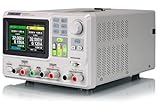
- 3 Independent Controlled And Isolated Outputs
- 32V/3. 2A X 2, 2. 5V/3. 3V/5V/3. 2A X 1, Total Power: 220W
- Output Modes: Independent, Series, Parallel
- Timing Output Function.Trending Graphs
Test the rails before connecting the circuit
- With power off, confirm the midpoint connection and check that no unintended earth, USB, instrument, or load connection joins the supplies.
- Turn on the supplies without the final load, following any manufacturer-required startup sequence.
- Using a multimeter set to measure DC voltage, measure from the midpoint to the positive rail. Expect approximately +12 V for the example.
- Measure from the midpoint to the negative rail, keeping the meter’s red lead at the midpoint. Expect approximately +12 V. With the red lead on the negative rail and black lead at the midpoint, the reading should be approximately −12 V.
- Measure between the outer rails. Expect approximately 24 V.
- Only after confirming polarity and readings, connect the load. Add load gradually where practical, then check both rails under the expected operating conditions and during startup.
A negative meter reading can simply mean the probes are reversed. A near-zero or unexpected reading, a supply entering protection, or unusual heating calls for switching off and checking the wiring and compatibility before proceeding.
Understand the current and grounding limits
Current on each rail
Supply A powers the negative rail and Supply B powers the positive rail. Treat each rail as limited by its own supply’s current rating, subject to thermal derating, minimum-load requirements, protection behavior, and regulation under load. Equal nominal voltages do not guarantee equal regulation. Circuits that draw substantially different current from the two rails may cause one rail to sag or one supply to trip; measure under the actual expected load, especially for precision applications.
Best Value

- Precise 4-digit LED Display, Auto Power Calculation: The NICE-POWER DC power supply variable is a professional switching power supply regulation device with a high resolution of 0.01V and 0.001A. The variable power supply features a big bright 4-digit LED display that shows the adjustable power supply output values of Voltage (V) / Current (A) / Power (W) in real-time. The high-definition backlit 4-digit LED display provides an accurate and clear readout for the voltage, current and power values even if you are in low-light condition
- OUTPUT Switch Control: Sometimes we need to switch between different voltage or current outputs in experiments or work, but we often forget to turn off the output and causing damage to the load. The adjustable DC power supply OUTPUT key is designed to solve this problem, just with a single press of the added OUTPUT key, you can easily turn the output on or off. The required voltage and current can be adjusted without actual output power, which makes this benchtop DC power supply more secure and more energy saving. Also, you don't need to remove the load or turn off the power each time, making the variable DC power supply more convenient and efficient to use
- Reliability and Safety: Safety is our priority, all lab power supplies are certified. The adjustable switching regulated power supply is built with premium electronic components and reliable circuit designs that include multiple protection functions, such as leakage, grounding terminal, over-voltage, over-current, over-power, over-load, over-temperature, short-circuit protection to ensure stable working performance and prolong the life of the adjustable DC power supply effectively. KINDLY REMIND - For safety considerations, the DC power supply comes with only 110V input which meets the US standard voltage. 220V input is NOT available for this bench power supply
- 5V 2A USB Port, Intelligent Cooling Fan: Complaining about mobile phones or repaired devices not being charged in time? The NICE-POWER adjustable DC power supply allows you to avoid this dilemma. The variable power supply has built-in 5V 2A USB charging interface which can quickly charge any USB devices anytime. The adjustable power supply features with intelligent temperature-controlled fan and heat sink for excellent heat dissipation when the working temperature of the switching power supply exceeds 122℉/50℃, greatly reduce working noise and improving the DC regulated power supplies working efficiency and lifespan
- Compact Design, Lightweight and Portable: The DC voltage stabilized power supplies adopt stable vertical design with the shock-absorbing rubber feet on the bottom of bench supply, making it safer and more stable when using. The size of adjustable DC power supply is 8.4*3.3*5.5 inches and the lab power supply weighs only 2.6 lbs, which is very light and portable. You can carry your bench supply in and out of various workplaces
0 V is not automatically protective earth
The midpoint is the circuit’s 0 V reference. Protective earth is a safety connection to the chassis or building wiring. They are different functions, even if a design intentionally bonds them at one point. Connect the midpoint to earth only when the system design and supply documentation allow it. An earth-grounded oscilloscope, PC, or USB device can create an unintended connection, so account for all attached equipment before energizing the stack. Mean Well’s series/parallel and grounding guidance notes that grounding and leakage-current considerations depend on the product and system.
Independent reader supportYour contribution helps us test, update, and keep practical guides available for everyone.Avoid common failure modes
- Stacking outputs that are not isolated: If an output is tied to earth or another common, the series junction can short a supply or create an unsafe condition.
- Confusing series and parallel wiring: Joining positive to positive and negative to negative is parallel operation, not a split-rail supply. If output voltages differ, current may flow between supplies.
- Ignoring reverse voltage or floating limits: The supplies’ documentation must allow the voltages and conditions imposed by the stack. Some products prohibit series operation or reverse voltage.
- Assuming simultaneous or independent startup is harmless: A supply that starts or shuts down first may expose the other to conditions it cannot tolerate. Switch them together where practical, and follow manufacturer sequencing instructions. Avoid connecting or disconnecting series terminals while energized.
- Letting a load backfeed: Batteries, charged capacitors, motors, inductors, or another supply can drive current back into an output, particularly during shutdown or a fault. Verify that the supplies and system can handle this.
- Overlooking mains safety: Do not open or modify mains-powered adapters unless qualified to work on hazardous voltages. Use certified enclosed supplies, suitable wiring, fusing, strain relief, insulation, and earthing as required.
- Ignoring noise: Switching supplies can add ripple, common-mode noise, or switching artifacts. Sensitive analog or audio circuits may need a suitably designed filter, regulator, or lower-noise supply.
Should you use ordinary wall adapters?
Only use them if the exact models are documented as suitable. Before stacking two adapters, confirm they are DC supplies with compatible ratings, isolated floating outputs, permitted series operation, and no unwanted connection through earth, USB, the load, or other equipment. Make sure the load is within each adapter’s rating and that wiring cannot be misconnected.
Do not assume USB chargers, PC power supplies, or multi-output consumer supplies can be stacked. Their negatives, shields, or multiple outputs may share a reference, and their protection or backfeed behavior may not support series use. If the documentation does not establish compatibility, choose another arrangement.
Quick Recap
Choose a purpose-built supply when the application demands it
- For lab work: A dual-output bench supply is often the clearer option when you need adjustable positive and negative rails, current limiting, metering, coordinated controls, or programmable operation. Check channel isolation, tracking, series mode, and output-to-earth ratings in the manual.
- For permanent equipment: Use a purpose-built enclosed dual-output supply with documented safety, grounding, protection, and noise characteristics appropriate to the design. Verify the exact model; product-family guidance does not guarantee that every model supports series operation.
- For a DC input source: An isolated DC-DC converter may provide bipolar rails if its channels and ratings are designed for the job.
- For a low-current virtual midpoint: A rail splitter can create a reference for some analog circuits, but it is not equivalent to a real negative supply: its ability to source and sink current is limited. A charge pump or inverter can also provide a negative rail, typically with current and noise trade-offs.
- For a traditional linear design: A center-tapped transformer can form a split supply, but the rectification, capacitors, regulation, fusing, thermal design, and mains-safety work make this a separate power-supply design task.
Product prices and availability are accurate as of the date/time indicated and are subject to change. Any price and availability information displayed on Amazon at the time of purchase will apply.

