
Free tools Windows power users keep installed
One-click scans. No signup required.
In AWS Elemental MediaLive, lower the video output’s bitrate in Stream settings → Codec settings → Rate control. If the output uses CBR, edit the Bitrate field. Choose a value based on YouTube’s guidance for your codec, resolution, and frame rate, then test it against your sustained upload capacity. A lower bitrate reduces bandwidth demand but can reduce picture quality; it cannot guarantee a stable stream on its own.
How do I lower the bitrate in AWS Elemental MediaLive?
- Identify the MediaLive video output that is sent to YouTube. Note its codec, resolution, and frame rate; those determine which YouTube bitrate guidance applies.
- Open that output’s video Stream settings, expand Codec settings, and find Rate control.
- For a predictable rate aligned with YouTube’s live-encoding recommendation, select or retain CBR, then enter the target in Bitrate. AWS says CBR is the default mode; if its Bitrate field is empty, MediaLive defaults to 5 Mbps. That default is not necessarily appropriate for your output. See the AWS Elemental MediaLive User Guide.
- Save the output configuration and run a representative test before relying on it for an event. Confirm the actual stream’s health in YouTube Studio as well as checking the configured value.
What bitrate should I use for YouTube Live?
There is no single target for every stream: match the row to the output codec, resolution, and frame rate. YouTube recommends CBR for live encoding. Its current H.264 guidance lists these values:
| H.264 output | Minimum bitrate | Recommended bitrate |
|---|---|---|
| 720p30 | 3 Mbps | 8 Mbps |
| 720p60 | 3 Mbps | 8 Mbps |
| 1080p30 | 5 Mbps | 14 Mbps |
| 1080p60 | 6 Mbps | 17 Mbps |
These figures are from YouTube’s live encoder settings. For other codecs, resolutions, or frame rates, use the corresponding row in YouTube’s table rather than extrapolating from these H.264 examples. If you must go below a recommended target to fit the connection, test the resulting image carefully; lower bitrate can make motion and detail look worse.
How to tell whether the lower bitrate is enough
- Check sustained upload capacity with a speed test, not just a brief peak measurement. Leave practical headroom rather than setting the stream at the connection’s full measured upload rate.
- Test before the event using representative audio and movement. Static scenes are not a sufficient test for a high-motion program.
- Watch YouTube’s stream-health indicators and messages during the test and event. YouTube recommends testing ahead of time and monitoring stream health; it also recommends RTMPS for YouTube Live. See its encoder settings guidance.
CBR, QVBR, and VBR: which rate control should you use?
CBR for a predictable ingest rate
With CBR, you set the output bitrate directly. It most directly matches YouTube’s stated recommendation for live encoding and is the straightforward choice when reducing bandwidth demand predictably.
The Tool Desk
Outbyte PC Repair FREEClear out junk files and repair common Windows errorsFree Scan →Outbyte Driver Updater FREEScan for outdated or missing drivers - takes under a minuteDriver Scan →#1 Best Overall
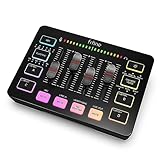
- [XLR Mic Input] One XLR microphone input interface is set on the gaming audio mixer, which is great to up your audio quality with your XLR setup. The XLR mixer is a stepping stone to upgrade your live streaming. Audio mixer offered built-in 48V phantom power which opens up more choices for mics. Directly use it with your condenser microphone but do not solve added peripherals. (NOT available for USB mic)
- [Individual Channel Control] Gaming audio mixer for one mic recording with smooth volume slider fader take your streaming recording to a whole new level with full pleasure. Four independent channels set on the DJ mixer give audio volume of the MICROPHONE, LINE IN, HEADPHONE, and LINE OUT channels individual control. Configurable on the PC audio mixer instead of just operating on your game or streaming software.
- [Mute and Monitor] The front mute and monitor buttons but not at the back, make it easier to get the audio interface use. Ability to mute audio, the audio mixer for streaming prevents background noise from damaging your live broadcast. Real-time feedback between speaking and hearing will not distract your attention, which encourage you to speak more confidently. The sturdy-built control button allow you to operate freely and easily during live streaming.
- [Sound Effects] The computer sound mixer supports four pre-recorded customized button that can be recorded and activated at the press of button to post production. 6 kinds of voice changing modes change your output style. 12 auto tune changes the tone of your voice. The podcast mixer being able to add different and fun effects is a huge bonus for your streaming or game voice.
- [Controllable Vibrant RGB] RGB button on the audio mixer DJ meets different live streaming themes. Lights on the video mixer is vibrant but not harsh on your eyes. Flowing or frozen RGB color rotation in a decent pace presents a greatly strong impression as a "light show" to your audience. Even a streaming equipment accessory will not be dull looking when video production.
QVBR when quality is the target
MediaLive’s QVBR targets a specified or inferred quality and uses the bitrate it needs, bounded by a maximum. The rate can vary from frame to frame; it does not maintain an average bitrate. AWS recommends this mode in cases where viewers or delivery pay for bandwidth. If you use QVBR for YouTube, verify compatibility with your intended workflow and observe the actual ingest rather than assuming a fixed rate.
VBR when scene complexity varies
VBR uses an average bitrate and a maximum, varying with scene complexity and allowing short peaks up to the maximum. That may suit content with brief complexity spikes, but it is less directly aligned with YouTube’s CBR recommendation. Consider whether your connection can accommodate those peaks.
Rank #2

- This sound card is not compatible with 48V dynamic microphones or USB microphones. It only supports XLR microphones. (Note: Connecting an XLR microphone requires a 1/4" TRS to XLR cable, which is available as part of a promotional offer and must be added separately.)
- All-in-One Audio Interface for Streaming – This mixer works as a complete audio hub for live streaming, podcasting, and gaming. It features a 1/4" TRS dynamic microphone input, built-in reverb, 4 custom sound effects pads, and a voice changer, so you can enhance your voice and engage your audience with creative audio in real time.
- Effective Noise Cancellation – Equipped with advanced noise reduction technology, the PUPGSIS mixer filters out background hum, fan noise, and other unwanted sounds. Your viewers will hear only your clear, professional voice – ideal for noisy gaming rooms or home studios.
- Customizable Sound Effects & Voice Changer – Personalize your stream with 4 programmable sound effect buttons. Load your own audio clips (laugh tracks, claps, alarms, etc.) and activate them instantly. The built‑in voice changer lets you alter your pitch for fun character voices or anonymous commentary.
- Adjustable Reverb for Professional Vocals – The mixer features a fully adjustable reverb effect, allowing you to dial in exactly the right amount of room ambience for your voice. Whether you want a subtle studio echo or a dramatic live‑stage sound, the dedicated reverb control lets you fine‑tune it on the fly – no software needed.
For complex footage, bitrate and quality remain a trade-off. AWS notes: “When encoding visually complex video (such as high-motion sports events with brightly dressed crowds in the background), there is always a trade-off between high video quality and low bitrate.” See the rate-control section of the MediaLive User Guide.
Should you lower resolution or bitrate?
First determine whether the problem is insufficient or inconsistent upload capacity. If the connection can sustain the bitrate appropriate for your current resolution and frame rate, lowering bitrate may unnecessarily reduce image quality. If it cannot, choose a lower target and test; if the resulting picture is unacceptable, consider reducing resolution or frame rate and then selecting the matching YouTube bitrate guidance. Do not keep a 1080p60 target while assuming a 720p30 recommendation applies: the output settings and bitrate guidance need to match.
Recommended Free Tools
Rank #3
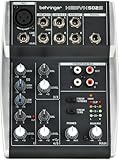
- Ultra-low noise analog mixer for streaming, podcasting and recording
- Award winning XENYX microphone preamp for warm and musical sound
- Stereo USB audio interface to connect your computer or mobile device
- Direct mixing of PC/gaming sounds into the streaming output
- Analog mixing and equalization for pure sound
Optional H.264 option: enhanced VQ
AWS enhanced VQ is an optional H.264 mode available with CBR or QVBR. AWS says it can improve quality without increasing bitrate and describes lowering bitrate by perhaps 5% while maintaining original target quality as one possible use. Treat that as general AWS guidance, not a promised result for a particular program. AWS also says enhanced VQ can help smooth complex high-motion transitions. Check the MediaLive User Guide and evaluate the result with representative content.
Troubleshooting an unstable YouTube stream
YouTube reports a poor connection after you lowered bitrate
Check the sustained upload rate and YouTube stream-health messages. The configured bitrate may still exceed what the connection can reliably sustain, or the connection may fluctuate. Test at a lower target with the same output settings, and avoid judging from a short speed-test peak.
Rank #4

- Upgrade Mic Clarity with XLR Power-Unlock studio-quality voice capture: The 48V phantom power XLR port supports high-sensitivity mics up to -50dB gain, while the Dynamic/Condenser toggle adapts to any microphone type. With <0.2% distortion and 75dB SNR, your comms cut through explosions crisply. Adjust mic monitoring via output knob on the gaming mixer keeping you aware of voice levels—perfect for intense FPS callouts.
- Seamless Multi-Platform Audio Control-Command all your gear: Optical AUX connects PS4/TV, 3.5mm AUX-In mixes commentary audio, and USB-C PnP works instantly across PC/PS5/Switch/mobile. The 3 smart knobs include push-mute volume controls—adjust mic, game, or background audio without tabbing out.
- Game/Chat Balance Dial & 7.1 Immersion-Dominate squad coordination: Twist the dedicated Game/Chat knob to prioritize enemy footsteps or teammate comms. Coupled with virtual 7.1 surround and 3 EQ presets (Game/Music/Movie), hear Valorant spike defuses from any directions while Discord chats stay crystal-clear.
- 8-Voice Changer & Customizable Sound Profiles-Troll with tactical flair: One-tap voice morphing (Demon/Robot/Megaphone etc.) spices up Among Us lobbies. 4 customizable buttons save audio pieces—store your Warzone gunshot with EQ tweaked or chatting stream presets for instant reply.
- RGB-Infused Streaming Ready Hub-Broadcast in style: Synchronized RGB lighting reacts to audio peaks for visual flair. Drive 32Ω headphones with 93dB SNR fidelity, while the aux chain lets you overlay music onto streams. Everything stays cool during 8-hour Fortnite marathons.
The stream is stable but the picture looks worse
A lower bitrate trades off against visual quality, especially in detailed or high-motion scenes. Test with representative movement and audio. If the picture is not acceptable at a bitrate the connection can sustain, test a lower resolution or frame rate and select the YouTube recommendation for that new output.
The configured CBR rate is not what you expected
Reopen the specific output’s video codec settings and inspect Rate control and Bitrate. AWS documents a 5 Mbps default when CBR’s Bitrate field is empty, so do not assume an unset value is tuned to your YouTube output.
Do these 3 things before closing this tab:
1Fix the driver behind crashes, sound loss and screen glitches2Clear out junk files and repair common Windows errors3Scan for outdated or missing drivers - takes under a minuteBest Value

- Analog mixing and equalization for pure sound
- Direct mixing of PC/gaming sounds into the streaming output
- Ultra-low noise analog mixer for streaming, podcasting and recording
- Stereo USB audio interface to connect your computer or mobile device
VBR or QVBR has varying bitrate
That variation is expected: QVBR can vary frame by frame and does not maintain an average, while VBR varies with scene complexity and can peak up to its maximum. If predictable ingest rate is the priority, test CBR against your connection.
Independent reader supportYour contribution helps us test, update, and keep practical guides available for everyone.Or let it run in the cloud
If your goal is a YouTube channel that keeps prerecorded video live around the clock, StreamNeo is a separate cloud option: upload a recording or build a playlist, add your YouTube stream key, and go live. Your computer and home connection do not have to stay on. StreamNeo plays uploaded videos to YouTube; it is not a camera-live service.
- Each slot streams your uploaded quality up to 4K 60fps at one flat price per slot, with no re-encode or quality tiers.
- It automatically recovers if YouTube drops the stream.
- The first day is free with no card required. Monthly pricing is $9.99 per month.
See StreamNeo for the service details, or start the free first day.
Quick Recap
Product prices and availability are accurate as of the date/time indicated and are subject to change. Any price and availability information displayed on Amazon at the time of purchase will apply.

