
The Tool Desk
Outbyte Driver Updater FREEFix the driver behind crashes, sound loss and screen glitchesFind Drivers →Outbyte PC Repair FREERepair Windows errors before they cause bigger problemsFix Now →First find out whether the audio is already out of sync in the stream you are sending to YouTube, or whether the problem appears only on a particular viewer’s device or connection. Those are different faults and need different checks. For a 4K 60fps YouTube Live playlist in India, compare the encoder output and local recording with playback on another device and connection before changing settings or buying equipment. YouTube’s published guidance does not identify a specific India-wide cause or a guaranteed sync fix.
Identify where the sync problem begins
Note what the mismatch looks and sounds like: for example, whether speech consistently follows the speaker’s mouth, whether the gap grows over time, or whether it appears after one playlist item changes to the next. Check whether it happens on every item and every viewer setup. These observations help isolate the fault; they are diagnostic clues, not proof of a cause.
- Creator-side fault: The audio and picture are already misaligned in the encoder preview or local recording. Investigate the source routing and encoding chain.
- Viewer-side fault: The encoder output and local recording seem synchronized, but playback is wrong on one device, app, browser, or connection. Compare playback conditions before changing the stream.
YouTube advises checking the audio and video sources routed to the encoder when a live stream sounds or looks bad, and says a healthy encoder output can point to an outbound internet issue. See YouTube’s live-stream troubleshooting guidance.
If you are watching the live playlist
- Check whether the issue is limited to this stream or playlist. Note if it affects every item or begins after a particular transition. If other streams play normally, that narrows the possibilities but does not by itself establish the cause.
- Reopen the stream and try another supported device. If possible, replay it on the same device using a different connection, such as Wi-Fi and mobile data. YouTube recommends trying another supported device and changing the connection when troubleshooting playback; mobile data charges may apply.
- Watch for buffering and changes in delay. Note whether the mismatch appears during interruptions or when the live broadcast falls behind. YouTube explains that network congestion can delay live programming, and that lower broadcast latency leaves less buffer and can mean more playback buffering. Delay and audio sync are related observations, not interchangeable diagnoses. See YouTube’s playback troubleshooting page and live latency guidance.
- Compare playback quality if the option is available. Try a lower resolution and compare it with 4K. If the issue changes, playback load or interruptions may be relevant; this is an isolation test, not a YouTube-prescribed cure for sync drift. 4K playback availability varies by device or browser.
- Send feedback if the problem persists. Include the stream link, approximate time, device and app or browser, selected quality, connection type, and whether the issue reproduces elsewhere. YouTube’s playback troubleshooter includes a feedback path.
If you operate the stream or playlist
- Inspect the signal before YouTube receives it. Listen to and inspect the encoder preview. Check that the intended audio source is routed with the intended video source, look for encoder errors, and note CPU load. Record a local archive and check its sync, too. YouTube recommends examining the routed sources and local archive when diagnosing poor live audio or video.
- Use the comparison to locate the fault. If the preview and local archive are both out of sync, start with the sources and encoding chain. If they appear synchronized but YouTube playback does not, check outbound connection quality and the stream’s health information in YouTube Live Control Room.
- Run a representative test before the next broadcast. Include movement and audio similar to the real event, inspect the Live Control Room preview, verify the local archive, and monitor audio and video quality. YouTube recommends test runs and continuous monitoring. See YouTube’s live-streaming tips and streaming tips.
- Check bitrate against your upload capacity. YouTube lists 10–40 Mbps as its recommended video bitrate range for 4K/2160p at 60fps. It also recommends about 20% upload headroom beyond the total stream bitrate. These are encoder and upload recommendations, not a guarantee of correct sync or a viewer’s required download speed. YouTube states that total streaming bitrate cannot exceed available upload bandwidth.
- Account for 4K latency settings. YouTube says the low-latency option is unavailable for 4K/2160p streams, which use normal latency. Do not treat a latency setting as a direct audio-offset control; changing latency alone is not an established sync fix. YouTube also automatically transcodes live streams into different output formats for viewers on different devices and networks. Details are in YouTube’s encoder settings and bitrate guidance.
- If you use HLS ingest, verify its documented settings. YouTube specifies 1–4 second segment duration and a rolling playlist with no more than five outstanding segments. HLS has higher latency than RTMP. Do not switch protocols solely on the assumption that doing so will fix sync; test and compare the result. See YouTube’s HLS setup guidance.
Use 4K figures as checks, not sync cures
| Check | YouTube guidance | What it tells you |
|---|---|---|
| 4K/2160p at 60fps encoder video bitrate | 10–40 Mbps | Recommended encoder range; it does not promise that audio and video will be synchronized. |
| Upload headroom | About 20% beyond total stream bitrate | Recommended capacity margin for the sending connection, not a viewer download-speed target. |
| 4K live latency | Normal latency; low-latency option unavailable | Relevant to buffering and delay, but not an audio-offset adjustment. |
| 4K UHD playback speed | 20 Mbps recommended sustained speed in YouTube’s approximate playback table | General playback guidance, not India-specific performance or a guaranteed threshold for every live stream. |
Sources: YouTube encoder settings, YouTube streaming tips, and YouTube playback troubleshooting.
#1 Best Overall

- 【HDMI Audio Extractor】The HDMI audio extractor can extract audio from HDMI signal and transmit it to AV receiver through optical or 3.5mm Cable.(Note: Devices do not support ARC and eARC.TV is not supported as the input source,otherwise product doesn't p video.)
- 【3 modes】2.0CH, 5.1CH and PASS mode. Select 3.5mm stereo output, please use 2.0CH mode. Select optical output, please use 5.1CH mode. When you use the first and two modes and find that no audio and video signal is output, use the pass mode.
- 【4K Ultra-HD with HDMI 1.4V】HDMI audio converter up to 10.2G bandwidth, support HDCP1.4,4K@30Hz RGB / YUV4:4:4 Ultra high definition image quality. The optical output supports DTS 5.1. The 3.5mm output supports PCM2.0. The audio splitter does not support 7.1 channels.Note: Fire TV, Apple TV, PS4/5 etc. only support 1080p format signals and do not support 4K
- 【Low energy consumption】HDMI audio splitter has a low energy consumption,only requires the USB port to be connected to the 5V-USB port of another device to work. Or use your other 5V-USB power adapter
- 【Wide Compatibility & Plug and Play】Suitable for various HDMI source devices without dedicated audio output as well as Blu-ray/ DVD/ HD player, cable/satellite box, Amazon Fire TV, PS4,PS5, Xbox, PC/laptop etc
Common symptoms and next checks
- Sync is wrong in the preview and local archive: Check the audio/video source routing, encoder errors, and CPU load before adjusting anything else.
- Local recording looks right, but YouTube playback does not: Check the outbound connection and stream health. Then compare another viewer device and connection to see whether the issue follows the broadcast or one playback setup.
- The problem occurs only on one device or connection: Reopen the stream, try a supported device or different connection, and compare quality if available. Treat this as evidence about that setup, not proof that the stream is fault-free.
- The mismatch coincides with buffering or a growing live delay: Record when it happens and check the connection and broadcast delay. Lower latency can reduce buffering headroom; it is not a guaranteed sync correction.
- The problem begins at a playlist transition: Note the item and timestamp, then inspect the encoder preview and local archive around that transition. If the fault is present before YouTube playback, investigate the source and encoding chain.
India-specific considerations
The YouTube guidance cited here does not identify an India-specific cause, ISP ranking, or regional audio-sync fix. Check the actual connection used by the encoder or viewer, and describe any result as specific to that setup rather than attributing it to India’s internet infrastructure.
YouTube’s advice about unequal audio and video track durations applies to uploads; it is not a direct fix for an active live playlist. Likewise, the published viewer troubleshooting guidance covers devices, network conditions, buffering, and delay, but does not provide a dedicated viewer-side audio-offset control or a playlist-specific correction sequence. See YouTube’s upload audio and video troubleshooting page.
Rank #2

- Supported Resolution: Video Pass-through Up to 4K @ 50/60Hz (YUV4:4:4), DOES NOT SUPPORT 1440@120hz, 4K @ 30Hz, 1080P @ 120Hz and 1080P 3D @ 60Hz. Supported Audio: LPCM 2/5.1/7.1CH, Dolby Digital, DTS 5.1, Dolby Digital+, Dolby TrueHD, DTS-HD Master Audio, Dolby Atmos, DTS:X.
- Supports HDMI High Bit Rate(HBR) audio pass through & CEC Bypass| HDMI 2.b (18Gbps), HDCP 2.2 and DVI compliant, NO ARC SUPPORT. The device comes with a dual voltage supply using a US plug, and an adapter/converter is provided for international use
- Dolby Digital & DTS Support – Supports LPCM 2CH, Dolby Digital 5.1, and DTS audio formats via optical output. Enjoy reliable surround sound performance for home theater systems
- 18Gbps Bandwidth with HDR Pass-Through – Maintains full 4K Ultra HD resolution with 10-bit HDR support. Ensures no video degradation while splitting audio from your HDMI source
- Wide Compatibility & Plug-and-Play – Compatible with Blu-ray players, PS5, Xbox, PCs, streaming devices like Apple TV, Fire TV Stick,and Roku.HDMI 2.0b and HDCP 2.2 compliant with a durable metal housing for home or commercial AV setups
Or let it run in the cloud
If your playlist’s main job is to keep a YouTube channel live, StreamNeo is a cloud service for looping uploaded videos. Upload your recording or build a playlist, add your YouTube stream key, and go live. You do not need to leave a computer or home connection running. It does not stream from a camera, and it streams to YouTube only.
Quick Recap
Best Value
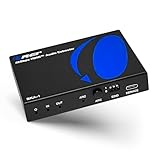
- 8K HDMI Audio Extractor: Designed to extract audio from any HDMI-compliant source and convert it to Optical (S/PDIF) or high-quality stereo 3.5mm audio output. Input: 1× HDMI | Output: 1× HDMI ARC, 1× L/R Audio Out, 1× Optical Out (S/PDIF).
- DOES NOT SUPPORT eARC: Supports video pass-through up to 8K @ 50/60Hz, 4K @ 120Hz (YUV 4:4:4), 4K @ 30Hz, 1080P @ 120Hz, and 1080P 3D @ 60Hz. HDMI 2.1 protocols supported — ALLM, QMS, QFT, SBTM, HLG Pass-through, Dolby Vision, HDR, HDR+. Supported Audio: LPCM 2/5.1/7.1CH, Dolby Digital, DTS 5.1, Dolby Digital+, Dolby TrueHD, DTS-HD Master Audio, Dolby Atmos, DTS:X.
- High Bandwidth & ARC Support: Supports 48 Gbps FRL and 18 Gbps TMDS video bandwidth. Features HDMI High Bit Rate (HBR) audio pass-through and CEC bypass. HDMI 2.1 | HDCP 2.3 | DVI Compliant | Supports ARC. NOTE: Volume cannot be controlled using the TV’s remote. The device comes with a dual voltage supply using a US plug, and an adapter/converter is provided for international use.
- HDMI 2.1 Cable Required: HDMI Input supports Computer, Laptop, PS5, PS4, PS3, Xbox, Blu-ray DVD Player, and STB devices. HDMI Video Output supports Projectors, HDTVs, Monitors, and Screens. Heavy-duty metal enclosure ensures efficient heat dissipation and durability; compact size allows easy plug-and-play installation.
- Package Includes: 100-240V 50/60 Hz auto-switching power supply (worldwide use), HDA-913 Audio Extractor, User Manual, Lifetime OREI Tech Support, and 12-Month Manufacturer’s Warranty.
Rank #4
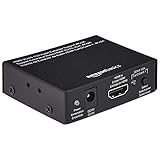
- 4K@30Hz HDMI to HDMI audio extractor converter box in durable metal housing
- Supports HDMI source devices without dedicated audio output
- Supports two channel left-right or SPDIF stereo output and uncompressed and compressed audio
- Supports up to 4k video resolution; 8-bit 4K (30 Hz), 12-bit 1080p (60 Hz), or 12-bit 720p/1080i (60 Hz), plus 3D formats
- Compatible with devices such as Blue-ray, DVD/HD/DVR players, cable/satellite, PS3/4, Xbox, PC/laptop, HD cameras and more
Rank #3

- 【Wide Compatibility】Works with various HDMI players, such as Roku or Chromecast without dedicated audio output, and Blu-ray/DVD/HD players, cable/satellite boxes, PS3/4, PS4 Pro, PS5 Xbox, Fire TV, HD camera, HD DVR, etc.Note: Devices do not support ARC and eARC. TV is not supported as the input source,otherwise product doesn't work.)
- 【4k 3D HDMI Audio Extractor】High performance and multifunction high definition audio extractor, can extract audio signals from HDMI high definition signals into power amplifier system to achieve audio effects that difficult to achieve with TV speakers. This HDMI audio extractor supports 3D stereo imaging technology, giving you an immersive and breathtaking visual experience(Requires your input and output devices to support 3D).
- 【Light Weight】Easy installation and smaller size. Normally no external power adapter is required. Plug and play. For some devices with a low power HDMI port (like PS4, PS4 Slim and other Sony devices), please use a USB adapter or other device's USB port to charge it (free USB cable included in the package).
- 【High Resolution】HDMI audio converter, convert HDMI input to HDMI output and R/L analog audio output, audio output supports R/L analog audio output, input resolution up to 4Kx2K@30Hz, can realize audio signal synchronous separation. The picture is more vivid and the visual effect is better.
- 【Package】Each product accessories include 1 x HDMI Audio Splitter,1 x USB Power Supply Cable,1xAudio cable,1x 4K HDMI cable,1 x Manual. Reminder: If you have any questions that need to be consulted, you can contact us at any time.
- Every slot supports the video as uploaded, up to 4K 60fps, at one price per slot with no re-encoding or quality tiers.
- It automatically recovers if YouTube drops the stream.
- The first day is free, with no card required (one free day per account).
- Monthly billing is $9.99 per month.
See StreamNeo for details, or start your free day.
Product prices and availability are accurate as of the date/time indicated and are subject to change. Any price and availability information displayed on Amazon at the time of purchase will apply.

