
iTechGuides is reader-supported. When you buy through links on our site, we may earn an affiliate commission. As an Amazon Associate I earn from qualifying purchases. Learn more
Quick answer: Convert metric tons per day to kilograms per second, then multiply by the usable enthalpy drop and the turbine-generator efficiencies. For 1,000 metric tons per day, the flow is 11.574 kg/s. With a 500 kJ/kg enthalpy drop, 80% turbine efficiency and 95% generator efficiency, the result is 4.41 MW gross. Net export will be lower after pumps, cooling, fans, controls and other parasitic loads.
That 4.41 MW figure is an example, not a conversion constant. Geothermal steam at a different pressure, temperature, moisture content, exhaust pressure or plant configuration can produce substantially different power from the same mass flow.
The conversion in one line
For metric tons, the mass-flow conversion is:
ṁ (kg/s) = flow (metric tons/day) × 1,000 ÷ 86,400
Because a day contains 86,400 seconds, one metric ton per day equals 0.011574 kg/s:
#1 Best Overall

- Flowmeters
- Vortex steam flow meter compressed thermal oil hot water boiler steam measurement
ṁ (kg/s) = flow (metric tons/day) × 0.011574
Electrical power is based on the energy removed from each kilogram of steam:
Pgross (MW) = ṁ × (hin − hout) × ηturbine × ηgenerator/mechanical ÷ 1,000
In this form, mass flow is in kg/s and enthalpy is in kJ/kg. The multiplication produces kW, so dividing by 1,000 converts it to MW. If enthalpy is entered in J/kg instead, divide by 1,000,000.
PC Slower Than It Used to Be?
A free scan shows the junk files, broken settings and background clutter dragging Windows down - then fixes them in one click.Free scan · Windows 10 & 11Crashes, No Sound, or Screen Glitches?
Random freezes, missing sound and display glitches usually trace back to one bad driver. Find and replace yours safely.Free scan · under a minuteFor plant net output, use:
Pnet = Pgross − Pparasitic
Parasitic demand includes equipment such as production or injection pumps, cooling systems, fans, controls and other electrical loads. Keep the gross-versus-net boundary explicit whenever you publish or compare a result.
What each input means
| Symbol or input | What it represents | How it is obtained |
|---|---|---|
| Flow | Mass of geothermal steam delivered per day | A calibrated flow measurement, stated in metric tons per day |
| ṁ | Continuous mass-flow rate in kg/s | Flow × 0.011574 |
| hin | Specific enthalpy at the turbine inlet | Calculated from inlet pressure and temperature, or pressure and steam quality |
| hout | Specific enthalpy at the turbine exhaust state | Calculated from exhaust or condenser pressure and the actual expansion condition |
| ηturbine | Fraction of ideal expansion work converted by the turbine | Manufacturer data, commissioning data or a validated operating model |
| ηgenerator/mechanical | Combined mechanical and generator conversion efficiency, if treated as one factor | Generator and drivetrain data; keep separate factors when available |
| Pparasitic | Electricity consumed by the plant | Measured auxiliary load or a documented design assumption |
Pressure by itself is not enough. You need a thermodynamic state for the inlet and a defined outlet state. Temperature or steam quality is required with pressure to determine inlet enthalpy. At the outlet, condenser or exhaust pressure must be combined with the expansion condition to determine the actual exhaust enthalpy.
Step-by-step calculation
- Confirm the ton definition. The factor 0.011574 applies to metric tons, each equal to 1,000 kg. If an operating report uses another definition of “ton,” convert that stated unit to kilograms per day before using the factor.
- Measure or obtain the steam flow. Use the mass flow entering the turbine or the clearly defined process boundary. A well-calibrated geothermal-service flow meter is preferable to a nominal well rate. The measured-flow, unit-conversion, enthalpy-difference and efficiency sequence is also the basis of standard steam-power calculations.
- Convert daily flow to kg/s. Multiply metric tons per day by 0.011574. Retain at least four significant figures during intermediate calculations.
- Define the inlet state. Record pressure and temperature, or pressure and quality. For wet steam, document the quality and whether the flow has passed through a separator. Use those state variables to obtain hin.
- Define the outlet state. Record turbine exhaust or condenser pressure. Determine hout for the actual expansion, not merely the enthalpy of an arbitrary saturated state at a convenient pressure.
- Calculate the enthalpy drop. Subtract hout from hin. A negative or implausibly small drop indicates that the state points or units need review.
- Apply conversion efficiencies. Multiply by turbine isentropic efficiency and generator/mechanical efficiency. If the generator and drivetrain efficiencies are known separately, multiply each rather than hiding them in one unexplained number.
- Label the result as gross. The equation gives shaft-to-generator gross electrical output before auxiliary consumption.
- Subtract parasitic loads for net output. State which pumps, condensers, cooling fans, controls and other loads are included, and whether the load is measured at the same operating point as the steam flow.
- Record the assumptions. Save pressure, temperature or quality, separator conditions, exhaust pressure, enthalpies, efficiencies, flow-meter basis and parasitic-load treatment with the result.
Worked example: 1,000 metric tons per day
1. Convert the flow
For 1,000 metric tons per day:
ṁ = 1,000 × 0.011574 = 11.574 kg/s
2. Apply the stated thermodynamic and equipment assumptions
Assume an enthalpy drop of 500 kJ/kg, turbine efficiency of 0.80 and generator efficiency of 0.95:
Rank #2

- Flowmeters
- Vortex flowmeter high precision steam flowmeter water lubrication oil vortex flowmeter
Pgross = 11.574 × 500 × 0.80 × 0.95 ÷ 1,000
Pgross = 4.41 MW
The unrounded calculation is approximately 4.409 MW, normally reported as 4.41 MW. This is an illustrative calculation under the stated assumptions. It does not establish that every geothermal plant receiving 1,000 metric tons per day will produce 4.41 MW.
Quick wins for a faster PC:
Repair Windows errors before they cause bigger problemsFix Now →Fix the driver behind crashes, sound loss and screen glitchesFind Drivers →Clear out junk files and repair common Windows errorsFree Scan →3. Convert gross to net only with a load assumption
If the plant’s auxiliaries consume 0.40 MW at that operating point, the corresponding net export would be:
Pnet = 4.41 − 0.40 = 4.01 MW
The 0.40 MW value is hypothetical; replace it with measured or design parasitic demand. A gross result and a net result answer different questions and should not be compared as if they were the same capacity.
How to obtain enthalpy correctly
Enthalpy is a property of the thermodynamic state, not a fixed attribute of “geothermal steam.” The International Association for the Properties of Water and Steam’s IAPWS-95 formulation, released in 2018, provides property calculations for water and steam, including enthalpy from state variables.
Superheated or dry steam
For a single-phase inlet, use measured pressure and temperature to calculate hin. Check that the temperature lies in the expected superheated or saturated region for the measured pressure. A data logger that reports pressure but not temperature cannot uniquely define the inlet enthalpy.
Saturated steam
If the inlet is saturated, pressure can identify the saturation temperature and saturated-vapor enthalpy. Confirm that the line really is vapor-only; droplets or carryover make the effective mixture enthalpy different from the dry-vapor value.
Rank #3

- The Walston industrial flow meter is suitable for a wide range of applications. This flow meter is perfect to keep track of water usage.
- This Walston Industrial flow meter is factory calibrated for water and can be easily recalibrated for maximum accuracy
- Powered by 2 AAA batteries (included)
- The Walston Industrial meter display and rugged aluminum body that provides strength and resilience for extreme duty industrial applications
- 4 units of measurement, gallon, quart, liter, and pint. Easily reset to your preferred unit.
Wet steam and steam quality
For a two-phase mixture, quality is the vapor mass fraction. With pressure and quality, calculate mixture enthalpy using the saturated-liquid and saturated-vapor properties at that pressure. Separator performance matters because a turbine receiving a separated vapor stream does not receive the same mass and enthalpy as the original wellhead mixture.
Report whether the quoted tons per day describe total well fluid, separator vapor, or turbine-inlet steam. Applying a turbine calculation to total two-phase well flow without accounting for separated liquid can materially overstate electrical output.
Exhaust and condenser state
Use the actual turbine exhaust or condenser pressure and the turbine expansion condition to determine hout. An ideal isentropic expansion is a reference state; the real turbine reaches a different outlet state according to its isentropic efficiency. Condenser pressure can vary with cooling-water temperature, ambient conditions and operating load, so a single design-point value should not be presented as a year-round result.
Free tools Windows power users keep installed
One-click scans. No signup required.
Why pressure and temperature alone still need a plant model
The same inlet state can feed different plant arrangements. The U.S. Department of Energy describes dry-steam, flash-steam and binary configurations and notes that the appropriate conversion depends on the subsurface fluid state and temperature.
| Configuration | What reaches the power-conversion equipment | Implications for a tons/day estimate |
|---|---|---|
| Dry steam | Steam from the reservoir is routed directly to a steam turbine after conditioning | Steam quality, pressure losses and moisture control directly affect turbine inlet enthalpy and flow |
| Flash steam | Hot pressurized fluid is depressurized; the vapor fraction is separated and expanded | Total well-fluid flow is not the same as turbine-steam flow. Separator pressure, vapor fraction and carryover must be included |
| Binary | Geothermal fluid heats a secondary working fluid through a heat exchanger | A direct steam enthalpy-drop equation is not the complete model. Heat-exchanger duty, secondary-cycle efficiency and geothermal-fluid cooling determine output |
For flash or dry-steam plants, the equation in this guide can estimate gross turbine-generator output when the turbine inlet and outlet states are known. For a binary plant, model the heat transferred to the secondary cycle rather than treating all geothermal-fluid flow as steam flowing through the generator turbine.
Gross power, net power and reporting boundaries
“MW” is incomplete unless the measurement boundary is stated. Gross generator output is the electricity produced by the turbine-generator set. Net plant output is what remains after the plant’s own electrical consumption. Capacity may also refer to a rated design value rather than the output at the measured flow and state.
Rank #4
- Flowmeters
- Vortex steam flow meter compressed thermal oil hot water boiler steam measurement
- Gross generator MW: electrical output before auxiliary loads.
- Net plant MW: gross output minus the defined auxiliary load.
- Net export MW: electricity delivered beyond the plant boundary after all included internal and interconnection loads.
NREL documentation distinguishes gross capacity from net output after parasitic load. When comparing two calculations, use the same boundary, operating condition and time basis. A gross value from one plant and a net value from another can make an otherwise sound comparison misleading.
Comparison framework for different steam streams
When two geothermal resources have the same daily mass flow, compare the variables that determine usable work rather than ranking them by flow alone.
| Comparison axis | Questions to ask | Why it changes MW |
|---|---|---|
| Steam quality | Is the flow dry, saturated or wet? Is quality measured upstream or after separation? | Liquid carryover changes mixture enthalpy, turbine erosion risk and the mass actually entering the turbine |
| Inlet pressure and temperature | Are both state variables measured at the turbine inlet? | They determine hin and therefore the available enthalpy drop |
| Exhaust or condenser pressure | Is the pressure measured at the turbine outlet, and under what cooling conditions? | It sets the expansion endpoint and hout |
| Enthalpy drop | Are hin and hout calculated with the same property formulation and units? | It is the thermodynamic work available per kilogram |
| Turbine type and efficiency | What turbine technology and isentropic efficiency apply at this flow? | Real expansion recovers less work than an ideal expansion |
| Generator and mechanical efficiency | Are drivetrain losses included separately? | Only part of turbine shaft power becomes electrical output |
| Separator and condenser conditions | What vapor fraction, pressure losses and cooling conditions occur? | They affect both the steam reaching the turbine and the outlet state |
| Parasitic load | Are pumps, fans, cooling and controls included? | They determine the difference between gross generation and net export |
A practical spreadsheet or calculator layout
Use one row per operating point so changes in well conditions and cooling conditions remain visible. A useful column layout is:
- Metric tons per day.
- Mass flow in kg/s:
=tons_per_day*0.011574. - Inlet pressure and temperature or quality.
- Calculated inlet enthalpy in kJ/kg.
- Exhaust or condenser pressure.
- Calculated outlet enthalpy in kJ/kg.
- Enthalpy drop:
=h_in-h_out. - Turbine efficiency as a decimal, such as
0.80. - Generator/mechanical efficiency as a decimal, such as
0.95. - Gross MW:
=mass_flow*(h_in-h_out)*turbine_efficiency*generator_efficiency/1000. - Parasitic MW.
- Net MW:
=gross_MW-parasitic_MW.
Use a consistent property reference for every row. IAPWS-95 is one recognized formulation for calculating water and steam properties. Engineering software can automate state calculations, but the inputs and boundary definitions still need review. NREL’s System Advisor Model includes geothermal electrical-output models for flash and binary plants; use its documentation to understand the modeled configuration and inputs rather than treating a software result as a universal flow-to-power factor.
Independent reader supportYour contribution helps us test, update, and keep practical guides available for everyone.Common mistakes and how to correct them
Using tons per day as if it were kg/s
Entering 1,000 directly into a power equation instead of converting it to 11.574 kg/s inflates the result by a factor of 86.4. Keep the unit conversion in a visible spreadsheet cell and show the units beside every intermediate value.
Recommended Free Tools
Publishing one MW-per-ton figure
A ratio derived from one operating point only applies to that point’s states and efficiencies. If you quote a ratio for planning, attach the inlet and outlet conditions, equipment efficiencies, plant configuration and gross/net boundary.
Best Value
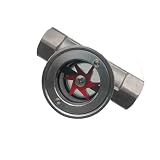
- Thread:1" NPT DN25 Female Thread
- Max Temperature: 120°C/248°F; Max Pressure:2.5 MPa /362 Psi
- The glass window can be viewed in the 180° direction. The window surface glass is easy to clean
- Horizontal dual use for easy installation or disassembly
- Medium: water, oil, gas and acid, alkaline liquid or toxic gas
Using pressure without temperature or quality
Pressure alone does not uniquely establish enthalpy for a general steam state. Add temperature for single-phase steam or quality for a two-phase mixture, and document separator conditions where applicable.
Confusing well-fluid flow with turbine-steam flow
Flash plants can produce a vapor stream that is only part of the total well-fluid mass. Identify the measurement location and apply the separator vapor fraction before calculating turbine output.
Applying the steam equation to a binary plant
In a binary system, geothermal fluid transfers heat to another working fluid. Use a cycle model based on heat-exchanger duty and secondary-cycle performance instead of assigning the geothermal-fluid flow a steam-turbine enthalpy drop.
Reporting gross as net
Subtract the documented auxiliary load and name the loads included. If parasitic consumption is not known, report gross MW and say that net output has not been established rather than silently assuming zero auxiliaries.
Mixing property methods or units
Do not combine enthalpies from incompatible references or mix J/kg and kJ/kg. Check that both state points use the same formulation and that the final division matches the enthalpy unit.
Ignoring operating variability
Wellhead pressure, steam quality, condenser pressure and cooling conditions can change over time. Present a range or multiple operating rows when those measurements vary, and identify whether a value is a design point, an instantaneous measurement or an average.
Minimum data sheet for a defensible estimate
- Flow-meter reading, calibration basis and measurement location.
- Confirmation that the flow is metric tons per day.
- Inlet pressure and temperature, or pressure and quality.
- Separator pressure, vapor fraction and moisture information for wet or flash steam.
- Turbine exhaust or condenser pressure.
- Inlet and outlet enthalpies and the property formulation used.
- Turbine isentropic efficiency at the relevant load.
- Generator and mechanical efficiency, separately if available.
- Gross-versus-net boundary and the auxiliary loads included.
- Operating date or period and any conditions that affect cooling or well output.
With those fields, another engineer can reproduce the calculation, test a different operating point and see exactly why two plants with the same tons-per-day figure may have different megawatt outputs.
The Tool Desk
Outbyte PC Repair FREERepair Windows errors before they cause bigger problemsFix Now →Outbyte Driver Updater FREEScan for outdated or missing drivers - takes under a minuteDriver Scan →Quick Recap
Product prices and availability are accurate as of the date/time indicated and are subject to change. Any price and availability information displayed on Amazon at the time of purchase will apply.

