
What’s actually slowing this PC down?
Pick the symptom - the matching free tool is one click away.
To turn 4K/30 footage into a 4K/60 YouTube Live loop, use frame interpolation to generate intermediate frames, inspect the render for artifacts, then loop the exported file in streaming software configured for 3840×2160 at 60 fps. Simply changing the frame-rate label does not create new motion. Interpolation can make movement appear smoother, but it estimates missing frames and may distort difficult motion.
What changes when you convert 30 fps to 60 fps?
A 30-fps recording contains 30 captured frames per second. A 60-fps output at the same playback speed needs twice as many frames, so an interpolation process estimates a frame between each pair of captured frames. It does not recover detail the camera never recorded. Results depend on the footage and the method: fast movement, objects crossing one another, occlusions, and erratic camera motion can produce warping, tearing, ghosting, or other unnatural frames.
Changing a file’s frame-rate metadata or duplicating each frame can produce a nominal 60-fps file, but neither creates genuinely new motion. If smoothness is the goal, select a retiming or interpolation mode that generates intermediate frames.
Convert the 4K source to 60 fps
Choose an interpolation workflow
- Open the original file in a video editor or frame-interpolation application that can preserve 3840×2160 resolution and export at 60 fps.
- Keep the intended duration and playback speed. Set the output frame rate to 60 fps and enable frame interpolation or a frame-generating retiming mode; do not use a speed change unless you intend to alter the clip’s duration.
- Render a short representative section first if processing time or hardware load matters. Include the fastest movement and most complicated shots.
- Inspect the result at normal speed and frame by frame, paying particular attention to moving edges, crossing objects, limbs, and camera pans. If the generated frames look wrong, try a different model or method, reduce the amount of processing, or keep the source at 30 fps.
- Check the audio. Some interpolation workflows process video only. Topaz’s documented interpolation enhancement removes audio, so replace or remux the original audio separately if your rendered file needs it.
Topaz Video
Topaz documents a “Convert to 60 FPS” preset that uses frame interpolation and has Chronos Fast enabled by default. It also documents a separate preset combining 4K output and 60 fps. Preset names and defaults can change; confirm the current settings in the application’s frame interpolation documentation and preset documentation. A preset is a starting point, not a guarantee that every shot will look better.
The Tool Desk
Outbyte Driver Updater FREEScan for outdated or missing drivers - takes under a minuteDriver Scan →Outbyte PC Repair FREERepair Windows errors before they cause bigger problemsFix Now →#1 Best Overall

- UPGRADE WITHOUT REPLACING CAMERAS: Still running analog security cameras but bought a new HDMI monitor or TV? This BNC to HDMI converter bridges the gap instantly, saving you the cost of replacing your entire camera system
- SUPPORTS MULTIPLE FORMATS: Works with TVI, CVI, AHD, and CVBS camera signals, making it useful for mixed or older CCTV systems. The converter automatically detects the video format for easier setup
- UP TO 8MP CAMERA INPUT: Supports 720P, 1080P, 3MP, 4MP, 5MP, and 8MP security camera input. A practical solution when working with different camera resolutions across a video surveillance system
- PAL AND NTSC SUPPORTED: Recognizes both PAL and NTSC video signals for broader camera support. Use it when connecting security cameras, CCTV equipment, or coaxial video sources to an HDMI monitor
- CRYSTAL CLEAR PICTURE QUALITY: This coax to HDMI converter outputs stable 1080P@60FPS video, so every face, license plate and detail stays sharp — no more blurry, laggy analog footage on your new display
DaVinci Resolve
Blackmagic’s Resolve 18 guide describes Nearest, Frame Blend, and Optical Flow retiming. Optical Flow estimates motion to generate frames and can look smooth when motion is unobstructed, but Blackmagic notes that crossing elements and erratic camera movement can cause stretching or tearing. It can also be processor-intensive and may require caching. These details refer to the Resolve 18 guide and should not be assumed to describe every later version’s interface or behavior. See Blackmagic Design’s Resolve 18 Editors Guide.
Make the rendered video repeat in OBS
- Open OBS and add a Media Source to the scene.
- Select the exported video file in the source properties.
- Turn on Loop. OBS documents that this restarts the file when playback finishes; Loop is off by default.
- Play through the end and beginning of the file to check the repeat point. A looping source is not automatically a seamless visual or audio loop. If the last frame and first frame differ sharply, adjust the edit or choose a more suitable in/out point.
OBS lists MP4, MOV, MKV, and other supported video formats. Check its current Media Sources documentation if a file does not load or a setting differs from the steps above.
Rank #2

- Compact but Powerful Design: ZowieBox is smaller than a phone, featuring a tally light and LCD screen for streaming status. Capture console gameplay in up to 4K with zero-lag HDMI passthrough, while the built-in video encoder converts video for IP streaming. The IP stream can also be decoded back to a 4K HDMI signal.
- Standalone Game Streaming: Just plug and play—ZowieBox enables PC-free live gaming without affecting gameplay. As an RTMP hardware encoder and HDMI streamer, it delivers stable streaming directly from your source, making it ideal for gaming, live events, and professional broadcasting.
- NDI|HX3 Converter Technology: ZowieBox converts HDMI signals to NDI|HX3/HX2/HX, functioning as an NDI video encoder, or NDI Video Decoder for flexible IP workflows. Certified NDI technology enables low-latency gameplay streaming through OBS/vMix. Note: Encoder and decoder modes cannot run simultaneously; full NDI signals are not supported.
- UVC to HDMI Conversion: Supporting up to 4K@30fps and 1080p@60fps decoding, ZowieBox enables flexible conversion for webcam and video workflows. As a video decoder and HDMI to IP converter, it expands connectivity options for professional video devices. Note: USB capture card functionality is not currently supported.
- All-around Configuration Options: Control ZowieBox through its web UI on a PC, phone, or tablet. Manage connected PTZ cameras, tally light, video/audio, OSD, work mode, streams, network, and system settings. Support for VISCA over IP encoder workflows enables flexible PTZ control, while the dashboard provides video preview and system status.
Set YouTube Live output for 4K60
The file’s original frame rate does not determine the live output by itself. Set the streaming software’s output deliberately to 3840×2160 at 60 fps if you want to send a 4K60 stream, then check the encoder settings against YouTube’s current guidance. YouTube’s encoder page, accessed in 2026, gives these H.264 recommendations:
| Live output | Recommended H.264 bitrate | AV1/H.265 range shown by YouTube |
|---|---|---|
| 4K / 2160p at 60 fps | 35 Mbps | 10–40 Mbps |
| 4K / 2160p at 30 fps | 30 Mbps | 8–35 Mbps |
The AV1/H.265 figures are the minimum and maximum settings shown in the corresponding YouTube rows, not the H.264 recommendation. The figures are YouTube’s published guidance, not a guarantee that a particular connection or encoder will sustain the stream. See YouTube’s live encoder settings, bitrates, and resolutions for the latest requirements.
Rank #3
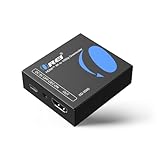
- Smooth 4K to 1080p Downscaling – Effortlessly converts 4K HDMI signals to 1080p, ensuring older TVs, monitors, and projectors work seamlessly with modern 4K sources like Blu-ray players, gaming consoles, and streaming devices.
- Ultra HD Video Support – Handles resolutions up to 4K@60Hz (4:4:4) with full HDMI 2.0 (18Gbps) bandwidth and HDCP 2.2 compliance, delivering crisp details, vibrant colors, and flawless playback for home theater and professional AV use.
- Stable & Reliable Signal Management – Built-in EDID and HDCP management guarantee smooth communication between devices, while the CEC block switch prevents unwanted device conflicts for uninterrupted performance.
- Flexible & Compact Design – Can be powered directly through HDMI or via USB-C for easy setup, with a slim, portable form factor that fits perfectly in entertainment centers, conference rooms, or portable AV kits.
- Package & Warranty – Includes 1x XD-3000 unit and 1x User Manual for quick setup. Backed by a 1-Year Warranty, ensuring long-lasting reliability and customer peace of mind.
Encoder settings to verify
- Resolution and frame rate: Set the output to 3840×2160 and 60 fps for a 4K60 stream. Confirm that both the streaming canvas/output and encoder are configured as intended.
- Video codec and bitrate: YouTube supports H.264, H.265, and AV1. For H.264 at 4K60, its published recommended bitrate is 35 Mbps. Use an upload connection with sufficient sustained capacity for the selected bitrate and other network use.
- Rate control: YouTube recommends CBR (constant bitrate).
- Keyframes: YouTube recommends a two-second keyframe interval and says not to exceed four seconds.
- Protocol: YouTube recommends RTMPS; its page also specifies RTMP/RTMPS streaming.
- Latency: YouTube states that the “improve for low latency” option is unavailable for 4K streams, which use normal latency.
Labels and available options vary by encoder. Use the software’s current controls to match these values, then run a test with representative motion and audio and monitor YouTube’s stream health before relying on the loop.
Choose between 4K60 and 4K30
Interpolation is optional. Compare the converted result with the original at normal playback speed: choose 4K60 if its motion looks better and your system and upload connection can support the higher output. If generated frames look distracting or the connection cannot sustain the 4K60 settings, keeping the stream at 4K30 is a valid choice. YouTube’s published H.264 recommendations are 35 Mbps for 4K60 and 30 Mbps for 4K30; 4K streaming uses normal latency rather than the low-latency option.
Rank #4
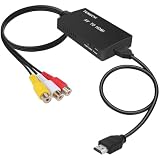
- RCA Female to HDMI Video Converters Adapter : The cable is used to convert analog composite input to HDMI 1080p output, displayed on a 1080p HD TV/TV/monitor.
- Input ports: 1xRCA Female (Yellow, White, Red), Output ports: 1xHDMI 1.3 1080p. NOT support 3D and 4K, NOT support HDMI Converts to AV
- AV to HDMI Converter: Plug and Play, Easy to Install and Operate, Powered by External USB Cable. Note: Please hook up the USB power cable (included) to 5V 1Apower source during use (not included power supply ).
- Support PAL, NTSC3.58, NTSC4.43, SECAM, PAL/M, PAL/N standard TV formats input. For PS2,PS3,Xbox,N64,STB, VHS, VCR, DVD Players and other devices with standard composite AV input.
- You Will Get : 1x RCA Female TO HDMI Converter, 1xHDMI cable, 1xUSB cable, 1xUser Manual. ONE YEAR WARRANTY - if you are not satisfied for any reason whatsoever, do not hesitate to contact us .
Troubleshooting a 4K60 loop
- The video looks no smoother after conversion: Check that frame interpolation or a frame-generating retiming mode was enabled. A changed frame-rate label or duplicated frames do not synthesize intermediate motion.
- Edges warp or objects tear: These are possible interpolation artifacts, especially around crossing elements, occlusions, fast movement, or erratic camera motion. Try another interpolation method, reduce processing, edit around the difficult shot, or return to 30 fps.
- The exported video has no sound: The interpolation process may be video-only. Restore the source audio as a separate track or remux it into the final file, then check synchronization.
- The loop visibly jumps: The file may be repeating correctly while its ending and beginning do not match. Adjust the in/out points or edit a transition that makes the boundary less abrupt.
- YouTube reports stream-health problems: Check that the encoder output matches the intended resolution and frame rate, uses the recommended rate control and keyframe interval, and does not exceed what the connection can sustain. Test again and monitor stream health.
- The stream cannot use low latency: YouTube’s guidance says 4K streams use normal latency; the low-latency option is unavailable at 4K.
Or let it run in the cloud
If you do not want a computer and home connection to run the loop, StreamNeo keeps a YouTube channel live from uploaded videos. Upload the processed recording or build a playlist, add your YouTube stream key once, and go live. It loops from the cloud, so nothing has to stay on at home. Every slot streams the uploaded quality up to 4K 60fps at one flat price per slot, with no re-encode or quality tiers, and automatically recovers if YouTube drops the stream. The first day is free with no card. Monthly pricing is $9.99 per month. StreamNeo is for YouTube and uploaded videos, not camera streaming. See StreamNeo or start the free first day.
Quick Recap
Best Value

- Preserve Your Memories: DigitPro VCR to Digital Converter is a simple solution to bring those precious memories from Capturing and converting your VHS tapes, Hi8 Mini DV VCR tapes, DVD’s, Set top recorded videos to Digital Format (MP4). You can share the digital format of your old good memorries with your family and friends anywhere anytime.
- 4K VCR to Digital Converter: With its 4K recording resolution and next-gen digitization chip, DigitPro Video to Digital Converter capture the beauty of every moment with precision. Whether it’s the breathtaking natural scenery or unforgettable family gatherings, 4K recording clarity brings out the details in stunning resolution, making your memories come alive with vivid realism. You can also choose from 720p and 1080p resolution options.
- Standalone, No Computer or Software required: No Computer, drivers or softwares are required, you can capture video from HDMI video source and saves them in MP4 format onto SD card (included) or USB Flash Drive(not included). The internal 3.5mm mic jack allows you to add own live commentary.
- 5" Screen HI8 to Digital Converter: Built-in 5" screen and built-in speakers for previewing and playing video and audio, you can connect a larger screen via HDMI port to share with your family and friends, or connect headphones via the separate headphone jack to listen to high-quality audio.
- Built-in Stereo Speakers & 3.5mm Headphone Output &Audio Recording: Built-in 2000mAh battery and speakers, portable and easy to carry, can be used and playback watch your video on anywhere. Up to 3 hours of playback after a full charge. With an independent headphone jack, you can use your headphones to listen to high-quality audio.
Product prices and availability are accurate as of the date/time indicated and are subject to change. Any price and availability information displayed on Amazon at the time of purchase will apply.
Free tools Windows power users keep installed
One-click scans. No signup required.

