
Crashes, No Sound, or Screen Glitches?
Random freezes, missing sound and display glitches usually trace back to one bad driver. Find and replace yours safely.Free scan · under a minuteWindows Errors? Fix Them Before They Spread
Repair common Windows errors and clear accumulated junk for a smoother, more stable PC - no reinstall needed.Free scan · no reinstallYou generally can’t connect a BNC video cable directly to a PC. You need a capture device that accepts the signal carried by the BNC connector—composite/CVBS, SDI, component, or a CCTV format—and connects to the computer over USB, Thunderbolt, or PCIe. A BNC-to-RCA adapter changes the connector only; it does not convert the video signal.
First identify what the BNC connector carries
BNC describes the connector, not the video standard. The same style of connector can carry incompatible signals, so check the label beside the port or the source device’s manual before choosing capture hardware. Don’t infer the signal from the cable’s appearance or from the fact that the source is a camera.
| Label or connection | Likely signal | What the PC needs |
|---|---|---|
CVBS, COMPOSITE, VIDEO, or VIDEO OUT |
Composite/CVBS analog video, usually standard definition | A composite or analog video capture device. If it has RCA inputs, use a BNC-to-RCA cable or adapter. |
SDI, HD-SDI, or 3G-SDI |
Digital serial video over BNC | An SDI capture device that supports the source’s specific SDI format. |
Three jacks marked Y, Pb, and Pr |
Component analog video | A component-capable capture device and, if needed, its breakout cable. |
| CCTV camera or recorder output | Could be CVBS, AHD, TVI, CVI, SDI, or another format | A device explicitly compatible with that format, or the DVR’s HDMI or network output. |
REF, SYNC, TC, or GENLOCK |
Reference, synchronization, timecode, or genlock—not necessarily picture | Find the device manual and identify an actual video output. |
For example, Blackmagic’s converter manual distinguishes analog composite NTSC/PAL BNC inputs from SDI BNC outputs. A BNC plug fitting the socket does not establish that the signal is compatible. Blackmagic converter manual.
Choose capture hardware that matches the signal and job
Composite or CVBS
Use a composite-capable USB capture device for a simple single-source setup, or a compatible PCIe card for a desktop installation. Composite sources normally produce standard-definition video, not HD. An RCA-to-BNC adapter is appropriate only when it connects a composite source to a composite input; it does not convert composite to SDI, HDMI, or USB.
#1 Best Overall

- UPGRADE WITHOUT REPLACING CAMERAS: Still running analog security cameras but bought a new HDMI monitor or TV? This BNC to HDMI converter bridges the gap instantly, saving you the cost of replacing your entire camera system
- SUPPORTS MULTIPLE FORMATS: Works with TVI, CVI, AHD, and CVBS camera signals, making it useful for mixed or older CCTV systems. The converter automatically detects the video format for easier setup
- UP TO 8MP CAMERA INPUT: Supports 720P, 1080P, 3MP, 4MP, 5MP, and 8MP security camera input. A practical solution when working with different camera resolutions across a video surveillance system
- PAL AND NTSC SUPPORTED: Recognizes both PAL and NTSC video signals for broader camera support. Use it when connecting security cameras, CCTV equipment, or coaxial video sources to an HDMI monitor
- CRYSTAL CLEAR PICTURE QUALITY: This coax to HDMI converter outputs stable 1080P@60FPS video, so every face, license plate and detail stays sharp — no more blurry, laggy analog footage on your new display
SDI
Use a dedicated SDI capture interface or an SDI-capable PCIe card, and verify support for the source’s SDI rate and format. AJA’s U-TAP SDI, for example, is a one-BNC 3G-SDI capture interface designed for USB 3.0 or better. AJA U-TAP SDI specifications. Magewell also offers SDI capture hardware; check the exact model because product families and revisions differ. Magewell USB Capture SDI 4K Plus.
Component video
Use a component-capable capture device and the correct breakout cable. The three component leads carry different parts of the picture; connecting just one to a composite input will not produce a proper image.
CCTV cameras and multi-camera systems
Check whether the camera outputs CVBS, AHD, TVI, CVI, SDI, or another format. A basic composite capture device may accept CVBS but not HD-over-coax formats such as AHD, TVI, or CVI. For a camera already connected to a DVR, capturing the DVR’s HDMI output or using its network stream may be simpler, especially when monitoring multiple cameras. A DVR can add compression, menus, or latency, so the choice depends on whether you need a convenient view or the camera’s original feed.
Rank #2

- FUNCTIONS: The video converters is a must-have to keep older devices with new modern PC monitor or LCD. It takes a connect from CVBS security camera directly to an HDMI TV, or converts old security system DVR output (analog video signal) to HDMI(digital video signal) for Flat Screen Monitor.
- COMPATIBILITY: This box composites CVBS BNC analog video signal input and 3.5mm aux audio signal input to HDMI output with a 720P/1080P switch. NOTE: 1) It's only for CVBS analog camera, can NOT fit the digital camera or AHD/TVI/CVI camera; 2) The output port is standard HDMI type A; 3) It's NOT an SDI converter, can NOT convert cable TV signal. Don't use it to connect your antenna and cable TV.
- SPECIFICATION: The adapter adapts 3D compensation technology: motion optimization, color Optimization and digital noise reduction. Automatically detects input signals in PAL or NTSC format, supports 720P@50/60Hz, 1080P@50/60Hz HDMI output resolution (The resolution can reach up to 1920*1080 on LED LCTV), freely switch between 4:3 and 16:9 modes.
- FEATURES: 1) It has an exclusive 3.5mm audio port to input audible signals, which allows you to inject sounds to the CVBS cameras video signals. 2) The low-power-consumption digital chip enables the adapter to work 24-hour uninterruptedly and stablely with low heat releasing. It's a simplistic way to broadcast live video feed and perfect for real-time video monitor using CVBS protocol.
- PLUG and PLAY:Wire it as follows, CVBS CCTV camera or DVR with BNC output - coax cable - this adapter - HDMI cable - pc monitor/ Projector/ Computer. Work after easy installation without any special settings, no driver software required. NOTE: if you use a TV set as the monitor, switch the“input or source” button on the TV clicker to the HMID mode.
Some cameras also need a separate power supply, receiver, or control unit. A BNC video cable normally carries the video signal; do not assume it powers or controls the camera.
USB versus PCIe
| Hardware | Usually suits | Trade-offs |
|---|---|---|
| USB capture device | A laptop, one camera, occasional recording, or a straightforward streaming setup | Portable and easy to connect, but driver quality, bandwidth, latency, audio handling, and supported inputs vary by device. |
| PCIe capture card | A desktop installation, several inputs, or a professional workflow | Can support multiple or professional-format inputs, but needs an available slot and may require drivers, breakout cables, and more setup. |
Some capture products support several signal families, but the precise model and connector breakout matter. Magewell’s USB Capture range, for instance, includes models with different analog and digital inputs. Magewell USB Capture product family. AJA’s desktop I/O range likewise varies by model, with different combinations of composite, component, SDI, and HDMI. AJA desktop I/O products.
Connect the source to the PC
Composite/CVBS
- Connect the source’s BNC video output to the composite capture device’s input. If the capture device has a yellow RCA input, use a BNC-to-RCA cable or adapter.
- Connect the capture device to the computer by USB, or install a compatible PCIe card in a desktop.
- If the source has separate left/right audio outputs, connect them to the capture device’s audio inputs or a separate USB audio interface.
The signal path is: composite BNC source → composite capture device → USB or PCIe → PC.
Rank #3
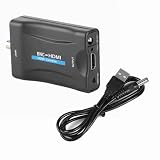
- Note 1:The Input of This BNC to hdtv converter is Coax BNC,Not for Coax RF. Not work for antenna and cable TV.(If you use a TV set as the monitor, switch the“input or source” button on the TV clicker to the HMID mode.)
- Note 2:The connection order is crucial as it determines whether the device will work. First, connect the power cable and BNC cable. Once everything is ready, then connect the HDTV cable.
- Note 3:This BNC to HDMI Converter does NOT include cables. Before purchase, please ensure you have compatible BNC cables for proper connectivity. If unsure, contact our customer support team for assistance. This will help avoid compatibility issues and ensure the product meets your needs.
- Adopting Scaler video processing technology: a:The BNC signal is multiplied to the HD 1080P / 720P @ 50 / 60Hz output b: Can convert standard definition video format (480i, 480p, 720p, 1080i), through the Scaler UP technology, into the high‑definition
- Adopting I2S technology, superimpose incoming L / R analog audio signal on the High Definition Multimedia Interface for the elimination of analog audio cable transmission interference. The system defaults to BNC signal input. Audio and video input, High Definition Multimedia Interface output.
SDI
- Connect the source’s SDI output to the SDI capture device’s input with a suitable 75-ohm BNC SDI cable.
- Connect the capture device to the computer using its supported USB, Thunderbolt, or PCIe connection.
- Confirm that both the source and capture device support the same SDI format. If audio is embedded in SDI, the source, capture device, and software must all support it.
The signal path is: SDI source → SDI capture device → computer. AJA specifies USB 3.0 or better for best performance with U-TAP SDI. AJA U-TAP SDI.
When you need a converter
If you already have capture hardware for another format, a converter may bridge the gap: for example, composite source → analog-to-HDMI converter → HDMI capture device. This adds equipment and can add latency, scaling artifacts, or aspect-ratio problems. A composite/component-to-SDI converter is another option in a professional SDI setup; Blackmagic documents converters that accept analog NTSC/PAL or component signals and output SDI over BNC. Blackmagic converter manual. When possible, capturing the source directly with a device built for its native signal avoids an unnecessary conversion stage. Magewell SDI capture product information.
Do these 3 things before closing this tab:
1Scan for outdated or missing drivers - takes under a minute2Repair Windows errors before they cause bigger problems3Fix the driver behind crashes, sound loss and screen glitchesSet up the capture device in OBS
- Install OBS Studio, connect and power the capture hardware, then confirm that the computer recognizes it.
- Connect the source to the capture device’s video input—not an output or loop-through connector.
- In OBS, create or select a scene, then choose Sources → + → Video Capture Device.
- Select the capture device and, if available, the correct input. On Windows, the standard capture source generally requires a DirectShow-compatible driver; compatible Linux devices commonly use V4L2. OBS video capture sources.
- Choose a supported resolution, frame rate, and video format. For composite video, select NTSC for most North American sources or PAL for many European and other international sources. If automatic detection gives a black or unstable image, select the standard manually.
- If sound is separate, add the capture device’s audio input or a separate audio input in OBS. Magewell’s setup guidance covers selecting linked audio or adding an audio input separately. Magewell USB Capture OBS setup.
- Check for a stable preview, then choose Start Recording or Start Streaming. Magewell also documents a recording workflow for its capture hardware. Magewell capture recording instructions.
Some professional devices use their own OBS source rather than the generic capture source. OBS documents dedicated source types for Blackmagic and AJA hardware as well as the standard device source. OBS video capture sources.
What to expect from the picture and sound
- Composite/CVBS capture is normally standard definition; a BNC connector does not imply HD.
- SDI can carry different video formats, but the source and capture device must support the same one.
- Capture and processing can introduce latency, particularly with USB devices. Some delay is normal.
- A device may appear as a webcam-like input, a vendor-specific source, or both, depending on its driver and software support.
- Video capture does not guarantee audio capture. Audio may use separate analog leads, be embedded in SDI, or be available only through the camera or DVR’s separate output.
Troubleshoot no picture, bad video, or missing audio
| Symptom | Likely causes | What to check |
|---|---|---|
| Capture device is missing in OBS | Driver, USB connection, unsupported source type, or another application using the device | Reconnect it, confirm the operating system sees it, install the manufacturer’s driver if needed, and close other video apps. On Windows, check for a DirectShow-compatible driver for OBS’s standard source. |
| Black screen or “no signal” | Wrong input, incompatible signal standard, inactive source, bad cable, or an output that is disabled | Confirm the source is powered and outputting; check that the cable runs from output to input; verify CVBS versus SDI or CCTV format; select the correct input and standard; test the source on a compatible monitor. |
| Rolling, distorted, or monochrome composite picture | NTSC/PAL mismatch, component/composite confusion, unstable source, or unsupported CCTV format | Set the correct video standard, verify every lead is connected to the intended input, and confirm the capture device supports the camera’s format. |
| Picture but no audio | Audio is on separate leads, is not supported by the capture device, or is not selected in OBS | Connect analog audio to the capture device or a separate audio interface, or select the supported embedded-audio input. Add the appropriate audio source in OBS. |
| Stuttering or unstable capture | USB bandwidth, driver, format, or connection issue | For troubleshooting, use a direct USB 3.x connection rather than a busy hub; confirm the selected format is supported and test with the manufacturer’s utility. |
| Picture is delayed | Normal capture/processing latency, buffering, or unnecessary conversion stages | Remove avoidable conversions, use a direct connection, and adjust buffering only after testing; disabling buffering can affect stuttering. OBS describes buffering as a hardware- and problem-dependent setting. OBS video capture sources. |
| Works in the manufacturer’s utility but not OBS | Wrong OBS source type, unsupported driver path, another app claiming the device, or an unsupported format selection | Check whether the device needs a dedicated Blackmagic or AJA source, close other apps, and try a supported resolution and frame rate. |
Check these details before buying
- The signal standard: composite/CVBS, SDI, component, or the exact CCTV format.
- The capture device’s input type and supported resolution and frame rate.
- Compatibility with your operating system, OBS or other application, and required drivers.
- Whether audio is included, embedded, or needs a separate input.
- The connection your computer supports: USB, Thunderbolt, or an available PCIe slot.
- The number of sources you need to capture and any required breakout cables, camera power, or audio adapters.
- The exact model and revision: a product family name or the word “BNC” alone does not confirm compatibility.
If the source format is uncertain, identify it from the equipment model and manual before purchasing; verify current availability and price on the manufacturer’s or authorized retailer’s page.
Quick Recap
Product prices and availability are accurate as of the date/time indicated and are subject to change. Any price and availability information displayed on Amazon at the time of purchase will apply.

