
Outdated Drivers Are Slowing You Down
One free scan finds every outdated or missing driver and matches the right update for your exact hardware.Free scan · exact hardware matchPC Slower Than It Used to Be?
A free scan shows the junk files, broken settings and background clutter dragging Windows down - then fixes them in one click.Free scan · Windows 10 & 11Compare a flu forecast only with an observation of the same outcome, place, and week. For CDC’s FluSight hospital forecast, that usually means matching a forecast of weekly influenza hospital admissions to the corresponding NHSN admission data—not to outpatient flu-like illness, positive-test percentages, FluSurv-NET rates, or a single hospital’s census. Keep the forecast’s issue date and lead time, note when the observed data were downloaded, and judge the forecast against a baseline as well as its uncertainty intervals.
First, identify what the forecast and observation measure
“Flu activity” can refer to several different measurements. CDC’s surveillance methods explain that surveillance shows where, when, and what influenza viruses are circulating; it does not directly count every influenza illness. A forecast’s accuracy is meaningful only when its target is matched to an observation with the same definition.
| Measure | What it represents | What not to substitute for it |
|---|---|---|
| FluSight hospital admissions | Weekly counts of new influenza hospital admissions reported through CDC’s National Healthcare Safety Network (NHSN). The 2025–2026 evaluation covers the United States, states, Puerto Rico, and Washington, D.C. | Outpatient ILI visits, positive-test share, FluSurv-NET rates, or a facility’s current inpatient census. |
| FluSurv-NET hospitalization rates | Rates of laboratory-confirmed, influenza-associated hospitalizations among residents of defined surveillance areas, calculated using the area population. | A nationwide admission count or an individual hospital’s admissions. |
| Outpatient influenza-like illness (ILI) | Outpatient visits meeting an ILI definition; ILI is a syndromic signal, not a count of laboratory-confirmed influenza admissions. | Hospital admissions or the number of people infected with influenza. |
| Laboratory positivity | The share of tested specimens that are positive in the relevant data series. | The share of all people with flu, or the number of people hospitalized. |
| Local hospital admissions or census | An institution’s own count, defined by its reporting rules; census describes patients present at a point in time, while admissions count arrivals over a period. | A state or national total unless the geography, population, and measure have been made comparable. |
What counts as an NHSN flu admission
CDC’s U.S. Influenza Surveillance: Purpose and Methods defines a new influenza admission as an inpatient admission with a positive influenza test at admission or during the preceding 14 days. That definition is not the same as counting anyone currently in a hospital who has ever tested positive, and it is not the same as measuring occupied beds.
What the public CDC displays show
CDC’s FluView Interactive description includes outpatient ILI and laboratory data at national, regional, and select-state levels; FluSurv-NET rates; NHSN hospitalization surveillance at national and HHS-region levels; and state ILI activity. These are complementary indicators, not alternate versions of one outcome. The FluSight evaluation uses state and jurisdiction targets, but that does not mean FluView Interactive exposes every hospital’s underlying series.
Quick wins for a faster PC:
Scan for outdated or missing drivers - takes under a minuteDriver Scan →Clear out junk files and repair common Windows errorsFree Scan →Fix the driver behind crashes, sound loss and screen glitchesFind Drivers →#1 Best Overall

- FDA Authorized 15-Minute Flu A&B, COVID Test Kit: Over-the-counter flu and COVID test for home use with rapid results in just 15 minutes.
- Made for Ages 2 and Above; Parents Can Stop Guessing: Quickly identify whether you or your kids are dealing with coronavirus or influenza A & B. Adult-collection is required for those aged 2-13 years, and self-collection by individuals aged 14 years and older.
- Same Ease-of-Use; Get 3 Results in 1 Test: Utilizing the familiar 4 user-friendly steps of at-home COVID tests, you can now get all 3 results for COVID-19 and Flu A & B at once with 5 drops of sample.
- Fast and Convenient COVID and Flu Tests for Home: Use this COVID and influenza rapid test kit in the comfort of your home. Bypass the need for a doctor's visit and protect your loved ones from potential exposure to contagious illnesses at school, work, or public gatherings.
- Compact Design for On-the-Go Testing: Stay safe wherever you go with our COVID-19, Flu A & B 3-in-1 self-test. Its compact design ensures easy storage and convenient portability for your travel bag.
Match the geography, week, and forecast horizon
A comparison needs the same geographic unit and event period on both sides. A national forecast belongs beside a national observation; a state forecast belongs beside that state’s target. A local forecast requires a local observation with the same population or facility definition. Comparing a local count with a national total, or a FluSurv-NET catchment rate with a state admission count, can make a sound forecast look wrong—or the reverse.
- Record the forecast issue date. This is when the forecast was made, not the week it predicts.
- Record the target week and lead time. For example, a one-week-ahead prediction and a three-week-ahead prediction for the same event week are different forecast tasks.
- Use the same event-week convention. Most influenza surveillance event weeks run Sunday through Saturday. Long-term-care facility data use Monday through Sunday, an exception noted by CDC.
- Write down the geography and population. State whether the value is national, a state or jurisdiction, an HHS region, a FluSurv-NET surveillance area, or a named hospital or health system.
- Freeze the observation vintage. Record the download date and whether the value was preliminary or final. Recent observations can be delayed, and CDC data may be revised.
CDC’s 2025–2026 FluSight target is weekly hospital admissions for the current week and up to three weeks ahead, for the United States, states, Puerto Rico, and Washington, D.C. Do not compare a forecast for a particular lead and target week with an observation from a different week or treat a later revised value as though it was available to forecasters at the time.
Rank #2

- FDA Authorized 15-Minute Flu A&B, COVID Test Kit: Over-the-counter flu and COVID test for home use with rapid results in just 15 minutes.
- Made for Ages 2 and Above; Parents Can Stop Guessing: Quickly identify whether you or your kids are dealing with coronavirus or influenza A & B. Adult-collection is required for those aged 2-13 years, and self-collection by individuals aged 14 years and older.
- Same Ease-of-Use; Get 3 Results in 1 Test: Utilizing the familiar 4 user-friendly steps of at-home COVID tests, you can now get all 3 results for COVID-19 and Flu A & B at once with 5 drops of sample.
- Fast and Convenient COVID and Flu Tests for Home: Use this COVID and influenza rapid test kit in the comfort of your home. Bypass the need for a doctor's visit and protect your loved ones from potential exposure to contagious illnesses at school, work, or public gatherings.
- Compact Design for On-the-Go Testing: Stay safe wherever you go with our COVID-19, Flu A & B 3-in-1 self-test. Its compact design ensures easy storage and convenient portability for your travel bag.
Use a repeatable comparison workflow
- Write the forecast target in plain language. Specify whether it predicts admission counts, admission rates, ILI visits, test positivity, or another outcome. Avoid the unqualified phrase “flu cases.”
- Select the matching observation. For FluSight’s hospital target, use the matching NHSN weekly admissions series. If you are using local hospital data, verify that the local measure follows the same admission definition before treating it as a direct match.
- Align geography and dates. Match the forecast and observation to the same jurisdiction or population, target week, and week-ending convention. Preserve the original forecast issue date and lead.
- Document local-data boundaries. For a hospital or health system, note its catchment, transfers, testing practices, and whether its value is new admissions or current census. Those details determine whether a local comparison is interpretable.
- Save the observation’s vintage. Record when data were retrieved and whether they were preliminary. Keep that version for the comparison even if CDC later revises the series; a later-vintage analysis can be reported separately.
- Compare uncertainty as well as the central estimate. Show the forecast’s median or central estimate and its prediction intervals when available, then check both the score and whether observed outcomes fall within the intervals.
- Stratify results. Report performance by lead time, jurisdiction, and epidemiologic period where possible. A season-wide average may hide errors near the peak or during a rapid change.
- State the benchmark. Compare with the published baseline when using CDC’s evaluation, or define a local naïve baseline explicitly. A forecast’s rank alone does not tell a reader how much it improved on a simple alternative.
Evaluate the forecast against a baseline and its uncertainty
CDC’s 2025–2026 evaluation primarily reports relative weighted interval score (relative WIS). In that evaluation, a relative WIS below 1 indicates better performance than the carry-forward baseline; a value above 1 indicates worse performance than that baseline. Relative WIS summarizes forecast accuracy while accounting for the predictive distribution, so it is more informative than checking only whether a median estimate matched an observed count.
Also examine prediction-interval coverage: the proportion of observed outcomes that fall inside the stated intervals. Coverage helps show whether forecast uncertainty was realistic. A narrow interval may look precise but miss often; a wider interval may cover more outcomes while offering less precision. Interpret the score and coverage together, and keep the forecast horizon and period attached to any coverage figure.
Rank #3

- 3-In-1 Flu A B And COVID-19 Test Kit: Designed to check for multiple respiratory targets in one test, allowing users to complete a single test instead of using separate kits at home.
- Simple At-Home Testing Process: Step-by-step format with nasal swab, buffer tube, and test cassette designed for straightforward use during everyday situations when testing is needed.
- Quick Results In About 10 Minutes: Provides results in a short timeframe, making it a convenient Covid home test to use before travel, or gatherings.
- Designed For Family Use Ages 2 And Up: Suitable for a wide range of users, including adults and children, making it a practical option for shared household use.
- Compact Single-Test Kit For On-Demand Use: The portable design on these covid tests allows for easy storage in a drawer, bag, or travel kit for quick access when needed.
For a local analysis, define a comparable baseline before scoring. A simple option is a carry-forward forecast based on the latest available observation, but the precise baseline must reflect what data would actually have been available at the forecast issue date. Do not give a model access to later revisions or observations when constructing its comparison baseline.
What CDC’s 2025–2026 evaluation says—and does not say
CDC published its FluSight 2025–2026 evaluation on September 30, 2026. Across the season, the CDC FluSight ensemble ranked seventh among 39 included models by average relative WIS for jurisdictions, excluding the national target. It was one of 12 models that consistently beat the baseline in all jurisdictions; 33 of the 39 evaluated models performed better than the carry-forward baseline. These are evaluation results for the stated season, target, and scoring method—not a guarantee about future seasons or a ranking of every system described as AI.
Rank #4
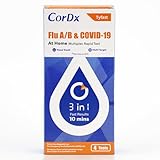
- 3-in-1 Multiplex Detection: Detects SARS-CoV-2, Influenza A, and Influenza B antigens from a single anterior nasal swab sample.
- Designed for Symptomatic Testing: Intended for individuals experiencing symptoms of respiratory infection within the first 5 days of symptom onset.
- Simple Nasal Swab Collection: Uses a short anterior nasal swab sample with step-by-step instructions included in the kit.
- Fast Results in 10 Minutes: Provides results in approximately 10 minutes when used according to the instructions for use.
- 10 minute accuracy —why wait 15? With our rapid testing kit, get peace of mind in 10 minutes and precise results without the extra wait. Proven higher PPA than major competitors, based on IFUs.
Performance also varied during the season. For the ensemble’s two-week horizon across jurisdictions, fewer than one-quarter of prediction intervals contained the observed outcome for the week ending December 27, 2025, which coincided with the national and most common jurisdictional peak. CDC reports that coverage stabilized near 95% starting in February 2026. The peak-period figure is not whole-season coverage, and the later coverage figure does not erase the earlier misses.
CDC notes that ensemble forecasts have often been among the more accurate approaches in influenza and other infectious-disease forecasting, but can fail to predict rapid changes, including season onset increases and peak shifts. “AI” is not one model class: FluSight submissions include methods categorized from teams’ descriptions as AI/ML, statistical, mechanistic, and ensemble approaches. The ensemble’s score should not be attributed to every AI or machine-learning forecast.
Best Value
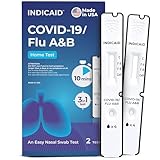
- Comprehensive 3-in-1 Test: The INDICAID COVID-flu test combo is a convenient way to detect COVID-19, Flu A, and Flu B. Everything you need is in this test home kit. It’s a must-have over-the-counter solution for anyone experiencing cold and flu symptoms.
- Fast, Reliable Results: This rapid influenza and COVID home test kit gives you 3 results in just 10 minutes, and it’s incredibly easy to use. All it requires is a shallow nasal swab, and the test can be completed in four simple steps. No more guessing!
- Trusted Technology: This flu and COVID test kit at home is FDA 510(k)-cleared, ensuring high-quality and accurate results. The combo test uses the same technology as COVID-19 rapid tests and can detect multiple COVID-19 and Flu A&B variants and strains.
- Versatile Use: The INDICAID COVID and flu test kit comes in a compact package, perfect for travel, school, work, and home. It’s also family-friendly. Individuals ages 14 and over can self-check, while children ages 2-14 require adult assistance.
- Extended Shelf Life: The shelf life of the INDICAID COVID-19/Flu A and Flu B Rapid Antigen Test has been extended to 16 months and is regularly extending. Simply scan the QR code on the box to find out the tests’ expiry date. Made in the USA.
How to use FluSurv-NET and local hospital data responsibly
FluSurv-NET is a population-rate lens
FluSurv-NET counts laboratory-confirmed influenza-associated hospitalizations among residents of defined surveillance areas and divides those counts by the area population to calculate rates. CDC describes coverage of more than 90 counties or equivalents in 14 states, representing more than 34 million people and an estimated 10% of the U.S. population. CDC cautions that FluSurv-NET data may not generalize to the whole country; beginning in the 2025–2026 season, the network collects data year-round. Use it to understand hospitalization rates and patient characteristics within its surveillance areas, not as a substitute for the NHSN admission-count target.
A local hospital series can add context, but may not be a direct validation set
NHSN receives aggregate facility submissions, including measures such as capacity, current patients, and new admissions. Public FluView descriptions expose NHSN hospitalization series at national and HHS-region levels; they do not establish a universal public hospital-by-hospital dataset or a standard route for obtaining every institution’s data. A local comparison therefore depends on lawful access to the institution’s appropriately defined data.
Even with access, one hospital’s series may differ from the state target because of catchment area, patient transfers, testing practice, or the fact that it measures census rather than new admissions. If no local forecast has the same facility or population definition, describe the local series as context for the regional or state forecast—not as a formal accuracy score. Do not scale one hospital’s count into a state total without a defensible population and reporting model.
Choose a comparison that fits the decision
Forecast usefulness depends on the decision as well as statistical performance. A hospital planning beds or staffing needs a hospitalization target and enough lead time to act. A public message about community respiratory illness may call for outpatient ILI or another relevant signal instead. For treatment or supply planning, be explicit about the geography and measure that the decision actually uses. A forecast can be informative for one task and a poor fit for another if its target or resolution does not match the operational question.
What’s actually slowing this PC down?
Pick the symptom - the matching free tool is one click away.
CDC’s FluSight program is designed to support situational awareness and planning for changes such as increases in flu-related hospitalizations. Its 2025–2026 evaluation page says evaluation of FluSight emergency-department visit percentages due to flu is forthcoming; the hospital-admission results above do not establish performance for that separate target.
Quick Recap
Product prices and availability are accurate as of the date/time indicated and are subject to change. Any price and availability information displayed on Amazon at the time of purchase will apply.

