
Quick wins for a faster PC:
Fix the driver behind crashes, sound loss and screen glitchesFind Drivers →Clear out junk files and repair common Windows errorsFree Scan →Scan for outdated or missing drivers - takes under a minuteDriver Scan →iTechGuides is reader-supported. When you buy through links on our site, we may earn an affiliate commission. As an Amazon Associate I earn from qualifying purchases. Learn more
Choose a wireless gaming mouse by starting with a shape that fits your hand, then compare measured responsiveness, wireless mode, battery behavior, weight, and controls. Polling rate matters, but it is only one part of latency: a high number does not guarantee a faster-feeling mouse, and it can increase power use or cause trouble in some games.
Start with shape, hand size, and grip
Grip labels are useful starting points, not rules for choosing a mouse. Logitech describes three common patterns: palm, claw, and fingertip. The right shell depends on how your hand naturally rests, its size, and whether the buttons and controls are easy to reach.
- Palm: Much of the palm rests on the shell. A shape with more hand support may feel natural, but the hump and overall dimensions need to suit your hand.
- Claw: The palm contacts the rear or hump while the fingers arch toward the buttons. Check that the button reach feels comfortable without forcing your fingers into position.
- Fingertip: The fingers steer the mouse with little or no palm contact. Logitech notes that compact, low-profile, lightweight designs may be worth considering, but they are not guaranteed to suit every fingertip user.
When possible, try a mouse for a longer session rather than judging it from a brief hold. Check whether your fingers reach the main buttons naturally, the hump meets your hand where you expect, your thumb rests comfortably, and you can lift and reposition the mouse without awkward strain. Weight and shape work together, so a grip label alone is not enough to predict comfort. Logitech’s grip-style guidance discusses grip, hand size, and shape selection.
Understand polling rate before comparing latency
Polling rate is how often a mouse reports its position to the computer; DPI describes how cursor movement relates to physical movement. A higher polling rate shortens the nominal interval between reports, but it does not by itself tell you the complete click-to-screen delay.
#1 Best Overall

- The next-generation optical HERO sensor delivers incredible performance and up to 10x the power efficiency over previous generations, with 400 IPS precision and up to 12,000 DPI sensitivity
- Ultra-fast LIGHTSPEED wireless technology gives you a lag-free gaming experience, delivering incredible responsiveness and reliability with 1 ms report rate for competition-level performance
- G305 wireless mouse boasts an incredible 250 hours of continuous gameplay on just 1 AA battery; switch to Endurance mode via Logitech G HUB software and extend battery life up to 9 months
- Wireless does not have to mean heavy, G305 lightweight mouse provides high maneuverability coming in at only 3.4 oz thanks to efficient lightweight mechanical design and ultra-efficient battery usage
- The durable, compact design with built-in nano receiver storage makes G305 not just a great portable desktop mouse, but also a great laptop travel companion, use with a gaming laptop and play anywhere
| Polling rate | Nominal interval between reports |
|---|---|
| 500 Hz | 2 ms |
| 1,000 Hz | 1 ms |
| 2,000 Hz | 0.5 ms |
| 4,000 Hz | 0.25 ms |
| 8,000 Hz | 0.125 ms |
These intervals are arithmetic conversions of the stated rates, not measurements of full input-to-display latency. The complete response can include switch actuation, the mouse’s electronics, the connection, the computer, the game, and the display. A test that starts at switch actuation and ends at a host frame is not directly comparable with one measuring only the device or using a different endpoint.
Logitech’s polling-rate explanation labels 500 Hz as suitable for serious gaming, 1,000 Hz for competitive gaming, and rates above 1,000 Hz for professional esports or niche scenarios. Those are Logitech’s recommendations, not a universal standard. The same page cautions that higher-than-1,000-Hz rates can make little practical difference in typical scenarios while using more power.
Rank #2

- ICONIC ERGONOMIC FORM WITH 9 CUSTOMIZABLE CONTROLS — Favored by millions worldwide, the mouse’s signature shape perfectly supports different grips, while its numerous easy-access buttons allow for an endless combination of commands and macros
- RAZER HYPERSPEED WIRELESS AND BLUETOOTH — Unleash seamless, low-latency performance that's faster than other wireless tech or switch to Bluetooth for longer hours of gaming. Outfitted with multi-device support for a streamlined setup
- UP TO 285 HOURS OF BATTERY LIFE — With up to 535 hours on Bluetooth and 285 hours on Razer HyperSpeed Wireless, last longer in the heat of battle with a mouse designed to play the long game. May vary depending on usage conditions
- RAZER 5G ADVANCED 18K OPTICAL SENSOR — Tailor the mouse to the playstyle with a new, robust set of sensitivity settings. Enjoy responsive, pixel-precise aim with an ultra-reliable sensor that tracks movement with zero spinouts
- RAZER MECHANICAL MOUSE SWITCHES GEN-2 — With new gold-plated contact points, the switches are less prone to degrading and have a longer lifespan of up to 60-million clicks, so gamers can enjoy crisp execution that’s just as consistent
Decide whether a high polling rate is worth it
An 8,000-Hz setting offers a shorter reporting interval than 1,000 Hz, but the interval alone cannot predict whether you will notice a difference. Your game, computer, display, and the mouse’s other latency stages all matter. Treat the highest rate as an option to test, not an automatic upgrade.
What’s actually slowing this PC down?
Pick the symptom - the matching free tool is one click away.
Compatibility is another consideration. Razer warns that some older game engines may not handle high polling rates well. For its HyperPolling setup, Razer advises lowering the rate to 4,000 or 2,000 Hz if a game stutters or disconnects, and placing the dongle within 30 cm and in line of sight. These are Razer-specific troubleshooting instructions, not requirements for every wireless mouse. See its HyperPolling guidance for details.
Rank #3

- Designed With Pros, Engineered to Win: Designed alongside the world’s best esports athletes, the Logitech G PRO X2 SUPERSTRIKE wireless gaming mouse delivers the fastest, fully customizable click
- Dominate with industry-leading speed: 30 ms faster clicks for peak performance in every esports match and deep customization with 10-level actuation points and 5-level rapid trigger reset
- Haptic Feedback: This breakthrough haptic gaming mouse with Haptic Inductive Trigger System (HITS) gives real-time feedback for an unmatched immersive experience for any game scenario or play style
- Precision from Within: The HERO 2 sensor in this PC gaming mouse delivers tracking at over 888 IPS, 88 g-force, and up to 44,000 DPI — ensuring the pinpoint accuracy that champions rely on for every play
- Play Longer : With 60-90 hours battery life and LIGHTSPEED Wireless, this rechargeable gaming mouse(with included USB-A to USB-C cable) delivers lag-free 8 kHz polling for uninterrupted focus
Razer also reports an average latency of 0.291 ms for its HyperSpeed Wireless Gen-2 8,000-Hz comparison. The company defines its test boundary as electrical switch actuation until a frame is received or reflected at the host in a controlled environment. This is a vendor result with a stated method, not a general benchmark for all 8,000-Hz mice or a direct substitute for independent measurements.
Choose the connection mode for your use
For gaming, RTINGS recommends a dedicated USB receiver over Bluetooth, describing Bluetooth as higher-latency and less reliable. A mouse that supports several connection modes may also limit its highest polling rate to the receiver or wired mode, so check the specifications for the exact model and mode you plan to use.
Rank #4
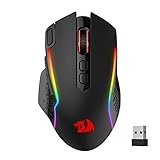
- Wireless for Boundless Winning - Cables truly will affect your detailed battle reaction, Redragon M810 pro wireless gaming mouse with 2.4Ghz nano receiver offers you the purest mouse moving experience and hype your KDA rise again.
- Adjustable DPI to 10000 - Geared with 5 on-board DPI levels (500/1000/2000/3000/10000) which allow your mouse movements to be registered to each pinpoint location. 5 DPI levels are free to DIY with software, for gamers to switch swiftly in game.
- Easy Keybinding with Macro - All 8 programmable buttons are all editable with customizable tactical keybinds in whatever game or work you are engaging. 1 rapid fire + 2 side macro buttons offer you a better gaming and working experience.
- Ultra Long-lasting Core - Equipped with the PAW3325 Optical Pixart sensor, the mouse consumption is further optimized with 1000Hz Polling Rate in dual mode. Rechargeable battery keeps the mouse working up to 45 hours at maximum (eco-mode).
- Adjustable True Color - With Redragon Pro driver, DIY endless style like dynamic streaming, breathing, waving. The game closely linked with various lighting modes makes your room full of competitive vibe.
- Confirm which connection supports the polling rate you want; do not assume Bluetooth offers the same performance as the receiver.
- Check whether a required high-rate receiver or dongle is included or sold separately.
- Consider receiver placement. If your mouse’s vendor gives placement guidance, follow the instructions for that model and setup.
- Look for Bluetooth or wired fallback if you need another way to connect, and check whether wired use is possible while charging.
RTINGS says its buying guide uses a standardized test bench and tools including a USB analyzer to isolate device-side click and sensor latency. Its guide, updated September 29, 2026, explains why measurement method matters when comparing mice: see RTINGS’ mouse testing methodology.
Windows Errors? Fix Them Before They Spread
Repair common Windows errors and clear accumulated junk for a smoother, more stable PC - no reinstall needed.Free scan · no reinstallCrashes, No Sound, or Screen Glitches?
Random freezes, missing sound and display glitches usually trace back to one bad driver. Find and replace yours safely.Free scan · under a minuteRead battery-life claims in context
Battery runtime is a model-specific manufacturer estimate, not a category-wide measure. Polling rate and other settings affect power consumption, so compare runtimes only after checking the connection mode and settings behind each claim. Charging method and whether the mouse remains usable while charging can matter as much as the headline number.
Best Value

- The next-generation optical HERO sensor delivers incredible performance and up to 10x the power efficiency over previous generations, with 400 IPS precision and up to 12,000 DPI sensitivity
- Ultra-fast LIGHTSPEED wireless technology gives you a lag-free gaming experience, delivering incredible responsiveness and reliability with 1 ms report rate for competition-level performance
- G305 wireless mouse boasts an incredible 250 hours of continuous gameplay on just 1 AA battery; switch to Endurance mode via Logitech G HUB software and extend battery life up to 9 months
- Wireless does not have to mean heavy, G305 lightweight mouse provides high maneuverability coming in at only 3.4 oz thanks to efficient lightweight mechanical design and ultra-efficient battery usage
- The durable, compact design with built-in nano receiver storage makes G305 not just a great portable desktop mouse, but also a great laptop travel companion, use with a gaming laptop and play anywhere
For example, MSI specifies up to 80 hours for the VERSA PRO Wireless, which supports 1,000-Hz polling and 2.4-GHz wireless, Bluetooth 5.3, and USB connections; MSI also says it can be used while charging. Razer advertises up to 140 hours for the Basilisk V3 Pro 35K over HyperSpeed Wireless, but says 8,000-Hz operation requires a separately sold Mouse Dock Pro or HyperPolling Wireless Dongle. These claims describe different products and are not based on established identical test conditions, so they do not show that one will last longer than the other in your setup. Check the manufacturers’ pages for current specifications: MSI VERSA PRO Wireless specifications and Razer Basilisk V3 Pro 35K.
Compare candidates with the same checklist
Once you have shortlisted mice that fit your hand, compare the details that affect your setup. Keep the method beside every latency figure: a vendor’s test and an independent device-side measurement may cover different stages.
- Fit: Shell shape and dimensions, tested against your hand size and natural grip; button reach and thumb comfort.
- Handling: Weight, tracking quality, button count, and control layout.
- Responsiveness: Measured click latency and sensor latency, with the measurement method and connection mode identified.
- Connectivity: Supported polling rates for receiver, Bluetooth, and wired modes; included receiver or separately sold dongle; receiver placement guidance.
- Power: Runtime estimate under the mode and settings you expect to use, charging method, and whether the mouse works while charging.
- Practicalities: Fallback connection options and current price in your region.
There is no established universal ideal polling rate, standardized battery-life figure across models, or scientifically preferred grip in the sources cited here. Choose based on the fit and features that meet your needs, then test a higher polling setting against your actual game and computer if the mouse offers one.
Quick Recap
Product prices and availability are accurate as of the date/time indicated and are subject to change. Any price and availability information displayed on Amazon at the time of purchase will apply.

