
iTechGuides is reader-supported. When you buy through links on our site, we may earn an affiliate commission. As an Amazon Associate I earn from qualifying purchases. Learn more
The right steel supplier is the one that can deliver the exact grade, product form, dimensions, properties, documentation and arrival date your design requires—not merely the lowest quoted price. Start with the governing design and product standard, issue every bidder the same written specification, and shortlist suppliers that can provide heat- or batch-traceable mill test certificates (MTCs). Compare itemized landed cost and committed delivery on equal terms, then verify certificates and product markings before shipment. Any alternate grade, standard, thickness or delivery condition needs written approval from the design authority before it is ordered.
This process prevents the most expensive failures: material that cannot be certified, a shipment that arrives too late to support fabrication, hidden processing and freight charges, or a nominally similar grade that is not acceptable for the design.

Use this decision sequence before requesting prices
- Define the application. Identify the governing design or product standard, product form, critical section, loading, environment, fabrication method and required service life.
- Specify the material. State the exact standard edition, grade or quality, thickness or section, dimensions, tolerances, delivery condition, surface condition and any chemistry, mechanical, toughness, weldability or corrosion requirements.
- Define evidence. Require a product-level MTC or inspection certificate, heat or batch traceability, specified inspection level (such as the applicable EN 10204 level), supplementary tests and marking requirements.
- Define logistics. Give quantity, cut sizes, packaging, destination, unloading limits, required arrival date, partial-shipment rules and quote-validity period.
- Qualify the supplier. Check product range, size capability, current certificates, inspection and nonconformance processes, references for comparable work and an escalation contact.
- Compare like with like. Normalize base material, processing, inspection, packaging, freight, duties, taxes, payment terms and delivery date into one landed-cost comparison.
- Release only after verification. Match the MTC to the ordered specification, heat or batch number, product markings and shipping documents before dispatch. Record and approve any change in writing.
Start with the governing standard and product form
Grade selection is not a matter of choosing the largest or strongest number. Suitability depends on the design standard, product form, section or thickness, required mechanical properties, toughness, delivery condition and the way the material will be cut, formed, welded, machined or coated.
Recommended Free Tools
Identify the product form
Tell suppliers whether you need plate, sheet, bar, beam, tube, pipe or another form. A grade designation can cover different product specifications, and the permitted thicknesses, tolerances, test methods and delivery conditions can differ by form. A bar-selection practice, for example, may guide the choice of composition and properties but does not itself constitute a procurement specification. ASTM A400 expressly states, “This is not a specification for the procurement of steel.” Use the applicable product specification on the purchase order.
#1 Best Overall

- 1:35 Scale Diorama Roof Tiles — Each corrugated tile measures approximately 45 x 37 mm (1.77 x 1.46 in), sized for 1:35 scale architecture models, sand table scenes, miniature villages, and factory building layouts
- Realistic Iron Construction — Made from iron for a realistic metal appearance and firm structure; the material gives model sheds and factory buildings an authentic corrugated steel look that plastic alternatives cannot replicate
- 8-Piece Set for Complete Scenes — Includes 8 corrugated tiles, providing enough pieces to roof a full steel shed or detail multiple small structures in one diorama layout
- Assembly Required for DIY Hobbyists — These are unassembled model parts intended for hobbyists who enjoy building and customizing; use small tweezers for placement; suitable for diorama supplies, model train villages, plant landscapes, and pet house miniatures
- Not a Toy — Small iron parts require careful handling; intended for adult miniature enthusiasts, model builders, and diorama hobbyists; check the 1:35 scale and 45 x 37 mm dimensions before ordering to confirm fit with your existing scene
Set the design-property requirements
- Determine the mechanical properties required at the critical section, including strength and any thickness-dependent limits.
- Set toughness or impact requirements when fracture resistance, low-temperature service or dynamic loading matters.
- Specify chemistry limits or weldability requirements needed for the fabrication procedure.
- State delivery condition and surface or internal-soundness requirements when they affect forming, welding, fatigue performance or coating.
- Define dimensions, tolerances and straightness or flatness requirements that the fabricator must receive.
Keep regional systems separate
Confirm whether the project calls for ASTM, EN, JIS, CSA, AS/NZS or another system. Put the exact standard edition and grade on both the request for quotation (RFQ) and the supplier’s certificate. A cross-reference supplied by a salesperson is not automatic equivalence; the design authority must confirm that chemistry, mechanical properties, toughness, dimensions, delivery condition and documentation all remain acceptable.
What ISO 630-2:2021 contributes
ISO 630-2:2021 addresses structural-steel designation, steelmaking and delivery condition, chemical composition, mechanical properties, surface condition, internal soundness, dimensions and tolerances, inspection, sampling, test methods and marking. It includes structural grades such as S235, S275, S355 and S460, with limits that depend on thickness and quality. Quote the complete grade and quality designation rather than only “S355” or another family name.
Build an RFQ that suppliers can quote accurately
Send one identical, written RFQ to every bidder. Ambiguous requests produce non-comparable offers because each supplier makes different assumptions about processing, testing, freight or delivery.
Material and quality fields
- Product form: plate, sheet, bar, beam, tube or other.
- Governing standard and edition, exact grade and quality class.
- Thickness, width, length, section size, cut sizes and dimensional tolerances.
- Required delivery condition, surface condition and processing such as cutting, machining, forming or coating.
- Minimum mechanical properties and any chemistry, toughness, weldability or corrosion requirements.
- Internal-soundness, ultrasonic or other supplementary tests where the specification requires them.
Traceability and inspection fields
- Product-level MTC or inspection certificate for each heat or batch.
- Required EN 10204 inspection level or equivalent contractual inspection requirement.
- Heat or batch number to remain visible on the product and on packing or shipping records.
- Third-party inspection or testing before dispatch for critical or high-value orders.
- Format, language, approval route and delivery date for certificates.
Quantity and logistics fields
- Total quantity, number of pieces, allowable mill-length variation and permitted over- or under-delivery.
- Packaging, corrosion protection, lifting points, unloading equipment and site access constraints.
- Delivery destination, required arrival date, acceptable delivery window and partial-shipment rules.
- Whether the quote is ex-works, delivered, or based on another delivery point; state who carries freight, duties and unloading risk.
- Quote validity period, payment terms, taxes, duties, surcharges and currency.
- Substitution, nonconformance, warranty and change-control terms.
Choose grades by properties, not by the grade number
A higher-looking grade number does not establish that the material is stronger in every relevant way or suitable for your process. Compare the properties required by the design at the actual thickness and product form.
Check the critical section first
Use the critical section and governing load case to determine the required strength and toughness. Then select a composition and delivery condition that the fabricator can process. A grade that meets a room-temperature strength value may still be unsuitable if the design requires impact performance, controlled weldability, a particular surface condition or tight dimensional tolerance.
Separate specification from guidance
Selection guidance, including ASTM A400, helps relate section size and desired properties to a suitable composition. It does not replace the product specification that controls chemical limits, mechanical tests, sampling, marking and acceptance. The purchase order should name that controlling specification and its edition.
Rank #2

- Wide-ranging use: for educational projects, exhibition displays, and personal collections, enriching cultural appreciation and decor style,mini construction building materials,mini roof tiles
- Multipurpose use: suitable for educational purposes, exhibitions, and personal collections, enriching cultural experiences and elevating decor aesthetics,building materials,miniature tile model
- Enhanced visual appeal: realistic corrugated patterns create striking roof effects, bringing your miniature scenes to life with vivid detail,scale model building,model roof tiles
- Lifelike roof texture: corrugated steel design enhances realism, delivering an authentic look for miniature industrial scenes,dollhouse miniature accessories,fake landscape accessories
- Broad application: for educational models, exhibition displays, and collectible setups, adding sophistication to any space,miniature craft supplies,fake model landscape
Record the complete designation
Write the full designation, quality class, thickness range and delivery condition in the RFQ. For structural products covered by ISO 630-2:2021, for example, the grade family, quality and thickness-related limits are all relevant. “Structural steel” alone is not an actionable material requirement.
The Tool Desk
Outbyte Driver Updater FREEScan for outdated or missing drivers - takes under a minuteDriver Scan →Outbyte PC Repair FREEClear out junk files and repair common Windows errorsFree Scan →Verify certifications and mill test certificates
An ISO 9001 quality-system certificate can show that a supplier operates a documented management system, but it does not prove that a particular shipment is the ordered grade. Product acceptance requires a certificate tied to the material itself.
What an acceptable MTC should show
- The applicable product standard and exact grade or quality.
- Heat or batch identifier that can be matched to the physical marking.
- Chemical analysis results and the required mechanical-test results.
- Any specified toughness, internal-soundness or supplementary-test results.
- Dimensions, product form and delivery condition when required by the specification.
- Inspection level, issuing organization, date and authorized approval.
Perform a three-way match
- Compare the certificate’s standard, grade, chemistry, mechanical results, dimensions and tests with the purchase order and governing specification.
- Match the certificate’s heat or batch number to the stencil, tag, label or other permanent product marking.
- Match those identifiers to the packing list, bill of lading and invoice so that documents cannot be detached from the material they describe.
Do this review before dispatch whenever possible. Steel Exchange describes matching certificates to heat numbers and arranging inspection or testing before shipment; a similar control is appropriate when a wrong shipment would stop fabrication or create a safety risk.
Know when to use independent inspection
Arrange third-party inspection before dispatch for a new supplier, a critical application, unusually large quantities or a purchase with severe consequences for nonconformance. Define the inspector’s hold points, sampling plan, tests, marking checks and document review in the order. Inspection does not replace the supplier’s certificate; it provides an independent check that the material and records correspond.
Qualify suppliers on capability and reliability
Ask for evidence rather than relying on a general statement that the supplier “handles steel.” A suitable supplier should demonstrate the following:
- Relevant grades, product forms and sizes in its normal supply range.
- Current quality-system and product certifications required by the contract.
- A traceability process that preserves heat or batch identity through cutting, processing and repacking.
- In-house or arranged inspection capability and a documented nonconformance process.
- References for comparable grades, sizes, industries or project schedules.
- A named commercial and technical escalation contact.
- Stock status, mill allocation or another credible basis for the proposed ship date.
For a new supplier or a critical application, place a trial order or use independent inspection before committing the full volume. Confirm how the supplier handles a failed test, damaged material, certificate discrepancy, shortage and late delivery.
Make delivery a contractual requirement
Ask for current stock status or mill allocation, a committed ship date and a realistic lead-time range. Put the required arrival date—not merely the date the supplier expects to ship—on the RFQ and purchase order. Include destination, packaging, unloading constraints and partial-shipment policy.
Compare the full delivery promise
| Delivery item | Question to ask | Evidence to retain |
|---|---|---|
| Availability | Is the material physically in stock, reserved at a mill, or still subject to production? | Stock statement, allocation reference or production schedule |
| Schedule | What are the committed ship and arrival dates, and what range is realistic? | Written dates and assumptions in the quotation |
| Partial shipment | Are split deliveries allowed, and do they create extra freight or handling charges? | Agreed lot plan and charges |
| Site constraints | Can the carrier meet unloading, access, appointment and lifting requirements? | Delivery instructions and carrier confirmation |
| Condition on arrival | How are corrosion protection, packaging damage and shortages documented? | Receiving inspection and damage-notification procedure |
Purchasers surveyed in a U.S. International Trade Commission publication ranked availability, quality, reliability of supply, product consistency, delivery time and price among their most frequent selection factors. Delivery terms, extension of credit and U.S. transportation costs also affected decisions. The practical lesson is to score reliability and schedule alongside price.
Compare steel quotes on the same landed basis
A quote is comparable only when every bidder prices the same grade, form, dimensions, quantity, processing, destination, schedule and documentation. Require an itemized breakdown rather than a single price per tonne.
Quick wins for a faster PC:
Repair Windows errors before they cause bigger problemsFix Now →Scan for outdated or missing drivers - takes under a minuteDriver Scan →Use an itemized comparison
| Cost component | What to normalize |
|---|---|
| Base material | Same standard, grade, quality, thickness or section and quantity |
| Processing | Cutting, machining, forming, drilling, coating, testing and certificates |
| Packaging | Bundling, protection, labels and special handling |
| Transport | Freight to the same destination, unloading, fuel or access surcharges |
| Import and tax | Duties, brokerage, taxes and currency-conversion costs |
| Inspection | Supplier tests, third-party inspection and travel or witness charges |
| Commercial terms | Payment charges, credit, quote validity and escalation clauses |
Compare landed cost at the same delivery point and for the same required arrival date. A lower ex-works number can become more expensive after freight, duties, cutting, inspection and schedule risk are included. Steel Exchange describes parallel sourcing that compares landed price and lead time while identifying the documentation carried by each route.
Interpret an unusually low bid
Treat a low offer as a prompt for verification, not automatic savings. Ask whether the bidder priced a different grade, thinner or undersized material, looser tolerances, untested stock, a different delivery condition, a longer lead time, a different freight assumption or fewer certificates. Confirm that the quote includes all required processing and that the proposed supply route can maintain heat traceability.
Understand why there is no universal steel price
Price varies with grade, product form, dimensions, volume, market conditions, processing, freight and delivery terms. Noor Deira Steel notes that steel is quoted per enquiry because these variables change; there is no reliable universal current price to use as a benchmark without a defined specification and destination.
Rank #4
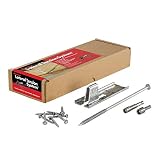
- Material : Steel
- Width : 9-1/4"
- One complete kit to make all four of these code conforming connections
- With the LTS, you can install the fastener first and then add the plate
- Repaces the use of a threaded rod
Request the quote’s validity period and the assumptions behind any mill, alloy, energy, freight or currency surcharge. If your project schedule is long, ask how a price adjustment would be calculated and what event triggers it. Keep the original quotation, revisions and accepted assumptions with the purchase record.
Control substitutions and nonconformance
Never accept a substitute because its name or nominal strength appears similar. ASTM A709 lists structural grades and warns that specified grades—including Grade 50W and high-performance steel (HPS) grades—must not be substituted for other listed grades without agreement.
Required approval path
- Supplier submits the proposed alternate grade, standard, thickness or delivery condition with complete chemistry, mechanical, toughness, fabrication and certification data.
- Engineer or design authority evaluates structural, fatigue, fracture, welding, corrosion and code implications.
- Purchaser confirms commercial, schedule and warranty effects.
- Supplier confirms availability, traceability and the exact certificate that will accompany the material.
- All parties sign the change or issue a revised purchase order before manufacture or shipment.
Record the approved change on the purchase order and in the certificate-review file. If the delivered material does not match the order, quarantine it, preserve its markings and documents, and obtain a written disposition before cutting or installing it.
Independent reader supportYour contribution helps us test, update, and keep practical guides available for everyone.Use a risk-based receiving and release process
Before dispatch
- Approve the supplier’s final specification and itemized quote.
- Review draft MTCs or sample certificates for completeness.
- Confirm inspection hold points, test scope and marking requirements.
- Verify ship date, carrier, packaging and destination instructions.
At receipt
- Count pieces and check dimensions, section sizes, surface condition and visible damage.
- Photograph labels and markings before material is moved or cut.
- Match each heat or batch number to the MTC and packing list.
- Quarantine unidentified, damaged or undocumented material.
- Release material to fabrication only after the technical review is signed.
If a document or marking fails
Stop processing the affected lot. Ask the supplier to correct the document or provide objective evidence linking the lot to the ordered specification. Do not relabel material from memory or combine heats to simplify paperwork. If identity cannot be demonstrated, obtain engineering and contractual disposition before use; testing may be required, but it does not automatically make an unidentified lot acceptable.
A worked RFQ example
Suppose a fabricator needs structural plate for a welded frame. A useful RFQ would identify the governing regional standard and edition, exact grade and quality, thickness and plate dimensions, quantity by cut size, required delivery condition, surface and flatness limits, welding-related chemistry requirements, any impact or supplementary tests, MTC and traceability level, destination, unloading constraints, required arrival date, permitted partial shipments and quote validity. It would request separate lines for plate, cutting, testing, certificates, packaging, freight, taxes and duties.
Each bidder would then answer the same questions: Is the plate in stock or allocated at a mill? What are the committed ship and arrival dates? Which heat numbers will be supplied? What inspection level and tests are included? What happens if a heat fails or a shipment is late? The buyer can compare technical compliance first, then landed cost and schedule risk, instead of choosing a nominal price that hides different assumptions.
Best Value

- Suitable for 1/35 Scale Dioramas Model.
- Model Steel Shed Corrugated Tile 1/35 Scale Sand Table Scenery Layout.
- for DIY Hobby and Fans.
- House model assembly required, Iron Materials Makes the House very Simulation.
- /35 Scale Steel Shed Corrugated Tile Can Match with Your Sand Table Building Scene.
Common mistakes and how to correct them
Choosing by grade number alone
Failure: Selecting a higher-numbered grade without checking thickness limits, toughness, delivery condition or weldability. Correction: Start with the governing design standard and critical-section properties, then name the complete product specification.
Accepting a quality-system certificate as product proof
Failure: Treating ISO 9001 registration as evidence that a shipment is the ordered grade. Correction: Require a product-level MTC and match its heat or batch number to markings and shipping records.
Comparing an ex-works price with a delivered price
Failure: Declaring a winner before adding cutting, inspection, freight, duties, taxes and unloading. Correction: Compare itemized landed cost at one destination and date.
Do these 3 things before closing this tab:
1Fix the driver behind crashes, sound loss and screen glitches2Repair Windows errors before they cause bigger problems3Scan for outdated or missing drivers - takes under a minuteUsing a cross-reference as automatic equivalence
Failure: Replacing an ASTM, EN, JIS, CSA or AS/NZS grade based on a sales table alone. Correction: Obtain written engineering approval after checking all relevant properties, dimensions, delivery condition and documentation.
Leaving delivery language vague
Failure: Accepting “three to four weeks” without defining whether it means mill release, ship date or arrival. Correction: State the destination, required arrival date, acceptable window and partial-shipment rules in the order.
Allowing traceability to disappear during processing
Failure: Cutting or repacking material without transferring the heat number. Correction: Require marking transfer and retain a cut-list or packing record that links every piece to its original heat or batch.
Supplier-selection scorecard
Use a documented scorecard so that a technically compliant, reliable supplier is not displaced by an apparently cheap but incomplete offer.
What’s actually slowing this PC down?
Pick the symptom - the matching free tool is one click away.
| Category | Pass question | Disqualifying evidence |
|---|---|---|
| Technical fit | Can the supplier provide the exact standard, grade, form, size and condition? | Only a different grade, unapproved cross-reference or unspecified tolerances |
| Documentation | Will every heat or batch have a complete, traceable MTC? | Generic certificate, missing identifiers or no document-review process |
| Quality control | Can the supplier arrange required tests and independent inspection? | No defined sampling, inspection or nonconformance response |
| Delivery | Are stock status, ship date and arrival date credible? | Uncommitted schedule or assumptions that conflict with the project |
| Commercial value | Is landed cost complete and valid for the required period? | Unitemized price, hidden surcharges or incomparable delivery basis |
| Risk response | Is there a clear escalation and substitution-approval path? | Supplier reserves unilateral substitution or cannot identify an accountable contact |
Keep the completed scorecard with the RFQ, quote comparison, certificate review and receiving records. It creates an auditable reason for the award and makes the next purchase faster without weakening technical controls.
Quick Recap
Product prices and availability are accurate as of the date/time indicated and are subject to change. Any price and availability information displayed on Amazon at the time of purchase will apply.

