
Choose an ESP32 battery and solar panel from measurements of your complete project—not from a generic ESP32 current figure. Measure energy use across active, wireless, peripheral, and sleep periods; size the battery for the time it must run without sun; then choose a chemistry-compatible solar charger and a panel that can replenish that energy under your installation’s real sunlight conditions.
What size battery and solar panel do you need?
There is no reliable universal battery capacity or panel wattage for an ESP32 project. The answer depends on the exact board and peripherals, firmware duty cycle, wireless schedule, required days of autonomy, installation location, seasonal sunlight, orientation, and shade. Use watt-hours (Wh) to compare energy needs and storage when the ESP32 supply voltage differs from the battery voltage.

Keep two measurements separate: average energy use determines battery capacity and solar harvest, while peak current during startup or radio transmission constrains the battery and voltage regulator. A design can have enough stored energy on paper and still reset if it cannot supply a brief current burst.
How to measure the complete ESP32 project
- Measure the assembled load. Use a current or power analyzer on the device in its final configuration. Include the development board, regulator, charger, LEDs, USB-to-serial circuitry, sensors, pull resistors, and any always-on voltage divider or indicator.
- Record each operating state. Measure boot, computation, sensor operation, Wi-Fi or Bluetooth activity, transmission, and sleep. Capture peak current as well as the time spent in each state.
- Calculate energy over a representative cycle. For a state with roughly steady current, estimate its energy as voltage × current × time. Sum the states over a full cycle, then scale to the expected day or reporting interval. Include always-on loads and conversion losses.
- Repeat under realistic conditions. Include reconnects and retries if they occur in normal operation, and test the final enclosure and installation rather than relying only on a bare-board measurement.
Espressif’s ESP-IDF v5.2 power-consumption example reports 8.14 μA in deep sleep, about 23.88 mA in its demonstrated active measurement, and 6.37 mW for the example’s full cycle. These are measurements for that documented setup, not promises for another ESP32, board, antenna, firmware, or workload. Espressif also notes that development-board circuitry can remain powered during deep sleep and add substantial current.
#1 Best Overall

- Solar-powered : With 5W solar panel built in battery slot.Can accommodate up to 4 18650 batteries.(Not included Battery)
- Easy to install : No chargers, outlets, or hassle, this solar-powered Meshtastic node ensures reliable off-grid communication whenever you need it.
- 360 ° adjustable bracket: The 360 ° rotating bracket ensures the maximum sunlight angle and allows for the installation of solar panels anywhere, fully absorbing sunlight and keeping your solar panels fully charged at all times.
- IP66 Waterproof: The solar panel kit features a surface made of monocrystalline silicon and is IP66 waterproof, rainproof, and snowproof, making it suitable for outdoor use
- Suitable for: IoT enthusiasts who enjoy DIY.
Deep sleep shuts down the digital core and wireless peripherals; waking from it restarts the application. Include boot and network-reconnection energy in the cycle. A device that must stay connected or respond quickly may need a different radio and sleep schedule from a sensor that wakes briefly to report.
How to size the battery for no-sun autonomy
First decide how long the project must keep running through poor or absent sunlight. Convert the measured daily load into energy, then multiply by the required autonomy. The battery’s rated capacity is not necessarily all usable: respect the cell maker’s discharge limits and account for temperature, aging, regulator efficiency, and an appropriate reserve.
Rank #2
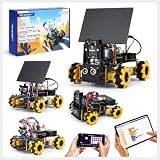
- ACEBOTT Smart Camera Solar Robot Car Kit: An educational kit for STEM beginners (kids) based on ESP32, built with omnidirectional Mecanum wheels, using high-quality metal gear servos, equipped with HD cameras, solar panels and ultrasonic infrared sensors, and programmed with Arduino, designed to help them learn how to build and program a fully functional robot, improve logical thinking and electromechanical skills, suitable for experimental projects or school training for teenagers and adults.
- Solar Science Fun: This smart robot building kit is equipped with a solar panel to support solar energy to charge the battery (Note: The kit does not include batteries, thank you for your understanding). Children explore renewable energy and energy-saving solutions by building a smart car powered by solar energy! At the same time, solar energy can be converted into battery capacity to achieve long-term endurance of the car and reduce the frequency of your charging.
- HD Video Real-time Transmission: This camera robot car is equipped with a high-definition camera, which can achieve real-time HD video transmission and real-time FPV experience through the WiFi hotspot of the ESP32 development board, allowing you to watch videos in real time on your smartphone. (Note: This kit does not contain batteries, please understand.)
- All-round control: The Robot Car Kit is equipped with advanced 6cm omnidirectional Mecanum wheels (omnidirectional wheels or lion wheels), which can easily achieve 360° movement in any direction, support multiple movement modes (forward, sideways, diagonal, rotation), and can complete difficult actions such as left and right drifting, and easily cross any position, including narrow bends, narrow alleys, and intricate roads. Built-in Wi-Fi and Bluetooth, enabling web page and APP control.
- Intelligent Perception: Accurate multi-way cruise allows the cart to easily plan the path and realize autonomous navigation; multi-direction ultrasonic obstacle avoidance allows flexible response in the face of obstacles; the new follow mode allows the car to always follow your steps. Allows children to control this car through the IR remote control and App, make you enjoy the fun and convenience of intelligent technology. Simply master all the actions of the car with just one touch.
When the load and battery operate at different voltages, compare them in watt-hours rather than comparing milliamp-hours alone. A nominal capacity in mAh is tied to the battery’s voltage; it does not directly state how much energy is available at a regulated 3.3 V output.
- Usable energy: capacity available at the project’s discharge rate and expected temperature.
- Discharge capability: maximum continuous and peak current, with sufficient margin for startup and wireless bursts.
- Voltage range: nominal, full, and depleted voltage across the number of cells in series.
- Protection and environment: overcharge, overdischarge, and overcurrent protection where required, plus operating and charging temperature limits, cycle life, size, and enclosure needs.
How to choose the battery and charger together
Match the charger to the battery chemistry and series-cell count. Verify the charge voltage and profile, permitted charge current, temperature provisions, and protection requirements; “lithium” alone is not a sufficient compatibility check. The charger must also support the panel’s input voltage and current, with behavior suited to a variable solar source.
Recommended Free Tools
Rank #3

- Complete Outdoor Meshtastic Solution: Specifically designed for the ESP32 LoRa V4 (with L76K GNSS module and OLED display), this 5W solar enclosure offers a ready-to-deploy, weatherproof solution for your long-range wireless projects
- Solar Power with High Efficiency: Featuring a 24.3% high-efficiency monocrystalline solar panel, this kit continuously harvests energy to provide a stable 3.7V/5W output, significantly extending your device's runtime
- Extreme Weather Proof: Built with a rugged IP67 waterproof enclosure and tempered glass face, this kit is fearless of extreme weather. It can protects your sensitive LoRa V4 development baord from rain, dust, and harsh outdoor conditions, ensuring long-term stability for agricultural monitoring or disaster relief scenarios
- Strong Signal: Equipped with a dedicated 915MHz single LoRa antenna, optimizing signal strength and range for both LoRa meshtastic communication and device configuration. This professional setup enhances the performance of your Meshtastic repeater or node
- Flexible Battery System: Supports a flexible 1-4 x 18650 battery configuration (batteries not included), allowing you to customize capacity for days of extra-long battery life. Combined with Type-C charging backup, it offers unparalleled power flexibility for ESP32 LoRa development board, and other Meshcore devices
Solar-capable charger examples illustrate why the exact part matters. Texas Instruments documents the BQ25798 as a buck-boost charger for one to four cells with solar input/MPPT and power-path features; its product documentation lists up to 5 A charging. The BQ25185 supports one cell, solar-input and power-path features, and up to 1 A charging. These are chip capabilities, not recommendations for an unspecified project; consult the datasheet and the details of the implemented module before selecting one.
For a solar-powered design, check input-voltage limits, MPPT or input-voltage regulation behavior, charge-current setting, thermal handling, battery-temperature monitoring, power-path operation, and reverse-current behavior. Analog Devices describes the LT8491 as a solar-capable buck-boost charger with automatic MPPT. Features such as these help manage a changing panel supply, but they do not determine the required panel size for your load and site.
Rank #4

- 🏞️【Compact 5V Solar Power for DIY Projects】This 5-pack of 1W 5V 200mA mini solar panels helps power small lights, toys, STEM models, and low-current electronics in direct sunlight.
- 🏞️【Ready-to-Connect Wire Clip Design】Included wire clips make it easier to attach the panels to simple circuits for testing, classroom builds, or quick DIY setups without soldering.
- 🏞️【Small Size for Flexible Builds】Each 89.5 x 89.5 mm small solar panel fits compact crafts, garden light repairs, model cars, and project boxes where space is limited.
- 🏞️【Built for Low-Power Solar Experiments】These solar cells are suitable for learning series or parallel layouts, comparing output, and building simple 5V solar panel projects.
- 🏞️【Match Before You Connect】Designed for low-current devices, each 1W solar panel should be used with the proper circuit, polarity, and sunlight conditions for better project results.
How big a solar panel do you need?
Size the panel to provide enough energy during the low-sun period that matters for the installation, not just by its nominal peak-watt rating. Estimate realistic daily harvest after accounting for season, weather, orientation, shade, mounting, and electrical conversion and charging losses. If harvest does not exceed the project’s energy use over the relevant period, the battery will gradually run down.
- Compare the panel’s operating voltage and current with the charger’s input range and MPPT or input-regulation range.
- Check the panel’s open-circuit voltage against the charger’s maximum input limit.
- Allow for power lost in conversion and charging; nominal panel watts are not delivered battery watt-hours.
- Consider the site’s shading exposure, available mounting area, orientation, and outdoor durability.
Do not connect a panel directly to a rechargeable battery without a suitable charge controller configured for that battery chemistry. A generic USB charger is not necessarily solar-aware: verify both its input behavior with a variable panel and its battery charge profile.
How to power the ESP32 reliably from the battery
Espressif’s ESP32 hardware design guidance recommends a 3.3 V single supply with output-current capability of at least 500 mA. This is a supply-design recommendation for the ESP32 circuit, not a statement that every application continuously draws 500 mA and not a battery-capacity target. The input connector on a development board may require a different voltage; follow the documentation for the exact board rather than applying 3.3 V to an arbitrary input.
Check the battery’s full-to-depleted voltage range against the regulator and the board’s permitted supply input. The regulator must maintain the required voltage while handling transient current, and its own quiescent draw should be included in the energy budget. Test the device at low battery and during radio bursts, including when the load and charger operate at the same time.
Quick Recap
Final design checks
- Measure the complete build and its real duty cycle; do not use an example chip or module sleep current as the system budget.
- Confirm peak load current against both the battery’s discharge rating and the regulator’s transient capability.
- Set the desired no-sun autonomy before choosing battery capacity.
- Verify battery chemistry, cell count, charge profile, temperature limits, and protection with the actual charger implementation.
- Confirm panel voltage/current compatibility and realistic low-season energy yield at the installation site.
- Test weak or changing sun, low battery, radio activity, and simultaneous charging and operation in the final enclosure and position.
Product prices and availability are accurate as of the date/time indicated and are subject to change. Any price and availability information displayed on Amazon at the time of purchase will apply.

