
Recommended Free Tools
iTechGuides is reader-supported. When you buy through links on our site, we may earn an affiliate commission. As an Amazon Associate I earn from qualifying purchases. Learn more
To find a contradiction between meeting notes and a project brief, first confirm which brief is approved, then compare statements about the same issue under the same conditions. Verify any apparent conflict against source records and the project’s approval process before changing the brief. A text-comparison tool can reveal wording differences, but it cannot decide which statement is authoritative.
Set the authoritative records before comparing them
Use the project’s currently approved brief as the baseline—not the oldest proposal, the newest file, or a draft that has not been signed off. A brief records the agreed scope, objectives, constraints, responsibilities, and decision-making basis; a project plan typically develops that scope into tasks, owners, and dates. See Microsoft’s project-brief guidance.

For both the brief and the meeting record, note the title, date, version, approval status, and repository location. For meeting records, also note the meeting date, author, and decision participants when available, and whether the record is informal notes, draft minutes, or approved minutes. Informal notes and formal approved minutes do not necessarily carry the same weight; record decisions and actions neutrally. Microsoft describes this distinction in its meeting-notes guidance.
Quick wins for a faster PC:
Repair Windows errors before they cause bigger problemsFix Now →Scan for outdated or missing drivers - takes under a minuteDriver Scan →Version history can help establish who changed a file and when. SharePoint and OneDrive version history provides access to earlier versions and change details; it is useful provenance, not proof that a particular version was approved. Consult Microsoft’s version-history instructions.
#1 Best Overall

- Confidently track and manage large jobs with ease
- Project ruling provides instant organization for notes, plans & deadlines
- Premium-weight paper is perforated to detach easily
- Snag-resistant coil and extra-strong back are perfect for notes on the go
- Gray, navy or maroon cover, 7-1/4" x 9-1/2", 84 sheets
Compare the same claims in context
Make one row for each issue that could affect delivery. Preserve the brief’s and notes’ original wording, or a short faithful excerpt, so reviewers can see exactly what differs. Compare each statement under the same audience, phase, route, and other relevant conditions.
| Topic | Approved brief | Meeting note | Source, date, version | Same conditions? | Difference type | Evidence or question | Owner and status |
|---|---|---|---|---|---|---|---|
| Scope or deliverable | Exact statement or excerpt | Exact statement or excerpt | Identify both records | Yes / no / unclear | Classify after review | What confirms the commitment? | Who will resolve it? |
| Dates, budget, or owner | Exact statement or excerpt | Exact statement or excerpt | Identify both records | Yes / no / unclear | Classify after review | Check source records | Who will resolve it? |
Check scope, deliverables, exclusions, milestones, dates, budget, named owners, approval status, dependencies, assumptions, risks, and constraints. For example, “collect a phone number for every booking” conflicts with “email-only booking” only if both statements apply to the same booking flow. A note about a separate route or later phase may be an exception, not a contradiction.
Rank #2
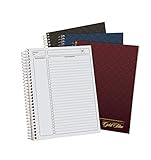
- 9-1/2 x 7-1/4
- Assorted Covers in Navy, Gray, Maroon
- Planner Ruled
- Designer Gold Fibre Series Planner Notebook. 84 Pages.
- INCLUDES 3 NOTEBOOKS: Each pack includes 3 notebooks that can be any combination of the three colors we offer: Navy, Gray, or Maroon; Your order may include 3 of the same color
Trace important claims back to source material and ensure summaries retain the source’s meaning. Microsoft’s decision-brief guidance recommends checking dates, numbers, budgets, owners, approvals, and scope boundaries, and resolving ambiguous or conflicting details before sharing.
Free tools Windows power users keep installed
One-click scans. No signup required.
Classify what the difference actually means
These working labels help teams avoid treating every mismatch as a conflict. They are practical categories, not a formal standard.
Rank #3

- TURN YOUR IDEAS INTO REALITY: Unleash your creativity with this unique planning notebook, consisting of 224 pages divided into 112 Project Planner sheets. Each sheet is designed to step-by-step completion and management of your project.
- EMPOWER YOUR MANAGEMENT: This professional project organizer keeps all project-related information in one place. Stay on top of multiple projects with the convenient project tracker notebook feature, ensuring no detail is missed.
- ARCHIVE YOUR PROJECT GOALS: Stay focused on your projects with dedicated sections for objectives, tasks with deadline, essential supplies and tools notes, space for ideas and sketches illustration, and notes. Experience a simple yet powerful tool to ensure completion and accomplish more with ease.
- EFFICIENT BONUS STATIONARIES: You will receive either set of a ball pen and two cute sticky notes or a set of remind stick pads (randomly). The versatile design can be used for projects at home, work, school, or business to organize, manage a team, and to delegate tasks. This planner is a simple way to make sure you finish what you start and accomplish more.
- HANDLE SINGLE PROJECT IN HAND: Designed with tearable sheets allow you taking any single sheet for more convenient. 7x10 inch sheets are printed on 70 lb premium paper. With advanced printing technology and leather cover, our planner exudes a premium feel and long lasting.
- Direct conflict: Two records make incompatible commitments for the same situation.
- Conditional exception: The statements differ because one applies only to a specified audience, condition, phase, or route. Write down the condition.
- Missing detail: One record is silent. Silence does not, by itself, cancel a stated requirement.
- Proposed change: The notes capture a suggestion or discussion, but there is no evidence it was approved. Keep it pending.
- Superseded decision: A later authorized decision replaces an earlier one. Retain the earlier record and link the replacement.
Use document comparison to spot wording changes
For two Word files, Microsoft documents this path: Review > Compare > Compare Documents. Word creates a new comparison copy with revision marks and leaves the original documents unchanged. Microsoft’s page says, “You can compare two versions of a document to see how they differ.” Its applicability section names Word 2019 for Mac, so check the current interface for your platform and version: Compare and merge two versions of a document.
Comparison marks reveal textual differences, not approval status, intent, or which document controls. Use them to locate changed wording, then check provenance, conditions, and decision evidence. Version history can add change dates and authorship; neither feature determines project authority on its own.
Rank #4

- Sold Individually as 3 Each
- Numbered spaces with heading and action columns
- Microperforation, 84 White Sheets
- Sheet Size: 9-1/2"x7-1/4"
- Dark Green Cover
Verify conflicts and get the right decision
- Trace the statement. Find the source behind the note or brief entry. Check dates, numbers, budget, owner, approval, scope boundaries, and stated assumptions.
- Confirm authority. Follow the project’s own governance and approval path. The correct approver depends on the organization and project; generic documentation cannot identify that person for you.
- Keep unconfirmed claims open. Do not turn a suggestion into approved scope by rewriting it as a firm commitment. If the evidence does not resolve the issue, state what remains unknown and ask the authorized decision-maker.
- Record the outcome. Capture the decision, supporting evidence, rationale, owner, date, status, and affected brief or meeting record. If unresolved, name the decision owner and set a follow-up date.
Microsoft’s guidance for architecture decision records recommends documenting context, options, outcome, trade-offs, status, and rationale. When a decision changes, create a linked record that supersedes the earlier one rather than silently overwriting history. Update the controlled brief only after approval, retain its prior version, and tell affected people which changes are confirmed and which questions remain open.
What’s actually slowing this PC down?
Pick the symptom - the matching free tool is one click away.
When two interpretations remain plausible
Lay out the evidence for each interpretation, the conditions under which it applies, and the delivery consequence of accepting it. Identify the authority needed to decide instead of choosing based on which record is newer. For tools, choose according to the actual need: side-by-side text comparison, revision marks, version history with author and time, approvals or comments, and access controls. The documented Word and SharePoint/OneDrive features above illustrate specific capabilities; they do not establish a cross-platform feature or price comparison.
Quick Recap
Best Value
Product prices and availability are accurate as of the date/time indicated and are subject to change. Any price and availability information displayed on Amazon at the time of purchase will apply.

