
Outdated Drivers Are Slowing You Down
One free scan finds every outdated or missing driver and matches the right update for your exact hardware.Free scan · exact hardware matchPC Slower Than It Used to Be?
A free scan shows the junk files, broken settings and background clutter dragging Windows down - then fixes them in one click.Free scan · Windows 10 & 11An ESP32 can coordinate fountain pulses and other water-flow patterns, but it cannot power a pump directly. The board generates control signals; a suitably rated driver switches power to a separately selected pump. The pump, driver, supply, plumbing and fountain geometry must be matched before you can predict flow or jet height.
How the fountain control system works
The basic arrangement separates control from power: an ESP32 development board runs the timing logic, its GPIO or PWM outputs signal a compatible pump driver, and the driver switches power from an appropriately sized supply to the pump. The pump moves water from a reservoir through an outlet, with the water returning to the reservoir. This is a conceptual architecture, not a wiring diagram.
Espressif documents the ESP32-DevKitC board and its GPIO functions in the ESP32-DevKitC User Guide. Its ESP32 datasheet describes LEDC as a PWM controller and identifies motor-control PWM separately. Neither makes a GPIO pin a suitable pump power source: the pump is a separate electrical load, so choose an interface and supply for the pump’s requirements.
Choose a control method
Timed on/off sequences
For a simple animation, program one or more pump outputs to switch on and off at timed intervals. Staggered starts or pulses can produce changing patterns without assuming the pump supports speed control. The effect depends on the pump, plumbing and outlet; timing alone does not specify a particular jet shape.
#1 Best Overall

- Powerful ESP-32 Board: Unlock the world of Internet of Things (IoT) and advanced electronics with the heart of this kit: the ESP-32 board. It features a powerful dual-core processor, integrated Wi-Fi and Bluetooth 4.2, making it perfect for building connected, smart devices that communicate with your phone or the cloud. It's fully compatible with the Arduino IDE for easy programming.
- Super Starter Kit: This kit contains over 35 different modules and electronic components, including sensors, displays, motors, and input devices. From LEDs and buttons to an OLED screen, servo motor, and keypad, you have everything needed to explore a vast range of projects in one box.
- Step by Step Online Tutorial: Jump right in with our detailed, beginner-friendly tutorial. Access 30+ projects with complete code, clear circuit diagrams, and step-by-step instructions. Learn the fundamentals of electronics, coding, and how to utilize the ESP-32's unique capabilities without any prior experience.
- Hands-on Learning for All Skill Levels: Perfect for students, makers, engineers, and hobbyists. Start with basic circuits and coding, then progress to intermediate and advanced IoT applications. Build practical projects like weather stations, smart home controllers, remote-controlled devices, and interactive gadgets. The skills you learn are the foundation for real-world innovation.
- Quality & Great Support: Elegoo is committed to quality. We provide a clear, detailed tutorial guide, refined code, and a well-organized component kit. All modules are carefully selected for reliability and ease of use. Our dedicated technical support team and active online community are ready to help you succeed in your learning journey.
PWM control
The ESP32’s LEDC peripheral generates PWM signals. Espressif’s ESP-IDF v4.2 LEDC guide describes PWM generation, including duty-cycle changes, for uses beyond its primary LED-intensity application. That versioned guide is useful for understanding the peripheral; consult current ESP-IDF documentation for API details.
PWM is a possible control signal, not a guarantee of smooth pump-speed adjustment. Confirm that the particular pump and driver support the intended control method. Duty cycle does not establish a linear relationship with water flow or jet height; the cited documentation does not validate such a relationship for fountain pumps. Espressif’s PWM tutorial, published 3 August 2026, discusses LEDC and MCPWM and their different intended capabilities.
Rank #2

- Perfect choice for beginners to learn, electronics and program.
- The Basic Starter Kit is easy to use and you can learn to program at an introductory level.
- You can use ESP32 modules to control other modules, such as LED,DHT11,OLED module, etc
- The tutorial include codes and lessons.It will teach every users how to assembly Basic Starter Kit for ESP32.
- Please download our tutorial and learn after you receive the goods.
Select the pump driver and power supply
A driver must be chosen for the actual pump rather than selected by name alone. Examples illustrate different approaches: SunFounder’s ESP32 “Pumping” lesson uses an L293D motor driver, while a University of Illinois Urbana-Champaign ECE 445 water-pump MOSFET design verification document describes an N-channel MOSFET as a low-side switch. These are examples, not interchangeable recommendations.
- Check the pump’s specified voltage and current, then verify the driver’s ratings and any motor-related protection against those requirements.
- Choose a power supply appropriate for the pump and driver. The ESP32 board’s control output is not the pump supply.
- Confirm whether the pump permits PWM speed control or is intended for on/off switching; do not infer compatibility from the fact that a driver can switch a load.
Size the hydraulic side before buying a pump
A pump cannot be recommended from the topic alone. Its suitability depends on the desired jet height and flow, nozzle, plumbing losses and available supply. Compare a candidate pump’s published flow and head specifications with the intended operating point; a maximum-head figure by itself does not establish the flow available at the nozzle. The sources cited here do not specify a target fountain geometry, tested pump, measured jet height or flow rate, so no universal pump model or performance figure can be claimed.
Free tools Windows power users keep installed
One-click scans. No signup required.
Rank #3

- ESP32-S3 camera board: Dual-core 32-bit microprocessor up to 240 MHz, 8 MB flash, 8 MB PSRAM, onboard 2.4 GHz Wi-Fi and Bluetooth 5 (LE), USB-OTG, USB code uploader, camera, memory card slot (Comes with 1GB memory card and card reader)
- 3 sets of code: MicroPython, C and Processing (Java). Python is one of the most popular languages, and C is one of the most classic languages. Processing code needs to run on computers to provide graphical interfaces
- Detailed tutorial: Can be downloaded (in English, 828-page in total) or viewed online (original in English, can be translated into other languages by browsers) (The tutorial link can be found on the product box, no paper tutorial)
- 121 projects from simple to complex: Provides step-by-step guide with electronics and components knowledge, each project has schematics, wiring diagrams, complete code and detailed explanations
- 243 items in total: This ultimate kit includes the most commonly used electronic components, modules, sensors, wires and other compatible items
For a practical parts plan, start with an ESP32 development board such as the ESP32-DevKitC, a small submersible water pump selected for the actual reservoir and outlet, and a compatible pump motor driver. Keep the exact pump and driver open until their specifications can be checked against each other and the fountain’s requirements.
Plan for multiple streams carefully
Separate pumps can make distinct streams easier to sequence, but each adds electrical and hydraulic requirements: driver capacity, supply capacity, wiring, plumbing and control outputs all need to be considered. One author-reported project describes 24 mini pumps controlled through WLED, a custom usermod and an ESP32 in an animated wooden fountain project. That is an individual example, not a validated recipe or a standard pump count.
Rank #4
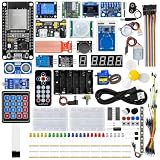
- All-in-one STEM Learning Kit: This complete starter kit is designed for beginners, students, and makers, containing a variety of electronic modules and sensors to help you learn programming, electronics, robotics, and IoT projects step-by-step.
- Includes introductory tutorials: The kit includes detailed tutorials, wiring diagrams, sample code, and project courses to help users quickly get started with open-source platforms and ESP32 development. Ideal for self-study, school courses, and STEM education.
- Learn Wi-Fi IoT Development: Unlike traditional introductory kits, this learning kit fully utilizes the powerful Wi-Fi capabilities of the ESP32 microcontroller. Users can build real-world web-based control systems and monitor sensor data in real-time via a browser on a smartphone, tablet, or computer. Through progressive projects, users will learn how to: create web control interfaces, remotely control LEDs, motors, and other modules to display real-time sensor data online, build smart home prototypes, and understand the fundamentals of IoT communication.
- Rich Components and Smart Modules: Includes a variety of commonly used modules, such as: ultrasonic sensors, RFID modules, servo motors, MPU6050 angle sensors, OLED displays, temperature and humidity sensors, PIR motion sensors, and dozens of other sensors, allowing users to build dozens of creative DIY projects out of the box.
- Main Functions and Projects: This kit allows users to create a variety of interactive projects, including over twenty different types: RFID smart access control systems, servo motor control, real-time environmental temperature and humidity monitoring, MPU6050 sensor 3D real-time animation, a Snake game, motion detection alarm systems, smart home systems, IoT wireless projects, and more.
Keep electronics away from water
Place the controller, driver and power equipment outside splash and leak paths, and use an appropriately rated power supply and load driver. SunFounder’s pump lesson explicitly warns users to keep the circuit away from water. The sources do not establish an enclosure rating, grounding or isolation design, residual-current protection, or local code requirements; this guidance is not a substitute for applicable electrical-safety requirements. Do not treat a generic enclosure or mains-wiring arrangement as certified.
Quick Recap
Best Value

- ESP32 camera board: Dual-core 32-bit microprocessor up to 240 MHz, 4 MB flash, 8 MB PSRAM, onboard 2.4 GHz Wi-Fi and Bluetooth 4.2 (LE), USB code uploader, camera, memory card slot (Comes with 1GB memory card and card reader)
- 3 sets of code: MicroPython, C and Processing (Java). Python is one of the most popular languages, and C is one of the most classic languages. Processing code needs to run on computers to provide graphical interfaces
- Detailed tutorial: Can be downloaded (in English, 795-page in total) or viewed online (original in English, can be translated into other languages by browsers) (The tutorial link can be found on the product box, no paper tutorial)
- 122 projects from simple to complex: Provides step-by-step guide with electronics and components knowledge, each project has schematics, wiring diagrams, complete code and detailed explanations
- 240 items in total: This ultimate kit includes the most commonly used electronic components, modules, sensors, wires and other compatible items
What to settle before committing to a build
- Reservoir dimensions, outlet or nozzle, desired flow pattern and target jet height.
- The candidate pump’s voltage, current, flow and head specifications, and whether it is suitable for submersion and the intended duty.
- A driver whose ratings and control method suit that pump, plus a supply designed for the combined load.
- How the electronics will remain physically separated from water, splashes and possible leaks.
Product prices and availability are accurate as of the date/time indicated and are subject to change. Any price and availability information displayed on Amazon at the time of purchase will apply.
The Tool Desk
Outbyte Driver Updater FREEFix the driver behind crashes, sound loss and screen glitchesFind Drivers →Outbyte PC Repair FREEClear out junk files and repair common Windows errorsFree Scan →
