
What’s actually slowing this PC down?
Pick the symptom - the matching free tool is one click away.
A DIY milliohmmeter measures small resistances by driving a known current through the part and measuring the voltage drop: R = V/I. For useful readings in the milliohm range, use separate current and voltage-sense connections (a four-wire Kelvin setup), then account for offset, test-current accuracy, and heating. Two documented approaches are an AD8210-based front end used with an ADALM platform, or a battery-powered current-source adapter used with a digital multimeter.
How a milliohmmeter measures resistance
At low resistance, an ordinary two-wire multimeter can include the resistance of its leads and contact points in the reading. A milliohmmeter instead sends a known test current through the device under test (DUT) and measures the resulting voltage. Divide the measured voltage by the actual current to calculate resistance.
For example, a 100 mA test current through a 10 mΩ part produces a 1 mV drop. That small signal is why the measurement circuit, probe placement, and electrical offsets matter. Common uses include checking cables, connectors, PCB traces, power inductors, switches, and relay contacts.
Choose a build approach
| Approach | What it uses | Published figures and qualifications | Best fit |
|---|---|---|---|
| AD8210-based front end | An AD8210 current-shunt monitor used as a differential-to-single-ended amplifier, plus an ADALM1000 or ADALM2000 platform for source and measurement functions. | The Analog Devices tutorial, approved 2022-02-07, uses gain 20 and the relationship RDUT = VOUT / (ITEST × 20). With its stated ADALM1000 and 0–5 V ADC assumptions, it estimates about 0.3 mΩ resolution at 150 mA and a maximum practical resistance near 1.667 Ω at that current; it gives about 50 Ω as the largest practical resistance at 5 mA. These are tutorial-specific estimates, not general performance guarantees. The tutorial lists AD8210 gain accuracy as ±0.5% maximum. | A reader who wants a programmable platform and software-based measurement, and can calibrate the circuit. |
| Battery-powered current-source adapter | A selectable constant-current adapter used with a DVM. | The Analog Devices design note specifies selectable 1 A, 100 mA, and 10 mA test-current ranges and says the illustrated circuit is about ±2% accurate. The stated accuracy depends on the DVM, op-amp input offset, and resistor tolerances; the source says component adjustments are needed for better accuracy. The page does not expose a publication year. | A reader who already has a DVM and wants a comparatively direct adapter approach. |
The ADALM1000 tutorial describes a practical setup range of roughly 5 mA to 150 mA or somewhat higher, although it notes the platform can source from −200 mA to +200 mA in principle. The ADALM2000 lacks the ADALM1000’s high-current drive and current-measurement capabilities; the tutorial describes finding actual current by measuring the voltage across a known series resistor. Choose the platform and current range based on the resistance and signal level you need, not on a figure quoted without its setup assumptions.
#1 Best Overall

- 4-wire low resistance measurement with 0.1mOhm resolution for precise testing.
- Digital milliohm meter suitable for measuring contact resistance and wire resistance.
- Battery powered with portable design for field and laboratory use.
- Multiple measurement ranges from 0.1mOhm to 20kOhm for versatile applications.
- Includes test leads and power adapter for immediate use out of the box.
Build the measurement connection as four-wire Kelvin
In a two-wire connection, the same leads carry current and measure voltage. Their resistance and the resistance of their contacts therefore contribute to the result. A four-wire connection separates those jobs: an outer pair of force leads carries test current, while a separate, high-impedance pair senses voltage across the DUT.
- Connect the force leads. Attach one force lead to each end of the DUT to carry the test current.
- Place the sense contacts inside the force contacts. Connect each sense lead on the DUT side of its corresponding force contact, close to the boundaries of the section being measured.
- Keep placement consistent. The sense contacts define what counts as part of the DUT. Use the same points each time when comparing readings.
- Check the current path. Make sure the source has sufficient compliance voltage for the DUT and force leads; otherwise it may not deliver the intended current.
Tektronix/Keithley’s application note, “Measuring Low Resistance Devices with High Current Using the Model 2460 SourceMeter SMU Instrument,” gives 1–10 mΩ as a typical lead-resistance range in its discussion and explains why lead resistance can undermine two-wire measurements. That range is an illustrative figure from the note, not a specification for every lead set. The note says, “Due to the limitations of the two-wire method, the four-wire (Kelvin) connection method shown in Figure 4 is generally preferred for low resistance measurements.”
Rank #2
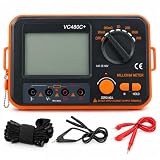
- 【HIGH‑ACCURACY 4‑WIRE KELVIN TEST】 Equipped with advanced 4‑wire Kelvin test technology, the VC480C digital milliohm meter delivers precise low‑resistance testing starting from 0.01mΩ with ±0.5% reading accuracy. It works great for lithium‑battery internal resistance measurement, motor winding resistance verification, PCB trace testing, cable resistance inspection and micro‑ohm analysis for industrial laboratory applications.
- 【RELIABLE PROTECTION & STEADY READINGS】 Built‑in full circuit protection together with advanced anti‑magnetic and anti‑electromagnetic interference (EMI) technology ensures stable and accurate measurement even under harsh industrial conditions. Suitable for production‑line quality control, electrical equipment maintenance, cabinet‑based device inspection and routine resistance verification on workshop‑based jobs.
- 【LARGE BACKLIT LCD DISPLAY】 This milliohm meter adopts a large backlit LCD screen with distinct test symbols and high‑contrast resistance readouts. The user‑friendly interface supports fast low‑resistance measurement, which simplifies on‑site data logging and analysis for electronics repair workshops and technical testing work.
- 【COMPACT & PORTABLE DESIGN】 Featuring a compact 75 × 52 mm lightweight body, the 4‑wire Kelvin digital milliohm meter is easy to transport for on‑site troubleshooting. The matched wrist strap offers secure handling during outdoor field inspections and on‑site commissioning of electrical machinery.
- 【VERSATILE POWER OPTIONS】 Powered by 6 AA batteries or an external 9V DC power adapter (adapter NOT included). Low‑power consumption plus integrated battery‑level indicator supports long‑hour continuous measurement. Perfect for mobile service work, automotive electrical repair shops and prolonged diagnostic testing sessions.
Separate force and sense conductors are the essential feature; special Kelvin clips, four-wire probes, or SMD tweezers can make contact easier. The Analog Devices tutorial also shows mini-grabber clips. Regardless of connector style, the sense contact must be electrically inside the current contact.
Set the test current without overheating the DUT
Higher current creates a larger voltage drop, which can make a small resistance easier to resolve. But it also increases power dissipated in the DUT according to P = I²R. Excess current can heat a resistor or conductor, change its resistance during the reading, or alter a contact being tested.
The Tool Desk
Outbyte Driver Updater FREEFix the driver behind crashes, sound loss and screen glitchesFind Drivers →Outbyte PC Repair FREEClear out junk files and repair common Windows errorsFree Scan →Rank #3

- Using the four‑wire measurement method, it can measure very low while maintaining
- Full function, strong anti‑magnetic and anti‑interference ability, to ensure the accuracy of measurement results.
- Large‑screen LCD display with clear handwriting makes it easier to measure and record data.
- Function display, detailed data display, convenient and simple
- Small size, portable and light weight, it can be easily handheld to measure in various situations.
- Start with a current that produces a voltage the measurement circuit can resolve.
- Use the lowest current that provides a sufficient signal, as recommended in the Tektronix/Keithley guidance.
- For a DUT that may heat during measurement, consider whether a brief pulse is more suitable than continuous current.
- Verify that the source can maintain the selected current through the DUT and its leads.
Keysight’s measurement guidance also identifies signal size, self-heating, zeroing and thermal EMF, and synchronization between source and measurement as considerations in precise low-resistance work. The right current depends on the DUT and the limits of the particular circuit; the ADALM1000 and adapter figures above should not be treated as universal settings.
Reduce offset and thermal EMF errors
The voltage being measured may be small enough that amplifier offset and thermoelectric voltage are significant compared with the DUT’s own drop. Thermal EMF can arise at junctions between dissimilar conductors when those junctions are at different temperatures, creating microvolt-scale errors.
Rank #4

- Using the four line measurement method to make the measurement data more accurate and convenient. This DC low resistance tester can measure resistance from 1μΩ~300kΩ, Resistance accuracy: 0.1%; Minimum resolution 1μΩ.
- This milliohm meter features a large LCD display and a backlight function that can be freely opened and closed. Turning on the backlight in low light or dark environments can provide clear visibility, while turning off the backlight can achieve energy savings, balancing adaptability to usage scenarios and environmental protection requirements.
- Data storage: Supports up to 99 sets of measurement data storage, without real-time recording, making it convenient to trace historical data.
- Intelligent numerical judgment: can preset comparison values, automatically compare and judge measurement results, and quickly screen qualified/unqualified data.
- Designed specifically for professionals, this micro-ohmmeter covers a wide range of resistance measurement scenarios — it can accurately measure cable conductor resistance, switch/relay contact resistance, winding resistance of coils, motors and transformers, resistance between metal riveted parts and components, as well as conductor resistance of connections between ground grids and ground electrodes. It not only fulfills cable performance testing requirements but also ensures the reliability of electrical connections, fully meeting the needs of professional use.
Zero the measurement
The AD8210 tutorial first sets the source to high impedance to estimate output offset, then uses software to zero it. It also warns that offset and linearity are poor when the output is near ground and describes shifting the zero-current output level upward. Those details apply to that circuit; a different design needs its own offset-handling approach.
Subtract the current-off reading
Where the design permits, record the voltage with current flowing, then record the voltage with current set to zero. Subtract the zero-current reading from the energized reading before calculating resistance. This helps account for a voltage offset present independently of the test current.
Best Value

- Large LCD display for easy reading - High accuracy and performance for low resistance measurements
- 4-wire cables with Kelvin clip connectors, capable of testing extreme low resistance - Accurate measurement of conductor, electric heating elements and solder point
- HOLD key for data hold - Backlit LCD for easy reading under dark light
- Connection for external power supply - Strong anti-magnetic and anti-jamming functions
- Full function protection - Manual zero display adjust
Reverse current when practical
Measuring with current in both directions can reduce the effect of thermal EMF. Use a circuit and measurement process that can safely reverse current, and keep the DUT and contacts stable between readings.
Independent reader supportYour contribution helps us test, update, and keep practical guides available for everyone.Calibrate and interpret the result
A four-wire connection removes much of the lead-resistance contribution, but it does not by itself make a measurement accurate. The result still depends on actual test current, amplifier gain and offset, ADC or meter resolution, stable contacts, sense-point placement, and DUT temperature.
- Establish actual current. Measure it or calibrate the source against a known resistor when accuracy matters. The ADALM2000 method described in the Analog Devices tutorial measures voltage across a known series resistor to establish current.
- Check gain and offset. Apply the correction appropriate to the circuit before converting measured voltage to resistance.
- Use a known reference. Compare against an appropriate four-terminal reference resistor and repeat measurements to check consistency.
- Control contact and temperature conditions. Re-seat probes consistently, keep sense points fixed, and avoid changing the DUT temperature with the test current.
As an example of design-specific calibration, the Analog Devices tutorial reports that one prototype required a 0.8% gain adjustment against a four-terminal 2 Ω, 0.05% calibration resistor. This is a result reported for that prototype, not a measurement of every AD8210 build.
Quick Recap
Sources and scope
- Analog Devices: Measuring Low Resistance Values (tutorial version approved 2022-02-07).
- Analog Devices: A Simple Low Resistance Measurement Adapter.
- Tektronix/Keithley: Measuring Low Resistance Devices with High Current Using the Model 2460 SourceMeter SMU Instrument.
- Keysight: Low Resistance Measurements.
- ICS Schneider: Low Resistance Measurement: Practical Tips for Precision and Repeatability (dated 2026-08-06).
Product prices and availability are accurate as of the date/time indicated and are subject to change. Any price and availability information displayed on Amazon at the time of purchase will apply.

