
Micron makes 3D NAND by building memory cells in vertically stacked layers, then forming narrow vertical channels through the stack and connecting them with wordlines. Its technology evolved from an early floating-gate design to replacement-gate NAND that combines charge-trap storage with CMOS-under-array (CuA). As layer counts rise, uniformity, precise etching and alignment become increasingly difficult—and increasingly important.
What makes Micron 3D NAND different from planar NAND?
Planar NAND places memory cells across a two-dimensional surface. 3D NAND adds cell layers vertically, increasing the amount of memory that can fit within a die without relying only on a smaller planar footprint. Micron and Intel described their 2014-era design as the first use of floating-gate cells in 3D NAND; Micron’s materials said the technology provided three times the capacity of existing planar NAND at the time.
That density gain changes the manufacturing problem. Instead of patterning only across a surface, manufacturers must build a tall stack whose layers remain uniform and aligned, then form connections that reach through it. Micron says a completed die can require many hundreds of individual processes. The number of layers is therefore only one measure of a NAND design: cell architecture, die capacity, density, performance, energy use, endurance and interface also matter.
How does Micron’s replacement-gate process work?
Micron’s later replacement-gate (RG) approach is a manufacturing flow, while charge trap describes how a cell stores information. They are related parts of the design, but they are not interchangeable terms. At a high level, the flow builds a multilayer structure, creates vertical channels and wordline structures, and replaces a temporary sacrificial structure with conductive metal wordlines.
Do these 3 things before closing this tab:
1Scan for outdated or missing drivers - takes under a minute2Clear out junk files and repair common Windows errors3Fix the driver behind crashes, sound loss and screen glitches#1 Best Overall

- Boot up faster. Load files quicker. Improve overall system responsiveness
- 300% faster than a typical hard drive
- Improves battery life because it’s 45x more energy efficient than a typical hard drive
- Micron 3D NAND – advancing the world's memory and storage technology for 40 years
- Crucial 3-year limited warranty
- Build the multilayer stack. Repeated layers create the vertical structure that will hold the memory array. Keeping the construction consistent from the bottom to the top is necessary for the layers and later connections to align.
- Etch vertical features. High-aspect-ratio pillars or channels are etched through the stack. “High aspect ratio” means a feature is tall relative to its width; as the stack grows, forming these narrow, deep structures becomes more demanding.
- Form the wordline structure. The wordlines connect and control cells across the stack. In replacement-gate processing, a sacrificial structure is removed and replaced with conductive metal wordlines.
- Integrate the memory and peripheral circuitry. Micron pairs its replacement-gate, charge-trap NAND with CMOS-under-array, or CuA, placing CMOS circuitry beneath the memory array rather than using the same area beside it.
Micron describes this combination as helping address capacitive-coupling and resistance problems while increasing density. The exact process recipes and dimensions are not established in the public material cited here, so this is a conceptual explanation rather than a step-by-step production recipe.
Why does adding NAND layers make fabrication harder?
A taller stack magnifies small process variations. Layers must be built uniformly, and etched pillars and channels must reach through the structure with the alignment needed to connect the intended features. Patterning and high-aspect-ratio etching become harder as layer counts increase; wordline resistance and capacitive coupling also affect how the array behaves.
Rank #2
- Boot up faster. Load files quicker. Improve overall system responsiveness
- 300% faster than a typical hard drive
- Improves battery life because it’s 45x more energy efficient than a typical hard drive
- Micron 3D NAND – advancing the world's memory and storage technology for 40 years
- Crucial 3-year limited warranty
Micron attributed its 232-layer production milestone to high-aspect-ratio structures, novel materials and design enhancements. That points to an important distinction: a layer-count milestone is not just a matter of repeating the same step more times. Materials, patterning, etching and circuit design must work together across the full stack.
How Micron’s NAND milestones compare
| Generation or announcement | Architecture or process detail | Published figure | What the figure establishes |
|---|---|---|---|
| Early 3D NAND, 2014-era | Vertically stacked floating-gate cells; Intel and Micron described this as the first use of floating-gate cells in 3D NAND. | Three times the capacity of existing planar NAND, as stated in Micron and Intel launch materials. | A claim about capacity versus planar NAND at that time, not a comparison with all later NAND. |
| 176-layer NAND, 2020 | Replacement-gate, charge-trap and CMOS-under-array techniques, according to Micron. | Micron stated 25% faster read and write times on its 176-layer product page. | The cited product page does not state the comparison baseline in the material available here. |
| 232-layer NAND, 2022 | Micron cited high-aspect-ratio structures, novel materials and design enhancements. | More than 200 layers in production and up to 1 terabit per chip in Micron’s launch material. | The capacity is an “up to” figure, not a claim that every die has 1 terabit. |
| G9 NAND | The cited Micron page presents G9 NAND performance; the material here does not specify its cell architecture or layer count. | 3.6 GB/s NAND I/O transfer rate and up to 50% faster transfer than the fastest NAND then shipping in an SSD, according to Micron. | The speed comparison is Micron’s stated comparison with NAND shipping in SSDs at the time of that page, not a universal benchmark. |
These figures come from different announcements and product pages, with different comparison points. They should not be read as a single controlled comparison across generations. In particular, layer count alone does not establish which NAND is faster, more efficient or more durable.
Rank #3

- Provides sufficient storage capacityof 500 GB for your computer, ensuring you have ample space for all your files and applications
- Power and energy-efficient design ensures maximum reliability for your SSD
- With the high write speed of 500 MB/s, experience quick responses when updating or transferring files
- Experience faster data storage with the SATA/600 interface, designed to optimize burst performance for enhanced efficiency
- The impressive read speed of 550 MB/s enhances system performance, allowing you to complete complex tasks efficiently
What does CMOS-under-array change?
CMOS circuitry supports the operation of the memory array. With CuA, that circuitry sits beneath the NAND array, rather than occupying separate lateral space alongside it. The arrangement is part of Micron’s approach to increasing density. Micron presents CuA alongside replacement-gate and charge-trap techniques; its public description does not provide enough detail to quantify how much density or performance each technique contributes independently.
Which products use Micron’s 176-layer NAND?
Micron identifies the 7450 NVMe SSD as a data-center SSD using its 176-layer NAND. The company also lists the 2400 as a client PCIe Gen4 QLC SSD on the same 176-layer product page. These examples show how NAND components can serve different markets and product types; the available information does not establish that every product in either family uses an identical configuration.
Rank #4

- Sequential read/write speeds of up to 560MB/s/510MB/s (Based on internal testing; performance may vary depending upon drive capacity, host device, OS and application. 1 megabyte (MB) = 1,000,000 bytes.)
- Faster app load and response times; faster boot-up and shut-down (As compared to 7200 RPM SATA 2.5” hard drive. Based on published specifications and internal benchmarking tests using PCMark Vantage scores.)
- Greater drive endurance and reliability, plus lower power usage with new 3D NAND technology
- nCache 2.0 technology delivers blazing-fast speeds
- Shock-resistant to help keep your data safe—even if you drop your computer
Micron describes its NAND products as serving client, mobile, automotive, enterprise, data-center and edge markets. A NAND process milestone is not itself a guarantee of a particular SSD’s capacity, endurance, interface performance or availability: those depend on the product’s specific design and specifications.
Independent reader supportYour contribution helps us test, update, and keep practical guides available for everyone.How should you judge a Micron NAND generation?
Use layer count as a useful indicator of stack scale, not as a complete scorecard. For a meaningful comparison, check the published specifications for the exact NAND component or SSD and consider:
What’s actually slowing this PC down?
Pick the symptom - the matching free tool is one click away.
Best Value
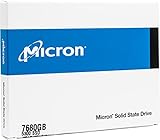
- Accelerate your system with the Micron 5300 PRO SATA SSD and get the best combination of reliability, security, and solid performance
- Innovative 96-layer 3D NAND technology - increase storage density with 7.68TB of storage in a 2.5 inch form factor
- Comprehensive security - AES 256-bit encryption, power-loss protection, enterprise data path protection, adaptive thermal monitoring, and TCG Opal Encryption
- Enhanced Read Write speeds - sequential read and write performance levels of up to 540 MB/s and 520 MB/s
- Optimized to deliver high-performance for media streaming, OLTP, block and object stores, and business intelligence
- Cell architecture, such as floating-gate or charge-trap, and whether the process uses replacement gates.
- CMOS placement, including whether the design uses CMOS-under-array.
- Areal density and die capacity, keeping any “up to” qualification attached to the stated figure.
- Read and write performance, including the comparison baseline and whether the claim concerns NAND I/O or an SSD.
- Energy efficiency, endurance and interface specifications.
- Target market and product configuration, such as client, mobile or data-center use.
Micron’s path—from floating-gate 3D NAND to replacement-gate, charge-trap designs with CuA—shows how vertical stacking has required changes to both cell architecture and fabrication. The central manufacturing challenge is to make a taller, denser structure uniform and accurately connected, not simply to achieve a larger layer count.
Quick Recap
Product prices and availability are accurate as of the date/time indicated and are subject to change. Any price and availability information displayed on Amazon at the time of purchase will apply.

