
A KV cache stores the attention keys and values an LLM has already calculated, so it can generate the next token without recalculating those representations for the entire conversation. That saves repeated work, but the cache grows with the sequence and with the number of requests being served at once—making it a significant consumer of accelerator memory.
What a KV cache does during LLM inference
When an LLM processes a prompt, it first runs a prefill stage: the model processes the input tokens and calculates attention state for them. It then generates output autoregressively, one token at a time. On each decoding step, the new token’s query attends to keys and values from earlier tokens.
Without a cache, the model would need to recalculate earlier tokens’ key and value representations at every step. With a KV cache, it retains those numerical tensors and appends the new token’s entries as generation continues. Hugging Face’s current inference-optimization documentation and the 2023 PagedAttention paper describe this reuse as a way to avoid repeated calculation.
Think of the cache as a growing record of attention-ready state—not a summary or a natural-language memory. It contains numerical representations rather than directly readable text, and it does not let a model exceed its context limit.
#1 Best Overall

- Ventilation Fan: Designed to quietly ASUS GT/RT- AC5300 , cool Xboxs, CPU/ GPU, Playtations, Rokus, TVs, receivers, mondems, routers, DVRs, window fans ,network appliances, DIY aquarium cooling and other audio video electronics
- Variable Speed Control: 110V - 220V Fan power supply with speed control function, turn the knob to adjust the speed, 4V - 12V adjustable fan speed,and can turn off the fan . | Input: 100V - 240V 50/60Hz | Output: DC 3-12V 200-2000ma
- DIY Vertical Window Fan: Can both vertical and horizontal, provide efficient cooling and ventilation. Mining rigs rely on the cooling power of fans for optimal operation.Double Metal Protective, the fan is equipped with double metal protective net
- Easy to Install: Draw out air in refrigerators, provide ventilation in greenhouses, prevent amplifier overheating, and vent hot air from living room consoles like PS4. Y cable connects 2 fans, two fans can be 42cm/16.5 in far away from each other
- Dual Ball Bearing: 240mm x 240mm x 25mm / 9.45in(L) x 4.72in(W) x 1in(H) in in total. | Rated Voltage :12V | Rated Current: 0.93A at full speed | Airflow: (82CFM)x4 at 12V | Speed: 2500 RPMx4
Why KV cache consumes so much GPU memory
The cache grows as tokens are added. Its total demand also rises with the number of active sequences, because a serving system must retain state for each request that is still being processed. The precise footprint depends on the model architecture and runtime configuration; there is no single reliable per-token figure for every LLM.
Cache is only one of the things that must fit in accelerator memory: model weights and other runtime state need space too. When cache demand is high, a serving system may have room for fewer concurrent requests or a smaller batch, which can constrain throughput. Longer contexts and higher concurrency can therefore increase memory pressure together.
Prefill and decoding use the cache differently. Prefill creates entries for the input; decoding repeatedly uses the growing cache while producing output. Which phase or resource limits performance depends on the workload, model, and hardware, so KV cache is an important constraint—not a universal explanation for every slow inference request.
Rank #2
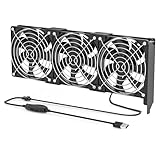
- 【Durable & Compact Design】This cooling fan is built with high-quality materials for enhanced durability. Its compact size makes it easy to install in tight spaces, providing reliable active cooling for graphics cards or server components
- 【Broad Compatibility for High-Performance Hardware】Ideal for graphics cards and other server hardware that require additional cooling. Perfect for use in consumer chassis with limited airflow to improve system stability and performance
- 【Adjustable Fan Speed for Custom Airflow】With a speed range of 1500–3000 RPM, the fan allows you to fine-tune airflow based on your cooling needs. Whether you prioritize silent operation or maximum cooling, this fan gives you full control
- Flexible Power Options with USB & 4-Pin Support】Comes with a USB to 4-PIN PWM cable for easy 12V power connection. The fan can be turned on or off manually, offering flexible control
- 【Complete Kit, Ready to Install】Includes 1 x cooling fan, 1 x USB to 4-PIN cable, and 1 x mounting screw. Everything you need for a quick and hassle-free installation—no additional parts required
How inference systems manage the cache
Cache strategies trade off allocation flexibility, reserved memory, transfer costs, and implementation support. The table compares their basic behavior; no method is best for every workload.
| Approach | How it manages cache | Main trade-off |
|---|---|---|
| Dynamic cache | Grows as generation proceeds. | Flexible sizing, but changing allocation shapes can complicate graph compilation and memory management. |
| Static cache | Reserves a configured maximum size in advance. | Can work with graph compilation, but may reserve more memory than a request ultimately uses. |
| Paged or block cache | Allocates fixed-token blocks on demand; blocks need not occupy contiguous memory. | Helps manage fragmentation and can enable block reuse in supported serving patterns; requires compatible runtime support. |
| Prefix caching | Reuses cached blocks when request prefixes match under the serving engine’s cache identity rules. | Useful for matching prefixes, but does not make semantically similar or differently represented prompts interchangeable. |
| CPU offloading | Keeps some cache data in host memory and transfers it as needed. | Can relieve GPU-memory capacity pressure, while adding host-device data movement that affects performance. |
| Lower-precision cache or compression | Uses a supported representation that requires less storage. | Availability and effects depend on model, backend, and configuration; lossy techniques can affect retained information or output fidelity. |
Dynamic and static allocation
A dynamic cache allocates as a request grows, avoiding a commitment to the maximum length up front. A static cache instead reserves a chosen maximum, giving the runtime a stable shape that can be more suitable for compilation. Hugging Face says pairing its static cache with torch.compile can deliver “up to a 4x speed up”; this is a maximum reported in its rolling documentation accessed in 2026, and the documentation cautions that actual results vary with model size and hardware.
PagedAttention and prefix reuse
PagedAttention organizes KV state into fixed-token blocks, which can be placed non-contiguously and allocated when needed. This avoids requiring each request’s cache to occupy one growing contiguous region. vLLM’s documentation describes prefix reuse by block identity and preceding prefix tokens: when the relevant prefix matches under the engine’s rules, a request can reuse those blocks. This is a cache identity match, not a way to share state between arbitrary prompts that merely mean the same thing.
Rank #3
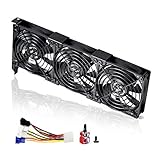
- 3 x 92mm fans combined into one interface, can be connected to the motherboard's 3-pin or 4-pin interface and you only need to access one interface to run all the fans
- This cooling fan's total size is 11in(L) x 4.72in(W) x 1.18in(H), designed for most universal graphic card video card VGA cooling,just please check the size to make sure your pc has enough space
- D-type interface cable included four interfaces, three voltages: 5V, 7V and 12V; different voltages with different airflow, speed and noise. You can select the appropriate voltage interface to start the fan
- The double ball bearing has a service life of 65,000 hours, and the 7 blades produce strong airflow to keep the computer case cool
- packing list: 3 x 92mm fans (PCI bracket screwed), 1 x multi-voltage cable ,1 x mini screwdriver,1 x fixing screw
CPU offloading and compression
Offloading can make more cache capacity available than GPU memory alone provides, but it shifts part of the cost to data movement between host and accelerator. A vLLM post from January 2026 discusses the transfer mechanics and throughput implications. Whether offloading helps depends on how much data must move and how that cost interacts with the workload.
Lower-precision cache formats and other compression approaches can reduce storage needs when the model and backend support them. vLLM’s versioned CLI documentation exposes KV-cache data-type options, but support is configuration-specific. Check the documentation for the exact engine version, model, and backend before relying on a particular format or assuming its quality and performance effects.
PC Slower Than It Used to Be?
A free scan shows the junk files, broken settings and background clutter dragging Windows down - then fixes them in one click.Free scan · Windows 10 & 11Outdated Drivers Are Slowing You Down
One free scan finds every outdated or missing driver and matches the right update for your exact hardware.Free scan · exact hardware matchWhat published performance figures do—and don’t—show
Published numbers illustrate results in particular configurations; they are not directly interchangeable benchmarks. Hugging Face’s “up to a 4x speed up” figure refers to static KV cache paired with torch.compile, with results varying by model size and hardware. The figures below belong to vLLM’s 2023 project post and the PagedAttention paper’s evaluated comparisons, respectively:
Rank #4

- 【Speed Controllable】Easy Cloud axial fan 120v allows you to freely adjust the computer cooling fan speed according to your needs. This flexibility allows you to adjust fan operation to a level that best suits your environment, whether you require powerful cooling or a quiet work environment
- 【AC Plug】Dual-ball bearings have a lifespan of 50,000 hours. Easy Cloud small computer fan 120mm comes with 3V to 12V multi-speed controller, increases maximum axial fan speed and powers the muffin fan from an AC outlet. Just plug it into an outlet and start the 120mm pc fan
- 【Applicability】Designed to meet the cooling and ventilation needs of a variety of devices, including pcs, game consoles, appliances, entertainment equipment, solar equipment and more, this 120mm vent fan provides effective silent cooling and is also an ideal replacement for your existing 12v computer fan. No matter what type of equipment you have, this 120mm case fan ensures it stays at the right operating temperature, improving performance and extending life
- 【Parameter】120 x 120 x 25 mm ( 4.72 x 4.72 x 0.98 inches. ) | Rated Voltage: 12V | Airflow: 95.8 ±10M | Rated Current: 0.3A | Bearings: Dual Ball | Speed: 700RPM to 2800RPM | Power: 3.3W | Noise: <41dB
- 【Customer Support】We strive to offer the excellent services out of your expectations. If you have any problems with our product, please feel free to contact us at anytime
- vLLM reported “up to 24x higher throughput” compared with Hugging Face Transformers. This is the project’s reported result, not a universal or independent comparison across current systems.
- In discussing the systems covered by its 2023 project post, vLLM said fragmentation and over-reservation wasted “60% – 80% of memory.” That diagnosis describes the systems in that post, not every modern inference engine.
- The 2023 PagedAttention paper reported a “2-4×” throughput improvement under its evaluated comparisons to then state-of-the-art systems at the same latency. The result is tied to those comparisons and evaluation conditions.
These reports do not establish a current, controlled, apples-to-apples winner across cache strategies, engines, models, and workloads.
How to choose a cache strategy for a workload
Start with the constraint you need to address, then verify that the model and serving stack support the proposed technique. Compare options using the workload you actually expect to serve:
- Memory capacity: account for model weights and runtime state as well as cache, and consider how context length and concurrent requests change demand.
- Allocation behavior: check whether requests have varied lengths and whether reserved space or fragmentation is limiting useful capacity.
- Transfer costs: for CPU offloading, measure the effect of host-device traffic rather than treating added capacity as free.
- Concurrency and throughput: evaluate the target mix of prompt lengths, output lengths, and active requests; results from another workload may not transfer.
- Model and backend support: confirm that the selected engine version, model, hardware, and cache format work together.
- Retention and fidelity: determine whether compression or eviction changes what context remains available or affects output quality.
- Operational complexity: weigh any memory or throughput benefit against the additional configuration and support burden.
The useful outcome is not simply the smallest cache or the highest isolated benchmark number. It is a cache policy that fits the target workload’s memory, latency, concurrency, and retention requirements.
Quick wins for a faster PC:
Repair Windows errors before they cause bigger problemsFix Now →Scan for outdated or missing drivers - takes under a minuteDriver Scan →Clear out junk files and repair common Windows errorsFree Scan →Quick Recap
Product prices and availability are accurate as of the date/time indicated and are subject to change. Any price and availability information displayed on Amazon at the time of purchase will apply.

