
Outdated Drivers Are Slowing You Down
One free scan finds every outdated or missing driver and matches the right update for your exact hardware.Free scan · exact hardware matchWindows Errors? Fix Them Before They Spread
Repair common Windows errors and clear accumulated junk for a smoother, more stable PC - no reinstall needed.Free scan · no reinstallFacilities reduce dismantling time by resolving avoidable uncertainty before work starts: characterize the equipment and contamination, choose and test a task-specific method, plan access and removal routes, and coordinate decontamination, material handling, waste management and worker protection. The aim is a safe, controlled sequence—not speed at the expense of containment or exposure controls.
Start by characterizing the equipment and hazards
There is no single dismantling method that suits every item. For radioactive controlled facilities, ARPANSA says the choice depends on factors including contamination or activation, equipment size and shape, and accessibility. Analyze each dismantling task separately, documenting what is known and which uncertainties could change the method or controls.
This initial characterization helps planners avoid committing to a procedure that later proves unsuitable because an item is inaccessible, cannot be handled as expected, or presents a different contamination challenge. The relevant hazard assessment and regulatory requirements depend on the facility and jurisdiction.
Choose a method and test it before the job
Compare feasible methods against the hazards and practical constraints of the task. Useful comparison criteria include:
Recommended Free Tools
#1 Best Overall

- Effective barrier against a range of organic and inorganic chemicals, including many acids, bases, salts, greases, oils and cbrn agents
- It is used extensively by major fire departments for Hazmat Response, major hospitals for Emergency Preparedness First Receivers, major chemical companies for a wide range of potential hazardous materials exposures
- The fabric has been subjected to a variety of long-term storage conditions and exhibits no degradation in performance over time when stored properly in a cool, dry place away from direct sunlight
- International products have separate terms, are sold from abroad and may differ from local products, including fit, age ratings, and language of product, labeling or instructions
- Fit for the contamination or activation and the equipment’s size, shape and access.
- Potential worker exposure and contamination spread.
- Waste volume and resulting waste form.
- Reliability, simplicity and need for special tools or devices.
- Compatibility with decontamination, lifting, transport, disposal and the facility’s defined end state.
- Any project-specific regulatory approval or infrastructure requirements.
ARPANSA states that careful selection and pre-testing of dismantling technology and procedures can help minimize decommissioning time, radioactive waste and contamination dispersion, optimize radiation doses, and contribute to safety. It gives no measured time saving, so a percentage or number of hours cannot be inferred.
Where practicable, test tools and procedures before using them on the equipment. The IAEA’s Decommissioning of Medical, Industrial and Research Facilities describes simulated-condition testing of special tools, and the use of computer-based or physical mock-ups to plan tasks, evaluate options, design tooling and train workers. That guide is marked superseded; treat it as historical technical guidance, not a current binding requirement.
Rank #2

- Exceptional Heat Resistance: This heat insulation suit is made of heat-resistant aluminum foil composite fireproof and flame-retardant materials. It can quickly prevent the accumulation of body heat, and has characteristics such as wear resistance, folding resistance, fire resistance, heat insulation, high temperature resistance, and anti iron splashing.
- Multiple Sizes Available: XL sizes are available for heights of 5.5-5.9ft. XXL sizes are available for heights of 5.9-6.3ft. Please note that due to individual differences in body shape, sizes may also vary. If you are not sure about the size, please consult our customer service.
- Main Use: This fireproof suit is a special clothing worn by high-temperature workers or firefighters during work, which can effectively protect them from being burned by heat, flames, and steam when they are close to a heat source. Additionally, it may make you stand out at a masquerade party.
- Suitable for Multiple Industries: This fireproof heat resistant suit is suitable for industries such as aerospace, firefighting, metallurgy, forestry, chemical, petroleum, and power. Not limited to metallurgical work, steel plant work, radiation protection work, dust work, welding work, etc.
- Comprehensive Coverage: The complete fire resistant clothing includes a cap, coveralls, gloves and shoe covers, as well as a portable storage bag, providing you with comprehensive protection.
Make access, isolation and removal routes predictable
Planning how an item will be reached, separated and moved can prevent difficult access work during dismantling. For radioactive substances activities in England, the Environment Agency recommends considering design features such as:
- Hatches or large doors that permit equipment removal.
- Modular construction that can simplify later removal.
- Separation of electrical and mechanical systems, or radioactive and non-radioactive systems.
- Features that support decontamination and equipment removal.
These are design and modification considerations where feasible; they are not a universal checklist of regulatory requirements for every facility. A removal route should be coordinated with the planned sequence, available lifting and moving devices, and the destination for the item or its components.
Rank #3
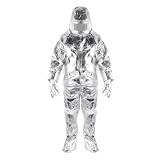
- Size: This heat-resistant clothing is available in two sizes. Large: about 70 kg (around 154.3 pounds) and 170 cm (around 5.58 ft); Extra Large: about 80 kg (around 176.4 pounds) and 175 cm (around 5.74 ft). Note: Due to individual differences in body shape, the size may vary. If you are not sure about the size, please ask us. The heat resistant suit needs to be worn over your own clothes, so it can be appropriately larger
- Composite material: The heat resistant insulation suit is composed of high reflective aluminum foil layer and aluminum foil composite layer etc., which has the function of blocking heat transfer, and keeps its own physical properties at a high temperature of 1000 degrees Celsius without shrinkage, melting and brittle carbonization. Our excellent materials are designed to give you maximum protection in high temperature environments
- Comfortable: The cotton lining of heatproof suit has a strong ability to absorb sweat, ensuring you feel comfortable and dry even when wearing it for extended periods of time. Additionally, its light weight and loose-cut allow you to perform casually running, climbing, jumping ect., and provide you a coordinated and low-burden experience
- Notice: This heat-insulating clothing has the function of flame retardant and high temperature resistance, but you must avoid in direct contact with the fire source. Otherwise, in a high-temperature environment, direct contact may cause protective clothing scrapped, and even the user is burned
- Application: This heat resistant suit includes 1 jacket, 1 pair of trousers, 1 hood, 1 pair of gloves and 1 pair of shoe covers. It provides full‑body protection. The heat insulation clothing can be used as firefighters' protective clothing and suitable for high temperature workers in the petroleum, chemical, glass, smelting and other industries
Build decontamination and waste handling into the sequence
Decide in advance where decontamination will take place, what equipment and methods it requires, how clean areas will be protected, and how items that cannot be decontaminated will be managed or disposed of. Plan segregation so contaminated material is not mixed with less- or non-contaminated material. Reducing component size may help manage material, but the method must account for the hazards created by dismantling and subdivision.
OSHA’s hazardous-waste decontamination guidance recommends establishing a site plan before personnel or equipment enter a potentially hazardous area. It addresses stations, equipment, methods, protection of clean areas and worker contact during PPE removal, and calls for revising the plan when clothing or equipment, site conditions or hazard assessments change. OSHA explicitly excludes radioactive contamination of personnel or equipment from this chapter; it should not be used as radiological decontamination guidance.
Rank #4

- The Microporous PE Film Coverall, designed to provide unparalleled protection, comfort, and durability.
- The 4-thread overlock stitch can result in stronger seam, reducing the risk of tears or breakages.
- Fabric with anti-static feature helps to prevent the buildup of static electricity during use.
- Andes disposable protective coverall provides protection from dry particulates such as dirt, dust, and paint.
- Heavy-duty disposable coverall features an integrated hood with elastic wrists and ankles for a secure fit and full-body coverage during painting and other demanding work applications.
Reduce avoidable contact, lifting and movement
Repeated handling and unplanned movement can add time while increasing opportunities for exposure or contamination spread. Depending on the hazard assessment and approved plan, OSHA’s hazardous-waste guidance gives examples such as remote sampling, handling and container-opening techniques; bagging instruments where appropriate; disposable outer garments or equipment where appropriate; protective strippable coatings; and containment.
WHO’s guidance for decommissioning Ebola care facilities—not radioactive facilities—recommends risk assessment, trained safety supervision, briefings, suitable tools and lifting devices, housekeeping, controlled waste movement, guards and appropriate PPE. These examples illustrate the importance of organizing people, tools and material routes for that specific context; they are not nuclear-specific requirements or a universal equipment list.
Best Value
- Size: This heat-resistant clothing is available in two sizes. Large: about 70 kg (around 154.3 pounds) and 170 cm (around 5.58 ft); Extra Large: about 80 kg (around 176.4 pounds) and 175 cm (around 5.74 ft). Note: Due to individual differences in body shape, the size may vary. If you are not sure about the size, please ask us. The heat resistant suit needs to be worn over your own clothes, so it can be appropriately larger
- Composite material: The heat resistant insulation suit is composed of high reflective aluminum foil layer and aluminum foil composite layer etc., which has the function of blocking heat transfer, and keeps its own physical properties at a high temperature of 1000 degrees Celsius without shrinkage, melting and brittle carbonization. Our excellent materials are designed to give you maximum protection in high temperature environments
- Comfortable: The cotton lining of heatproof suit has a strong ability to absorb sweat, ensuring you feel comfortable and dry even when wearing it for extended periods of time. Additionally, its light weight and loose-cut allow you to perform casually running, climbing, jumping ect., and provide you a coordinated and low-burden experience
- Notice: This heat-insulating clothing has the function of flame retardant and high temperature resistance, but you must avoid in direct contact with the fire source. Otherwise, in a high-temperature environment, direct contact may cause protective clothing scrapped, and even the user is burned
- Application: This heat resistant suit includes 1 jacket, 1 pair of trousers, 1 hood, 1 pair of gloves and 1 pair of shoe covers. It provides full‑body protection. The heat insulation clothing can be used as firefighters' protective clothing and suitable for high temperature workers in the petroleum, chemical, glass, smelting and other industries
Keep speed subordinate to hazard-specific controls
Dismantling can create new hazards and spread contamination. In radioactive work, the selected approach must address radiological controls, exposure, waste and contamination dispersion. OSHA’s cited chapter covers general hazardous-waste decontamination planning but not radioactive equipment; radioactive work requires qualified health physics expertise and applicable radiological requirements. WHO’s cited controls apply to Ebola care facility decommissioning. Use guidance only within its stated scope, together with the facility’s hazard assessment and approved plan.
What the evidence can—and cannot—say about time savings
The cited official guidance supports the direction of the advice: task-specific selection, pre-testing and coordinated planning can help minimize decommissioning time while addressing safety and contamination control. It does not provide a quantified time-saving estimate. Actual duration depends on the equipment, hazards, access, chosen method, waste route and site-specific approvals.
Quick Recap
Sources
- ARPANSA, Regulatory Guide — Decommissioning of Controlled Facilities.
- Environment Agency, Planning for decommissioning of radioactive substances activities.
- IAEA, Decommissioning of Medical, Industrial and Research Facilities (superseded guide).
- OSHA, Hazardous Waste — Decontamination.
- WHO, Rapid Guidance on the Decommissioning of Ebola Care Facilities.
Product prices and availability are accurate as of the date/time indicated and are subject to change. Any price and availability information displayed on Amazon at the time of purchase will apply.

