
A brain-computer interface (BCI) moves a cursor by recording brain activity, extracting usable signal features, and feeding them into a trained decoder that produces cursor commands. The cursor’s movement is therefore the output of a specific sensor-and-decoder system—not a direct reading of unstructured thoughts. The user sees the cursor and can adjust subsequent attempted or imagined movement, creating a feedback loop.
How a BCI signal becomes cursor movement
The path from intended movement to a screen usually has four stages. The details differ by sensor type and system, but the essential job is to convert measured neural activity into a control signal the computer can use.
- Record brain activity. A sensor captures neural signals. An intracortical system uses electrodes implanted in the brain, while non-invasive electroencephalography (EEG) records electrical activity from the scalp. These methods capture different signal types and do not provide interchangeable inputs. A review of motor decoding also describes signals recorded from the brain, peripheral nerves, and muscles: Human motor decoding from neural signals: a review (2019).
- Extract features. Software processes the recordings into patterns the decoder can use. In the intracortical approach described in a 2017 review, processing can identify spikes and estimate firing rates across recorded neural units. EEG systems may instead use rhythmic activity, including features in motor-related frequency bands. Brandman, Cash, and Hochberg’s review of intracortical recording and decoding describes how a decoder reduces complex spike data to a more manageable output.
- Decode a control variable. A trained algorithm maps the changing features to a command, such as cursor position or velocity in two dimensions. In one method, a Kalman filter combines the observed relationship between neural activity and movement with a model of how cursor movement is likely to evolve. The output is a usable control signal, not a sentence or a complete interpretation of what a person is thinking.
- Move the cursor and use feedback. The decoded command drives the on-screen cursor. The user can see whether it moved as intended and adjust subsequent attempted or imagined movement. Training can also use this feedback to adapt the decoder. In intracortical systems, the recorded signal, decoder, cursor, and visual feedback form a closed loop, as explained in this 2017 review.
Why the sensor changes the process
“BCI cursor control” covers different recording methods, not one universal device. Intracortical electrodes record activity from inside the brain and can support decoders based on spiking activity. EEG records from the scalp and can use features such as changes in rhythmic activity. Sensor placement affects what is measured and the processing needed before a decoder can act on it; results from one method should not be treated as evidence of equivalent performance from another.
For example, a 2009 EEG experiment tested discrete two-dimensional cursor movement using both motor execution and motor imagery. In five naïve participants, the researchers reported contralateral motor-cortex beta-band activity as a useful feature for detecting the tested movement and stop conditions. This was a small study of discrete control, not a matched comparison with an implanted array or evidence that EEG provides the same kind of continuous control. The study is described here.
Windows Errors? Fix Them Before They Spread
Repair common Windows errors and clear accumulated junk for a smoother, more stable PC - no reinstall needed.Free scan · no reinstallCrashes, No Sound, or Screen Glitches?
Random freezes, missing sound and display glitches usually trace back to one bad driver. Find and replace yours safely.Free scan · under a minute#1 Best Overall

- Spacious Design: Measuring 21.1" wide and 14.1" deep, our lap desk comfortably fits most laptops up to 15.6". Extra room for accessories ensures convenience.
- Enhanced Functionality: Packed with handy features, including a 5x9" precision tracking mouse pad and a built-in phone slot for seamless work or video calls. Plus, enjoy ergonomic support with the integrated cushioned wrist rest.
- Cool Comfort: Enjoy a stable surface with our lap desk's dual bolster cushion, designed for comfort and airflow, keeping your lap cool during extended use.
- Durable Surface: Work with confidence on our lap desk's solid surface, featuring a sleek black carbon color, ensuring optimal air circulation to prevent your laptop from overheating.
- On-the-Go Convenience: With an integrated handle and lightweight design (2.8 lbs), our lap desk is portable for travel or moving around the house, offering flexibility in any space.
Position and velocity are different decoder targets
A decoder must be trained to produce a particular kind of command. It might estimate where the cursor should be, or how fast and in which direction it should move. The choice affects how the cursor responds, so algorithm labels alone do not tell the whole story.
In a 2008 intracortical study, Kim and colleagues compared cursor-control approaches in two people with tetraplegia. The experiment used a chronically implanted 96-channel microelectrode array, with recordings digitized at 30 kHz per channel; those are methods details of that historical study, not general BCI specifications. The authors reported that velocity decoding produced more accurate closed-loop cursor control and was achieved faster than direct position decoding. In their experiments, velocity-based Kalman decoding was smoother and more accurate than position decoding with a linear filter. Their comparison suggested that choosing the movement variable could matter more than choosing between the tested velocity-based Kalman and linear decoders. These findings apply to those two participants and the study’s tasks, not to every user, decoder, or BCI system. Read the 2008 study.
Rank #2

- 5-in-1 Connectivity: Equipped with a 4K HDMI port, a 5 Gbps USB-C data port, two 5 Gbps USB-A ports, and a USB C 100W PD-IN port. Note: The USB C 100W PD-IN port supports only charging and does not support data transfer devices such as headphones or speakers.
- Powerful Pass-Through Charging: Supports up to 85W pass-through charging so you can power up your laptop while you use the hub. Note: Pass-through charging requires a charger (not included). Note: To achieve full power for iPad, we recommend using a 45W wall charger.
- Transfer Files in Seconds: Move files to and from your laptop at speeds of up to 5 Gbps via the USB-C and USB-A data ports. Note: The USB C 5Gbps Data port does not support video output.
- HD Display: Connect to the HDMI port to stream or mirror content to an external monitor in resolutions of up to 4K@30Hz. Note: The USB-C ports do not support video output.
- What You Get: Anker 332 USB-C Hub (5-in-1), welcome guide, our worry-free 18-month warranty, and friendly customer service.
What published demonstrations establish—and what they do not
Intracortical and EEG studies show that neural signals can be converted into cursor commands under defined experimental conditions. They do not establish that all BCIs work alike, that their results transfer directly between participants or tasks, or that a research system is available as an everyday consumer product. A 2023 review discusses the broader technical challenges in neural decoding for intracortical BCIs.
- Intracortical research: the cited 2008 cursor-control comparison involved two participants with tetraplegia and a specialized implanted system.
- EEG research: the cited 2009 demonstration involved five naïve participants and discrete cursor commands.
- Comparisons: meaningful comparisons need to account for sensor location, signal processing, control type, training and feedback, task, and participant group. The cited experiments are not a matched test of EEG against intracortical control.
These examples support a specific explanation of the mechanism: sensors record signals, processing extracts features, a trained decoder maps them to a chosen cursor command, and feedback lets the user and system adapt. They do not show that a cursor is moved by thoughts being read directly.
The Tool Desk
Outbyte Driver Updater FREEFix the driver behind crashes, sound loss and screen glitchesFind Drivers →Outbyte PC Repair FREEClear out junk files and repair common Windows errorsFree Scan →Quick Recap
Best Value

- Spacious Design: Measuring 21.1" wide and 12" deep, our lap desk comfortably fits most laptops up to 15.6". Extra room for accessories ensures convenience.
- Enhanced Functionality: Packed with handy features, including a 5x9" precision tracking mouse pad and a built-in phone slot for seamless work or video calls. Plus, enjoy laptop support with the integrated device ledge.
- Cool Comfort: Enjoy a stable surface with our lap desk's dual bolster cushion, designed for comfort and airflow, keeping your lap cool during extended use.
- Durable Surface: Work with confidence on our lap desk's solid surface, featuring a blush pink color, ensuring optimal air circulation to prevent your laptop from overheating.
- On-the-Go Convenience: With an integrated handle and lightweight design (2.14 lbs), our lap desk is portable for travel or moving around the house, offering flexibility in any space.
Rank #4

- Anti-Slip Surface - Transform your laptop into a mobile workstation with the AboveTEK portable laptop lap desk. The anti-slip surface provides a strong grip for laptops up to 15.6 inches(Diagonal), while the double rubber strip on the bottom ensures a stable display or typing experience on your lap, couch, or bed.
- Retractable Mouse Pad - Retractable laptop mouse pad extends on both directions for the left/right handed with elevation along the edges for stopping mouse from falling off. The size of laptop tray is 14" X 9.7" and the size of mouse pad is 7.4" X 6.1".
- Effective Heat Shield - The effective heat shield made of sturdy and thick material protects your laptop from overheating. Prioritizes your comfort and safety, an ideal lap pad or board for working anywhere.
- EASY to Carry and Store - With an ergonomic and simplistic design, the lap desk is portable to store in a backpack. Only 15" in size, 2.2 lb of weight and with slim 0.6 inch thickness, it is ready to be easily carried around.
- Widely Applicable - The smooth platform accommodates laptops and tablets up to 15.6 inches(Diagonal), making it a versatile accessory and one of the best gifts for mom, dad, students and professionals. Perfect for use as a laptop bed tray or tablet holder anywhere at home, library, or park.
Rank #3
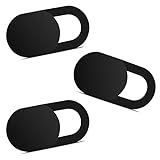
- Note: Not suitable for MacBooks released after 2023 or devices with a protruding front camera; Not applicable to full-screen or notch-style tempered glass screen protectors; Do not use on the rear camera of the phone.
- 💻 Why Do You Need a Webcam Cover Slide? — Safeguard your privacy by covering your webcam with our reliable webcam cover when not in use. Don't let anyone secretly watch you. Stay protected!
- ✅ Thin & Stylish — Enhance your laptop's functionality and aesthetics with our 0.027" ultra-thin webcam covers. Seamlessly close your laptop while adding a touch of sophistication.
- ✅ Fits Most Devices — Compatible with laptops, phones, tablets, desktops! Keep your privacy intact on Ap/ple, Mac/Book, iPh/one, iP/ad, H/P, L/novo, De/ll, Ac/er, As/us, Sa/msung devices.
- ✅ 365 Days Protection — Our upgraded 3.0 adhesive ensures a strong hold that won't damage your equipment. Experience reliable, long-term privacy protection day in and day out.
Product prices and availability are accurate as of the date/time indicated and are subject to change. Any price and availability information displayed on Amazon at the time of purchase will apply.

