
Android can read a photo stick, flash drive, card reader, or external drive when the phone supports USB host mode and the connected storage works with its connector, file system, and power needs. In everyday use, this is often called USB OTG. With Files by Google on Android 7.0 or later, you can browse a connected drive and copy or move files manually; connecting a drive does not by itself create an automatic photo backup.
What USB OTG means when you connect a drive
In this setup, the phone acts as the USB host: it controls the connection to a peripheral such as a flash drive. The connector shape alone does not establish compatibility. The phone must support host mode, and the storage device must be connected through a compatible data path.
A common arrangement is a phone connected to a USB-C OTG adapter and then to a USB drive. A direct-plug photo stick combines the adapter and storage, while a USB card reader can provide a way to access a camera card. These are connection options, not guarantees that a particular phone or drive will work.
USB accessory mode is different: in that arrangement, the accessory acts as host and supplies bus power. It should not be confused with a phone hosting a flash drive. Android Developers’ USB accessory overview describes accessory mode separately.
#1 Best Overall

- USB-C 2-in-1 storage OTG: The Lexar JumpDrive Dual Drive D40E features USB Type-A and Type-C connectors in a slim, portable form factor for easy device compatibility
- Transfer speeds up to 100MB/s: Based on internal testing, performance may vary depending upon the host device, interface, and usage conditions. 1MB=1,000,000 bytes
- Plug and Play: Widely compatible with USB Type-C smartphones, tablets, laptops, Macs, and traditional Type-A devices, no software installation required. The 360° swivel design allows for easy switching between connectors without the hassle of losing a cap
- Durable & Compact: The Lexar D40E USB memory stick features a metal enclosure, withstands temperatures from 0° to 50° C (32°F to 122°F), and is lightweight at 26g with dimensions of 70.4 x 16.9 x 11.7mm
- Security & Warranty: Securely protects files using an advanced security software solution with 256-bit AES encryption. Backed by a Lexar 3-year limited warranty
How do I enable OTG on Android?
There is no universal OTG switch or setting documented for every Android phone. First confirm that the exact phone model supports USB host/OTG operation. Android 16’s Compatibility Definition Document says devices with a USB port “SHOULD support USB host mode”; that is a platform recommendation, not certification of every handset. Read the Android 16 Compatibility Definition Document and check the phone maker’s instructions for your model.
Use a connector that matches the phone and storage device. If you need an adapter, it must support data and host use; a charging-only adapter will not provide file access. Google’s USB-storage instructions do not certify individual adapter models, so consult the adapter and phone documentation if the connection is uncertain.
Rank #2

- 2 in 1: USB C + USB 3.0, 32GB usb c flash drive has dual ports, usb 3.0 port is applied to all devices which have usb 3.0 interface and usb c port is widely used in all Android smartphones with OTG function
- High Speed USB 3.0: Read speed up to 90 MB/s, Write speed up to 30 MB/s, the speed of USB 3.0 interface is faster than USB 2.0, save time to wait, increases work productivity. Note: Speed will be limited if you use the USB key in the USB 2.0 interface
- Large Compatibility: The USB 3.0 Connector is compatible with USB 3.0 & USB 2.0 backward USB 1.1 devices, such as Laptop, Desktop, Car Audio, Tablet, TV, Speakers, Projector. USB-C port is compatible with all Android Smartphones
- Expand Storage: Good performance in storing, transferring and sharing digital data with families, friends, colleagues, customers. It can expand the capacity of smartphone, you can watch movies or share pictures when you go on vacation with your family
- Note: Make sure your smartphone is equipped with OTG function and need to open OTG function in Settings when you plug memory stick, then you can transfer easily data bewteen different devices
Browse and copy files with Files by Google
Google says Files by Google can access USB storage on Android 7.0 and later. Once the phone recognizes the drive, the basic workflow is:
- Connect the drive, photo stick, or card reader to the phone, using a compatible data-capable host adapter if needed.
- Open Files by Google. Tap the “USB available” notification, then tap “Allow” if prompted.
- Open the device under “Storage devices” and browse to the files or folder you need.
- Select the items, choose “Copy to” or “Move to,” select a destination, and confirm.
- Finish file operations before disconnecting the drive. For a backup, copy rather than move, open a few copied files to check them, and only then consider deleting the originals.
The copy-and-move workflow is manual. The Files instructions do not establish that plugging in a drive automatically backs up camera photos. See Google’s Use USB storage devices instructions for the Files by Google steps.
Rank #3
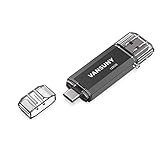
- 【Important】: Default format of the usb flash drive 128gb is exFAT as this is the format recognized by the smartphones and tablets. These 128gb thumb drives are only compatible with C-Port enabled mobile phones & computers only. While formatting the usb flash drive dual type c usb 3.0 OTG keep a check on the drive format
- 【Easy to Use】: Directly plug the 2-in-1 USB flash drive and play, no need to install any software. The jump drive is easy to be recognized by computer, laptop, notebook, PC, car audio, speaker, smart TV, vidoe projector etc
- 【Fast Speed】: High-speed USB 3.0 flash drive for fast data transfer, backwards compatible with USB 2.0 easy to complete the storage and transport functions. USB 3.0 and Class A chip help you transfer a 4G movie from the thumb drive to your smartphone in about 40 seconds, and reverse transfer in 2 mins to save memory for your smartphone with Type C port.Save your time
- 【Good Compatibility】: Dual connectors USB type C + USB 3.0. Support windows 7 / 8 / 10 / XP / 2000 / ME / NT Linux and Mac OS, compatible withUSB 3.0 & USB 2.0 backwards USB1.1. Support videos formats: AVI, M4V, MKV, MOV, M P4, MPG, RM, RMVB, TS, WMV, FLV, 3GP; AUDIOS: FLAC, APE, AAC, AIF, M4A, MP3, WAV
- 【OTG Function】:Support nearly all mobile phones which support OTG function,and very easy to operate
Why is my USB drive not showing on my phone?
A drive that does not appear may reflect a phone, connection, format, or power mismatch. Check these in order rather than assuming the drive is faulty:
- Phone host support: Confirm USB host/OTG support for the exact handset and software build in the manufacturer’s documentation. The Android compatibility recommendation is not a model-by-model guarantee.
- Connector and adapter: Check that the phone-to-drive connection fits and carries data in host mode. If possible, try a known-good data-capable cable or adapter and another drive. Community troubleshooting suggestions are not universal platform rules.
- Drive format: Google’s Files help explains how to connect and manage USB storage, but does not publish a universal Android file-system compatibility matrix. Check the phone maker’s guidance for the model; do not reformat as a first troubleshooting step. Reformatting erases data, so make and verify a separate backup before changing a drive’s format.
- Power: A compact flash drive and a mechanical external drive may have different power needs. Android 16’s compatibility document strongly recommends USB Power Delivery support for data and power-role swapping on USB-C devices that support host mode; it does not specify universal output power or guarantee that a particular phone can run a particular drive. Check the drive maker’s power requirements. If needed, consider an externally powered setup only after confirming it preserves a compatible data connection.
- Recognition and Files: If the USB notification does not open, Google recommends removing and reconnecting the storage. Then check Files > Browse or “Storage devices,” the phone’s storage settings, the adapter, the drive’s condition, and the phone maker’s instructions.
Do not reformat or erase a drive simply because one phone fails to mount it. The Google Files USB-storage page describes access and file management, not universal format or capacity limits.
Rank #4

- USB-C 2-in-1 storage OTG: The Lexar JumpDrive Dual Drive D40E features USB Type-A and Type-C connectors in a slim, portable form factor for easy device compatibility
- Transfer speeds up to 100MB/s: Based on internal testing, performance may vary depending upon the host device, interface, and usage conditions. 1MB=1,000,000 bytes
- Plug and Play: Widely compatible with USB Type-C smartphones, tablets, laptops, Macs, and traditional Type-A devices, no software installation required. The 360° swivel design allows for easy switching between connectors without the hassle of losing a cap
- Durable & Compact: The Lexar D40E USB memory stick features a metal enclosure, withstands temperatures from 0° to 50° C (32°F to 122°F), and is lightweight at 26g with dimensions of 70.4 x 16.9 x 11.7mm
- Security & Warranty: Securely protects files using an advanced security software solution with 256-bit AES encryption. Backed by a Lexar 3-year limited warranty
Keep an OTG drive portable
Treat a USB drive attached to a phone as portable storage. Android Open Source Project guidance warns against adopting a phone-connected USB drive as internal storage: accidental disconnection can cause data loss or corruption. Finish file activity before unplugging it. See Android’s adoptable storage guidance.
OTG is not the same as transferring files to a computer
With OTG, the phone hosts the attached drive. In Google’s computer-transfer workflow, the computer hosts the connection: unlock the phone, connect it to the computer, and select “File Transfer” on the phone. Those are different setups, even though both involve moving files over USB. Follow Google’s computer-to-Android file transfer instructions for the latter.
Quick Recap
Best Value

- USB-C 2-in-1 storage OTG: The Lexar JumpDrive Dual Drive D40E features USB Type-A and Type-C connectors in a slim, portable form factor for easy device compatibility
- Transfer speeds up to 100MB/s: Based on internal testing, performance may vary depending upon the host device, interface, and usage conditions. 1MB=1,000,000 bytes
- Plug and Play: Widely compatible with USB Type-C smartphones, tablets, laptops, Macs, and traditional Type-A devices, no software installation required. The 360° swivel design allows for easy switching between connectors without the hassle of losing a cap
- Durable & Compact: The Lexar D40E USB memory stick features a metal enclosure, withstands temperatures from 0° to 50° C (32°F to 122°F), and is lightweight at 26g with dimensions of 70.4 x 16.9 x 11.7mm
- Security & Warranty: Securely protects files using an advanced security software solution with 256-bit AES encryption. Backed by a Lexar 3-year limited warranty
Product prices and availability are accurate as of the date/time indicated and are subject to change. Any price and availability information displayed on Amazon at the time of purchase will apply.

