
Windows Errors? Fix Them Before They Spread
Repair common Windows errors and clear accumulated junk for a smoother, more stable PC - no reinstall needed.Free scan · no reinstallCrashes, No Sound, or Screen Glitches?
Random freezes, missing sound and display glitches usually trace back to one bad driver. Find and replace yours safely.Free scan · under a minuteEpoch AI estimates that Google owned about one quarter of global cumulative AI compute capacity as of Q4 2025, making it the largest single owner in its estimate. Google’s advantage is built primarily on custom Tensor Processing Units (TPUs), but its infrastructure also uses NVIDIA GPUs. The ranking is an external estimate—not a Google-published inventory or an independently auditable count.
Does Google own the most AI compute?
According to Epoch AI, Google had about one quarter of the world’s cumulative AI compute capacity as of Q4 2025. Epoch AI identifies Google’s custom TPUs as its primary source of compute among hyperscalers in that estimate. The public material does not provide enough detail to reproduce the full global ranking, and Google has not published a complete worldwide accelerator inventory.
“AI compute” here means the capacity used to perform AI workloads, rather than a count of chips alone. The estimate describes cumulative capacity; it should not be read as a live tally of accelerators currently available for a particular customer or task.
How Google builds its AI infrastructure
Google’s approach is an integrated stack: custom chips and other accelerators sit within systems, software, cloud platforms, models, and products. Google CEO Sundar Pichai has described infrastructure as the foundation of the company’s broader AI approach, alongside research, models and tools, and products and platforms. Alphabet says its infrastructure includes both NVIDIA GPUs and Google-built TPUs, including Ironwood, and serves Google products as well as Google Cloud customers.
The Tool Desk
Outbyte Driver Updater FREEScan for outdated or missing drivers - takes under a minuteDriver Scan →Outbyte PC Repair FREERepair Windows errors before they cause bigger problemsFix Now →#1 Best Overall

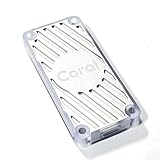
- A USB accessory that brings machine learning inferencing to existing systems. Works with Raspberry Pi and other Linux systems
- Performs high-speed ML inferencing: the on-board edge TPU Coprocessor is capable of performing 4 trillion operations (tera-operations) per second (tops), using 0.5 watts for each tops (2 tops per watt). For example, it can execute state-of-the-art mobile vision models such as mobilenet V2 AT 400 FPS, in a power efficient manner
- Works with Debian Linux: connects to any debian-based Linux system with an included USB 3.0 Type-C cable
- Supports tensorflow Lite: no need to build models from the ground up. Tensorflow Lite models can be compiled to run on the edge TPE
- Supports automl vision edge: easily build and deploy fast, high-accuracy custom image classification models to your device with automl vision edge
Custom TPUs alongside NVIDIA GPUs
TPUs are Google-designed accelerators for machine-learning workloads. Google Cloud describes them as co-designed with software and says its TPU offering supports frameworks such as PyTorch and JAX, as well as the vLLM inference engine. That makes TPUs an option for developers whose workloads and software fit the service; it does not mean that all Google AI runs on TPUs or that GPUs are absent from its infrastructure.
The practical comparison is workload-specific. Training and inference can place different demands on memory, interconnects, software, and serving conditions. Framework compatibility, scale, availability, and measured performance for the intended workload matter more than a general claim that one accelerator type is always faster or better.
Rank #2

- High-Performance ML Accelerator: Integrates Edge TPU, delivering 4 TOPS (int8) peak performance for machine learning inference tasks.
- Strong Compatibility: Supports M.2 A+E key interface for easy integration into existing systems.
- Low Power Design: Provides 2 TOPS per watt, ideal for embedded and energy-efficient applications.
- Wide OS Support: Compatible with Linux (Debian 10/Ubuntu 16.04+) and Windows 10 (64-bit).
- Industrial-Grade Reliability: Operating temperature range of -20°C to +85°C, suitable for harsh environments.
AI Hypercomputer connects hardware, software, and cloud access
Google Cloud presents AI Hypercomputer as purpose-built hardware combined with open software and flexible cloud consumption. The system-level design matters because large jobs depend not only on individual accelerators, but also on how many can work together, how data moves among them, and how customers can access the capacity.
Google’s description of its network spans connections within a compute system, links between compute campuses, and the broader network that moves data to where it is processed. It says facilities are placed near sustainable energy or where clean-energy supply can be added, and that networking can distribute workloads across campuses when a single site encounters space or power constraints. These are Google’s descriptions of its architecture, not evidence that every workload uses this arrangement.
What Google announced about TPU 8t and TPU 8i
In April 2026, Google announced two TPU designs: TPU 8t for training and TPU 8i for inference and reinforcement learning. The figures below are Google’s announced specifications and claims, not independently tested results. Google Cloud’s product page labels TPU 8t “Coming soon,” so the announcement should not be confused with general availability.
| Accelerator | Intended workloads | Announced configuration and claims |
|---|---|---|
| TPU 8t | Training | Google says a superpod can scale to 9,600 accelerators and 2 petabytes of shared high-bandwidth memory. It claims three times Ironwood’s processing power and up to twice its performance per watt. |
| TPU 8i | Inference and reinforcement learning | Google says a pod can connect 1,152 TPUs and describes three times more on-chip SRAM. |
Those configurations signal different design priorities: TPU 8t emphasizes large-scale training capacity, while TPU 8i is positioned for inference and reinforcement-learning workloads. Specifications alone do not establish which option will deliver better results for a given model, software stack, or service requirement.
Rank #4

- Performs high-speed ML inferencing: The on-board Edge TPU coprocessor is capable of performing 4 trillion operations (tera-operations) per second (TOPS), using 0.5 watts for each TOPS (2 TOPS per watt). For example, it can execute state-of-the-art mobile vision models such as MobileNet v2 at 400 FPS, in a power efficient manner. Works with Debian Linux: Integrates with any Debian-based Linux system with a compatible card module slot. Supports TensorFlow Lite: No need to build models from the ground up. TensorFlow Lite models can be compiled to run on the Edge TPU.
How much is Google spending on AI compute?
Alphabet reported $91.4 billion in capital expenditures in 2025. That is company-wide capital expenditure, not an AI-only total or a disclosed price tag for TPUs. Alphabet also said it expected 2026 investment in technical infrastructure to increase significantly relative to 2025; it did not make that statement a precise AI-spending forecast.
The distinction matters because infrastructure spending can cover more than accelerators. Data centers, power, networking, and other equipment all support computing capacity, while the public figures cited here do not break out a complete accelerator inventory or a standalone AI-capex total.
Best Value

- A USB accessory that brings machine learning inferencing to existing systems. Works with Raspberry Pi and other Linux systems
- Performs high-speed ML inferencing: the on-board edge TPU Coprocessor is capable of performing 4 trillion operations (tera-operations) per second (tops), using 0.5 watts for each tops (2 tops per watt). For example, it can execute state-of-the-art mobile vision models such as mobilenet V2 AT 400 FPS, in a power efficient manner
- Works with Debian Linux: connects to any debian-based Linux system with an included USB 3.0 Type-C cable
- Supports tensorflow Lite: no need to build models from the ground up. Tensorflow Lite models can be compiled to run on the edge TPE
- Supports automl vision edge: easily build and deploy fast, high-accuracy custom image classification models to your device with automl vision edge
What Google says about AI-compute energy efficiency
Google says its compute performance per unit of energy in 2025 was more than three times higher than five years earlier. The comparison appears on Google’s AI sustainability page and is based on Google’s internal analysis of estimated energy needed for comparable CPU and GPU/TPU work. It is a company-reported comparison, not an independent measurement of every workload or data center.
Can you use Google TPUs through Google Cloud?
Yes. Google offers TPU compute to Google Cloud customers, alongside NVIDIA GPU instances. Access is through the cloud service rather than a retail TPU chip purchase. Before choosing an accelerator, check the current product’s availability and whether its framework, workload, capacity, and serving requirements fit your application; the announcement of a new TPU model does not itself mean that model is generally available.
How to choose between a TPU and an NVIDIA GPU
There is no universal winner established by the specifications or claims above. Compare the options against the job you need to run and the service conditions you can actually obtain.
Quick Recap
- Workload: Identify whether you need training, inference, or reinforcement learning, and evaluate the accelerator intended for that kind of work.
- Software fit: Check support for your framework, inference engine, and existing workflow rather than assuming migration will be seamless.
- Scale and memory: Compare the configuration you can access, including memory and communication among accelerators, with the model’s requirements.
- Performance and energy: Use results measured on your workload and deployment conditions. Vendor claims and broad internal comparisons are not substitutes for workload-specific results.
- Availability: Confirm that the relevant model and capacity are actually offered in the Google Cloud service and region you need.
Product prices and availability are accurate as of the date/time indicated and are subject to change. Any price and availability information displayed on Amazon at the time of purchase will apply.
Free tools Windows power users keep installed
One-click scans. No signup required.

