
iTechGuides is reader-supported. When you buy through links on our site, we may earn an affiliate commission. As an Amazon Associate I earn from qualifying purchases. Learn more
Choose the finish based on the light you cannot control. A matte OLED monitor is the safer starting point when a window or bright lamp reflects toward your fixed desk, because its surface diffuses that reflection. A glossy OLED monitor is easier to consider in a dim room or when you can reposition, shade, or switch off the offending lights and prefer reflections to stay sharper rather than spread across the image. Neither label guarantees better picture quality: the exact panel, coating, brightness and measured reflection behavior matter more than the word on the box.
The short answer: match the coating to your room
Glossy and matte describe how the outer surface treats incoming light. Glossy surfaces tend to show a distinct, mirror-like reflection of a window or lamp. Matte surfaces scatter that light over a wider area, making one reflected object less sharply defined. Diffusion does not remove the light; it changes how it appears over the picture.
| Your room or desk | Best starting point | What to verify before buying |
|---|---|---|
| A window or bright fixture reflects toward the screen, and the desk cannot move | Compare matte OLED models first | Look for the exact monitor’s direct-reflection results, ambient-black-level behavior and brightness. Matte can soften the reflection without eliminating the reflected light. |
| A dim room or a few lights that you can turn, shade or switch off | Glossy is worth considering | Check where a lamp or window appears relative to your usual content. A glossy surface can leave a conspicuous reflected shape if the light remains in its path. |
| Mixed lighting, shared space or uncertainty | Compare the actual models side by side if possible | Move or rotate the display, shade the source and inspect dark scenes and bright scenes before paying extra for a finish. |
These are decision rules, not a universal ranking. “Glossy,” “matte” and “semi-glossy” cover families of surface treatments rather than a single standardized recipe. Two monitors carrying the same label can therefore handle reflections differently. RTINGS explains the distinction in its glossy-versus-matte coating overview; use the individual model review and measurements for the final decision.
What’s actually slowing this PC down?
Pick the symptom - the matching free tool is one click away.
What the coating changes on an OLED display
Glossy: sharper reflections and a clear-looking image
A glossy layer reflects more light in a concentrated, mirror-like image. If the reflected source is outside the part of the screen you are reading, that can look clean and unobtrusive. If it sits over a dark game scene, a film or a spreadsheet, the shape of the window or lamp remains easy to see and can be distracting. In a controlled, dim room, many buyers prefer this presentation because the surface does not visibly spread a reflection over a large portion of the panel.
Popular on Amazon

- Samsung’s 27” Odyssey OLED G6 Gaming Monitor is engineered for perfection with a QD-OLED Display featuring QHD resolution made to deliver high brightness and a wide range of colors for gameplay
- OLED Safeguard technology supports performance by actively helping to prevent burn-in with a thermal modulation system
- Glare Free Technology keeps screen clear of reflection from external light sources
- The Pantone Validated screen accurately reproduces 2100+ lifelike colors and 110+ skin tone shades
- HDR10 provides brighter highlights and nuanced shadows for added depth and more realistic scenes
ASUS describes glossy finishes as retaining a more vivid-looking image in its own guidance. That is a manufacturer characterization, not an independent promise that every glossy OLED will look better. Perceived clarity also depends on pixel structure, image processing, brightness, viewing distance and the amount of ambient light in the room.
Matte: diffused reflections across a wider area
A matte treatment breaks up the reflected image. A bright window may become a broad glow rather than a recognizable rectangle, and a lamp may lose its crisp outline. The trade-off is that the scattered light can cover more of the display, affecting perceived picture quality even though the source is less sharply defined. Matte therefore reduces the mirror effect; it does not make the panel immune to glare.
ASUS calls the coating on its ROG Swift OLED PG27AQDM a “special matte micro-texture coating” that “significantly reduces glare.” That statement applies to that named product and should not be read as a rating for every matte OLED. The official PG27AQDM product page identifies the manufacturer’s implementation.
Crashes, No Sound, or Screen Glitches?
Random freezes, missing sound and display glitches usually trace back to one bad driver. Find and replace yours safely.Free scan · under a minuteWindows Errors? Fix Them Before They Spread
Repair common Windows errors and clear accumulated junk for a smoother, more stable PC - no reinstall needed.Free scan · no reinstallSemi-glossy sits between the two
Semi-glossy treatments aim to retain some of the clean, high-contrast appearance associated with glossy panels while diffusing more light than a mirror-like surface. The term is not a performance grade. A semi-glossy panel may behave closer to glossy in one room and closer to matte in another, so rely on model-specific photographs, measurements and reviews rather than the category name.
How to decide for common room layouts
A fixed desk facing a window
If daylight reaches the screen and moving the desk is impractical, start with matte models. Their diffusion can make the window less visually distinct during daytime work. Check whether blinds, curtains or a change in monitor angle can remove the reflection first; a glossy panel with the light moved out of its reflection path may outperform a matte panel that is still facing a bright source.
Also popular on Amazon

- 27" QHD DISPLAY: Immerse yourself in stunning visuals with a 27-inch QHD (2560x1440) resolution, delivering crisp detail and vibrant colors.
- 240Hz REFRESH RATE & 0.03ms RESPONSE TIME: Enjoy smooth, blur-free gameplay with a lightning-fast 240Hz refresh rate and ultra-low 0.03ms (GtG) response time.
- HDR400 TRUE BLACK: Experience deeper blacks and brighter highlights with HDR400 True Black certification, enhancing contrast and visual realism.
- QD OLED TECHNOLOGY: Quantum Dot OLED panel ensures rich colors with 147.6% sRGB and 110.2% DCI-P3 color gamut coverage, providing stunning color accuracy
- ADAPTIVE-SYNC TECHNOLOGY: Eliminate screen tearing and stuttering with Adaptive-Sync compatibility, ensuring a seamless and fluid gaming experience.
A lamp behind or beside the viewer
Identify the lamp’s position from the monitor, not from the chair. A light behind your head can still reflect directly from the screen. With a glossy finish, the bulb or shade may appear as a sharp highlight. Matte can make the shape less obvious, but the total light falling on the panel still matters. Rotating the lamp, lowering its output or placing it outside the screen’s reflection angle is often more effective than changing coating alone.
A dim gaming or movie room
Glossy becomes easier to justify when ambient light is low and controllable. Dark OLED scenes can remain free of an obvious reflected window or lamp, and you avoid diffusing a light source across the panel. Keep a practical workaround available: if daylight enters unexpectedly, close the blinds or reposition the display rather than assuming the glossy finish will hide it.
Free tools Windows power users keep installed
One-click scans. No signup required.
A shared office, living room or studio
When other people switch lights on, or when the monitor must face several directions during the day, compare both finishes in the actual space. A matte screen may be more forgiving of changing conditions. A glossy screen may look excellent at night but become distracting at noon. If a store allows returns, inspect a dark scene, a white document and a mid-gray background at the times you normally use the monitor.
Uncertain lighting or a planned room change
Do not pay a premium for a finish before trying low-cost changes. Pull the monitor away from the window, rotate it a few degrees, raise or lower the screen, use a shade, or move a lamp. Photograph the display from your seated position with the room lights on. If the reflection remains in the same area where you read or aim, choose the finish that makes that remaining source less intrusive and verify the exact model’s measurements.
Use measurements, not the coating label alone
RTINGS separates several useful tests. Its direct-reflection test reports how intense a concentrated reflection can be. Its ambient-black-level test shows how surrounding light raises the apparent black level, an important issue for OLED because the panel’s dark-scene advantage is easiest to see in controlled lighting. RTINGS also publishes a total-reflected-light test, which considers the overall amount of light returned from the screen.
Also popular on Amazon
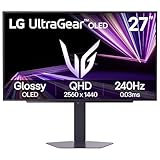
- LG UltraGear OLED Goes Glossy - Experience ultra-smooth, tear-free gameplay with up to 240Hz refresh rate and 0.03ms response time on a glossy, bright 27” QHD OLED display. React instantly, spot every detail, and outpace your opponents in every frame with outrageous speed and clarity.
- Next-Level OLED Brightness, for Next-Level Play - The brilliant OLED display brings every scene to life with jaw-dropping color and intensity. Delivering a standard 275 nits of brightness and peaking at 1300 nits, your games shine with vivid clarity—keeping dark corners detailed, explosions dazzling, and the action always visible no matter the environment.
- VESA DisplayHDR True Black 400 - An OLED display with VESA DisplayHDR True Black 400 and a 1.5M:1 contrast ratio deliver deep blacks and dazzling highlights, so you catch every hidden detail in dark scenes and every spark in the bright ones. With up to 98.5% DCI-P3 color, your worlds burst with vibrant intensity—making every game feel more alive.
- Three UL Certifications. One Clear Advantage for Eye Comfort. - This UltraGear OLED display is three times UL-certified—for Anti-Glare, Flicker-Free, and Low Blue Light. Combined with a glossy finish, the display helps reduce distractions, keep your view crisp, and maintain visual comfort—so you can stay focused and perform at your best, even during extended gaming sessions.
- 27” OLED Brilliance with up to 240Hz of Game-Changing Speed - Experience ultra-smooth, tear-free gameplay with up to 240Hz refresh rate on a glossy, bright 27” QHD OLED display.
These measurements answer different questions. A monitor can have a moderate peak reflection but still show a noticeable overall glow, or it can spread a source widely while keeping the brightest point relatively low. Read the test conditions and the individual review rather than treating one number as a universal score. Brightness belongs in the same comparison: a brighter display can help overcome some room light, while a dimmer one may look washed out sooner. RTINGS notes that monitors with poor reflection handling may require controlled ambient lighting or maximum brightness; if those changes do not work, it recommends considering another monitor.
Do these 3 things before closing this tab:
1Fix the driver behind crashes, sound loss and screen glitches2Clear out junk files and repair common Windows errors3Scan for outdated or missing drivers - takes under a minuteTwo published model results
| Model | RTINGS peak direct-reflection result | How to interpret it |
|---|---|---|
| MSI MPG 271QRX QD-OLED | 24.9% | RTINGS.com result; the search result does not state the test year. It is a measurement of this model, not a rate for all glossy or matte OLEDs. |
| LG 27GS95QE-B | 13.8% | RTINGS.com result; the search result does not state the test year. Compare it only with models measured under the same test framework. |
The two values demonstrate why a coating stereotype is unsafe. They do not establish that every matte monitor beats every glossy monitor, or the reverse. Confirm the current review page, test method and model revision before using a number to choose between products.
OLED examples with different surface treatments
OLED displays are sold with more than one surface treatment. ASUS identifies the ROG Swift OLED PG27AQDM as using a matte micro-texture coating. RTINGS identifies the Samsung Odyssey OLED G60SD as matte and the LG C4 OLED as glossy in its ambient-black-level material. These examples illustrate availability, not a recommendation or a complete current buying list. Availability and specifications can vary by country and over time, so check the manufacturer and the retailer serving your region.
| Example | Finish identified in the cited material | Source and qualification |
|---|---|---|
| ASUS ROG Swift OLED PG27AQDM | Matte micro-texture | ASUS official product information; the glare statement applies to this model. |
| Samsung Odyssey OLED G60SD | Matte | RTINGS ambient-black-level material; verify the current regional specification. |
| LG C4 OLED | Glossy | RTINGS ambient-black-level material; this is a television example, not a claim about every LG OLED monitor. |
What ASUS and independent coating comparisons say
ASUS presents matte coatings as useful where several light sources are present because they diffuse reflections. It presents glossy finishes as preserving a more vivid-looking image in its stated use case, and semi-glossy as a compromise. Those are manufacturer guidelines, so use them to understand the intended design rather than as an objective ranking.
TFTCentral’s coating comparison discusses the appearance of matte, semi-glossy and glossy OLED panel treatments on the models and panels it examined. Its observations are tied to those samples and generations; they should not be converted into a timeless rule for every manufacturer.
The Tool Desk
Outbyte Driver Updater FREEFix the driver behind crashes, sound loss and screen glitchesFind Drivers →Outbyte PC Repair FREEClear out junk files and repair common Windows errorsFree Scan →Also popular on Amazon

- 27 Inch OLED Gaming Monitor with QD-OLED Technology - Experience true blacks and infinite contrast with advanced QD-OLED panel, delivering ultra-vivid colors (147% sRGB / 110% DCI-P3) for immersive gaming and content.
- 240Hz 1440p Gaming Monitor for Ultra-Smooth Performance - Play at peak performance with 240Hz refresh rate and ultra-fast 0.03ms response time, reducing motion blur and ghosting for competitive gaming.
- QHD 1440p Resolution with HDMI 2.1 Connectivity - Crisp 2560x1440 resolution with HDMI 2.1 and DisplayPort 1.4 supports high refresh rate gaming on PC, PS5, and Xbox Series X.
- G-SYNC Compatible for Tear-Free Gaming - Enjoy smooth, stutter-free gameplay with adaptive sync technology that reduces screen tearing and improves responsiveness.
- Height Adjustable Gaming Monitor with USB Hub - Ergonomic stand with height, tilt, swivel, and pivot adjustment plus USB 3.2 hub, VESA mount compatibility, and Flicker-Free technology for extended comfort.
A practical pre-purchase procedure
- Map the light sources. From your normal seated position, list windows, ceiling fixtures, desk lamps and bright walls that can be seen in the screen. Include daylight and nighttime arrangements.
- Try positioning changes. Move the monitor away from the brightest source, rotate it, alter its height or close a blind. If a small change removes the reflection, you may have more freedom to choose glossy.
- View both finishes at realistic brightness. If possible, compare actual units, not stock photos. Display a dark game or film scene, a white document and a mid-gray background. Look for both sharp reflected shapes and broad veiling light.
- Read the exact model’s tests. Check direct-reflection, ambient-black-level and total-reflected-light results. Note the test date or conditions when provided, and do not substitute a result from a similarly named model.
- Check brightness and the rest of the specification. Compare brightness mode and limitations alongside resolution, refresh rate, HDR behavior, pixel layout, ergonomics and the inputs you need. Coating cannot compensate for a monitor that otherwise misses your requirements.
- Confirm regional details. Surface treatment, model suffixes, availability and firmware can differ by market. Verify the manufacturer’s page and the seller’s return policy before ordering.
Glossy and matte trade-offs at a glance
| Factor | Glossy tendency | Matte tendency |
|---|---|---|
| Appearance of a single lamp or window | More distinct and mirror-like | Less sharply defined, spread over a wider area |
| Best lighting context | Dim or controllable rooms | Rooms with fixed or multiple bright sources |
| Risk in dark content | Obvious reflected shapes can sit over the image | Diffuse glow can lift or veil part of the image |
| Predictability from the label | Low; implementations vary | Low; texture and diffusion vary |
| What else matters | Brightness, the monitor’s measured reflection behavior, ambient-black-level rise and your ability to reposition the screen or lights | |
Common mistakes and how to avoid them
Assuming matte means glare-free
Matte scatters reflected light; it does not absorb or eliminate it. A bright window can still wash over a large portion of the display. Reduce the source or change the screen angle when possible.
Assuming glossy always has deeper blacks
Glossy may avoid the broad haze created when light is diffused, but any direct reflection can raise what you perceive in dark areas. Ambient light, panel behavior and brightness determine the result in your room.
Comparing only the coating name
“Matte OLED” is not a standardized performance tier. Use the named model’s reflection tests and specification sheet. The MSI and LG RTINGS results above show why values from individual products cannot be generalized.
Ignoring brightness
Brightness can help a screen compete with room light, but running at maximum output may affect comfort, power use or the monitor’s operating limits. Treat brightness and reflection handling as a pair.
Buying before checking the desk geometry
The same monitor can look comfortable on one desk and distracting on another. Measure the angle between the panel and each light source, then test a different position before spending more for a coating.
A decision checklist for two specific OLED monitors
- Is a window or bright lamp likely to reflect toward your seated position?
- Can you move, shade or switch off that source at the times you use the monitor?
- Does the exact model have published direct-reflection and ambient-black-level results?
- How does its brightness compare with the other candidate under the modes you will use?
- When viewing a dark scene, do you prefer one sharp reflection or a broader, dimmer-looking veil?
- Are the panel’s resolution, refresh rate, HDR behavior, ergonomics and inputs suitable independently of the coating?
- Does the model suffix and finish match the version sold in your country?
If the first answer is yes and the second is no, matte is usually the sensible starting point. If the first answer is no because the room is dim or controllable, glossy deserves a direct comparison. In either case, the final choice should follow the exact monitor’s measurements and your room’s geometry, not a blanket claim that one coating is better.
Quick Recap
Product prices and availability are accurate as of the date/time indicated and are subject to change. Any price and availability information displayed on Amazon at the time of purchase will apply.

