
The Tool Desk
Outbyte PC Repair FREEClear out junk files and repair common Windows errorsFree Scan →Outbyte Driver Updater FREEScan for outdated or missing drivers - takes under a minuteDriver Scan →Facebook’s 2018 Fabric Aggregator separated data-center traffic within a region from traffic going between regions. It used repeatable Wedge100S switches in independent downstream and upstream layers, so Facebook said it could expand each kind of capacity separately instead of relying on a single large chassis. The design addressed a specific scaling problem; the available sources describe Facebook’s 2018 system, not its current deployments or hardware availability.
Why Facebook redesigned in-region interconnection
As data-heavy applications such as search, artificial intelligence, and machine learning grew, Facebook said traffic between servers and fabrics within a region rose substantially. The company reported that its conventional large, general-purpose chassis no longer met its needs for scale, power efficiency, and flexibility. In contemporaneous reporting, Facebook technical product manager Sree Sankar said the company was already using the largest switch available to it and needed to innovate. Data Center Knowledge reported in March 2018 that Facebook expected to need three times as many aggregation-layer ports as it had roughly a year and a half earlier. That was a historical planning estimate, not a current capacity forecast.
What Fabric Aggregator does
Facebook described Fabric Aggregator as a distributed system built from Wedge 100-family switches. A Fabric Aggregator node represents a unit of bandwidth that can be replicated to meet demand at a particular network tier. Its two-layer cross-connect architecture divides work by the destination of traffic:
- Downstream switches: Handle east-west traffic between fabrics within the same region.
- Upstream switches: Handle north-south traffic entering or leaving the region and aggregate those connections toward Facebook’s backbone.
Because the layers have separate roles, Facebook said it could increase regional east-west capacity independently from north-south capacity by adding subswitches to the relevant layer. The company summarized the intent this way: “Separating the solution into two distinct layers allows us to grow the east/west and north/south capacities independently by adding more subswitches as traffic demands change.” Facebook Engineering’s March 2018 design description is the primary account of the architecture.
#1 Best Overall

- DEVICE INTERFACE: 4 x 2.5G ports (100Mbps/1Gbps/2.5Gbps); 2 x 10G SFP+ ports (1Gbps/10Gbps); LED Indicators
- LIFETIME PROTECTION: We stand by the quality of our products. TRENDnet LIFETIME PROTECTION: The TEG-S562 multi-gig switch comes with Lifetime TRENDnet Manufacturer Protection.
- NDAA + TAA COMPLIANT: With our NDAA and TAA compliant network switches, you can plan and install networking solutions that Government customers demand today (U.S. and Canada Only)
- RELIABLE TECH SUPPORT: Our team of advisors, support and tech experts are English speaking, and available for all your needs during normal business hours. We take pride in being there for our customers.
- 2.5G PORTS: This 6 Port Multi-Gig Ethernet switch is equipped with four 2.5GBASE-T RJ-45 ports that provide multi-gigabitspeeds capable of up to 2.5Gbps over existing Cat5e or better cabling.
Repeatable switches instead of a single large chassis
Facebook said its documented implementation used Wedge100S switches running FBOSS, its open-source network operating system, with BGP routing between subswitches. The system was distributed rather than centrally controlled: subswitches operated independently, and Facebook said neither depended on another for operation. Upstream and downstream roles did not require different hardware or software, so the same kind of building block could serve either layer.
This design trades a large chassis for an assembly of repeatable components and cabling that Facebook said emulated a chassis backplane. In the company’s words, it chose “well known, simple, and open building blocks like Wedge 100 and FBOSS” and developed a cabling assembly to address challenges associated with an electrical backplane. The sources describe Facebook’s design rationale; they do not provide an independent comparison against other systems.
Rank #2

- 𝐅𝐥𝐞𝐱𝐢𝐛𝐥𝐞 𝐅𝐮𝐥𝐥 𝐆𝐢𝐠𝐚𝐛𝐢𝐭 𝟏𝟖-𝐏𝐨𝐫𝐭 𝐏𝐨𝐄 𝐂𝐨𝐧𝐟𝐢𝐠𝐮𝐫𝐚𝐭𝐢𝐨𝐧: 16x PoEplus (802.3at/af) 10/100/1000 Mbps RJ45 ports providing up to 30W per port and total PoE power budget of 250W, together w/ 2x Gigabit Non-PoE Ports and 2 Combo SFP Slot for high-speed connections.
- 𝐏𝐥𝐮𝐠 𝐚𝐧𝐝 𝐏𝐥𝐚𝐲: Easy setup with no software installation or configuration needed.
- 𝐀𝐝𝐯𝐚𝐧𝐜𝐞𝐝 𝐒𝐨𝐟𝐭𝐰𝐚𝐫𝐞 𝐅𝐞𝐚𝐭𝐮𝐫𝐞𝐬: Prioritize your traffic and guarantee high quality of video or voice data transmission with Port-based 802.1p/DSCP QoS and IGMP Snooping.
- 𝐒𝐭𝐮𝐫𝐝𝐲 𝐌𝐞𝐭𝐚𝐥 𝐂𝐚𝐬𝐞: Durable metal casing and and professional heat dissipation design are well-suited for different environment with reliability.
- 𝟑 𝐘𝐞𝐚𝐫𝐬 𝐖𝐚𝐫𝐫𝐚𝐧𝐭𝐲: Backed by our industry-leading 3-year warranty and free technical support from 6am to 6pm PST Monday to Fridays, you can work with confidence.
Scaling and fault handling
Facebook said independent components helped isolate failures and let it vary node sizes between regions. For operations, the company described removing a faulty subswitch from service for debugging, or taking the upstream and downstream subswitches in a node out of service with tools that abstract their interactions. It also said node-level redundancy allowed multiple nodes to be taken out at once.
These are Facebook’s descriptions of its architecture and operating approach, not independently verified fault-test results in the available reporting. They explain how the system was intended to handle maintenance and component failures without making every switch part of one tightly coupled chassis.
Do these 3 things before closing this tab:
1Repair Windows errors before they cause bigger problems2Fix the driver behind crashes, sound loss and screen glitches3Clear out junk files and repair common Windows errorsRank #3

- Experience faster data transfers with the NUBASA 8-port 2.5G ethernet switch, featuring eight 2.5Gbps RJ45 ports and one 10Gbps SFP+ uplink port. Ideal for high-speed connections between NAS, gaming consoles, PCs, and workstations, supporting 10/100/1000/2500Mbps auto-negotiation for seamless compatibility
- This 2.5g switch built-in 10Gb SFP+ port supports 1G/2.5G/10G optical and copper modules (sold separately), enabling flexible fiber or Ethernet backbone connections. Perfect for linking to 10GbE routers, servers, or network storage without bottlenecking your uplink speed. Bundle available with 10G module—check options for a ready-to-use kit
- Constructed with a full aluminum alloy casing, this 2.5 gigabit switch delivers superior heat dissipation for stable long-term performance. No fans or moving parts ensure completely silent operation—ideal for home offices, entertainment centers, or quiet environments
- Designed for simplicity: just plug in and go. No configuration needed—this plug-and-play multigig switch automatically detects connection speeds (10M/100M/1G/2.5G) and works seamlessly with existing routers, modems, and network devices. Great for upgrading your wired network in minutes
- Engineered with a compact, durable design that resists scratches and blends neatly into any workspace. Invest in a stable network foundation designed to serve you reliably for years to come. If you seek a durable solution that minimizes the need for frequent upgrades, this 2.5Gbe switch is the strategic choice for your setup
Choosing a rack layout and cable assembly
Facebook described both single-rack and multi-rack assemblies. It said the choice depended on available space and power, required capacity, and the desired failure boundaries; neither layout was presented as universally better.
| Deployment | Space and power considerations | Capacity and failure boundary |
|---|---|---|
| Single rack | Space and failure constraints are well defined; power parameters are tightly set by the user. | Capacity is bounded by the rack and its building blocks. |
| Multiple racks | Space and power parameters can be more flexible. | Capacity is defined by the room and its building blocks; failure constraints are room-defined. |
The engineering post lists four cable approaches and their supported deployment layouts:
Rank #4
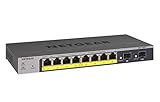
- GIGABIT ETHERNET PORTS: Features 8 x 1.0Gbps Ethernet ports for high-speed connectivity. Auto-negotiating ports detect the optimal speed for connected devices and work with existing Cat5e or Cat6 Ethernet cables.
- POWER-OVER-ETHERNET (PoE): Includes 8 PoE+ ports with 55W total power budget to support power-hungry devices
- SFP CONNECTIVITY: Includes 2 x 1G SFP ports for fiber optic connections and network expansion
- SMART MANAGED NETWORK SWITCH: Smart software with easy-to-use interface offers managed control for secure setup, access, and SNMP (NMS 300) management. Includes 1 year NETGEAR Insight to remotely manage your networks from anywhere.
- FLEXIBLE MOUNTING OPTIONS: Compact metal design supports desktop or wall-mount placement for versatile installation.
| Cable approach | Single rack | Multiple racks | Facebook’s stated topology detail |
|---|---|---|---|
| CWDM4 with single-mode fiber | Supported | Supported | Not further specified in the post. |
| PSM4 with parallel single-mode fiber | Supported | Supported | Not further specified in the post. |
| Pig-tail active optical cable | Supported | Not supported | Requires a sideplane topology. |
| Direct-attach copper cable | Supported | Not supported | Sideplane assembly integrated into the topology. |
Facebook said it submitted specifications for these backplane options to the Open Compute Project (OCP), making OCP a technical design reference for the work. The source does not establish current document availability or commercial terms.
What the reported efficiency figure means
Data Center Knowledge reported Sankar’s claim that Fabric Aggregator offered higher port density and 60 percent higher power efficiency than Facebook’s prior approach. The report gives no benchmark method or baseline, and Facebook’s engineering post does not supply an independent measurement of that percentage. It should therefore be read as a company-reported comparison from 2018, not as a verified general performance figure.
Crashes, No Sound, or Screen Glitches?
Random freezes, missing sound and display glitches usually trace back to one bad driver. Find and replace yours safely.Free scan · under a minutePC Slower Than It Used to Be?
A free scan shows the junk files, broken settings and background clutter dragging Windows down - then fixes them in one click.Free scan · Windows 10 & 11The same contemporaneous report said the design took about five months and rollout lasted nine months. Those are historical figures about Facebook’s reported design and rollout period. It also discussed the transition from 100G to 400G networking as a future power challenge at the time; those 2018 expectations are not a forecast of today’s deployment schedule.
What the 2018 sources establish—and what they do not
The March 20, 2018 Facebook Engineering post documents how the company said Fabric Aggregator was built and operated. Data Center Knowledge’s March 21 report adds attributed context and claims about efficiency, port growth, and rollout. Together, they explain the historical design response to rising regional traffic. They do not establish the system’s present deployment footprint, current performance, present-day Wedge100S availability, or the current status of OCP materials.
Quick Recap
Product prices and availability are accurate as of the date/time indicated and are subject to change. Any price and availability information displayed on Amazon at the time of purchase will apply.

