
iTechGuides is reader-supported. When you buy through links on our site, we may earn an affiliate commission. As an Amazon Associate I earn from qualifying purchases. Learn more
External graphics cards, usually called eGPUs, let a compatible laptop, handheld, or compact computer use a desktop GPU through Thunderbolt or USB4. They can add substantial graphics capability for gaming and creative work, but they are not as fast as an internal PCIe card, and ordinary USB-C, Apple-silicon Macs, and unsupported hosts are not safe assumptions.
An eGPU is an external PCIe enclosure containing a desktop graphics card, power delivery, cooling, and a PCIe bridge. The enclosure may also provide laptop charging, USB ports, Ethernet, or another Thunderbolt connection, but the GPU is usually purchased separately. The decisive buying question is whether the host computer, enclosure, selected card, operating system, and display path are compatible as a complete system.
Key takeaways
- An eGPU requires a Thunderbolt 4, Thunderbolt 5, or USB4 port with confirmed external-graphics support; an ordinary USB-C port is not enough.
- Thunderbolt 5 provides up to 80 Gbps of bidirectional bandwidth and up to 120 Gbps in its display bandwidth-boost mode, but an eGPU still does not behave like a graphics card installed in an internal desktop PCIe slot.
- The Razer Core X V2 accepts graphics cards up to 3.5 slots wide and supplies up to 140 W of USB-C Power Delivery, but the GPU and standard ATX power supply are purchased separately.
- The Sonnet Breakaway Box 850 T5 has an internal 850 W power supply, 100 W laptop charging, USB-A ports, and 5GbE networking, while the Sonnet Breakaway Box 750ex is the more compatibility-focused choice for supported Intel Macs.
- Apple’s standard eGPU support requires an Intel Mac with Thunderbolt 3 and macOS High Sierra 10.13.4 or later; Apple-silicon Macs should not be treated as conventionally eGPU-compatible.
What is an external graphics card?
An external graphics card is a desktop GPU installed inside an external PCIe enclosure and connected to a laptop, handheld, or compact computer through Thunderbolt or USB4. The enclosure supplies the PCIe bridge, cooling, and power, and some models also provide laptop charging, USB ports, Ethernet, or an additional Thunderbolt connection.
Free tools Windows power users keep installed
One-click scans. No signup required.
An external graphics card is usually not an all-in-one purchase. The desktop GPU is commonly sold separately, and the Razer Core X V2 also requires a separately purchased standard ATX power supply. Sonnet’s Breakaway Box products are add-your-own-card enclosures as well. The total system therefore consists of the host computer, enclosure, graphics card, suitable power supply where required, connection cable, and display or other peripherals.
Popular on Amazon

- NVIDIA & AMD DESKTOP GPU READY — Designed to fit PCIe desktop graphics cards up to 4 slots wide, give any compatible laptop a massive boost in power by connecting the latest NVIDIA GeForce and AMD Radeon GPUs (GPU & power supply not included)
- NEXT-GEN THUNDERBOLT 5 PERFORMANCE — Featuring an ultra-fast bandwidth of up to 80 Gbps, enjoy the smoothest performance with a Thunderbolt 5 connection that easily manages the most demanding creative apps and AAA games
- MULTI-DEVICE COMPATIBILITY — From Thunderbolt 4 and Thunderbolt 5 laptops to USB 4 gaming handhelds, integrate the Razer Core X V2 to seamlessly turn compatible devices into gaming or creative powerhouses instantly
- SIMPLE SETUP — Connect the Razer Core X V2 to a compatible device via an included Thunderbolt 5 cable to get a graphical boost when needed and simply unplug when done
- MODULAR GPU & PSU SUPPORT — Swap out to the latest GPU and ATX PSU—or upcycle an older card with PCIe Gen 4 support via easy tool-free install using included thumbscrews
The main reason to buy an eGPU is to add desktop-class graphics capability to a computer that cannot accept an internal desktop graphics card. Common workloads include gaming, 3D applications, video editing, rendering, color grading, animation, special effects, AI experimentation, virtual reality content creation, and multi-monitor workstations. An eGPU is less attractive when the host has no supported high-speed connection, when the chosen application cannot use an external GPU, or when a desktop PC with an internal PCIe slot would be practical.
Which connection does an eGPU need?
An eGPU needs a Thunderbolt 4, Thunderbolt 5, or USB4 connection that explicitly supports external graphics. A USB-C connector only describes the shape of the port; USB-C does not guarantee Thunderbolt, USB4, PCIe tunneling, or eGPU support. Both Razer and Sonnet instruct buyers to confirm external-GPU compatibility with the computer manufacturer before purchase. See the Razer Core X V2 compatibility guidance and Sonnet’s Breakaway Box 850 T5 specifications.
| Connection | Documented bandwidth or condition | What the condition means for an eGPU buyer |
|---|---|---|
| Thunderbolt 5 | Up to 80 Gbps bidirectional; up to 120 Gbps for display transmission in bandwidth-boost mode; Intel describes 64 Gbps of PCIe bandwidth for demanding PCIe devices. | The strongest mainstream connection in the current enclosure choices, but still an external link with more constraints than a direct desktop PCIe slot. |
| Thunderbolt 4 | 40 Gbps connection. | A supported Thunderbolt 4 host can be a sensible eGPU platform, but it has less connection bandwidth than Thunderbolt 5. |
| USB4 | eGPU capability depends on the computer’s implementation; the USB-C label alone proves nothing. | Confirm PCIe tunneling and external-graphics support with the computer manufacturer rather than relying on the port symbol or a generic USB4 specification. |
| Ordinary USB-C | No documented eGPU capability merely from the connector shape. | Do not buy an enclosure until the exact port is confirmed as Thunderbolt 4, Thunderbolt 5, or compatible USB4 with external-graphics support. |
The Thunderbolt 5 technology brief documents the 80 Gbps bidirectional figure, the 120 Gbps display bandwidth-boost mode, and the 64 Gbps PCIe bandwidth description. Those figures describe the connection technology, not a guaranteed frame rate or a universal percentage advantage in every game or application.
Recommended Free Tools
A Thunderbolt 5 enclosure can work with a Thunderbolt 4 host when the particular enclosure and computer support that arrangement. The Sonnet Breakaway Box 850 T5 is documented for Windows computers with Thunderbolt 5 or Thunderbolt 4 and lists USB4 Windows compatibility subject to host verification. The Core X V2 likewise requires a compatible Thunderbolt 4, Thunderbolt 5, or USB4 implementation. Compatibility is a property of the complete host-and-enclosure combination, not just the cable or connector.
How do current eGPU enclosures compare?
The enclosure determines which GPUs physically fit, how much power the system can deliver, how much laptop charging is available, and which desk peripherals can connect through the same box. The following comparison uses documented specifications rather than marketplace prices, which vary by country, seller, and publication date.
| Enclosure | Host and operating-system path | Graphics-card clearance | Power and laptop charging | Ports and included hardware | Best fit |
|---|---|---|---|---|---|
| Razer Core X V2 | Windows 11 with compatible Thunderbolt 4, Thunderbolt 5, or USB4 external-graphics support. | Full-length cards up to 3.5 slots; approximately 362.7 mm long, 82 mm high, and 185.1 mm wide. | Standard ATX power supply purchased separately; up to 140 W of USB-C Power Delivery for the host laptop. | GPU and power supply are not included; use the supplied Thunderbolt 5 cable according to Razer’s installation guidance. | Enthusiasts who want to select their own large NVIDIA or AMD card and need generous clearance or high host charging. |
| Sonnet Breakaway Box 850 T5 | Windows 11 2024H2 or newer in Sonnet’s stated Windows compatibility path; Thunderbolt 5 or 4, with USB4 requiring host verification. | Triple-wide cards up to 345 mm long, 155 mm high, and 70 mm wide. | Internal 850 W power supply and 100 W laptop charging. | Three USB 3.2 Gen 2 Type-A ports and 5GbE networking; supports one 16-pin 12VHPWR connector or three 8-pin connectors. | High-power Windows workstation and creator systems that benefit from built-in USB and 5GbE networking. |
| Sonnet eGPU Breakaway Box 750ex | Windows systems and Intel Macs; Intel Macs can use compatible eGPU cards, while M-series Macs are limited to non-GPU PCIe-card use according to Sonnet. | One full-length, full-height, double-width card no larger than 312 mm long, 160 mm high, and 55 mm wide. | 750 W power supply; cards requiring up to 375 W continuous power plus 100 W peak power; up to 85 W laptop charging. | Four USB Type-A ports and Gigabit Ethernet; the GPU is an add-your-own-card component. | Compatibility-conscious Windows users and Intel Mac owners using a supported AMD card; the double-width limit excludes many newer high-end cards. |
The Razer Core X V2 is the flexible enthusiast enclosure, not an all-in-one eGPU. The Sonnet Breakaway Box 850 T5 is the strongest documented high-power Windows Thunderbolt 5 workstation option in this comparison because it combines an internal 850 W supply with 100 W charging, USB ports, and 5GbE. The 750ex remains useful for supported Intel Mac workflows and mature Windows setups, but its double-width clearance is a serious limitation for modern triple-slot cards.
An enclosure’s headline wattage does not automatically make every graphics card safe to install. Check the selected card’s continuous power requirement, peak or transient behavior, connector type, cable clearance, and exact board dimensions. A power supply can have sufficient total wattage while the card still fails the enclosure’s physical or connector requirements.
Which desktop GPU should you put in an eGPU enclosure?
The right GPU depends on the host connection, enclosure clearance, application, display resolution, and power budget. There is no single universal eGPU graphics card because a thin laptop used for 1080p gaming has different requirements from a Windows workstation running demanding rendering or AI workloads.
| GPU tier | Appropriate workload | Representative choice | Important eGPU checks |
|---|---|---|---|
| Midrange desktop GPU | 1080p or 1440p gaming, lighter video editing, and general creative work. | Select a current NVIDIA or AMD card that fits the enclosure’s exact length, width, height, connectors, and power limit. | Prioritize host compatibility and value; buying a card that the enclosure cannot cool or power wastes the enclosure investment. |
| Current upper-midrange | Demanding 1440p gaming and entry-level 4K work. | Radeon RX 9070 XT graphics card. | AMD lists 16 GB of GDDR6, 304 W typical board power, two 8-pin connectors, and a 750 W minimum PSU recommendation; partner-card dimensions still vary. |
| High-end desktop GPU | High-end gaming, rendering, and workloads that can use a large amount of GPU memory and compute. | GeForce RTX 5090 class. | NVIDIA lists 32 GB of GDDR7 and 575 W total graphics power for the RTX 5090 Founders Edition, with a 1,000 W recommended system power level and a 600 W PCIe Gen 5 cable or adapter arrangement; exact add-in-card dimensions must be checked. |
The Radeon RX 9070 XT is relatively straightforward to evaluate for an eGPU because AMD documents 304 W typical board power and two 8-pin connectors, but an individual partner board may be longer, taller, or wider than the reference specification. Match the exact partner model to the enclosure rather than shopping by GPU family name alone.
The GeForce RTX 5090 is a much more demanding enclosure choice. NVIDIA lists 575 W total graphics power, 32 GB of GDDR7 memory, a three-slot Founders Edition clearance requirement, and a 1,000 W recommended system power level. Those requirements make the 5090 unsuitable for the Sonnet 750ex’s documented 375 W continuous-card limit, even before the card’s exact physical dimensions are considered. A 5090 should only be paired with an enclosure after checking the specific board model, power connectors, power supply, cooling, and host-link limitations.
A larger and more powerful GPU does not automatically produce a proportional eGPU improvement. The external connection, host CPU, application support, display path, and game engine can all limit the result. Spend more on the GPU only when the enclosure and workload can use the additional capability.
Quick wins for a faster PC:
Repair Windows errors before they cause bigger problemsFix Now →Scan for outdated or missing drivers - takes under a minuteDriver Scan →Also popular on Amazon
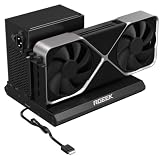
- PCIe 5.0 x4 Bandwidth: the Oculink eGPU Dock supports PCIe 5.0 x4 with up to 128Gbps bandwidth, backward compatible 4.0/3.0. Most existing OCuLink ports only support PCIe 4.0 with a max speed of 64Gbps. To reach full PCIe 5.0 speed, you need an M.2 slot or a PCIe 5.0 to OCuLink adapter (Adapter not included; need be purchased separately)
- High Qulity Material: Full aluminum material for great heat dissipation & sturdy durability. Factory-soldered cable avoids extra adapters with negligible signal loss.
- Broad GPU Compatibility & Multi-Scenario Use: this OCuLink eGPU dock supports mainstream NVIDIA and AMD graphics cards, such as RTX 4090 and RX 7900. It fits both gaming and professional GPUs perfectly. Ideal for gaming, 3D modeling, graphic rendering and AI computing tasks, it is an ideal external GPU expansion solution for laptops and mini PC upgrades.
- Easy to Use & Wide Compatibility:No size restrictions for graphics cards, compatible with most GPUs. It supports ATX, SFX and SFX-L power supplies. Uniform I/O port layout keeps your desktop wiring neat, and installation is hassle-free.Simply download the driver after assembly to get started. Note that hot plugging is not supported.
- Package Includes: aluminum Pcie 5.0 OCuLink SFF-8611 to PCIe x16 eGPU Dock with 50cm/19.7inch Cable. Note: Graphics card and power supply are not included.
Which operating systems support external graphics cards?
Windows 11 is the clearest current platform for a new eGPU build, while Intel Macs have a narrower but official Apple-supported path. Apple-silicon Macs do not inherit the standard Intel-Mac eGPU workflow.
| Host platform | Support position | Conditions and practical decision |
|---|---|---|
| Windows 11 laptop or compact PC | Best current platform for new eGPU builds. | Use a compatible Thunderbolt 4, Thunderbolt 5, or USB4 implementation, current BIOS and firmware, a supported GPU driver, and an enclosure with sufficient power and clearance. Sonnet’s 850 T5 statement specifies Windows 11 2024H2 or newer. |
| Intel Mac with Thunderbolt 3 | Supported through Apple’s official eGPU path. | Apple requires an Intel processor, Thunderbolt 3, and macOS High Sierra 10.13.4 or later. Apple’s supported path uses compatible AMD Radeon architectures, and not every app or game supports eGPU acceleration. |
| Apple-silicon Mac | Not supported by Apple’s standard eGPU documentation. | Apple’s support article expressly requires an Intel processor. Sonnet describes experimental GPU support for AI developers on some M-series Macs with the 850 T5, but that vendor-specific experiment should not be treated as ordinary macOS eGPU support. |
| Older Windows Thunderbolt 3 computer | Compatibility-specific rather than automatically supported. | Check the exact laptop model, firmware, driver path, enclosure requirements, and software support before buying a used Thunderbolt 3 enclosure or assuming a current GPU will work. |
Apple’s official external graphics processor guidance requires an Intel Mac with Thunderbolt 3 running macOS High Sierra 10.13.4 or later. Apple also warns that not all applications and games support eGPU acceleration. For many gaming and graphics-heavy workflows, Apple recommends connecting the external display directly to the eGPU rather than sending rendered frames back through the Mac’s internal display.
Sonnet’s documentation makes an important distinction for the 750ex: Intel and M-series Macs can use the enclosure for non-GPU PCIe cards, but only Intel Macs are compatible with eGPU cards. A MacBook with an Apple silicon processor should therefore not be purchased with a conventional eGPU enclosure on the assumption that an Intel Mac setup will work.
What performance should you expect from an eGPU?
An eGPU can be substantially faster than integrated graphics, but the external link prevents a universal performance promise. Results depend on the host CPU, Thunderbolt or USB4 implementation, GPU model, game or application, display connection, resolution, driver, and whether the software supports external-GPU acceleration.
A graphics card installed directly in a desktop PCIe slot has a lower-latency, higher-capacity path to the rest of the system. Thunderbolt 5 improves the connection compared with Thunderbolt 4, but Thunderbolt 5 does not turn an external enclosure into an internal desktop slot. The official Thunderbolt 5 brief describes the connection bandwidth; it does not establish one benchmark that applies to every laptop, application, game, and display arrangement.
Connecting a monitor directly to the eGPU is usually the preferred layout for gaming and display-heavy work when the host and application support it. Rendering to an external monitor connected to the eGPU avoids sending completed frames back across the same external link to the laptop’s internal panel. The direct-display recommendation is especially relevant to the Intel Mac workflow documented by Apple.
Use an eGPU when portability and graphics expansion matter more than maximum desktop efficiency. A thin laptop with no internal GPU upgrade path may gain a useful graphics workstation from an enclosure, while a desktop buyer who can install a card internally will generally have the simpler and less bandwidth-constrained design.
How do you install an external graphics card?
Install the card and its power supply, connect the enclosure directly to the host’s verified eGPU port, update the host software, install the GPU driver, and attach the display directly to the eGPU where practical. Razer’s current installation guidance specifically calls for installing the graphics card and compatible ATX PSU, connecting the included Thunderbolt 5 cable, updating the operating system, and installing the GPU driver.
PC Slower Than It Used to Be?
A free scan shows the junk files, broken settings and background clutter dragging Windows down - then fixes them in one click.Free scan · Windows 10 & 11Outdated Drivers Are Slowing You Down
One free scan finds every outdated or missing driver and matches the right update for your exact hardware.Free scan · exact hardware match- Verify the host before unpacking. Confirm the exact port is Thunderbolt 4, Thunderbolt 5, or USB4 with external-graphics support. Confirm the operating system, firmware requirements, and driver path for the specific computer.
- Verify the complete card specification. Measure the exact graphics-card board, including length, height, width, slot thickness, power plugs, and the space required for airflow. Do not rely on the dimensions of a reference card when buying a factory-overclocked partner model.
- Prepare the enclosure. Install the desktop GPU and connect every required GPU power plug. For a Core X V2, install a separately purchased standard ATX power supply sized for the GPU and enclosure requirements. For a Sonnet enclosure, confirm that the selected card’s power connectors and draw fit the internal supply and documented limits.
- Update the host software. Install current computer BIOS and Thunderbolt or USB4 firmware where the manufacturer provides it. Update Windows when using a Windows eGPU, and use the operating system and driver versions documented for the enclosure and GPU.
- Connect the enclosure directly. Use the enclosure’s supplied or appropriate certified Thunderbolt cable and connect it directly to the host’s compatible port. Avoid placing an unverified dock, hub, adapter, or long extension between the computer and the eGPU.
- Install the official GPU driver. Install the driver supplied by the GPU manufacturer for the host operating system. Restart if the driver installer requests it, then verify that the GPU appears in the operating system’s device and graphics settings.
- Connect the display to the eGPU. Attach the monitor, VR headset, or other high-bandwidth display device to the outputs on the external GPU when possible. Test the workload on the external display before judging performance through the laptop’s internal screen.
- Test one variable at a time. Confirm that the enclosure is detected, the driver is loaded, the display is connected to the intended GPU, and the application is configured to use the external GPU. Only then add USB devices, Ethernet, extra displays, or other peripherals.
If a replacement connection is needed, choose a certified Thunderbolt 5 cable rather than assuming that every USB-C cable has the bandwidth and PCIe behavior required by an eGPU. Use the cable supplied with the enclosure first, and treat cable replacement as a specification and certification decision rather than a generic charging-cable purchase.
How should you troubleshoot an eGPU that does not work?
| Symptom | Most likely checkpoint | Recovery action |
|---|---|---|
| The enclosure powers on but the computer does not detect the GPU. | Unsupported USB-C port, incorrect USB4 implementation, outdated firmware, or a non-direct connection. | Confirm external-graphics support for the exact host model, update BIOS and Thunderbolt or USB4 firmware, connect directly, and test the supplied cable. |
| The GPU is detected but the application uses integrated graphics. | Application support or operating-system graphics selection. | Check the application’s GPU preference, install the correct manufacturer driver, and test with a display connected directly to the eGPU. |
| The internal laptop screen performs worse than an external monitor. | Rendered frames must travel back through the external link to the host display. | Connect the monitor directly to the eGPU for gaming and display-heavy workloads where the host and application support that arrangement. |
| The system shuts down, resets, or becomes unstable under load. | Insufficient power, an incorrect connector, poor cable seating, inadequate cooling, or a card beyond the enclosure’s documented power limit. | Recheck every power plug, compare GPU continuous and peak requirements with the enclosure specification, verify airflow, and test a card that fits the documented limit. |
| The graphics card cannot be inserted or the enclosure will not close. | The partner card is wider, taller, or longer than the enclosure allows. | Measure the exact board and compare it with the enclosure’s length, height, width, and slot limit. Replace the card or enclosure; do not force the installation. |
| An Intel Mac does not accelerate an application. | The application or game may not support eGPU acceleration. | Check Apple’s app-support conditions, use a compatible AMD card and Intel Mac, and connect the external display directly to the eGPU when appropriate. |
| An Apple-silicon Mac does not recognize a conventional eGPU. | Apple’s standard eGPU path requires an Intel processor. | Do not treat the Intel-Mac instructions as applicable. Consider the Mac’s internal GPU, a supported desktop, or a vendor-specific experimental workflow only if the exact use case is documented. |
| Windows security or enterprise policy interferes with the PCIe device. | Thunderbolt and USB4 PCIe peripherals are external, hot-pluggable devices and may be affected by DMA-security configuration. | Review the computer manufacturer’s Thunderbolt security controls and Windows Kernel DMA Protection documentation before changing security settings. |
Windows should be updated before deeper troubleshooting, followed by the computer BIOS, Thunderbolt or USB4 firmware, enclosure firmware where available, and the official NVIDIA or AMD driver. An optional Windows troubleshooting tool such as Outbyte Driver Updater advertises device scanning, recommendations for official device drivers, and driver backup and restore. Outbyte Driver Updater should not replace the GPU manufacturer’s official driver page and should not be presented as a way to increase eGPU performance by itself.
Independent reader supportYour contribution helps us test, update, and keep practical guides available for everyone.What are the older Thunderbolt 3 enclosure options?
Older Thunderbolt 3 enclosures can be useful on the used market, but older products are not equivalent to current Thunderbolt 5 models and should be treated as compatibility-specific purchases.
| Older product | Documented limitation | Used-market implication |
|---|---|---|
| ASUS ROG XG Station 2 | Thunderbolt 3, 600 W power supply, and a 2.5-slot card limit. | Check the exact card fit, host support, driver behavior, and physical condition rather than comparing its 600 W figure directly with a current enclosure. |
| AKiTiO Node-family products | Legacy enclosure range with model-specific Thunderbolt and card-clearance specifications. | Confirm the exact model, included power supply, cable, firmware, and operating-system support before purchase. |
| Lenovo Legion BoostStation | Thunderbolt 3 accessory with narrow model-specific software support documented by Lenovo. | Do not assume that a generic Thunderbolt 3 laptop and a modern GPU will work without checking Lenovo’s support material for the particular system. |
The Lenovo Legion BoostStation support material is a reminder that Thunderbolt 3 compatibility can depend on software and host-model support, not merely on the presence of a USB-C-shaped port. A cheap used enclosure is only a bargain when its card clearance, power supply, firmware, cable, and host support match the intended build.
What’s actually slowing this PC down?
Pick the symptom - the matching free tool is one click away.
Also popular on Amazon

- BOSGAME GVP 7600M eGPU supports Laptop, PC, and Handheld Console PC with Thunderbolt 3/4, USB 4, or OCuLink ports.
- BOSGAME GVP 7600M Features up to 4TB SSD expansion (M.2 2280 PCIe 3.0), RJ45 ethernet port, and two USB-A 3.2 ports. Video output includes 2x HDMI 2.1 (4k60Hz) and 2x DP 2.0 (4k120Hz), and supports 4 displays setup.
- BOSGAME eGPU GVP-7600M Built-in AMD Radeon RX 7600M XT video graphic card gives you performance equal to an RTX 4050 laptop, all crafted into a portable and sleek aluminum alloy enclosure, and weighs only 1.92lb.
- BOSGAME eGPU Radeon 7600M XT default GPU TDP is 100W, short press the Turbo Button to switch to 120W for more performance.
- Reliable After-Sales Service: We provide reliable after-sales service. All products have FCC, ROHS, and CE certifications. Additionally, we offer 3 year of professional factory support and 24/7 online customer service
Is cloud streaming a substitute for an external graphics card?
Cloud streaming can be a better solution than an eGPU when the goal is an always-on broadcast rather than local gaming, editing, rendering, or GPU compute. StreamNeo describes a cloud workflow that loops recorded video to YouTube, includes automatic recovery, and does not require a local PC or OBS to run overnight.
The StreamNeo cloud live-streaming service does not add local graphics power to a laptop. Choose an eGPU when the computer must render games, edit video, run 3D applications, or drive local displays. Consider cloud streaming when the main requirement is unattended online playback and local GPU ownership would solve the wrong problem.
Which eGPU should you buy?
Choose an external graphics card setup by following the host-first decision tree below:
- Windows 11 with Thunderbolt 5 and a high-power workstation workload: Start with the Sonnet Breakaway Box 850 T5 if its triple-wide clearance, 850 W supply, 100 W charging, USB ports, and 5GbE fit the planned GPU. Confirm the exact card dimensions and power connectors.
- Windows 11 with Thunderbolt 5 and a large self-selected GPU: Consider the Razer Core X V2 for its 3.5-slot support, approximately 362.7 mm length clearance, and up to 140 W laptop charging. Budget for the separately purchased standard ATX power supply as well as the GPU.
- Windows Thunderbolt 4 or compatible USB4: Choose an enclosure whose documentation covers the host path, then verify the computer manufacturer’s eGPU support. Do not infer compatibility from USB-C branding alone.
- Intel Mac with Thunderbolt 3: Use Apple’s supported AMD-card path and a compatible enclosure such as the Sonnet Breakaway Box 750ex when its double-width, 312 mm by 160 mm by 55 mm card limit fits the selected card. Confirm application support.
- Apple-silicon Mac: Do not purchase a conventional eGPU expecting Intel-Mac behavior. A vendor-specific experimental AI workflow is not the same as standard macOS eGPU support.
- Older Thunderbolt 3 enclosure: Buy used only when the exact enclosure, host computer, GPU, firmware, drivers, cable, and physical limits have been checked together.
External graphics card buying checklist
- Confirm Thunderbolt 4, Thunderbolt 5, or USB4 external-graphics support on the exact host computer.
- Confirm the operating-system and driver path, especially if the host is a Mac.
- Measure the exact GPU’s length, height, width, slot thickness, airflow clearance, and power connectors.
- Match continuous and peak power capability instead of relying only on the enclosure’s headline wattage.
- Check laptop charging wattage if one-cable charging is important: the documented figures are up to 140 W for the Core X V2, 100 W for the 850 T5, and 85 W for the 750ex.
- Confirm whether the enclosure includes a power supply and GPU. The Core X V2 includes neither the GPU nor the separately acquired ATX PSU.
- Use the supplied or a certified Thunderbolt cable and connect the enclosure directly to the host.
- Connect an external monitor directly to the eGPU when gaming or using display-heavy applications.
- Update BIOS, Thunderbolt or USB4 firmware, Windows or macOS, and the official GPU driver before diagnosing performance.
- Reject the purchase if the host is only ordinary USB-C or if the selected card exceeds the enclosure’s dimensions or power limits.
Bottom line
External graphics cards are worthwhile when a compatible Windows laptop, handheld, or compact computer needs more local graphics power and cannot accept an internal GPU. Buy the enclosure and desktop card as one compatibility project: verify the host connection, operating system, exact card dimensions, power connectors, cooling, and display path before spending money.
For new Windows builds, Thunderbolt 5 enclosures offer the most capable connection and current feature sets, but Thunderbolt 4 can still be practical. Intel Macs have an official but narrower AMD-card path, while Apple-silicon Macs should not be assumed to support conventional eGPUs.
Frequently Asked Questions
Can I use an external graphics card with any USB-C laptop?
An external graphics card requires a Thunderbolt 4, Thunderbolt 5, or USB4 port with confirmed external-graphics support. A USB-C connector by itself does not guarantee that an eGPU will work.
Do external graphics cards work with Apple-silicon Macs?
Apple’s standard eGPU support requires an Intel Mac with Thunderbolt 3 and macOS High Sierra 10.13.4 or later. Apple-silicon Macs should not be expected to support a conventional eGPU, although Sonnet documents a separate experimental AI use case for some M-series systems.
Does an eGPU enclosure include the graphics card?
Most current eGPU enclosures require you to provide the desktop GPU separately. The Razer Core X V2 also requires a separately purchased standard ATX power supply, while Sonnet’s Breakaway Box products are add-your-own-card enclosures.
The Tool Desk
Outbyte PC Repair FREEClear out junk files and repair common Windows errorsFree Scan →Outbyte Driver Updater FREEScan for outdated or missing drivers - takes under a minuteDriver Scan →Should I connect my monitor to the eGPU or the laptop?
A monitor connected directly to the eGPU is usually preferable for gaming and display-heavy workloads because rendered frames do not need to travel back across the external link to the laptop’s internal display. Actual performance still depends on the host, application, driver, GPU, and connection.
The Bottom Line
Bottom line: Buy an eGPU only after confirming the host’s external-graphics support and matching the enclosure to the exact GPU’s dimensions, connectors, and power draw. Thunderbolt 5 is the strongest current connection, Windows 11 is the clearest platform, Intel Macs have limited official support, and Apple-silicon Macs are not a conventional eGPU target.

