
Shyri Villar’s ESP32 project turns a traditional Game Boy Advance into a Bluetooth gamepad: with no cartridge inserted, the console boots a small ROM sent through its link port, then passes button input through an ESP32 to a paired PC, phone or Android TV. The documented target is the original GBA, not the GBA SP.
How the ESP32 turns a GBA into a Bluetooth controller
The adapter connects an ESP32 to the Game Boy Advance link port. On startup, the ESP32 sends a small program to the console using the GBA multiboot protocol. That program lets the GBA communicate with the adapter; the ESP32 manages Bluetooth and forwards the console’s button input as gamepad controls to a paired host.
- Leave the cartridge slot empty and connect the ESP32 adapter to the GBA link port.
- Power on the GBA. The ESP32 sends the small multiboot ROM to the console.
- Pair the adapter with a compatible Bluetooth host, such as a PC, phone or Android TV.
- Use the GBA buttons as gamepad input. On a later launch, press A to reuse the stored device address.
Hackaday’s April 21, 2020 coverage says five wires are enough for the connection. The available project description does not give a pin-by-pin wiring map, so use the project’s own build instructions rather than inferring connections from the wire count.
Which ESP32 and parts does the build use?
The project author identified the module as an ESP32-WROOM-32 in a Hackaday discussion on April 23, 2020. A related open-hardware implementation provides a more specific parts list for its PCB build:
The Tool Desk
Outbyte Driver Updater FREEFix the driver behind crashes, sound loss and screen glitchesFind Drivers →Outbyte PC Repair FREEClear out junk files and repair common Windows errorsFree Scan →#1 Best Overall
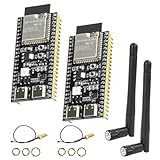
- 【High-performance dual-core processor】Integrated Xtensa 32-bit LX7 dual-core processor, offering powerful computing power and performance with low power consumption.
- 【Wi/Fi and BT Dual Mode Support】for ESP32-S3 supports Wi-Fi 802.11 b/g/n and Bluetooth 5.0. Its Bluetooth Low Energy subsystem supports Bluetooth 5 (LE) and Bluetooth Mesh. Equipped with a low-power coprocessor and a high-power mode of up to 20 dBm, it can meet the requirements of a variety of application scenarios.
- 【Upgrade from for ESP32 S3】Compared to other ESP32S3 development boards, this development board features enhanced features and additional external antenna interfaces, to meet more user requirements.
- 【Comprehensive Wi-Fi Features】 Supports WMM, A-MPDU, A-MSDU, instant block confirmation and other features to improve multitasking efficiency.
- 【Large Storage Capacity】The ESP32 module integrates 8 MB RAM and 16 MB Flash and provides enough storage for the development of complex applications.
| Part | Quantity or specification |
|---|---|
| ESP32 module | ESP-WROOM-32 ESP32-WROOM-NARROW |
| PCB | 1 mm thick |
| Resistors | One 1 kΩ 0603 and two 10 kΩ 0603 |
| LED | One 0603 LED |
| Switches | Two bottom switches, 4.6 × 2.8 mm |
| Programming adapter | CP2102 USB-UART adapter |
| GBA connection | GBA link-cable connector; a third-party GBA-to-GameCube cable is described as a possible donor |
The related implementation includes Gerber files for PCB fabrication. Its firmware must be compiled or flashed to the ESP32; the listed USB-UART adapter is relevant to that programming step. Hackaday also describes salvaging the male connector from a GBA-to-GameCube cable, which can serve as a compact enclosure donor. These are distinct approaches: the donor cable reuses a connector and casing, while the open-hardware design uses a custom thin PCB.
How the ESP32 redesign compares with the earlier prototype
| Design | What the project coverage establishes | Practical implication |
|---|---|---|
| Earlier Atmega/HC-05 prototype | The earlier version used an Atmega and HC-05 Bluetooth module. | It uses multiple main chips rather than the ESP32 redesign’s single ESP32. |
| ESP32 redesign | Hackaday describes an ESP32 connected to the GBA link connector, with five wires reported for transferring the small ROM and user input. | The design consolidates the Bluetooth hardware and link communication around one ESP32 module. |
Does it work with a GBA SP?
The documented target is a traditional Game Boy Advance. The author reports that the adapter did not work with a GBA SP and suspects the SP does not provide enough current. The project description does not establish a tested SP-compatible modification, so treat SP support as unproven rather than assuming the original build will work.
Rank #2
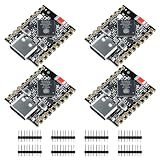
- ESP32-S3 Dual-Core: Powered by ESP32-S3 dual-core processor running up to 240MHz, suitable for IoT applications, embedded systems, real-time control, and edge computing tasks with low power consumption.
- A I and Vector Processing Support: Includes vector instruction support and an optimized architecture, providing compatibility with AIoT-related applications such as voice processing, sensor data handling, and basic image processing scenarios.
- WiFi and BT 5.0: Supports 2.4GHz WiFi and Bluetooth 5.0 Low Energy (BLE), enabling wireless communication for IoT devices, smart home applications, sensors, and cloud-based systems.
- USB-C Port: Features a USB-C port with native USB capability for power supply, firmware flashing, and serial communication, simplifying development setup and standard debugging processes.
- Compact Design with Flexible Integration (No Header): Compact ESP32-S3 mini development board without pre-soldered pin headers, allowing direct soldering or custom PCB integration for embedded system design and space-limited applications.
The ESP32 receives 3.3 V through the GBA port. That power arrangement is part of the documented original-GBA build; it is not evidence that another GBA model supplies the same usable power under this setup.
Independent reader supportYour contribution helps us test, update, and keep practical guides available for everyone.What firmware and Bluetooth version should builders expect?
The original project README records ESP-IDF v3.3.2 as the tested development environment and identifies a specific btstack commit as the most recent version proven to work with that project. This is historical build information, not a guarantee that the firmware will compile unchanged with a current ESP-IDF release.
Recommended Free Tools
Rank #3

- DC 5V-12V
- 1 analog input(3.2V max input)
- Micro USB connection
- Compatible with For Arduino
- D1 R32=WiFi+Bluetooth+UNO
Current Espressif documentation describes the ESP32 as supporting Dual-Mode Bluetooth 4.2 and provides Bluetooth Classic stack and application APIs. That general platform capability does not establish that this 2020 project’s firmware builds or behaves identically on a current toolchain. Builders should distinguish the ESP32’s documented Bluetooth capabilities from the project’s older tested software combination.
Quick Recap
Best Value

- ESP32-P4-WIFI6-DEV-KIT development board, based on ESP32-P4 and ESP32-C6, high-performance MCU with RISC-V 32-bit dual-core and single-core processors, supports 2.4GHz Wi-Fi 6 and Bluetooth 5 / BLE 5, supports AI speech interaction
- 32MB PSRAM in the chip's package, with onboard 16MB Nor Flash. 128 KB HP ROM, 16 KB LP ROM, 768 KB HP L2MEM, 32 KB LP Static RAM, 8 KB TCM
- Rich human-machine interfaces, such as MIPI-CSI, MIPI-DSI, USB 2.0 OTG, Ethernet, SDIO 3.0 TF card slot, onboard microphone, speaker header, etc. Reserved PoE module header, connect to a PoE Module for PoE power supply
- Powerful image and voice processing capability. Provides image and voice processing interfaces including JPEG Codec, Pixel Processing Accelerator, Image Signal Processor, H264 encoder
- Security features: Secure Boot, Flash Encryption, cryptographic accelerators, and TRNG. Additionally, hardware access protection mechanisms help to enable Access Permission Management and Privilege Separation
Rank #4

- Package: 1pcs* ESP32 KEY
What this project does—and does not—cover
- It is a GBA controller project: the multiboot program runs on a Game Boy Advance and the ESP32 sends its controls over Bluetooth.
- It is not a generic Game Boy Color wireless adapter: the documented interface and startup method are specific to the GBA link port and multiboot process.
- It does not establish universal Bluetooth-host compatibility: the project names a PC, phone and Android TV as possible paired hosts, but does not provide a compatibility matrix for particular operating systems or devices.
- It does not establish a current-toolchain recipe: the recorded known-working environment is ESP-IDF v3.3.2 with the named btstack revision.
Product prices and availability are accurate as of the date/time indicated and are subject to change. Any price and availability information displayed on Amazon at the time of purchase will apply.

