
What’s actually slowing this PC down?
Pick the symptom - the matching free tool is one click away.
AI can generate alternative periodic-table layouts and model properties of hypothetical elements, but it cannot declare a new element into existence. A scientifically recognized element requires laboratory evidence, independent assessment and the formal discovery and naming process coordinated by the International Union of Pure and Applied Chemistry (IUPAC).
What “a new periodic table” can mean
The phrase combines three different projects. Keeping them separate prevents a visualization or a computer prediction from being mistaken for a chemical discovery.

| Meaning | What AI can contribute | What would count as evidence |
|---|---|---|
| New layout | Rearrange known elements by atomic number, electron structure, properties or another stated rule; generate a chart or interactive visualization. | The chart is a representation. Its quality depends on accurate data, a clear organizing principle and transparent labeling. |
| Predicted element or property | Estimate properties of an undiscovered nucleus, compare theoretical candidates and identify experiments worth attempting. | A prediction must state its model, assumptions and uncertainty, then be tested against measurements or accepted calculations. |
| Discovered element | Help analyze collision data, decay chains and candidate reactions. | Experimental synthesis and decay evidence followed by evaluation under IUPAC discovery criteria. Naming comes only after that process. |
How to use AI to build a scientifically responsible table
1. Define the scope and date
Start by stating whether the table contains only recognized elements, theoretical candidates, or both. Date the dataset and identify the authority used. The U.S. Department of Energy reported 118 known elements in 2025, of which 90 occur naturally on Earth. A chart mixing those 118 with hypothetical entries should visibly distinguish the categories.
2. Assemble structured element data
Provide the model with fields such as atomic number, symbol, name, electron configuration, state, density, melting point, oxidation states and radioactive status. Keep source values and units attached to each field. AI can format, classify and visualize this information, but it should not silently fill missing measurements with plausible-sounding values.
The Tool Desk
Outbyte Driver Updater FREEScan for outdated or missing drivers - takes under a minuteDriver Scan →Outbyte PC Repair FREEClear out junk files and repair common Windows errorsFree Scan →#1 Best Overall

- Periodic Table of Elements Poster Chart
- High-quality 3 MIL lamination for added durability
- Easy to read, clear font for optimum learning
- Tear Resistant
- 18" x 24"
3. Choose an organizing principle
The conventional table orders elements by atomic number while exposing recurring chemical behavior. An alternative may emphasize electron shells, valence patterns, crystal structure, abundance or predicted stability. Explain what the layout makes easier to see and what it obscures; no arrangement is universally “best.”
4. Label certainty at the entry level
- Known: recognized element with an established atomic number.
- Predicted: a model output or theoretical estimate, not an observed element.
- Illustrative: a placeholder used to demonstrate a layout, with no claim about existence.
Use a legend and include the model version, training or calculation data, date and uncertainty range where available.
Rank #2

- Large Format: Generously sized at 54" x 35", providing a comprehensive view of the periodic table for easy reference and study.
- Educational Content: Clearly labeled with atomic numbers, symbols, names, and atomic masses for all elements, facilitating effective learning and understanding of chemistry.
- Vibrant Colors: High-quality printing with vibrant colors enhances visibility and makes the poster visually appealing in educational settings.
- Durable Construction: Made from sturdy material with a thickness of 0.011 inches, ensuring durability and resistance to wear and tear.
- Versatile Use: Suitable for classrooms, laboratories, and home study spaces, catering to students, educators, and science enthusiasts interested in exploring chemical elements.
5. Check chemistry and arithmetic
Have independent software or a second calculation verify atomic-number order, symbols, electron configurations and unit conversions. Test whether the model reproduces known elements before trusting extrapolations. A visually polished chart can still contain duplicated atomic numbers, impossible configurations or properties copied from the wrong element.
Can AI predict elements that have not been discovered?
It can help explore hypotheses about superheavy nuclei and their possible properties. A 2024 Nature Reviews Physics review describes theoretical calculations, high-performance computing and machine learning as contributors to the study of superheavy systems, where direct experimental data are scarce.
Rank #3
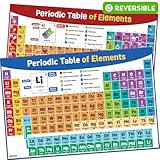
- More Than Just Science. Simplify complex concepts with a unique, reversible 1pc Periodic Table Poster for classroom use that presents all the scientific information kids need to know simply and clearly - sparking interest by making Chemistry relatable and interesting.
- Large, Reversible 2025 Updated Design with Color-Coded Element Groups. This fun 2-in-1 Periodic Table of Elements Poster for classroom use is fully up to date and based on 2025 IUPAC standards, showing a scientifically accurate standard table on one side and an illustrated version on the other with practical real-world uses of the elements. Each 24” x 16” large periodic table poster is color-coded according to element groups to enhance visual clarity, encourage a broad understanding and simplify learning.
- Vibrant, Engaging Visuals That Stimulate Interest. Featuring bright, colorful periodic table wall art learning posters designs that captivate children's attention, its eye-catching colors and illustrations encourage engagement without being overstimulating, ensuring distraction-free learning. Beautiful and engaging classroom decor that can be seen even from a distance.
- Clear, User-Friendly Back to School Supplies That are Easy to Understand. Our classroom educational posters utilize large, clear fonts in a clean layout for easy readability and seamless learning. Information is presented in a simple, straightforward layout that helps students grasp key concepts and easily remember details. Pair with periodic table flashcards for quicker learning.
- Reusable, Durable & Waterproof PVC Science Posters. Premium-quality Chemistry posters and back to school decorations made of waterproof PVC plastic, eliminating the need for lamination. Sturdy & durable with clear UV printing and a matte finish, it looks great and matches any room aesthetic. An engaging educational tool that will last for years without needing to repurchase. Order Periodic Table for Kids Now!
Those predictions are unusually difficult to interpret. Strong relativistic effects increase with atomic number, and familiar trends from lighter elements may break down. A model can therefore suggest a reaction, stability window or property worth investigating, but the result remains conditional on its assumptions. Report confidence intervals or competing predictions rather than presenting a single generated value as fact.
How a genuinely new element is made
Superheavy elements are produced in laboratories, not by a chart-generating prompt. Researchers direct an ion beam at a target; in rare collisions, the nuclei fuse. The product is usually highly radioactive and may survive only briefly. Scientists can infer its identity from a characteristic sequence of radioactive decays when the atom cannot be observed for long.
Rank #4

- COMPREHENSIVE SET: Package includes 2 educational chemistry posters featuring the periodic table of elements and essential chemistry reference information
- EDUCATIONAL VALUE: Perfect visual aid for high school and college students, featuring clear and detailed chemistry equations and reference charts
- CLASSROOM READY: Ideal for science classrooms, study rooms, or dorm rooms to provide quick access to important chemistry concepts
- REFERENCE MATERIAL: Functions as a helpful cheat sheet for chemistry formulas, equations, and periodic table information all in one convenient display
- VISUAL LEARNING: Clear and organized layout makes complex chemistry concepts easier to understand and remember
In an April 4, 2025 report, the U.S. Department of Energy described a titanium-50 approach that produced two atoms of the known element livermorium (element 116). The work may inform attempts to reach element 120, but it was not a discovery of element 120.
Who decides whether the result is an element?
IUPAC establishes discovery criteria, assesses claims and coordinates names. Its account of elements 113, 115, 117 and 118 illustrates the sequence: laboratories submit evidence, the claim is evaluated against the criteria, and an accepted discovery proceeds to a naming stage. An AI output, simulation or image has no standing as a discovery until experimental evidence passes that assessment.
Free tools Windows power users keep installed
One-click scans. No signup required.
Best Value
How to evaluate an AI-generated periodic table
| Question | What to inspect |
|---|---|
| What does each entry represent? | Known element, model prediction or illustrative placeholder; the legend should make this unambiguous. |
| Where did the data come from? | Named source, edition or retrieval date, units and any missing-value policy. |
| Has a prediction been tested? | Measurements or independent calculations that agree, and the conditions under which they agree. |
| How is uncertainty handled? | Error bars, probability ranges, alternative models and warnings where periodic trends may fail. |
| Can another reader reproduce it? | Model name and version, input data, prompt or code, transformation steps and rendering settings. |
Common failure modes
- Calling a visualization a discovery: a new shape or color scheme changes representation, not the list of elements.
- Inventing element names and symbols: temporary labels are not official names, and naming follows IUPAC assessment.
- Hiding speculative values: predicted melting points, densities or “island of stability” claims need explicit assumptions and uncertainty.
- Overextending periodic trends: superheavy atoms can show relativistic behavior unlike lighter congeners.
- Confusing synthesis of a known element with a new one: the 2025 livermorium result demonstrates this distinction.
- Assuming a model is authoritative: the available evidence does not establish an AI system that independently creates or validates a scientifically superior periodic table.
A practical prompt for a transparent visualization
Ask an AI system to “create an alternative periodic-table layout using the 118 elements recognized as of [date]. Preserve atomic-number order in the data, group entries by [stated property], mark radioactive elements, cite the source for every field, identify missing values, and add a separate section for predictions that are not experimentally confirmed.” Then verify every generated entry against the underlying data before publication or teaching use.
What AI has—and has not—achieved here
AI is useful for organizing known element data, exploring theoretical possibilities and prioritizing difficult experiments. Current evidence does not show that an AI model has independently synthesized, validated or received recognition for a new element. Treat generated tables as tools for explanation and hypothesis-building, not as replacements for nuclear experiments and IUPAC review.
Quick Recap
Product prices and availability are accurate as of the date/time indicated and are subject to change. Any price and availability information displayed on Amazon at the time of purchase will apply.

