
Scientists have proposed a lunar biorepository: a protected store of selected, frozen biological samples that could help safeguard Earth’s biodiversity. It is not a working Moon facility, and the proposal still faces major engineering, scientific and governance hurdles.
What is a lunar biorepository?
In a 2024 BioScience paper, researchers proposed storing selected live biological samples on the Moon at cryogenic temperatures. The goal is to reduce the chance that terrestrial disasters or other losses could eliminate important biological material. The authors also suggest the repository could eventually support future space exploration. Their abstract describes a “passive lunar biorepository” for prioritized cryopreserved samples; that is a proposed capability, not an existing vault. Read the 2024 paper in BioScience.
The initial focus is animal skin samples and fibroblast cells. The authors use the Starry Goby fish (Asterropteryx semipunctata) as an example for developing collection and cryopreservation methods. They report collecting ten fish in Hawai‘i in 2023 and sampling their fins. The planned work includes expanding cells into fibroblasts, testing packaging under space-like conditions and seeking International Space Station testing. These are steps in a research roadmap, not evidence that samples have been sent to the Moon.
Why consider the Moon?
Some permanently shadowed regions near the lunar poles may be cold enough for long-term cryogenic storage without continuous electrical refrigeration at the storage site. The 2024 authors discuss a target near −196 °C for preserving living animal cells. But a naturally cold location is only one part of the problem: samples must stay cold during transport, and the final installation must protect them from radiation and allow for management and eventual retrieval.
Quick wins for a faster PC:
Scan for outdated or missing drivers - takes under a minuteDriver Scan →Clear out junk files and repair common Windows errorsFree Scan →Fix the driver behind crashes, sound loss and screen glitchesFind Drivers →#1 Best Overall
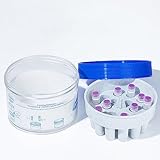
- 【PRODUCT SPECIFICATIONS】: With a diameter 4.75 inches (120mm) cover, saving space during cooling process, 18 1 ml/2 ml tubes for cryostorage can be accommmodated in this cooling cox.
- 【MATERIAL WITH STABILITY】:PC box body, HDPE box cover and foam liner.
- 【EASY TO USE】: only 100% isopropyl and mechanical refrigeration device are required.
- 【GOOD APPLICABILIY】: simple to use, with a cooling rate close to -1℃/ min, raising the survival rate of cryogenic storage samples.
- 【CUSTOMER SERVICE】:If you encounter any problem, please contact us. we will help you solve the problem as soon as possible.
Earth-based repositories depend on infrastructure and ongoing oversight, and they remain exposed to terrestrial disasters. A lunar store might diversify that risk, but it would introduce difficult access, launch, construction and governance requirements. The potential resilience is an idea to investigate, not a demonstrated guarantee. The paper’s comparison is conceptual rather than a completed cost or operational study.
What would have to be solved first?
- Radiation protection: Long-term exposure could damage samples. Researchers discuss shielding, including lunar regolith, but the necessary packaging and protection still need to be designed and tested.
- Cold-chain transport: A storage site’s temperature does not solve how to preserve cryogenic conditions through launch, transit, landing and placement.
- Biological effects: The long-term consequences of microgravity and other space exposures for cryopreserved material are not fully understood.
- Site choice and planetary protection: Permanently shadowed regions may present scientific, operational or planetary-protection concerns. A 2026 perspective calls for consultation and careful site selection. Read the 2026 perspective.
- Governance and access: Participants would need to resolve who oversees the repository, which samples qualify, how international participation works, and who could retrieve samples over the long term.
What is the project’s status?
The idea remains a long-term proposal. The 2024 paper outlines early exemplar work and proposed packaging tests on Earth, followed, if feasible, by tests on the ISS. A 2026 perspective broadens the case for the concept as an astrobiology and space-exploration capability and calls for continued planning, design, testing and collaboration. It says the concept does not currently fit within an existing NASA program. Neither paper establishes that a lunar repository has been funded, built or stocked.
Rank #2

- Lightweight and Durable Material: The liquid nitrogen tank is crafted from high-strength aviation-grade aluminum alloy, ensuring both portability and durability. This material effectively protects the stored liquid nitrogen and prevents scratches and deformation, ensuring safety and reliability during use.
- Vacuum Insulation Design: Surrounding the liquid nitrogen container with a multi-layer insulation structure and special gas adsorbents creates an excellent vacuum storage space. This minimizes heat transfer, maintaining a stable low-temperature environment inside the container and extending the storage time of samples.
- 6 Canisters: Our liquid nitrogen dewar is equipped with 6 canisters, including 2 without holes for precise nitrogen extraction and 4 with holes for storing samples, allowing users to quickly access or replace stored materials as needed.
- Portable Carry Bag: The protective cover prevents scratches and damage from accidental impacts, and adds an extra layer of protection. It's also easier to transport and carry, ensuring the cryogenic tank can be safely transported to laboratories, hospitals, or any other necessary location.
- Wide Applications: The LN2 container is widely used in laboratories, medical institutions, farms, beauty salons, and more. They can safely store a variety of samples, including semen, embryos, cells, dry ice, and metal materials, meeting diverse needs from biological research to industrial applications.
For now, the most accurate description is a proposed backup strategy whose scientific and engineering questions are still open. It may eventually complement Earth repositories, but it cannot yet be treated as a practical substitute for them.
Quick Recap
Best Value

- [WIDE APPLICATION] The liquid nitrogen tank is dual purpose transportation and storage, mainly suitable for laboratory users and users with a small amount of samples for short-term transportation needs. The liquid nitrogen dewar can store semen/embryos/cells/dry ice /metal material and etc. Lightweight and easy to carry with carry Bag
- [COMPACT 50mm CALIBER] Small diameter allows for longer storage and cycle, while large diameter will cause liquid nitrogen leakage. Compact 50 mm caliber with Very slow dissipation of liquid nitrogen, especially with Styrofoam insert under the lid.
- [AEROSPACE MATERIALS] The liquid nitrogen container is made of high-strength aerospace aluminum material, which is corrosion-resistant and can store liquid nitrogen safely.
- [CANISTERS] Each of the liquid nitrogen tanks come with six canisters; 5 canisters come with holes at the bottom to store biological specimen and 1 sealed canister for dipping, Canisters Diameter 1.4" (36 mm) Height 4.72" (123 mm)
- [PLEASE NOTE] Due to air traffic control, we will only send you empty liquid nitrogen tanks. You can buy liquid nitrogen locally, which is cheap and very convenient. And the storage time range is in completely sealed condition. If you keeps it statically but opens it every day, it will not reach that time.
Rank #4
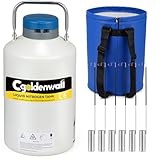
- [WIDE APPLICATION] The liquid nitrogen tank is dual purpose transportation and storage, mainly suitable for laboratory users and users with a small amount of samples for short-term transportation needs. The liquid nitrogen dewar can store semen/embryos/cells/dry ice /metal material and etc. Lightweight and easy to carry with carry Bag
- [COMPACT 50mm CALIBER] Small diameter allows for longer storage and cycle, while large diameter will cause liquid nitrogen leakage. Compact 50 mm caliber with Very slow dissipation of liquid nitrogen, especially with Styrofoam insert under the lid.
- [AEROSPACE MATERIALS] The liquid nitrogen container is made of high-strength aerospace aluminum material, which is corrosion-resistant and can store liquid nitrogen safely.
- [CANISTERS] Each of the liquid nitrogen tanks come with six canisters; 5 canisters come with holes at the bottom to store biological specimen and 1 sealed canister for dipping, Canisters Diameter 1.4" (36 mm) Height 4.33" (110 mm)
- [PLEASE NOTE] Due to air traffic control, we will only send you empty liquid nitrogen tanks. You can buy liquid nitrogen locally, which is cheap and very convenient. And the storage time range is in completely sealed condition. If you keeps it statically but opens it every day, it will not reach that time
Rank #3

- High-quality materials: The container is made of high-strength aluminum alloy, making it both lightweight and durable.
- Large capacity: With a capacity of 2 liters, the container can hold a significant amount of liquid nitrogen for extended periods of time.
- Static design: The static design of the container ensures that the liquid nitrogen stays in a liquid state, preserving its quality for longer periods of time.
- Convenient straps: The container comes with convenient straps that allow for easy transport and storage, making it more practical for various applications.
- Versatile use: The container is suitable for a wide range of applications, such as cryotherapy, biological samples storage, animal husbandry, and scientific research.
Product prices and availability are accurate as of the date/time indicated and are subject to change. Any price and availability information displayed on Amazon at the time of purchase will apply.

