
Recommended Free Tools
Colocation interconnection connects your equipment in a data center to carriers, cloud services, exchanges, or other facilities. It is a coordinated service—not just a cable purchase: the facility and the network or cloud provider may each have separate provisioning steps, charges, and support boundaries. To choose the right setup, verify who is physically present, how traffic reaches the destination, whether routes are genuinely diverse, and what each party’s quote and SLA cover.
What are colo interconnection services?
Colocation gives you space and power for your equipment; interconnection supplies network links between that equipment and outside networks or services. Depending on the facility and destination, the link may be a private cross-connect to a carrier or another tenant, a carrier circuit, a private cloud connection, or a connection through an exchange or fabric. Product names and responsibilities differ by provider.
A cross-connect is a physical connection provisioned within a facility, often between your equipment and another party’s equipment. It does not, by itself, establish the full service to a remote network or cloud: the other party may need to provision its side, and the facility may have its own order and fee. Twilio describes its Cross Connect setup as requiring three participants: “you, Twilio, and your data center provider.” Its specific service uses gigabit fiber and may connect in a meet-me room; those details should not be assumed for other providers or facilities. Twilio’s Cross Connect documentation
Which interconnection model fits your need?
| Model | What it provides | What to verify |
|---|---|---|
| Facility cross-connect | A physical link between your equipment and a carrier, tenant, or provider in the facility. | Provider presence in the building; media and connector requirements; who supplies and provisions each component; order process and lead time; recurring and one-time fees; and the demarcation point. |
| Cloud on-ramp or private cloud link | A private connectivity path to a cloud network, sometimes through a colocation or interconnection provider. | Whether the connection is physically in the facility or transported from elsewhere; supported locations and speeds; port or attachment charges; redundancy; and support boundaries. |
| Third-party network or transport circuit | A carrier circuit linking the facility to another site or network. | Route and handoff; contract owner; restoration commitments; physical diversity; and whether provider charges are separate. |
| Cloud exchange or fabric | A provider’s service for establishing logical or physical connectivity to multiple destinations. | Availability at the chosen facility; participating providers; port and virtual-connection charges; any cross-connect requirement; provisioning process; and support scope. These details depend on the provider and location. |
How do you connect colocated equipment to a cloud provider?
A private cloud connection usually involves both a cloud-side service and a facility or third-party arrangement. Google’s Cross-Cloud Interconnect, for example, is described as dedicated connectivity between Google Cloud and another cloud provider. Google documents dedicated physical connectivity and notes that a colocation router is one possible approach. The exact architecture and available service depend on the providers and location. Google Cloud Cross-Cloud Interconnect overview
#1 Best Overall

- DEVICE INTERFACE: 4 x 2.5G ports (100Mbps/1Gbps/2.5Gbps); 2 x 10G SFP+ ports (1Gbps/10Gbps); LED Indicators
- LIFETIME PROTECTION: We stand by the quality of our products. TRENDnet LIFETIME PROTECTION: The TEG-S562 multi-gig switch comes with Lifetime TRENDnet Manufacturer Protection.
- NDAA + TAA COMPLIANT: With our NDAA and TAA compliant network switches, you can plan and install networking solutions that Government customers demand today (U.S. and Canada Only)
- RELIABLE TECH SUPPORT: Our team of advisors, support and tech experts are English speaking, and available for all your needs during normal business hours. We take pride in being there for our customers.
- 2.5G PORTS: This 6 Port Multi-Gig Ethernet switch is equipped with four 2.5GBASE-T RJ-45 ports that provide multi-gigabitspeeds capable of up to 2.5Gbps over existing Cat5e or better cabling.
- Confirm the endpoint and path. Ask whether the cloud connection terminates in your colocation building or whether a provider transports traffic from another facility. Identify the physical handoff and any router or exchange involved.
- Confirm both sides’ requirements. Ask the cloud provider and facility or interconnection provider what each must provision, which locations and speeds are supported, and what ports, attachments, or cross-connects are required.
- Design redundancy across failure domains. Specify the availability target and request the topology showing connections, facility dependencies, and provider handoffs. Redundant circuit count alone does not establish physical diversity.
- Get a coordinated order and quote. Identify which party owns each order, activation dependency, support case, and charge before placing orders.
- Check the service boundaries. Read each segment’s SLA and determine where that provider’s responsibility begins and ends; a cloud provider’s SLA may not cover the full end-to-end path.
Google documents Cross-Cloud Interconnect connection sizes of 10, 100, and 400 Gbps for AWS and OCI, and 10 and 100 Gbps for Azure and Alibaba Cloud. These are product options in Google’s documentation, subject to service and location availability; they are not universal colocation speeds. Google also describes 99.9% availability for its documented minimum two-connection configuration and 99.99% for specified production-critical configurations. Those figures apply to the stated Google designs, not to interconnection services generally. Google’s SLA covers its infrastructure up to the handoff to the other cloud provider; consult its topology and SLA documentation for the configuration and boundary that apply. Google Cloud Cross-Cloud Interconnect overview
What does carrier-neutral colocation mean?
A carrier-neutral facility offers a choice of network providers rather than requiring customers to use a single carrier. That choice is useful for comparing providers, but the label alone does not establish that your preferred carrier is physically available in the specific building—or that separate providers use separate physical routes. Netrality describes carrier neutrality as access to a diverse carrier and cloud-provider ecosystem; confirm the actual on-net provider list for the facility you are considering. Netrality’s explanation of carrier-neutral colocation
Rank #2

- 𝐅𝐥𝐞𝐱𝐢𝐛𝐥𝐞 𝐅𝐮𝐥𝐥 𝐆𝐢𝐠𝐚𝐛𝐢𝐭 𝟏𝟖-𝐏𝐨𝐫𝐭 𝐏𝐨𝐄 𝐂𝐨𝐧𝐟𝐢𝐠𝐮𝐫𝐚𝐭𝐢𝐨𝐧: 16x PoEplus (802.3at/af) 10/100/1000 Mbps RJ45 ports providing up to 30W per port and total PoE power budget of 250W, together w/ 2x Gigabit Non-PoE Ports and 2 Combo SFP Slot for high-speed connections.
- 𝐏𝐥𝐮𝐠 𝐚𝐧𝐝 𝐏𝐥𝐚𝐲: Easy setup with no software installation or configuration needed.
- 𝐀𝐝𝐯𝐚𝐧𝐜𝐞𝐝 𝐒𝐨𝐟𝐭𝐰𝐚𝐫𝐞 𝐅𝐞𝐚𝐭𝐮𝐫𝐞𝐬: Prioritize your traffic and guarantee high quality of video or voice data transmission with Port-based 802.1p/DSCP QoS and IGMP Snooping.
- 𝐒𝐭𝐮𝐫𝐝𝐲 𝐌𝐞𝐭𝐚𝐥 𝐂𝐚𝐬𝐞: Durable metal casing and and professional heat dissipation design are well-suited for different environment with reliability.
- 𝟑 𝐘𝐞𝐚𝐫𝐬 𝐖𝐚𝐫𝐫𝐚𝐧𝐭𝐲: Backed by our industry-leading 3-year warranty and free technical support from 6am to 6pm PST Monday to Fridays, you can work with confidence.
How can you verify physical route diversity?
Count independent paths and failure domains, not carrier logos or circuit orders. Multiple carriers may share a building entrance, conduit, or other segment, so a failure on that shared path could affect them all. Request a topology or other documentation that identifies:
- Building entrances and outside fiber routes for each proposed service.
- Conduits, meet-me rooms, and other facility elements shared by the paths.
- Where each circuit hands off and which provider owns each segment.
- The relevant failure domains and how the design addresses them.
Also ask whether a cloud on-ramp physically terminates in the same building or reaches it by transport from another site. QuoteColo highlights both this distinction and the risk of carriers sharing a fiber entry path. Treat its marketplace guidance as a prompt for diligence, not proof of the topology or availability at a particular facility. QuoteColo’s connectivity and cost guide
Rank #3

- Experience faster data transfers with the NUBASA 8-port 2.5G ethernet switch, featuring eight 2.5Gbps RJ45 ports and one 10Gbps SFP+ uplink port. Ideal for high-speed connections between NAS, gaming consoles, PCs, and workstations, supporting 10/100/1000/2500Mbps auto-negotiation for seamless compatibility
- This 2.5g switch built-in 10Gb SFP+ port supports 1G/2.5G/10G optical and copper modules (sold separately), enabling flexible fiber or Ethernet backbone connections. Perfect for linking to 10GbE routers, servers, or network storage without bottlenecking your uplink speed. Bundle available with 10G module—check options for a ready-to-use kit
- Constructed with a full aluminum alloy casing, this 2.5 gigabit switch delivers superior heat dissipation for stable long-term performance. No fans or moving parts ensure completely silent operation—ideal for home offices, entertainment centers, or quiet environments
- Designed for simplicity: just plug in and go. No configuration needed—this plug-and-play multigig switch automatically detects connection speeds (10M/100M/1G/2.5G) and works seamlessly with existing routers, modems, and network devices. Great for upgrading your wired network in minutes
- Engineered with a compact, durable design that resists scratches and blends neatly into any workspace. Invest in a stable network foundation designed to serve you reliably for years to come. If you seek a durable solution that minimizes the need for frequent upgrades, this 2.5Gbe switch is the strategic choice for your setup
What does interconnection cost?
There is no single all-in price established for colo interconnection. The total depends on the facility, destination, bandwidth, architecture, and providers involved. Request a written quote that separates each cost rather than comparing a rack rate or one provider’s price as if it covered the whole path.
- Facility cross-connect: recurring and one-time charges.
- Cloud connectivity: ports, attachments, or virtual-circuit charges.
- Carrier or transport circuit: bandwidth, term, and circuit charges.
- Architecture-dependent costs: applicable data transfer, gateway, or network processing.
- Commercial terms: lead time, activation dependencies, cancellation, and upgrade terms.
AWS says its Interconnect pricing depends on bandwidth and geographic scope, while “The service provider on the other side of your Interconnect determines their pricing independently of AWS.” An AWS-side price therefore does not represent the end-to-end cost. AWS Direct Connect pricing
Rank #4
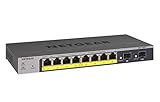
- GIGABIT ETHERNET PORTS: Features 8 x 1.0Gbps Ethernet ports for high-speed connectivity. Auto-negotiating ports detect the optimal speed for connected devices and work with existing Cat5e or Cat6 Ethernet cables.
- POWER-OVER-ETHERNET (PoE): Includes 8 PoE+ ports with 55W total power budget to support power-hungry devices
- SFP CONNECTIVITY: Includes 2 x 1G SFP ports for fiber optic connections and network expansion
- SMART MANAGED NETWORK SWITCH: Smart software with easy-to-use interface offers managed control for secure setup, access, and SNMP (NMS 300) management. Includes 1 year NETGEAR Insight to remotely manage your networks from anywhere.
- FLEXIBLE MOUNTING OPTIONS: Compact metal design supports desktop or wall-mount placement for versatile installation.
QuoteColo publishes indicative cross-connect ranges and cautions that connectivity expenses can be obscured by published rack costs. Those marketplace estimates are not guaranteed facility prices or universal industry rates; get current, location-specific written quotes. QuoteColo’s connectivity and cost guide
What should you confirm before ordering?
- Presence: Is each carrier, cloud provider, or exchange physically available in the exact building?
- Path: Where does the connection terminate, and is any off-site transport involved?
- Physical diversity: Do documented routes avoid shared entrances, conduits, and meet-me-room dependencies?
- Provisioning: Which parties must approve or complete the order, and what dependencies affect activation?
- Technical fit: Are the handoff, media, connector, optics, and supported speed confirmed by the responsible providers?
- Cost: Are one-time and recurring charges from every party listed separately, along with any applicable data-transfer or processing costs?
- Service commitments: What SLA applies to each segment, where is it measured, what exclusions and remedies apply, and who owns escalation?
Do not buy a generic cable on the assumption that it creates a cross-connect. The required fiber, connector, length, optics, handoff, and responsibility for supplying components depend on the facility and the ordered service. A current technical specification from the providers is needed before selecting hardware.
The Tool Desk
Outbyte PC Repair FREERepair Windows errors before they cause bigger problemsFix Now →Outbyte Driver Updater FREEScan for outdated or missing drivers - takes under a minuteDriver Scan →Quick Recap
Product prices and availability are accurate as of the date/time indicated and are subject to change. Any price and availability information displayed on Amazon at the time of purchase will apply.

