
What’s actually slowing this PC down?
Pick the symptom - the matching free tool is one click away.
For most NAS and RAID systems with sustained writes, frequent updates, or rebuilds, choose a NAS-rated CMR drive. SMR can be suitable for lighter, mostly sequential workloads with plenty of idle time, but its performance during updates and some rebuild patterns is less predictable. SMR is not automatically unusable in RAID: the result depends on the drive, workload, filesystem, and controller.
Is CMR or SMR better for NAS?
CMR is the safer default for busy NAS use, particularly when several users update files, applications generate random writes, or the system must rebuild or resilver an array. Those workloads benefit from more predictable sustained-write behavior.
SMR may be reasonable for lighter home or small-office use—such as basic file sharing, backups, or content archiving—when writes are mostly sequential and the drive has idle time. This is workload guidance, not a guarantee for every SMR model or NAS.
What changes between CMR and SMR?
Conventional magnetic recording (CMR) writes distinct tracks with gaps between them, so a sector can be rewritten directly. Shingled magnetic recording (SMR) overlaps tracks, like roof shingles. This can increase recording-surface efficiency, but changing data may require internal recovery or rewriting of a larger band of tracks.
#1 Best Overall
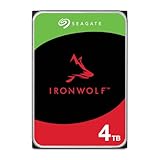
- IronWolf internal hard drives are the ideal solution for up to 8-bay, multi-user NAS environments craving powerhouse performance
- Store more and work faster with a NAS-optimized hard drive providing ultra-high capacity up to 16TB and cache of up to 256MB
- Purpose built for NAS enclosures, IronWolf delivers less wear and tear, little to no noise/vibration, no lags or down time, increased file-sharing performance, and much more
- Easily monitor the health of drives using the integrated IronWolf Health Management system and enjoy long-term reliability with 1M hours MTBF
- Three-year limited warranty protection plan included and three year Rescue Data Recovery Services included
Toshiba explains the consequence this way: “Because the tracks are overlapping, re-writes directly into previously written sectors are no longer possible. The recovery of space containing outdated data may affect performance.” Toshiba describes a media-cache approach that stages random updates and later merges old and new data into another SMR band. That is a drive-specific mitigation; SMR models should not be assumed to behave identically.
Western Digital’s 2023 technical white paper says SMR offers “up to an additional 11% increase in areal density” compared with same-generation CMR drives. That is a WD-published maximum for areal density, not a promise that every SMR model offers 11% more capacity or a measured speed comparison.
Rank #2

- Store more, compute faster, and do it confidently with the proven reliability of BarraCuda internal hard drives
- Build a power house gaming computer or desktop setup with a variety of capacities and form factors
- The go to SATA hard drive solution for nearly every PC application from music to video to photo editing to PC gaming. Ax. Sustained transfer rate OD: 190MB/s
- Confidently rely on internal hard drive technology backed by 20 years of innovation
- Frustration Free Packaging - This is just an anti-static bag. No cables, no box.
Can you use an SMR drive in RAID?
Sometimes, but the recording type alone does not determine whether a drive will work in a particular array. Workload and rebuild behavior matter. WD says its Red DMSMR drives performed similarly to CMR, or somewhat slower, in rebuild scenarios on typical Synology and QNAP non-ZFS systems. WD also notes that results can vary with drive condition and the extent of the rebuild, and acknowledges slower results in some cases.
Are SMR drives bad for RAID rebuilds?
Not categorically. A rebuild can involve a large amount of data transfer, and the impact on an SMR drive depends on the rebuild pattern and the drive’s opportunity to handle internal data management. WD specifically cautions against using DMSMR for ZFS: “The increased amount of sustained random writes during ZFS re-silvering (a rebuild) causes a lack of idle time for DMSMR drives.” WD identifies Red Plus and Red Pro as CMR and recommends them for ZFS.
Rank #3

- IronWolf internal hard drives are the ideal solution for up to 8-bay, multi-user NAS environments craving powerhouse performance.date transfer rate:6.0 gigabits_per_second
- Store more and work faster with a NAS-optimized hard drive providing 8TB and cache of up to 256MB
- Purpose built for NAS enclosures, IronWolf delivers less wear and tear, little to no noise/vibration, no lags or down time, increased file-sharing performance, and much more
- Easily monitor the health of drives using the integrated IronWolf Health Management system and enjoy long-term reliability with 1M hours MTBF
- Three-year limited product warranty protection plan and three year Rescue Data Recovery Services included
These are manufacturer statements, not a universal benchmark for every drive, filesystem, RAID controller, or rebuild. If predictable rebuild behavior is important, CMR is the more conservative choice.
Which NAS hard drive should I buy for ZFS?
Choose a NAS-rated CMR model for a ZFS system, especially if it will be used for resilvering or other sustained random-write work. WD’s guidance favors its CMR Red Plus and Red Pro tiers for ZFS. Confirm that the exact drive model and capacity are supported by the NAS maker; a recording label does not establish overall reliability or compatibility.
Rank #4

- Available in capacities ranging from 2 to 22TB(1) | (1) 1GB = 1 billion bytes and 1TB = 1 trillion bytes. Actual user capacity may be less depending on operating environment.
- For RAID-optimized NAS systems with unlimited number of bays
- Rated for 550TB/yr workload rate(2) | (2) Annualized Workload Rate = TB transferred x (8760 / recorded power-on hours). The maximum rated workload is specified for operating at typical temperature of 40C. Workload Rate will vary depending on your hardware and software components and configurations.
- Designed to handle the demands of high-intensity 24x7 multi-user NAS environments
- Western Digital partners with a wide range of NAS system vendors for extensive testing to ensure compatibility with most NAS enclosures
Examples of NAS-rated CMR options
| Drive or tier | Published specifications | How to interpret them |
|---|---|---|
| Toshiba N300 Pro | CMR across listed capacities; 3.5-inch SATA; 7200 RPM; up to 24 TB; support for up to 24 drive bays; workload rating up to 550 TB/year. | Toshiba positions it for enterprise and commercial NAS and RAID-optimized systems. Figures are manufacturer specifications accessed in 2026; verify the exact SKU and current availability. |
| WD Red Plus | CMR; up to 180 TB/year workload rating; 3-year warranty. | WD describes the tier as typically aimed at lighter 1–8-bay NAS setups. Manufacturer product-page figures accessed in 2026; specifications can change. |
| WD Red Pro | CMR; up to 550 TB/year workload rating; 5-year limited warranty; RV sensors for multi-bay RAID systems. | WD describes it as the higher-performance Red tier. Manufacturer product-page figures accessed in 2026; specifications can change. |
These specifications describe individual product lines, not an independent comparison of CMR and SMR performance. Do not choose a drive by brand alone: compare the exact model, workload rating, bay support, and features with your needs.
Independent reader supportYour contribution helps us test, update, and keep practical guides available for everyone.How do I tell if my hard drive is CMR or SMR?
Look up the exact model number in the manufacturer’s current data sheet or product documentation. Do not infer the recording method from a family name or capacity: WD says its Red products include both CMR and SMR, and recommends checking data sheets for WD Red, Blue, Purple, Gold, and WD_BLACK products.
Quick Recap
- Find the full model number on the drive label, purchase listing, or NAS drive-information screen.
- Check the manufacturer’s data sheet for that exact model and confirm whether it specifies CMR or SMR.
- Check the NAS compatibility list for your exact enclosure, firmware, and drive capacity. WD and Toshiba both advise confirming compatibility with the NAS maker.
What to check before choosing a NAS or RAID drive
- Exact recording type: Verify the precise model rather than relying on the product family name.
- Write pattern: Frequent updates, sustained random writes, and busy multi-user use favor CMR; lighter, mostly sequential use with idle time may suit some SMR drives.
- Rebuild behavior: Consider your filesystem and controller. For ZFS resilvering, WD advises CMR; other platform behavior can depend on rebuild scope and drive condition.
- NAS fit: Match the model and capacity against the NAS maker’s current compatibility list and bay support.
- Drive tier: Compare workload ratings, vibration features, and warranty alongside recording technology.
- Capacity and price: Compare usable capacity and cost for the exact compatible models; do not treat SMR’s potential density advantage as a guaranteed capacity increase.
Product prices and availability are accurate as of the date/time indicated and are subject to change. Any price and availability information displayed on Amazon at the time of purchase will apply.

