
The Tool Desk
Outbyte PC Repair FREERepair Windows errors before they cause bigger problemsFix Now →Outbyte Driver Updater FREEScan for outdated or missing drivers - takes under a minuteDriver Scan →Cloudera CEO Charles Sansbury’s argument is straightforward: for large Gulf organisations, hybrid AI is becoming the practical destination, not a temporary compromise. Sensitive data, predictable 24/7 processing and local latency requirements favour private or sovereign infrastructure, while public clouds remain valuable for elastic and experimental work. The capability that connects those environments is workload portability—the ability to operate the same data and AI applications across them with a consistent control model.
Why Cloudera says hybrid AI fits the Gulf
Sansbury says financial institutions, energy companies and government bodies in the region run high-volume, always-on workloads. Moving every one of those workloads to a hyperscaler can create recurring infrastructure costs and complicate control over sensitive information. His position is not that public cloud is unsuitable; rather, each workload should run where its security, performance and economics make the most sense.
“It’s clear that not everything goes to the cloud,” Sansbury said. He also described customers wanting “the cloud experience but with on-premise economics and control.” In that model, a bank might keep continuous fraud detection on owned infrastructure, use a sovereign cloud for regulated analytics and burst into a public cloud for short-lived experimentation.
What workload portability means
Workload portability is the ability to deploy and operate a data or AI application in more than one infrastructure environment without redesigning its entire operating model. Cloudera presents the target as the same workloads running across public clouds, sovereign clouds, private data centres and isolated, air-gapped networks.
Quick wins for a faster PC:
Repair Windows errors before they cause bigger problemsFix Now →Scan for outdated or missing drivers - takes under a minuteDriver Scan →#1 Best Overall
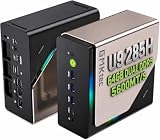
- EVOLUTION CORE ULTRA 9 285H MINI PC - GMKtec EVO-T1 is the next evolution in AI mini PC Ultra 9 series. The Core Ultra 9 285H offers 16 cores (six P-cores + eight E-cores + two LPE-cores) and 16 threads with a turbo clock of 5.4 GHz. It is currently one of the best value for performance AI mini PC computers.
- AI NPU - The 285H features an Intel AI Boost NPU, capable of up to 13 TOPS (Tera Operations per Second) for INT8 calculations, which is designed to accelerate AI tasks.
- INTEL ARC 140T GAMING PC - The Arc 140T GPU includes 8 Xe cores and supports features like DirectX 12, OpenGL 4.5, and OpenCL 3, making it capable of handling modern games and creative applications. It also supports Quick Sync Video for efficient video encoding and decoding, as well as AV1 encoding and decoding.
- 64GB DDR5 RAM + 1TB SSD - The EVO-T1 is equipped with Dual 32GB (Total 64GB) SO-DIMM DDR5 5600MHz memory sticks. 2TB PCIE 4.0 SSD Drive with 3x M.2 2280 Expansion slots. Each slot capable of reading up to 4TB. (12TB MAX)
- QUAD SCREEN 8K DISPLAY SUPPORT - EVO-T1 AI Mini PC support 4-screen 4K/8K output via HDMI 2.1 (8K@60Hz), DisplayPort 1.4 (4K@60Hz), and USB Type-C Transfer speed (supporting PD3.0/DP1.4/DATA). Ideal for gaming, video editing, and multitasking, it provides expansive and crisp multi-display support.
The practical promise
- A common way to package, deploy, monitor and upgrade applications.
- Data and AI services that can move when residency, capacity, cost or latency requirements change.
- Consistent governance, including policy enforcement and protection of personally identifiable information (PII).
- Less dependence on a single cloud provider’s proprietary services.
Cloudera calls its approach “write-once portability” in the product description for Cloudera Anywhere Cloud. That is a platform objective, not a guarantee that every application will move with no engineering work: hardware accelerators, identity systems, networking and provider-specific services can still require configuration.
Why data sovereignty is the first design constraint
Financial, government and healthcare information can be subject to privacy, residency and sector-specific rules. The applicable requirements differ by country and by organisation, but the architectural consequence is similar: some data must remain inside a national boundary, a corporate facility or an approved private environment.
Hybrid AI allows an organisation to separate placement from capability. A model-training job using non-sensitive or anonymised data may run in a public cloud, while source records, production scoring or government datasets stay on infrastructure under local control. Governance policies can then determine which data may be copied, queried or combined.
How the proposed architecture works
Cloudera Anywhere Cloud
Cloudera describes Anywhere Cloud as a modular platform for deploying data and AI applications across public clouds, sovereign infrastructure, private data centres and air-gapped networks. Its product materials highlight zero-copy Apache Iceberg querying, automated governance, PII masking and a marketplace for Cloudera services, partner services and open-source engines.
What’s actually slowing this PC down?
Pick the symptom - the matching free tool is one click away.
Rank #2

- LOW ENERGY HIGH PERFORMANCE MINI PC - The Intel Core Ultra 5 125U is part of the Ultra 5 lineup, using the Meteor Lake architecture with BGA 2049. Intel Hyper-Threading technology is available and effectly doubles the core-count of the P-Cores, to a total of 14 threads. Core Ultra 5 125U has 12 MB of L3 cache and operates at 1300 MHz by default, but can boost up to 4.3 GHz, depending on the workload. With a TDP of 15 W, the Core Ultra 5 125U consumes very little energy but outputs high performance efficiency
- 32GB DDR5 RAM + 512GB SSD - The K15 mini computer is equipped with Dual 16GB (Total 32GB) SO-DIMM DDR5 4800MHz memory sticks. 512GB PCIE 4.0 SSD Drive with 3x M.2 2280 Expansion slots. Each slot capable of reading up to 8TB. (24TB MAX)
- QUAD SCREEN 4K DISPLAY SUPPORT - K15 Mini PC support 4-screen 4K/8K output via HDMI 2.1 (8K@60Hz), DisplayPort 1.4 (4K@60Hz), and USB Type-C Transfer speed (supporting PD3.0/DP1.4/DATA). Ideal for gaming, video editing, and multitasking, it provides expansive and crisp multi-display support
- OCULINK PORT - The Oculink port on the rear interface enables higher bandwidth capabilities, better frame rates and lower lag. The standard also operates at PCIe x4 speeds, compared to Thunderbolt's x3. Gamers and content creators can benefit from Oculink's higher bandwidth, resulting in better performance and lower lag for eGPU setups
- DUAL NIC FAST 2.5GBE + WIFI 6E + BT 5.2 - Dual Ethernet 2.5GbE LAN port design provides more applications, such as firewall, multichannel aggregation, soft routing, file storage server. Built-in WIFI 6E / Bluetooth 5.2 is more stable and efficient to connect multiple wireless devices such as projector, printer, monitor, speakers and etc
Zero-copy querying is significant for regulated teams because it is intended to let users query data where it resides rather than creating another full copy in a different cloud. The governance and masking features are designed to apply controls as data is accessed, although each customer still has to configure policies for its legal and operational requirements.
The Taikun acquisition and the control plane
Cloudera says its Taikun acquisition adds a container-native Kubernetes platform and cloud-infrastructure management. The strategic purpose is a unified control plane: teams can provision and manage environments in clouds, private facilities, sovereign locations and air-gapped networks through a more consistent operating experience.
Sansbury called the deal “a pivotal step in our mission to bring the cloud experience wherever enterprise data resides.” Kubernetes can standardise application packaging and orchestration, while the control plane is intended to streamline deployment and upgrades. It does not remove the need to operate the underlying networks, storage, security controls or hardware in each location.
Where each environment fits
| Environment | Data sovereignty and governance | Steady-state economics | Latency and resilience | Portability role |
|---|---|---|---|---|
| Public cloud | Provider and region controls can support residency, but the customer must verify jurisdiction, contracts and data-handling policies. | Well suited to elastic, variable or experimental workloads; continuous high-volume use can become expensive. | Broad regional reach and on-demand capacity; latency depends on the selected region and network path. | Useful as one target in a multi-environment operating model. |
| Private or owned infrastructure | Offers direct organisational control over location, access and retention. | Can be more economical for predictable, always-on workloads such as bank fraud detection, according to Sansbury. | Local processing can reduce latency and dependence on external connectivity; capacity must be planned and funded. | Requires a platform that can deliver cloud-like operations without changing the application stack. |
| Sovereign cloud | Designed to keep data and operations within approved national or sovereign controls; exact protections vary by service. | Economics depend on the provider and workload; no comparative price was stated. | Can provide in-country processing and support regulatory objectives. | Provides a regulated destination alongside public and private environments. |
| Air-gapped network | Strongest physical separation for especially sensitive or restricted data. | Infrastructure and operations are dedicated; no comparative price was stated. | Independent of public connectivity, but isolated systems need their own update and support processes. | Portability is valuable only if software can be deployed and upgraded without external network access. |
Is on-premises AI cheaper than cloud AI?
There is no universal answer. Sansbury’s economic argument is workload matching: hardware owned or privately operated can be cheaper for a stable workload that runs continuously, because the organisation is not paying variable cloud capacity every hour. Public cloud can be more economical when demand is intermittent, capacity needs are uncertain or a team is testing a new model and wants to avoid buying equipment.
Outdated Drivers Are Slowing You Down
One free scan finds every outdated or missing driver and matches the right update for your exact hardware.Free scan · exact hardware matchWindows Errors? Fix Them Before They Spread
Repair common Windows errors and clear accumulated junk for a smoother, more stable PC - no reinstall needed.Free scan · no reinstallRank #3

- Entry-level NAS Personal Storage:UGREEN NAS DH2300 is your first and best NAS made easy. It is designed for beginners who want a simple, private way to store videos, photos and personal files, which is intuitive for users moving from cloud storage or external drives and move away from scattered date across devices. This entry-level NAS 2-bay perfect for personal entertainment, photo storage, and easy data backup (doesn't support Docker or virtual machines).
- Set Your Devices Free, Expand Your Digital World: This unified storage hub supports massive capacity up to 64TB.*Storage drives not included. Stop Deleting, Start Storing. You can store 22 million 3MB images, or 2 million 30MB songs, or 43K 1.5GB movies or 67 million 1MB documents! UGREEN NAS is a better way to free up storage across all your devices such as phones, computers, tablets and also does automatic backups across devices regardless of the operating system—Window, iOS, Android or macOS.
- The Smarter Long-term Way to Store: Unlike cloud storage with recurring monthly fees, a UGREEN NAS enclosure requires only a one-time purchase for long-term use. For example, you only need to pay $459.98 for a NAS, while for cloud storage, you need to pay $719.88 per year, $2,159.64 for 3 years, $3,599.40 for 5 years. You will save $6,738.82 over 10 years with UGREEN NAS! *NAS cost based on DH2300 + 12TB HDD; cloud cost based on 12TB plan (e.g. $59.99/month).
- Blazing Speed, Minimal Power: Equipped with a high-performance processor, 1GbE port, and 4GB RAM on Board, this NAS handles multiple tasks with ease. File transfers reach up to 125MB/s—a 1GB file takes only 8 seconds. Don't let slow clouds hold you back; they often need over 100 seconds for the same task. The difference is clear.
- Let AI Better Organize Your Memories: UGREEN NAS uses AI to tag faces, locations, texts, and objects—so you can effortlessly find any photo by searching for who or what's in it in seconds. It also automatically finds and deletes similar or duplicate photo, backs up live photos and allows you to share them with your friends or family with just one tap. Everything stays effortlessly organized, powered by intelligent tagging and recognition.
The relevant calculation should include compute, storage, networking, software, facilities, specialist staff, security and the cost of idle capacity. A workload that appears inexpensive in a cloud invoice may carry data-transfer or managed-service charges; an owned cluster that appears cheaper may require substantial capital and operational expertise.
Does hybrid AI mean keeping data out of the public cloud?
No. Hybrid AI means using more than one infrastructure type and assigning workloads according to their requirements. An organisation can retain regulated source data in a private or sovereign environment while using a public cloud for approved analytics, model development or burst capacity. The boundary is set by policy and architecture, not by the word “hybrid” itself.
Independent reader supportYour contribution helps us test, update, and keep practical guides available for everyone.Saudi Arabia as a regional example
Cloudera announced plans to launch its platform on the AWS Saudi Arabia Region, framing the move around local data control, governance, compliance and Saudi Vision 2030. A local cloud region can help organisations keep workloads in-country, but customers still need to examine the service terms, operator controls, encryption, access procedures and the specific residency rules that apply to their data.
The announcement cited an IDC forecast of 27% average annual growth in sovereign-cloud infrastructure investment, reaching $258 billion by 2027. That is an IDC projection quoted by Cloudera, not a measurement of Cloudera sales or proof of adoption by every Gulf market.
Rank #4

- [Powerful PC] Gaming PC equipped with Core i9-14900F, 24 Cores 32 Threads, 36M Cache, Max Turbo Frequency: 5.8GHz, Windows 11 pro (64 Bit). With GeForce RTX 50 Series GPUs. Adopting DLSS 4 technology, it dramatically improves frame rate performance, supports FP4 low-precision computing, and doubles the efficiency of AI inference. SD graph generation speed is 3 times faster than RTX 4070 Super, significantly increasing creative productivity. Graphics work productivity has increased significantly.
- [High Speed DDR5 RAM & PCIE4.0 SSD] The desktop computer is equipped with Dual-DDR5 RAM (dual channel DDR5 high-speed memory, which can support up to 128GB RAM), 1 x M.2 2280 PCIE4.0 high-speed SSD, and support add 2 x 2.5-inch SATA HDD/SSD(not include) is enough to accommodate system files and massive games, Excellent reading and writing speed greatly shortening your boot time.
- [8K@60Hz Quad-Display] Desktop PC with GeForce RTX 5070 12G GDDR7, supporting DLSS 4, ray tracing, and AI cores. Easily connect 4 monitors via 1×HDMI 2.1 + 3×DP 1.4a — all ports support 8K@60Hz. Delivers stunning visuals and ultra-smooth performance for home entertainment, live streaming, video editing, AI workloads, 3D rendering, and AAA gaming.
- [Functional Interfaces] Mini computer is equipped with 4 x USB 3.2, 4 x USB2.0, 1 x HDMI2.1 port, 3 x DP ports, 2xRJ-45 Gigabit Network Ethernet, 1 x Fiber Optic PORT, 1 x Audio in/out. Built-in Bluetooth 5.4 and IEEE 802.11be wifi 7, Higher transfer rates and lower latency. Mini PC supports multiple device connection and can be used with servers, monitoring equipment, office equipment, projectors, televisions, etc, Mini desktop computer support automatic power on and Wake On Lan.
- [Warranty & Liquid Cooling] Warrant: 2 year/24 months. The compact computer size: 11.6*9.3*3.9in, 9.25lb, Chassis built-in 2 large copper fans, built-in liquid cooling device, to further enhance the computer heat dissipation, and at the same time can reduce noise, give full play to the overall performance of the computer.
What the market signals—and what they do not prove
Computer Weekly reported Cloudera annual revenue of $1.1 billion in 2025, providing company-level scale rather than a regional adoption figure. A Cloudera launch release in 2026 said 73% of IT leaders reported infrastructure-performance constraints hindering operational initiatives. That survey statistic indicates a perceived operational problem; it does not independently establish how many Middle East organisations have implemented portable AI.
The central regional thesis remains management commentary. No independently audited Middle East customer-growth figure attributable specifically to workload portability has been provided.
Questions Gulf technology leaders should ask
- Residency: Which datasets must remain in-country or inside a controlled corporate facility, and which may be processed elsewhere?
- Workload profile: Is the application predictable and always-on, or does it need short bursts of capacity?
- Latency: What response time is required, and what happens if the external network is unavailable?
- Portability: Can the application run on the target Kubernetes distributions, storage systems, accelerators and identity services?
- Governance: Are masking, encryption, audit and policy controls applied consistently in every environment?
- Operations: How will disconnected sites receive upgrades, security patches, model artefacts and support?
- Exit planning: Can data and models be moved without relying on proprietary services that exist in only one cloud?
The takeaway for the Middle East’s AI strategy
Cloudera is not claiming that one location wins every workload. Its proposition is that a unified operating layer makes location a decision that can change over time. For Gulf enterprises balancing sovereignty, predictable costs, low latency and cloud agility, that flexibility is the foundation of a durable hybrid AI architecture.
Quick Recap
Product prices and availability are accurate as of the date/time indicated and are subject to change. Any price and availability information displayed on Amazon at the time of purchase will apply.
Recommended Free Tools

