
ClawStage is a compact hardware platform designed to let OpenClaw agents interact with a physical device: OpenClaw runs on the unit, where it can exchange feedback with sensors and actuators. The key choice is whether to buy the $399 ClawStage 1.0 with a Raspberry Pi 5 (8 GB RAM) included or the $219 BYOP version, which requires your own Raspberry Pi 5. Those prices and preorder details are vendor-published and may change.
What ClawStage is—and what “bringing OpenClaw to life” means
ClawStage calls itself “The physical playground for OpenClaw agents” and describes the product as a local, private, isolated control plane for connecting OpenClaw to physical hardware. The intended difference from using OpenClaw only through a computer interface is embodiment: the agent can work with the device’s camera, microphones, sensors and servo mechanism, and receive feedback from them. These are product capabilities described by ClawStage, not independent performance findings. ClawStage’s product page
The product page says “OpenClaw runs natively on ClawStage,” with agent execution on-device. That supports a local-execution design, but it does not establish that every model, service, or connected messaging channel runs locally; OpenClaw’s documented channels include Discord, Signal, Telegram and WhatsApp, which involve external services. Review the configuration and integrations you plan to use if your privacy requirement is that no information leave the device. OpenClaw documentation
ClawStage 1.0 vs. 1.0 BYOP
| Consideration | ClawStage 1.0 | ClawStage 1.0 BYOP |
|---|---|---|
| Vendor-published price | $399; price and preorder status should be checked with ClawStage before purchase. | $219; price and preorder status should be checked with ClawStage before purchase. |
| Raspberry Pi 5 included? | Yes. Includes a Raspberry Pi 5 with 8 GB RAM and is described as ready to use out of the box. | No. Uses the buyer’s own Raspberry Pi 5 as the main controller. |
| Setup effort | Lower hardware setup: the Pi is included. Software onboarding and configuration still apply. | More hardware preparation: supply and install a compatible Raspberry Pi 5, then complete software onboarding. |
| Storage expansion | M.2 2230/2242 SSD interfaces are listed on the product page; included SSD capacity is not stated. | M.2 2230/2242 SSD interfaces are listed on the product page; included SSD capacity is not stated. |
| Privacy controls | Hardware switch to disable microphone and camera, according to ClawStage. | Hardware switch to disable microphone and camera, according to ClawStage. |
| Touchscreen, camera, microphones, sensors and servo | Part of the ClawStage device, according to the product page. | Part of the ClawStage device, according to the product page. |
The BYOP price is $180 less than the listed 1.0 price, but it does not include the Pi. ClawStage’s pricing page did not establish the current price of a separate Raspberry Pi 5 or the full cost of a BYOP setup, so the listed price difference is not necessarily the difference in total cost. Choose BYOP if you already have a suitable Pi 5 and are comfortable assembling the controller; choose 1.0 if you want the controller included.
#1 Best Overall

- AI-Powered Raspberry Pi Smart Car — PiCar-X: PiCar-X brings AI learning to life — powered by Openclaw and multi-LLMs including ChatGPT, Gemini, Grok, DeepSeek, Qwen, Doubao, Ollama (Local LLMs), and compatible with many more AI platforms. Featuring OpenCV, MediaPipe, TTS & STT, PiCar-X enables true AI vision and voice interaction — it can see, listen, talk, drive and think like an intelligent companion. Ideal for students (10+), educators, and engineers, PiCar-X is the perfect gateway to explore AI, robotics, and machine learning on Raspberry Pi 5/4/3B+/3B/Zero 2W (Raspberry Pi not included)
- Engaging Interactions with Multi-LLMs: PiCar-X, powered by Openclaw and multi-LLMs — including ChatGPT, Gemini, Grok, DeepSeek, Qwen, Doubao, and Ollama (Local LLMs) — and compatible with many other AI platforms, supports voice interaction and visual recognition to make the robot smarter and more responsive. Users can enjoy natural AI conversations, solve math problems through the camera, and interpret gestures, unlocking a world of diverse and fun AI-driven interactions
- Feature-rich and Adaptable: PiCar-X offers engaging applications like line following and obstacle avoidance, supports TTS (Text-to-Speech) and STT (Speech-to-Text) for interactive voice control, and includes a camera for video and vision recognition. It also comes with various sensors, while its customizable design enables a wide range of creative AI and robotics projects
- Versatile Programming Options: Catering to users of all skill levels, PiCar-X supports both Python and Scratch programming languages, allowing for flexible learning and skill development
- Simplified Assembly & Support: PiCar-X is perfect for beginners, yet learning with experienced users is recommended for best results. It comes with easy assembly instructions and forum support for smooth project completion
What hardware does ClawStage include?
The following specifications are published by ClawStage on its 2026 product page; they are vendor figures, not independent test results. ClawStage product specifications
- Form factor: 92 × 92 × 184 mm enclosure; nominal weight 1.2 kg.
- Display: 3.95-inch capacitive touchscreen with 720 × 720 resolution and stated brightness of 800 nits.
- Audio: dual-microphone array rated at 65 dB(A) signal-to-noise ratio and a 3 W mono speaker.
- Camera: 1920 × 1080 resolution and 83.9° field of view.
- Sensors: 3-axis MEMS accelerometer and ambient-light sensor.
- Motion: servo support from 5° to 175°; stated peak torque of 0.49 Nm, mechanical backlash of no more than 1°, and rotation speed up to 375°/s.
- Expansion and power: M.2 2230/2242 SSD interfaces and USB Power Delivery-compatible power.
- Physical privacy control: a hardware switch to disable the microphone and camera.
These specifications describe the published hardware, but they do not by themselves show how well a particular OpenClaw agent will recognize scenes, respond to audio, or move a connected mechanism. No independent benchmarks or long-term reliability results are established in the cited product information.
Rank #2
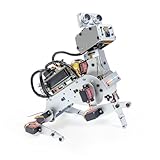
- AI-Powered Raspberry Pi Robot Dog — PiDog: Powered by Raspberry Pi (5/4B/3B+/3B/Zero 2W), OpenClaw, and multi-LLMs like ChatGPT, Gemini, Grok, DeepSeek, Qwen & Ollama. With 12 servos, camera, gyroscope, hearing & touch sensors, PiDog can see, listen, talk, move, and interact intelligently. Supports OpenCV, MediaPipe, TTS & STT, app control, FPV & Python. A great STEM robotics gift for students, makers & tech enthusiasts—perfect for birthdays and holidays. (Raspberry Pi not included)
- Realistic Dog-like Movements: PiDog's 12 powerful servos enable 32 dog-like actions, including walking, sitting, standing, shaking its head, wagging its tail, and performing playful tricks, closely mimicking a real dog and providing an engaging experience. This is an AI development robot product designed for engineers, suitable for ages 15 and above
- Rich Sensor Suite for Interactive Experiences: PiDog features ultrasonic, touch, gyroscope, sound, camera, speaker and microphone. These provide it with advanced hearing, vision, and touch, enabling it to see, detect obstacles, respond to touch, and recognize sounds, making interactions highly engaging
- AI-Powered Interactions with OpenClaw & Multi-LLMs. PiDog combines voice, vision, and gesture recognition for immersive AI experiences. Powered by OpenClaw and multi-LLMs like ChatGPT, Gemini, Grok, DeepSeek, Qwen, Doubao, and Ollama (local LLMs), it can understand questions, respond naturally through TTS & STT, recognize math problems, interpret hand gestures, and hold smart conversations. OpenClaw also enables customizable AI behaviors and personalized robotics development, helping users create their own intelligent robotic companion
- Comprehensive Learning Resources and Support: PiDog offers detailed online documentation, video tutorials, prompt technical support, and an active forum community, ensuring beginners can easily complete all projects and enjoy a great experience
What OpenClaw setup involves
ClawStage’s hardware does not remove the normal OpenClaw software requirements. OpenClaw’s installation guide supports macOS, Linux and Windows and lists Node 24.16+ or 26.1+ as requirements. It documents desktop apps, installer scripts, npm/pnpm/bun, source builds and containerized deployment. The guide’s installer is described as detecting the operating system, installing Node if needed, installing OpenClaw and launching onboarding. OpenClaw installation guide
- Choose the hardware configuration. For 1.0, the Raspberry Pi 5 with 8 GB RAM is included. For BYOP, provide your own Raspberry Pi 5.
- Install and onboard OpenClaw. Follow the current OpenClaw installation instructions for the target system and complete onboarding.
- Configure the Gateway and Control UI. OpenClaw documentation describes a Gateway and a browser-based Control UI; use the project’s current setup guidance for their configuration. OpenClaw documentation
- Connect only the channels and hardware functions you intend to use. OpenClaw documents messaging connections including Discord, Signal, Telegram and WhatsApp. Review each integration’s data flow and permissions alongside any camera, microphone or actuator use.
The cited ClawStage page positions OpenClaw as native to the device, but it does not detail every software installation screen or guarantee that a particular channel or agent workflow is preconfigured. Treat onboarding and integration as configuration work rather than assuming that every use case is ready immediately.
Quick wins for a faster PC:
Scan for outdated or missing drivers - takes under a minuteDriver Scan →Clear out junk files and repair common Windows errorsFree Scan →Fix the driver behind crashes, sound loss and screen glitchesFind Drivers →Rank #3

- 【RaspberryPi 5 & ROS2 Platform】TurboPi robot car runs on the ROS2 operating system and leverages Python and OpenCV to deliver efficient AI processing and a wide range of robotic applications.
- 【Multimodal Large AI Model ChatGPT & OpenClaw】With an integrated multimodal large AI model and OpenClaw, TurboPi robot car kit supports smart conversations, environment awareness, and flexible task execution for richer human-machine interactions.
- 【AI Vision & Autonomous Driving】Equipped with a 2DOF HD camera, TurboPi robot car offers FPV video feedback, object and color recognition, line following, and autonomous driving features—perfect for creative AI projects.
- 【360° Omnidirectional Movement & 2-DOF Robotic Arm】Featuring a robust metal chassis and Mecanum wheels, TurboPi robot car pairs with a 2DOF robotic arm to smoothly execute complex, dynamic transporting tasks across all scenarios.
- 【Comprehensive Code & Learning Resources】 We provide full Python source code, diverse experiment examples, and detailed course materials to support your journey in mastering AI and programming while inspiring endless innovation.
Can OpenClaw control hardware through ClawStage?
ClawStage is designed to connect agent activity with sensors and actuators, including a servo mechanism, and its product page frames this as scene-triggered automation with user-in-the-loop control. That makes physical interaction a stated use case, not proof that any OpenClaw agent can safely or reliably operate every connected device without setup. The published material does not give independent demonstrations, response-time measurements, or safety guarantees for specific tasks.
For any physical workflow, decide what the agent may sense and what actions it may take, and retain a way to supervise or stop motion. Treat camera and microphone capture as separate from local execution: a local controller can still exchange data with connected services when integrations are enabled.
Quick Recap
Best Value

- Raspberry Pi 5 & ROS2 Platform. TurboPi runs on the ROS2 operating system and leverages Python and OpenCV to deliver efficient AI processing and a wide range of robotic applications.
- Multimodal large AI model ChatGPT & Voice Interaction. With an integrated multimodal large AI model and AI voice interaction capabilities, TurboPi supports smart conversations, environment awareness, and flexible task execution for richer human-machine interactions.
- AI Vision & Autonomous Driving. Equipped with a 2-DOF HD camera, TurboPi offers FPV video feedback, object and color recognition, line following, and autonomous driving features—perfect for creative AI projects.
- 360° Omnidirectional Movement. Featuring a robust metal chassis and Mecanum wheels, TurboPi can move in any direction and rotate on the spot, adapting smoothly to various scenarios.
- Comprehensive Code & Learning Resources. We provide full Python source code, diverse experiment examples, and detailed course materials to support your journey in mastering AI and programming while inspiring endless innovation.
Rank #4
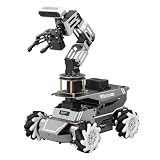
- 【ROS2 Robot Car & Multi-Board Support】Engineered for advanced robotics R&D, the ROSOrin Pro AI robot car operates on the ROS2 framework. It supports Jetson Nano, Jetson Orin Nano Super, Jetson Orin NX Super, and Raspberry Pi 5. This compatibility allows learners, developers, and institutions to select the processing hardware that best aligns with their specific project requirements and computational needs.
- 【AI Large Models & OpenClaw Agent】Integrated with the OpenClaw Agent and multimodal AI large models (such as Gemini, ChatGPT, Grok, Llama, and Deepseek), ROSOrin Pro robot car supports both online access and local offline deployment. You can voice control or send remote text commands via the app. The system autonomously breaks down complex instructions and executes intelligent decision-making, providing a practical environment for AI application development.
- 【SLAM Mapping & 3D Vision Navigation】Equipped with a TOF LiDAR and a 3D depth camera, the robot car achieves dynamic SLAM mapping, path planning, and real-time obstacle avoidance, while enabling 3D object recognition, grasping, sorting, transport, and other advanced human-robot collaboration tasks.
- 【6DOF Robotic Arm & Integrated Algorithm Framework】Featuring a 6DOF robotic arm powered by inverse kinematics, this robot performs 3D object recognition, sorting, and transport operations in spatial environments. Supported by machine vision algorithms including YOLO26 and MediaPipe, it achieves precise object manipulation for industrial-level simulation and human-robot collaboration research.
- 【Comprehensive Development & Educational Resources】Designed to support the developer workflow, this robotics kit provides source codes (including OpenCV and Gmapping) and detailed development tutorials. Whether used for laboratory curricula, university academic research, personal learners, or students, the provided tutorials guide users systematically from fundamental ROS2 concepts to advanced algorithm deployment.
Who should consider ClawStage?
- Consider it if you want to experiment with OpenClaw interacting with a dedicated touchscreen device, camera, microphones, sensors and servo hardware in a compact enclosure.
- Consider the standard 1.0 if you want a Raspberry Pi 5 with 8 GB RAM included and prefer less hardware assembly.
- Consider BYOP if you already own a Raspberry Pi 5 and accept the additional setup involved in using it as the controller.
- Pause before buying if you need independent validation of performance, reliability, privacy behavior across integrations, or a specific automation workflow; the cited vendor and project materials do not establish those outcomes.
Product prices and availability are accurate as of the date/time indicated and are subject to change. Any price and availability information displayed on Amazon at the time of purchase will apply.

