
CAST’s BA22 is a licensable 32-bit RISC processor IP core, not a retail processor or a standalone development board. The June 3, 2011 announcement made it available worldwide without royalties; CAST’s current BA2X family lists two BA22 configurations, a compact deeply embedded core (BA22-DE) and a cache-enabled core (BA22-CE), plus the Talos-BA2X evaluation kit. “Royalty-free” describes the royalty model, not necessarily a no-cost license: teams should confirm commercial licensing terms and integration costs with CAST.
What CAST announced in 2011
On June 3, 2011, Beyond Semiconductor announced that CAST would provide the BA22 processor core worldwide without royalties. The announcement presented it as a fast, compact, power-saving 32-bit RISC core, initially aimed at deeply embedded systems and customers considering migration from 8-bit 8051 designs. CAST also planned to package the core with peripheral controllers and other IP, and to offer integration services. Beyond Semiconductor’s announcement
Contemporaneous Embedded.com coverage described three preconfigured versions: BASE for compact embedded controllers; ADV, adding 32 registers and instruction and data caches for larger systems and RTOS use; and AP, adding instruction and data MMUs with optional floating-point, divider, and multiply-accumulate units. These are historical product names and configurations, not the current CAST lineup. Embedded.com’s coverage
Which BA22 configuration is current?
CAST’s current BA2X family page lists BA22-DE and BA22-CE, along with the Talos-BA2X evaluation kit. The legacy BA22-AP is marked discontinued by CAST, so its historical MMU-focused specifications should not be treated as a current orderable option. CAST BA2X family
Recommended Free Tools
#1 Best Overall

- Flexible MCU Board: Incorporate the ESP32-C3 32-bit RISC-V chip, operating up to 160 MHz, mounted multiple development ports,
- Developer Friendly: Compatible with Arduino IDE, MicroPython, CircuitPython, PlatformIO, ESP IDF, Zephyr, Matter, ESPNow, Meshtastic, WLED, ESPHome, Home Assistant, Ubidots
- Outstanding RF performance: Complete Wi-Fi functions and Bluetooth Low Energy, while supporting communication over 100m with anFL antenna
- Elaborate Power Design: 4 working modes as low as 44 μA in deep sleep mode, while supporting lithium battery charge management
- Thumb-sized Design: 21 x 17.5mm, Seeed Studio XIAO series classic form factor
| Configuration | Best fit | Key features | Published implementation figures |
|---|---|---|---|
| BA22-DE | Compact, deeply embedded controllers | Harvard-style core; four- or five-stage pipeline; 16–32 general-purpose registers; AMBA AHB, AXI4, Wishbone, and Quick Memory interface options; power management and interrupt control; optional multiply, divide, MAC, floating-point, DSP, and vectored-interrupt units. | CAST reports a 15K-equivalent-gate base version and more than 800 MHz in 28 nm. These are vendor figures, not independent results; implementation outcomes depend on configuration and design conditions. |
| BA22-CE | Designs with off-chip instruction/data memory and potentially an RTOS | Adds instruction and data caches to the BA22 design; broad bus and Quick Memory interface choices; optional MAC, IEEE 754 floating point, and DSP acceleration. CAST describes it as cache-enabled, not as the current AP configuration with MMUs. | CAST reports a minimum configuration of approximately 30K equivalent gates and 22,000 µm² in 28 nm, excluding cache SRAM; more than 800 MHz in 28 nm and 16 nm examples; and 2.93 CoreMarks/MHz. Vendor-reported figures; actual results depend on process, configuration, libraries, and memory assumptions. |
| BA22-AP | Historical application-processor-oriented option | The 2010-era description added instruction and data MMUs, with optional floating point, divider, and MAC. CAST currently marks it discontinued. | Current comparable implementation figures: not stated (CAST BA2X family page marks AP discontinued). |
Sources: CAST BA22-DE, CAST BA22-CE, Embedded.com’s historical coverage, and CAST BA2X family. CAST cautions that area, power, and speed vary with process, configuration, libraries, and memory assumptions, so these figures are orientation points rather than a like-for-like comparison.
BA22-DE: keep the core compact
DE is the current choice to investigate when the workload resembles a small embedded controller and minimizing core size is important. Designers can choose among bus and memory interfaces and add optional arithmetic or signal-processing units as needed. CAST describes it as a Harvard-style core, with separate instruction and data paths, and reports a 15K-equivalent-gate base version. CAST BA22-DE specifications
Rank #2
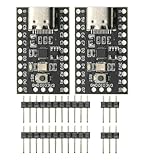
- CH32V003 Development Minimum System Board for Nano RISC-V CH32V003F4U6 Chip TYPE-C USB 22Pin
- on-board 24MHz Crystal oscillator
- Power by TYPE-C USB
BA22-CE: add caches for larger software
CE is the current cache-enabled option for systems using off-chip instruction and data memories and workloads that may benefit from an RTOS. Caches can reduce the cost of repeated external-memory access, but they add memory requirements and configuration choices; the published minimum-area figure explicitly excludes cache SRAM. CAST lists optional floating-point, MAC, and DSP support. CAST BA22-CE specifications
What does royalty-free mean?
The 2011 announcement says CAST would offer BA22 without royalties. That means the announcement’s commercial distinction is the absence of per-unit royalties; it does not establish that the IP license itself, support, tools, or integration work is free. The announcement also described CAST integration services. Prospective users should ask CAST for current license terms, permitted use, deliverables, support, and any upfront or service fees. Beyond Semiconductor’s 2011 announcement
Windows Errors? Fix Them Before They Spread
Repair common Windows errors and clear accumulated junk for a smoother, more stable PC - no reinstall needed.Free scan · no reinstallOutdated Drivers Are Slowing You Down
One free scan finds every outdated or missing driver and matches the right update for your exact hardware.Free scan · exact hardware matchRank #3

- The ESP32-C3 SUPERMINI is positioned as a high-performance, low-power, cost-effective IoT mini development board, suitable for low-power IoT applications and wireless wearable applications
- It is equipped with a rich set of interfaces, including 11 digital I/Os that can be used as PWM pins and 4 analog I/Os that can be used as ADC pins.
- It supports four serial interfaces, including UART, I2C, and SPI.
- The ESP32-C3 features a 32-bit RISC-V CPU, including an FPU (Floating Point Unit) capable of 32-bit single-precision
- Package: 2PCS ESP32-C3 MINI Development Board ESP32 SuperMini ESP32 C3 WiFi Module
Can BA22 run an RTOS?
BA22-CE is described as suitable for larger systems and potentially RTOS use; the historical ADV configuration was explicitly positioned for larger systems and RTOS use. The available descriptions do not name a specific supported RTOS or establish that every BA22 configuration runs one out of the box. Confirm the intended operating system, board-support package, memory-management needs, and toolchain compatibility with CAST for the exact core configuration. CAST BA22-CE Embedded.com’s historical coverage
What ISA and development tools come with the core?
The BA2 instruction set uses variable-length 16-, 24-, 32-, and 48-bit instructions, with 16–32 general-purpose registers and arithmetic, control-flow, DSP, and floating-point operations or extensions. CAST argues that dense encoding can reduce nonvolatile-memory use, cache misses, and instruction count, which may lower energy at the system level. Those are architectural benefits claimed by CAST, not a guarantee of a particular product’s power or code-size result. CAST BA2X family CAST BA22-DE
Rank #4

- ESP32-C6 WiFi 6 microcontroller development board adopts ESP32-C6-WROOM-1-N8 module, which is equipped with RISC-V 32-bit single-core processor, up to 160MHz main frequency, built-in 8MB Flash
- Integrates WiFi 6, Bluetooth 5 and and IEEE 802.15.4 (Zigbee 3.0 and Thread) wireless communication, with superior RF performance
- Integrates rich peripherals including SPI, UART, I2C, I2S, LED PWM, SDIO and other interfaces, compatible with the pinout of ESP32-C6-DevKitC-1-N8 development board, more convenient to use and expand a variety of peripheral modules
- Onboard CH343 and CH334 USB HUB chips, supports USB and UART development at the same time via a USB-C port
- Comes with online examples and tutorials for ESP-IDF development environment
CAST says BA22 deliveries include BeyondStudio, an Eclipse-based IDE for Windows and Linux, GNU C/C++ tooling, libraries, an architectural/instruction-level simulator, debugging support, and reference designs. The IP package is described as including synthesizable Verilog for ASIC implementation or optimized FPGA netlists, documentation, a testbench, a sample SoC design, and synthesis and simulation scripts. Confirm the precise package and tool versions in a current proposal. CAST BA22-DE CAST BA22-CE
Independent reader supportYour contribution helps us test, update, and keep practical guides available for everyone.Is there a BA22 development board?
CAST lists the Talos-BA2X evaluation kit on its family page. That establishes an evaluation-kit option, but does not establish current stock, price, included hardware, or a direct retail purchase path. Ask CAST about availability and whether the kit matches the core variant and interfaces you need. CAST BA2X family
Best Value

- Ample PSRAM Storage – The development board offers 8MB PSRAM, providing substantial extra memory for handling more complex tasks, large data buffers, and advanced processing.
- Enhanced Multi-Tasking Capability – With the additional 8MB PSRAM, the ESP32-C5-WIFI6-KIT can efficiently manage multiple protocol stacks simultaneously, ensuring smooth operation in multi-tasking IoT environments.
- Support for Medium-Load Applications – The 8MB PSRAM allows the ESP32-C5 to handle medium-load applications more effectively, making it ideal for scenarios requiring real-time data processing or continuous communication.
- Seamless Performance – The increased memory improves the overall performance and responsiveness of the device, particularly when running applications with larger memory footprints or more demanding computations.
- Future-Proof for Complex Projects – With 8MB of PSRAM, developers are better equipped to build scalable, high-performance solutions that support both current and future IoT use cases, offering flexibility for future-proofing designs.
How to evaluate BA22 for a design
- Match the workload. Start with BA22-DE for a compact controller; consider BA22-CE if caches and larger software are relevant. Treat BA22-AP as discontinued unless CAST confirms otherwise.
- Specify interfaces and options. Identify required AHB, AXI4, Wishbone, or Quick Memory connectivity, register count, and any multiplier, divider, MAC, floating-point, DSP, or vectored-interrupt features.
- Set implementation assumptions. Ask CAST to estimate the exact configuration in your process, libraries, clock target, and memory architecture. Compare area and timing with cache SRAM treatment made explicit.
- Validate software needs. Confirm compiler and debugger support, the needed RTOS and its memory-management requirements, and what reference design or board support is included.
- Confirm commercial and evaluation terms. Request the current royalty-free license terms, integration/support costs, delivery package, and Talos-BA2X kit availability.
How strong are the published performance comparisons?
CAST’s current BA22-CE page reports 2.93 CoreMarks/MHz and example frequencies above 800 MHz for 28 nm and 16 nm implementations. These are vendor-published figures, not independent benchmarks, and do not specify enough common test and implementation conditions to predict another team’s result. The historical Embedded.com article also quoted a Linley Group study claiming BA22 instruction streams were 5–20% denser than ARM Thumb-2; that is a secondary historical claim, not a current independent comparison. CAST BA22-CE Embedded.com’s 2010 coverage
Quick Recap
Product prices and availability are accurate as of the date/time indicated and are subject to change. Any price and availability information displayed on Amazon at the time of purchase will apply.

