
No: the published specifications do not support running any of DeepSeek-R1’s listed model checkpoints locally on the DFRobot Beetle ESP32-C6. Its 512 KB of SRAM is far below the scale implied by even the smallest listed checkpoint, at 1.5 billion parameters. A more plausible design is to use the Beetle as a Wi-Fi-connected sensor or controller and send selected requests to a remote inference service.
What the Beetle ESP32-C6 can do
The DFRobot Beetle ESP32-C6 Mini Development Board (SKU DFR1117) is a compact IoT development board, not a dedicated AI accelerator. DFRobot lists these resources and features for the board:
- 160 MHz single-core RISC-V processor
- 512 KB SRAM and 4 MB flash
- 320 KB ROM and 16 KB RTC SRAM
- 13 digital I/O and USB 2.0 CDC
- 2.4 GHz Wi-Fi, Bluetooth 5/BLE, Thread 1.3, and Zigbee 3.0
DFRobot describes the board as coin-sized, with dimensions of 25 × 20.5 mm. Its small form factor and wireless options suit compact sensor, wearable, and smart-home projects. These are board specifications; they do not mean the board has resources for hosting a large language model.
Why local DeepSeek-R1 inference is not a practical fit
DeepSeek’s official R1 repository lists the full R1 and R1-Zero models at 671 billion parameters. Its distilled checkpoints are listed at 1.5B, 7B, 8B, 14B, 32B, and 70B parameters, making 1.5B the smallest listed option. Those parameter counts are already far beyond the Beetle’s stated 512 KB SRAM.
What’s actually slowing this PC down?
Pick the symptom - the matching free tool is one click away.
#1 Best Overall
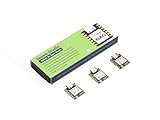
- Enhanced Connectivity: Combines 2.4GHz Wi-Fi 6 (802.11ax), Bluetooth 5(LE), and IEEE 802.15.4 radio connectivity, allowing you to apply the Thread and Zigbee protocols.
- Matter Native: Supports building Matter-compliant smart home projects thanks to its enhanced connectivity, achieving interoperability
- Security Encrypted on Chip: Powered by ESP32-C6, it brings enhanced encrypted-on-chip security to your smart home projects via secure boot, encryption, and Trusted Execution Environment (TEE)
- Outstanding RF performance: Has an on-board antenna with up to 80m BLE/Wi-Fi range, while reserving an interface for external UFL antenna
- Leveraging Power Consumption: Comes with 4 working modes, with the lowest being 15 μA in deep sleep mode, while also supporting lithium battery charge management.
Flash is not interchangeable with working RAM for model inference, so the board’s 4 MB flash should not be added to SRAM as if they formed one pool of model memory. The comparison is enough to rule out a realistic local deployment of the listed checkpoints on this board. It is a conclusion from published specifications, not a reported benchmark or device test; the sources do not establish a precise memory requirement, quantization setup, throughput, or Beetle-specific port.
Local model versus remote API
These are different architectures with different constraints:
Rank #2

- ESP32-C6-DevKitC-1 development board using the universal module ESP32-C6--1 with 16 MB SPIflash
- ESP32-C6 development board has complete Wi-F, low-power Bluetooth and other functions
- ESP32-C6--1 uses an onboard PCB antenna, and the module has a built-in ESP32-C6 chip, which has good functionality
- The ESP32 USB Type-C interface of the ESP32-C6 chip supports USB 2.0 full-speed mode and can also be used as the power supply interface of the development board. It can burn firmware to the chip, communicate with the chip through the USB protocol, and can also be used for debugging
- ESP32-C6-DevKit most of the pins of the module on the board have been led out to pin headers on both sides. Developers can easily connect various peripheral devices through jumpers according to actual needs. The development board can also be plugged into a breadboard for use
| Approach | Where inference runs | Beetle’s role | Main considerations |
|---|---|---|---|
| Local model | On the Beetle itself | Would have to host the model | The published memory and model scale do not support the listed DeepSeek-R1 checkpoints; no Beetle-specific port or benchmark is established. |
| Remote API | On a remote service | Wi-Fi-connected sensor, controller, or interface | Evaluate network availability, latency, privacy and data handling, service terms, and operating cost for the project. |
DeepSeek’s release page identifies deepseek-reasoner as an API model name. That makes a remote-service design a possible direction to investigate, not proof that a particular project will meet its latency, privacy, reliability, regional-availability, or cost requirements. The Beetle would send data over Wi-Fi; the model inference would not be happening on the board.
When the Beetle makes sense in an AI-connected project
The Beetle can still be useful around an AI feature. For example, it could collect a sensor reading, trigger a request based on a local event, or provide a compact control interface. A system can keep time-sensitive or safety-relevant decisions on the device and use a remote model only for tasks where a network request and service dependency are acceptable.
Rank #3

- Equipped with a high-performance 32-bit RISC-V processor with clock speed up to 160 MHz, and a low-power 32-bit RISC-V processor with clock speed up to 20MHz
- Supports 2.4GHz Wi-Fi 6 (802.11 b/g/n) and Bluetooth 5 (LE), with onboard antenna
- Built in 320KB ROM, 512KB of HP SRAM, 16KB LP SRAM and 4MB Flash memory. Onboard 1.47inch LCD display, 172×320 resolution, 262K color
- Adapting multiple IO interfaces, integrates full-speed USB port. Onboard TF card slot for external TF card storage of pictures or files
- Supports accurate control such as flexible clock and multiple power modes to realize low power consumption in different scenarios. Built-in RGB LED with clear acrylic sandwich panel for cool lighting effect
Before designing around a remote model, decide what information the device is allowed to transmit, how the system behaves when Wi-Fi or the service is unavailable, and whether the response time and ongoing cost fit the application. The reviewed sources do not assess those factors for a specific project.
Independent reader supportYour contribution helps us test, update, and keep practical guides available for everyone.Choosing a development path
DFRobot documents Arduino IDE, ESP-IDF-related board material, MicroPython, and PlatformIO tutorial paths. Espressif describes ESP-IDF as its development framework for ESP32-C6. Choose a toolchain according to the board features, libraries, and networking behavior your project needs; changing toolchains does not change the Beetle’s physical memory capacity.
Rank #4

- ESP32-C6-DevKitC-1 development board using the universal module ESP32-C6--1 with 4 MB SPIflash
- ESP32-C6 development board has complete Wi-F, low-power Bluetooth and other functions
- ESP32-C6--1 uses an onboard PCB antenna, and the module has a built-in ESP32-C6 chip, which has good functionality
- The ESP32 USB Type-C interface of the ESP32-C6 chip supports USB 2.0 full-speed mode and can also be used as the power supply interface of the development board. It can burn firmware to the chip, communicate with the chip through the USB protocol, and can also be used for debugging
- ESP32-C6-DevKit most of the pins of the module on the board have been led out to pin headers on both sides. Developers can easily connect various peripheral devices through jumpers according to actual needs. The development board can also be plugged into a breadboard for use
If local model inference is a requirement, select a host only after checking the model’s actual runtime and memory requirements against that hardware. The published information here does not establish a suitable alternative device or a Beetle implementation that runs DeepSeek-R1 locally.
Quick Recap
Product prices and availability are accurate as of the date/time indicated and are subject to change. Any price and availability information displayed on Amazon at the time of purchase will apply.

