
iTechGuides is reader-supported. When you buy through links on our site, we may earn an affiliate commission. As an Amazon Associate I earn from qualifying purchases. Learn more
The safest night-running setup uses several modest layers rather than one painfully bright lamp: broad retroreflective material on your torso, reflective bands on moving arms and legs, a front or rear light that makes your position obvious, and a headlamp or handheld flashlight aimed at the ground only as brightly as necessary. When another person approaches, dim the lamp and direct the beam away from faces. Choose routes with sidewalks or dedicated paths, useful street lighting and simple, well-observed crossings.
Three different visibility jobs
Night visibility is not one problem. Other people need to detect you, understand that you are moving, and judge where you are going. You also need enough light to spot cracks, roots, puddles, curbs and other hazards. One device rarely performs all of those jobs well.
| Job | Most useful layer | Why it helps |
|---|---|---|
| Be detected by approaching drivers, cyclists and walkers | Retroreflective vest or jacket panels | Returns headlight or flashlight beams toward the source without shining continuously into anyone’s eyes. |
| Make movement recognizable from the side | Reflective ankle and arm bands | Moving points help observers identify a human runner rather than a static object. |
| Signal your position when no beam is aimed at you | Clip-on LED or running light | Produces active light from the front, rear or both directions. |
| See the surface ahead | Adjustable headlamp or handheld flashlight | Illuminates hazards under your control; it is not a substitute for reflective coverage. |
Keeping these jobs separate prevents a common mistake: wearing a powerful headlamp while remaining almost invisible from the side or rear.
Make retroreflection your baseline
Retroreflective fabric does not emit light. Tiny reflective elements send incoming headlights back toward the vehicle, so a driver can see the material from much farther away than ordinary dark clothing. The UK Highway Code says reflective armbands, sashes, jackets, footwear and waistcoats can be seen by drivers using headlights up to three times as far away as non-reflective materials. That is a statement about visibility under headlights, not a guarantee that a driver will react correctly.
#1 Best Overall

- LED Reflective Vest; It features LED lights on both front and rear as well as reflective strips on the gear. Super‑bright for 360° visibility, it keeps you visible up to 1000 feet away in darkness to protect your safety
- 5 Colors Light Running Vest; Features 5 light colors--White, Green, Blue, Pink, and Red. Choose from 3 dynamic modes – Steady On, Single Color Flashing, or 5-Color RGB Flashing mode. Long‑press the button for 3 seconds to power off under any mode
- USB Rechargeable Running Gear; Comes with a dual Type‑C USB cable, allowing you to charge the front and rear lights simultaneously. Approximately 50‑minute charging time delivers 8‑20 hours of runtime, depending on the selected light mode
- Adjustable Reflective Gear; Made with elastic fabric, move buckles to adjust size, shoulder to waist length ranges 14" to 24", waist circumference ranges from 25" to 45", it fits most
- Our LED‑Light Reflective Vest is ideal for nighttime walking, running, cycling, jogging, dog‑walking and other outdoor activities. It is also good choice for anyone who works in dark
Cover the torso without creating glare
A reflective running vest is usually the strongest first purchase because it gives broad, glare-free coverage while adding little heat. Look for reflective panels or strips that remain visible from the front, sides and back. A jacket with small logos may look reflective in a shop but leave large areas of your body visually blank; broad panels are easier to detect at a distance.
Wear the vest over the layer that will be visible for the entire run. If you add a rain shell later, put the reflective layer on top or choose outerwear with its own panels. Check that a hydration pack does not cover the rear strip.
Put reflectors on moving limbs
NHTSA reports that nighttime conspicuity is greatly enhanced when pedestrians are in motion and use retroreflective clothing, especially on their extremities. Reflective ankle bands create an unmistakable alternating motion when you run. Arm bands add a second moving cue that is visible from the side and during a turn.
Use matching bands on both sides when traffic or other path users can approach from multiple directions. Place ankle bands where they will not be hidden by long tights or socks, and secure arm bands so they do not slide toward your wrists. They should be snug enough to stay in place but not restrict circulation or rub when wet.
Check every viewing direction
Stand in front of a mirror, then turn sideways and backward while wearing your normal pack, jacket and accessories. A vest that is obvious from the front can disappear behind a pack; a rear light clipped to a shoulder strap may point sideways instead of backward. Reposition or add a second piece until a person approaching from each likely direction can identify you.
Rank #2

- ✔HIGHLY VISIBLE & SAFE – Excellent 360 Degree reflective bands keep you safe in all weather conditions(rain, fog, dark) at day or night. Super reflective running gear can be seen from 800 feet or more.Your family at home can relax, knowing you are wearing high performance reflective gear and are so much safer.
- ✔ELASTIC & ADJUSTABLE – Reflective safety vest shoulder to waist expands from 13" to 21", waist circumference expands from 27" to 40"; You can freely adjust the size of the reflective vest, allowing you to move freely.Our reflective bands are perfect for any age and gender!
- ✔HIGH QUALITY – Reflective bands are made of a top quality Nylon fabric and super-bright reflective silver stripes with a belt buckle and strap adjusters made of strong ,hard plastic which will withstand a lifetime of repeated use.
- ✔COMFORTABLE AND LIGHTWEIGHT – Unlike vests, these straps are more comfy.Fully adjustable and breathable design allows for a full range of motion. It is also super lightweight easy to carry. Fits over any clothing in any season.
- ✔UNLIMITED VERSATILITY: High visibility suspender type reflective harness vest for ANY outdoor activity; including Trekking, Running, Cycling or motorbiking, Walking, Jogging, Construction or traffic work,Roadside emergencies where high vis clothing is required.
Add active lights for detection
Reflective material works when a beam reaches it. An active light makes you detectable even when the approaching person is not yet shining a headlight directly at you. Canada’s Department of National Defence guidance for people exercising near roads in darkness recommends reflective clothing, a clip-on safety light, a handheld flashlight and a headlamp.
Front and rear placement
Use a small clip-on LED or running light on the front of a vest, chest strap or waistband. Put a second light on the back of a vest, pack or waistband when you may be overtaken. Keep the rear light unobstructed by a jacket flap or pack pocket.
Crashes, No Sound, or Screen Glitches?
Random freezes, missing sound and display glitches usually trace back to one bad driver. Find and replace yours safely.Free scan · under a minuteWindows Errors? Fix Them Before They Spread
Repair common Windows errors and clear accumulated junk for a smoother, more stable PC - no reinstall needed.Free scan · no reinstallA front light tells an approaching person that something is ahead; it does not show how far to the side you are. Reflective strips on the torso and limbs provide that spatial information. A rear light tells traffic behind you that you are there, while the reflective elements help the driver see your outline and movement.
Choose the least distracting mode
Use a steady or gently pulsing mode that is easy to track. A rapidly changing flash can be uncomfortable for other path users and may make it harder to judge your speed. There is no universal flashing pattern established for runners, so prioritize a mode that remains visible without distracting people sharing the route.
Use a headlamp to see the path, not to announce yourself
REI separates illumination from conspicuity: a bright headlamp or handheld light helps you see hazards, while reflective elements and safety lights help approaching road users detect you. There is no evidence-based universal lumen number for every road, trail or weather condition. Choose the lowest setting that lets you identify the surface several steps ahead, then increase it only when conditions demand more.
Rank #3
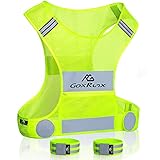
- ✅HIGH 360º VISIBILITY – The reflective vest which could be seen from max 800 feet away and have a 360ºcoverage in all weather at day or night. Bright color and excellent reflective strips make you easy to be found, much safer at night!
- ✅ULTRA LIGHTWEIGHT & BREATHABLE – Good quality thin mesh fabric and quick drying material provides ultra soft and breathable feeling, you’ll even forget wearing this reflective safety vest. Great outdoor sport reflective jacket for running, cycling, jogging, motorcycling, also suitable for walking the dog and traffic.
- ✅ADJUSTABLE & COMFORTABLE DESIGN – 5 sizes high reflective running vest with adjustable velcro waist band perfectly fit different body shape for women men in all seasons. Large zippered pocket allow you carry phones, keys and cards and so on.
- ✅SUPER-VALUE REFLECTIVE SET – 1 pcs reflective running vest comes with 2 pcs adjustable hi vis arm/ankle/wrist bands, better to be seen from all angles. And, we recommend hand washing in cold water, hang to dry.
- ✅100% SATISFACTION – GoxRunx reflective gear is guaranteed to be the top quality, promising 24 hours online service. Please contact us if you have any problem.
Set brightness by the environment
- Well-lit sidewalk: Start on a low setting. The lamp should reveal uneven pavement without overpowering nearby street lighting.
- Mixed lighting or a dim path: Use a medium setting and check that the beam reaches far enough to plan around obstacles.
- Unlit trail: Increase brightness only as much as needed to distinguish roots, stones, edges and changes in grade. A handheld light can supplement a headlamp when you need to look to the side.
- Rain, fog or reflective surfaces: Test the setting before accelerating. Water and pale surfaces can throw light back toward you and other people, making a lower setting more comfortable.
Aim the beam at the ground
Adjust the lamp so the center of the beam lands on the path several steps ahead rather than at eye level. A downward beam still reveals hazards while reducing glare for walkers, cyclists and drivers. A narrow, high-powered beam pointed straight ahead can temporarily impair someone coming toward you even if the total lamp output is not unusually high.
The Tool Desk
Outbyte PC Repair FREERepair Windows errors before they cause bigger problemsFix Now →Outbyte Driver Updater FREEFix the driver behind crashes, sound loss and screen glitchesFind Drivers →Use a four-step approach protocol
- Notice the approach early. Watch for a person, bicycle or vehicle before it reaches the brightest part of your beam.
- Lower output. Move to a lower setting when one is available. If the lamp has no quick control, briefly cover or tilt it rather than pointing it at the other person.
- Redirect the beam. Tilt the lamp toward the ground at your side or turn your head slightly so the concentrated beam misses faces and windscreens.
- Restore illumination after passing. Return the beam to the path only when the other person is clear, and check the surface again before resuming speed.
This is a practical application of glare-reduction guidance, not a runner-specific legal standard. The Federal Highway Administration says lighting should improve pedestrian visibility while reducing glare for motorists, and the Highway Code tells drivers to dip or switch lights to avoid dazzling other road users.
Match the setup to your route
| Route condition | Priority equipment | Adjustment during the run |
|---|---|---|
| Street with continuous lighting and sidewalks | Reflective vest, limb bands and a low-output front or rear light | Keep the headlamp low or off if the surface is already clear; use it briefly for dark sections. |
| Dedicated running or pedestrian path | Vest, limb bands, active light and adjustable headlamp | Dim and redirect the beam whenever walkers or cyclists approach. |
| Unlit trail | Full reflective coverage, front/rear lights and a headlamp or handheld light | Use enough output to identify hazards, but keep the beam aimed at the ground and scan deliberately. |
| Road shoulder or crossing-heavy route | High-coverage vest, moving limb reflectors and front/rear active lights | Slow at every uncertain crossing and never rely on a driver seeing your lamp. |
Choose safer routes before choosing brighter gear
Gear cannot correct a blind bend, a fast crossing or a section where parked cars hide you from traffic. Prefer sidewalks, designated running tracks and pedestrian paths. Favor routes with useful lighting, clear sightlines and fewer complicated crossings. Avoid unlit gaps, dense rows of parked cars, blind corners and intersections where vehicles approach quickly from several directions.
Follow local rules about which side of a road pedestrians should use. Where no sidewalk exists, the correct side can depend on local law and road design; check the rule for your area rather than applying a universal assumption. A route that is slightly longer but has continuous pedestrian space and predictable crossings is often safer than a direct route beside fast traffic.
Build a baseline night-running kit
- Start with a reflective vest or jacket. Confirm that panels cover the torso from front, side and rear.
- Add ankle and arm bands. Use both sides when traffic can come from either direction, and verify that clothing will not hide them.
- Add a clip-on light. Place one where it is visible from the front and, when needed, another on the rear of your pack or waistband.
- Add path illumination. Carry an adjustable headlamp or handheld flashlight and set it to the lowest useful brightness.
- Rehearse the dim-and-tilt action. Practice lowering output and aiming down before you encounter someone on a narrow path.
- Inspect the route and equipment together. Walk the first section at night, check the actual surface, and make sure every light remains visible while you run.
Compare gear by function, not by brightness
| Gear | Front, side and rear coverage | Visibility type | Beam control | Comfort concerns | Power dependence | Best use |
|---|---|---|---|---|---|---|
| Reflective vest | Broad torso coverage; depends on panel layout | Retroreflective | No beam | Check heat, fit and pack interference | None | First purchase for glare-free conspicuity |
| Reflective ankle or arm bands | Strong motion cues; coverage is narrow | Retroreflective | No beam | Prevent slipping and chafing | None | Side visibility and recognizable movement |
| Clip-on running light | Depends on mounting direction; add rear coverage when needed | Self-luminous | Usually limited to light modes | Check bounce and secure the clip | Battery or charging required | Active front or rear detection |
| Adjustable headlamp | Illuminates in the facing direction | Self-luminous | Brightness and tilt can be controlled | Check strap pressure, bounce and sweat | Battery or charging required | Seeing hazards on dark surfaces |
| Handheld flashlight | Illuminates wherever you point it | Self-luminous | Very flexible; requires one hand | Can affect arm swing and grip | Battery or charging required | Supplemental scanning and route illumination |
Evaluate weather resistance as well as comfort. Rain, sweat and mud can affect clips, charging ports, reflective surfaces and battery contacts. A light that is technically bright but bounces, chafes or cannot be operated with cold fingers is a poor safety tool because you are likely to leave it at home or point it carelessly.
Rank #4

- 【360° Visibility at Night】 Brighten your path with a 500LM chest light reaching 70m. Choose between floodlight for wide nearby coverage or spotlight for focused long-distance visibility. For superior safety over traditional headlamps, the vest features a 200-meter visible reflective board and 360° reflective straps — offering all-around visibility without needing to turn your head.
- 【Customizable Lighting】 Choose from 7 lighting modes, allowing you to switch between different colors and flashing patterns to grant you the freedom of choosing the perfect setting for any situation. Our reflective running gear with 45° adjustable beam angle lets you spotlight distant paths or illuminate nearby surroundings.
- 【Comfortable & Adjustable Fit】 Enjoy customized comfort with adjustable buckles and elastic straps accommodating shoulder widths of 12-23 inches (30-60cm) and waist sizes of 31-51 inches (80-130cm). This running light vest is designed wider dual-shoulder strap, which distribute weight evenly and enhances stability and comfort, perfectly resolving the head fatigue caused by traditional headlamps during long-distance running.
- 【Long Battery Life】 This running light is powered by a lithium-ion battery integrated into the device (battery model: XXKJ103450; prismatic battery; dimensions: 52 mm (L) × 34 mm (W) × 10 mm (T)), and is designed for long-lasting performance and safety. Powered by a robust 1800mAh battery, our running lights benefit from 3.5-20 hours of continuous illumination, ensuring uninterrupted visibility throughout your night runs.
- 【IPX4 Waterproof & Multi-Use】 Built to withstand rain, sweat, and splashes, the IPX4 waterproof rating ensures durability in various weather conditions. Whether running, cycling, hiking, walking the dog or other outdoor activities, this running reflective gear offers a more comfortable, flexible and convenient lighting solution than headlamps.
Manage batteries and charging
Active lights and headlamps depend on power; reflective material does not. Charge or replace batteries before every run long enough to outlast the expected operating time, and carry a backup plan for routes where darkness would leave you unable to see the surface. Check the indicator while the light is still indoors, not after you have reached an unlit section.
Keep charging contacts clean and dry according to the device instructions. Store spare batteries where they cannot short against keys or coins. If a light dims unexpectedly, switch to a lower mode and leave the route rather than continuing into terrain you can no longer see.
Stay behaviorally visible
Never assume that seeing a vehicle means its driver sees you. Headlights can be pointed elsewhere, a windscreen can be dirty, and a driver may be focused on another hazard. Make eye contact only when it is safe and treat uncertain crossings as stops: slow down, look for every traffic direction, and proceed only when the path is clearly available.
Keep enough ambient awareness to hear other path users. Avoid sealing both ears from the environment, and do not let a bright beam or phone screen prevent you from noticing a cyclist, approaching runner or vehicle. On a narrow path, slow down early and give the other person room rather than expecting them to move around your beam.
What’s actually slowing this PC down?
Pick the symptom - the matching free tool is one click away.
Understand what visibility gear can and cannot prove
NHTSA, citing NCSA 2023c in its countermeasures review, reports that 77% of pedestrian fatalities occur at night. That figure is an attribution about the US fatality data discussed by NHTSA, not a universal worldwide rate and not a prediction of an individual runner’s risk.
Best Value

- 360° High Visibility to Keep You Safe; Super-bright silver reflective stripes on the reflective vest offers 360°visibility, makes you be seen 800 feet away by cars at any weather like dark/rain/fog, and protect your safety
- Adjustable Reflective Vests; Made with elastic fabric, designed with 4 adjustable buckles to adjust size for your need. Shoulder size expands from 14" to 24", waist circumference expands from 25" to 45". Fit most people
- Comfortable Wearing; Suspender design running vest, lightweight and breathable, easy and comfortable wearing, you can move freely. With high flexibility, you can wear it over coat in winter, also easy to fold, you can carry it in your pocket
- Ideal for outdoor sports; reflective gear is perfect for nighttime walking, running, cycling,motorcycling, skateboarding, jogging, dog-walking, kids play. It is also good choice for anyone who works in dark
- Note; the reflective gear can't illuminate by themselves, they will only be reflective when light falls on them. No need batteries for these reflective vests
NHTSA also states that studies have not linked visibility aids to a decrease in crashes. Reflective clothing and lights improve conspicuity, but they do not compel a driver to yield, remove the need for a suitable route or replace defensive behavior. Treat the equipment as one layer in a system that includes route selection, speed control, observation and prudent crossing decisions.
Pre-run inspection checklist
- Reflective torso panels are visible from the front, side and rear.
- Ankle and arm bands are secure, uncovered and comfortable.
- Front and rear active lights are switched on and mounted in the intended direction.
- The headlamp or flashlight has enough charge for the planned route.
- The beam is aimed at the ground, not at eye level.
- You can lower brightness or redirect the beam without stopping awkwardly.
- The route avoids unlit gaps, blind bends and crossings with poor sightlines.
- You know where you will slow or stop if traffic, glare or surface conditions become uncertain.
Fix common visibility failures
People still do not notice you
Check for coverage gaps first. A dark pack may hide your rear vest, and a single chest light may be invisible from behind. Add rear and side reflectors, then verify them from several angles in actual headlights rather than indoor lighting.
Others complain that your lamp is dazzling
Lower the output, tilt the beam toward the ground and use the dim-and-redirect protocol before the person reaches you. If glare continues, use a less concentrated setting or rely more on reflective and clip-on layers for detection.
Recommended Free Tools
Your light bounces or causes chafing
Move the mount to a stable chest or waistband position, tighten it enough to prevent movement, and test it over the clothing you actually run in. A handheld light may be preferable when a head strap cannot remain stable, but preserve a natural arm swing and keep one hand available for balance.
You can see the path but not the traffic
That is an illumination-versus-conspicuity mismatch. Keep the headlamp aimed down for hazards, then add reflective torso and limb coverage plus a front or rear active light so other people can detect you without receiving your beam in their eyes.
Quick Recap
Product prices and availability are accurate as of the date/time indicated and are subject to change. Any price and availability information displayed on Amazon at the time of purchase will apply.

