
There is no evidence-backed universal winner. Choose a real-time speech-to-text API by testing its recognition on your languages and audio, then checking how its streaming interface, partial and final transcript behavior, endpointing, deployment regions, limits, and billing fit your app. OpenAI, AssemblyAI, Google Cloud, Deepgram, and Microsoft Foundry each document a different integration shape; published prices and latency claims are not a like-for-like performance comparison.
Compare the documented options
The figures and capabilities below reflect official provider pages and documentation inspected on October 3, 2026. Models, prices, and service limits can change; confirm the selected model’s current documentation before implementation. A language count or vendor latency figure does not establish how well a model will perform on your audio.
| Provider and option | Streaming behavior and interface | Languages and endpointing | Published price or latency |
|---|---|---|---|
| OpenAI GPT-Live-Transcribe | Low-latency streaming with transcript deltas; a Live session endpoint is listed. Tunable latency, unstructured context, keyword hints, and multiple language hints are documented. | Multiple language hints are listed; an exact supported-language count and endpointing details are not established by the model page summarized here. | OpenAI lists $0.017 per minute of realtime audio. Rate limits vary by usage tier; the page says the free tier is unsupported for this model. No comparable accuracy or latency test against the other providers is established. |
| AssemblyAI Universal-3.6 Pro Realtime | Secure WebSocket delivery with partial and final transcripts. | AssemblyAI lists 32 languages and automatic language detection. The product page distinguishes prompting, code-switching, diarization, and medical-mode features. | AssemblyAI lists $0.45 per hour and advertises approximately 150 ms P50 latency for this model. This is a vendor claim, not an independent cross-provider result. |
| AssemblyAI Universal Streaming and Universal Streaming Multilingual | Streaming variants; the product page lists these separately from Universal-3.6 Pro Realtime. | Universal Streaming is listed as English-only. The multilingual variant is listed for EN/ES/FR/DE/IT/PT. Check the product feature rows for the exact prompting and other capabilities you need. | AssemblyAI lists $0.15 per hour for these variants. The captured page does not establish a comparable independent latency or accuracy result. |
| Google Cloud Speech-to-Text streaming | Bidirectional streaming returns interim results as audio is processed and final results for completed segments. The v1 documentation says streaming requests are supported only over gRPC; synchronous recognition is a separate blocking mode. | Language configuration and speech-context hints are documented. Confirm limits for the API version, model, and region you select. | Price and a comparable latency figure are not stated in the Google v1 documentation summarized here. |
| Deepgram live streaming | The live-streaming guide shows SDK and non-SDK integrations and discusses interim results, end-of-speech detection, and measuring streaming latency. Its example uses model=nova-3 and smart_format=true. |
Check the selected model’s current language and endpointing documentation. The guide says Deepgram does not store the response, so the caller should save the output or pass it to a callback for custom processing. | Price and a comparable measured latency are not stated in the Deepgram guide summarized here. |
| Microsoft MAI-Transcribe-2-Streaming | Continuous audio over WebSocket with incremental and final transcripts. Maximum session duration is one hour. | Microsoft documents 60 languages with automatic detection when language is unset. Audio must be mono PCM16 at 16 or 24 kHz. Turn detection and noise reduction must be null in the described integration; the client must decide when to commit audio. | Pricing is referred to a separate Microsoft page and was not captured in the documentation summarized here; no comparable latency figure is stated. |
Microsoft also documents Voice Live as a broader real-time audio path. Its guidance says, “In most cases, use Voice Live API with WebRTC for real-time audio streaming in client-side applications such as a web application or mobile app.” Voice Live requires a Microsoft Foundry or supported Speech resource; it is not the same endpoint as standalone MAI streaming transcription.
Choose based on your app’s actual requirements
Start with languages and recognition quality
Confirm support for the exact language and locale on the streaming model you plan to deploy—not just a provider-wide language count. Then test representative accents, code-switching, names, numbers, specialist vocabulary, background noise, and overlapping speech. A provider’s language count does not show comparative accuracy, and the available official claims do not provide a shared independent benchmark across these services.
What’s actually slowing this PC down?
Pick the symptom - the matching free tool is one click away.
#1 Best Overall

- Microphone grille with optimized structure
- Integrated pop filter
- International products have separate terms, are sold from abroad and may differ from local products, including fit, age ratings, and language of product, labeling or instructions.
Define what “real time” means for your experience
For a live caption, a voice-controlled interface, and a voice agent, the important delay may be different. Measure at least time to first partial transcript, the cadence of subsequent updates, and time to a stable final transcript after speech ends. If the API publishes a P50 latency, establish which of those events it measures before treating it as relevant to your app. AssemblyAI’s approximately 150 ms P50 figure applies to its Universal-3.6 Pro Realtime product-page claim; it is not a cross-provider benchmark.
Match the transport and client environment
WebSocket streaming and bidirectional gRPC streaming have different client and infrastructure implications. Google Cloud’s v1 documentation specifies gRPC for streaming requests. Check SDK support for your target platforms and how browser or mobile clients will connect before choosing an architecture. For Microsoft client-side web and mobile audio streaming, evaluate the separately documented Voice Live with WebRTC guidance rather than assuming MAI’s standalone WebSocket transcription endpoint is interchangeable.
Rank #2

- Omnidirectional Microphone - It is not a Speaker or Speakerphone, it is a condenser microphone. The microphone has an omnidirectional pickup pattern with a pickup distance of 11.5 ft, making it easy to capture the most subtle sounds from 360° directions and transmit the sound more loud and clear. Participants can hear each other without raising their voices.
- Made for Conferences - This microphone is perfect for small or medium meetings over an internet network by using Skype/GoToMeeting/WebEx/Hangouts/Fuze/VoIP/Zoom and other softwares. You can also use it for court reports, seminars, remote training, business negotiations, video chats, etc.
- Plug & Play, No Drivers Required - The microphone is compatible with all operating systems - both Windows and macOS. You just need to plug the microphone to start recording. If there is no response after inserting the mic, please go to the microphone setting of your computer and select the mic as the INPUT device.
- Convenient Mute Button - Quickly mute/unmute your microphone. The built-in blue indicator light for checking whether the USB microphone is working.
- Well Designed Cable - The microphone is constructed of sturdy and metal material and the base is fitted with an anti-slip mat which keeps it stable on desktop during use. It is small, convenient and does not require much space when in use. Connected with a 1.8m nylon shielded wire, it effectively eliminates signal interferences to achieve the best recording results.
Decide who handles turns and transcript state
Check whether partial text can be revised, what event marks a final segment, and whether the service detects the end of a user’s turn or expects your client to do it. This distinction is explicit for MAI-Transcribe-2-Streaming: the documented integration does not perform server-side speech detection or automatic commit, so the client must decide when to commit audio, for example using its own voice-activity detection. For Deepgram, plan to persist or otherwise route transcript output yourself because its guide says the response is not stored by Deepgram.
Check operational fit before committing
- Confirm session duration, concurrency, rate limits, and any tier restrictions for the exact model and account.
- Verify serving-region availability where your app needs to run. Microsoft’s MAI documentation lists Sweden Central, Central US, and South India as available, and marks East US 2 as “Coming soon”; verify current availability before relying on it.
- Plan for disconnects and reconnections: determine how your application will preserve audio and transcript state, and whether it can resume or must start a new session.
- Review retention and storage behavior, data handling terms, and any application-specific privacy requirements directly in current provider documentation.
How to evaluate finalists fairly
- Prepare representative audio. Use the same consented recordings for each candidate, covering your target languages, accents, domain vocabulary, noise conditions, and interruption patterns.
- Measure separate timing events. Record time to first partial, partial-update cadence, and finalization after speech ends over the network path your app will actually use.
- Score transcript quality against reviewed references. Include names, numbers, and task-critical phrases, not only average word accuracy. For a voice agent, assess whether recognition supports successful completion of the user’s task.
- Exercise the real client integration. Test the browser, mobile, or server path, including turn-taking, endpointing, disconnects, and transcript persistence.
- Estimate total cost using your traffic pattern. Normalize the providers’ billing units against billable audio or connection time, idle time, channels, retries, add-ons, and supporting infrastructure. The listed prices alone do not establish which service will cost least for your workload.
How to read the published prices and claims
The captured official pages list OpenAI GPT-Live-Transcribe at $0.017 per minute of realtime audio, AssemblyAI Universal-3.6 Pro Realtime at $0.45 per hour, and AssemblyAI’s Universal Streaming variants at $0.15 per hour. These are provider-listed rates as inspected on October 3, 2026, not normalized estimates of a particular application’s bill. Confirm current rates and billing rules with each provider before budgeting.
Rank #3

- Free-floating, decoupled microphone for precise recordings
- Built-in pop filter for perfect sound quality
- Built-in motion sensor for device control by gestures
- Freely configurable function keys for personalised workflow
- Microphone grille with optimised structure for crystal clear sound
Likewise, the approximately 150 ms P50 latency figure is AssemblyAI’s vendor claim for Universal-3.6 Pro Realtime. The available official material does not establish a common independent test of latency or accuracy across OpenAI, AssemblyAI, Google Cloud, Deepgram, and Microsoft. Select on a controlled evaluation of your own use case rather than ranking vendors by unlike figures.
Quick Recap
Best Value
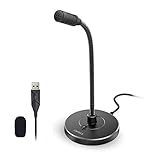
- 【Crystal Clear Audio Quality】Our Omnidirectional pattern condenser microphone accurately captures your voice, making it perfect for dictation, online classrooms, and more.
- 【Active Noise-Cancelling】Come in CMTECK CCS2.0 SMART CHIP with Omnidirectional Polar Pattern, which can effectively block the background noise. The pop filter prevents plosives from overloading the microphone, ensuring only your voice is heard.7
- 【Convenient Mute Button with LED Indicator】You can quickly mute/un-mute the microphone with the Mute Button and the built-in LED light lets you know the working status(Greenlight: Connected; Red light: Mute mode).
- 【Easy to use】 No drivers needed, just plug and record without external power supply, directly connect the microphone to a USB compatible device, well compatible with Windows(7, 8 and 10), Mac OS and PS4 (NOT compatible with Raspberry Pi/Linux/Android)
- 【Mini size with Adjustable Gooseneck】Adopted flexible and adjustable gooseneck metal pipe, easily adjust position 360 degrees to suit user comfort. The compact and stable base maximizes your desktop space.
Rank #4
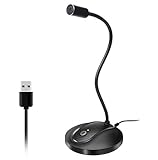
- 360 Degree Position Adjustable Gooseneck Design --Plug and play USB microphone Pick up the sound from 360-degree with high sensitivity, in the best possible location for sound to your PC gaming, dragon voice dictation, and talk to Cortana
- Mute Button & LED Indicator --One-click to mute/unmute your microphone for pc, Build-in LED indicator tells you the working status at any time
- Intelligent Noise-Canceling Tech --Premium omnidirectional condenser microphone with noise-canceling technology can pick up your clear voice and reduce background noise and echo
- USB Plug&Play(1.8/6ft USB Cable) -- No driver required. Just need to plug & play for the microphone to start recording, well compatible with Windows(7, 8, 10 and 11) and macOS. (NOT compatible with Xbox/Raspberry Pi/Android)
- Solid Construction--Adopting premium metal pipe and heavy-duty ABS stand to make sure that you will be satisfied with our computer mic quality
Product prices and availability are accurate as of the date/time indicated and are subject to change. Any price and availability information displayed on Amazon at the time of purchase will apply.

