
iTechGuides is reader-supported. When you buy through links on our site, we may earn an affiliate commission. As an Amazon Associate I earn from qualifying purchases. Learn more
The best energy-efficient space heaters are usually not more efficient at converting electricity than other resistance heaters: ceramic, infrared, oil-filled, and fan-forced models generally turn electricity into heat at roughly the same rate. Choose the lowest adequate wattage, a thermostat or ECO mode, and short runtime; choose a heat pump instead for whole-home efficiency.
Portable electric heaters can still lower energy use in the right situation: heating one occupied zone can be less wasteful than heating an entire home. The recommendations below separate conversion efficiency from control efficiency and comfort efficiency, so a heater is not called “energy efficient” merely because its marketing uses ceramic, infrared, PTC, or oil-filled terminology.
The product recommendations are portable electric-heater choices, with U.S. electrical and safety details identified where the supplied documentation specifies them. Prices, stock, retailer listings, model suffixes, and certification status can change, so verify those details at the time of purchase.
PC Slower Than It Used to Be?
A free scan shows the junk files, broken settings and background clutter dragging Windows down - then fixes them in one click.Free scan · Windows 10 & 11Crashes, No Sound, or Screen Glitches?
Random freezes, missing sound and display glitches usually trace back to one bad driver. Find and replace yours safely.Free scan · under a minuteKey takeaways
- Ceramic, infrared, oil-filled, and fan-forced portable heaters are generally electric-resistance heaters, so the same wattage produces broadly comparable heat from the electricity consumed.
- The Dreo Solaris Max 2nd Gen offers 1,000–1,500 watts, ECO mode, and a 41°F–95°F target range adjustable in 1°F increments for precise control.
- The Vornado AVH10 uses 750-watt and 1,500-watt heat settings, automatic climate control, and whole-room air circulation rather than concentrating warmth directly in front of the heater.
- A 1,500-watt heater running continuously consumes 1.5 kilowatt-hours per hour; a thermostat, lower setting, or shorter runtime reduces actual consumption.
- According to the U.S. Consumer Product Safety Commission’s January 23, 2026 guidance, portable heaters were associated with an average of 1,600 fires, 70 deaths, and 150 injuries annually from 2020 through 2022.
- For persistent whole-home heating, the U.S. Department of Energy says a heat pump can reduce electricity use for heating by up to 75% compared with electric resistance.
What are the best energy-efficient space heaters?
Among portable resistance heaters, the best choice depends on the size of the occupied zone, the desired heat pattern, and how well the controls prevent unnecessary runtime.
Popular on Amazon

- CUSTOMIZABLE HEATING OPTIONS: Choose from three settings to suit your needs - High (1500W), Low (900W), or Fan Only for air circulation without heat.
- COMPACT & PORTABLE: Weighing just 3 lbs and sized at 7.5“L x 6.3”W x 9.5“H, this space heater is easy to move and perfect for your Home, Office.
- Built-in Tip-Over Protection, Overheat Protection, and a Power Indicator Light for safe operation.
- RAPID HEATING TECHNOLOGY: Ceramic heating provides fast and efficient heat in minutes with only 43 dB noise level, keeping you warm quickly on cold days.
- NOT FOR HUMID ENVIRONMENTS: Please avoid using this heater in Bathrooms, Laundry Rooms, or other high-moisture areas.
| Best for | Model or type | Power and controls | Why it stands out | Main limitation |
|---|---|---|---|---|
| Precise ECO-mode control | Dreo Solaris Max 2nd Gen ceramic heater | 1,000–1,500 watts; ECO mode; 41°F–95°F target range in 1°F steps | Adjustable output and a thermal sensor can reduce full-power runtime | It remains an electric-resistance heater; ECO mode does not create more heat per watt |
| Whole-room circulation | Vornado AVH10 | 750-watt low setting; up to 1,500-watt high setting; two heat settings, fan-only mode, and automatic climate control | Vortex circulation spreads warmth more evenly through a room | Circulation improves distribution, not the basic electrical efficiency of resistance heating |
| Quiet, steady heat | De’Longhi Dragon 4 TRD40615E/TRD40615ECA oil-filled radiator | 1,500 watts; three heat settings; adjustable thermostat and Eco Plus | Sealed oil retains heat after the element cycles off, smoothing the heating experience | Heat retention does not lower the heater’s maximum electrical input |
| Radiant-plus-forced-air comfort | Dr Infrared Heater DR-968 | 1,500 watts; infrared and PTC heating; thermostat, timer, remote, and caster wheels | Combines direct radiant warmth with forced-air heating | Advertised room-size, noise, and heat-output claims are conditional and not universal guarantees |
| Whole-home efficiency | Properly selected heat pump | Heat-pump heating and cooling; not a portable resistance heater | DOE says heat pumps can use up to 75% less electricity for heating than electric resistance | Installation, climate, home design, and equipment selection determine suitability and cost |
Why are ceramic, infrared, oil-filled, and fan-forced heaters similar in efficiency?
Ceramic, infrared, oil-filled, and fan-forced portable heaters are generally electric-resistance appliances, so their conversion efficiency is not the most useful way to separate them. The U.S. Department of Energy describes electric resistance and infrared heating as having an effective coefficient of performance of 1 in its technical guidance on electric resistance and infrared heating.
A 1,500-watt ceramic heater does not automatically produce more useful heat per kilowatt-hour than a 1,500-watt oil-filled radiator. The heater types mainly change warm-up time, airflow, surface temperature, noise, heat distribution, and comfort. Those differences can reduce how long a person needs to run a heater, but they do not make a same-wattage resistance element dramatically cheaper to operate.
Infrared warmth can feel stronger when a person is close to the heater or has a clear line of sight to its radiant surfaces. An oil-filled radiator can feel steadier because its oil mass continues releasing heat after the element cycles off. A fan-forced ceramic heater can distribute warmth quickly. None of those comfort characteristics should be presented as proof of superior conversion efficiency.
Do these 3 things before closing this tab:
1Repair Windows errors before they cause bigger problems2Fix the driver behind crashes, sound loss and screen glitches3Clear out junk files and repair common Windows errorsWhich space heater is best for each use?
Best for precise ECO-mode control: Dreo Solaris Max 2nd Gen
Choose the Dreo Solaris Max 2nd Gen when the main energy-saving opportunity is accurate temperature control in a small room or occupied zone. The manufacturer’s official specifications for the Dreo Solaris Max 2nd Gen identify a 25-inch ceramic heater with a 1,000–1,500-watt range, ECO mode, and a thermal sensor that supports targets from 41°F to 95°F in 1°F increments.
The useful feature is controllability, not a special ceramic conversion rate. A user can select a target temperature and let the thermal sensor and ECO mode reduce or modulate output instead of operating continuously at maximum power. The Dreo Solaris Max 2nd Gen is therefore a strong choice for a desk, bedroom, or other zone where the user will set a target and allow the controls to manage runtime.
Do not confuse this model with the Dreo Whole Room Heater 714. A separate Tom’s Guide review of the Dreo Whole Room Heater 714 covers a different model, so test results or pricing descriptions for the Heater 714 should not be transferred to the Solaris Max 2nd Gen.
Best for whole-room circulation: Vornado AVH10
Choose the Vornado AVH10 when warmth needs to circulate through a room instead of being concentrated immediately in front of the appliance. Vornado’s AVH10 product listing describes Vortex Heat Circulation, two heat settings, fan-only operation, automatic climate control, a cool-touch case, automatic safety shutoff, and a five-year satisfaction guarantee.
Vornado’s AVH10 FAQ says the heater can lower element wattage and fan speed as the room approaches the selected temperature. The FAQ lists up to 1,500 watts on high and 750 watts on low. That combination makes the AVH10 a credible whole-room option for users who value even distribution and automatic control, although actual electricity use still depends on the selected output and runtime.
Independent testing supports the AVH10’s role rather than a universal “most efficient” claim. TechGearLab’s 2025 AVH10 review ranked the model highly among the space heaters tested and reported particularly strong room-heating and consistent-warmth results, with weaker direct-heating performance. In practical terms, the AVH10 is more compelling when the goal is room-wide comfort than when one person wants immediate heat at close range.
Best quiet, steady heat: De’Longhi Dragon 4 TRD40615E
Choose the De’Longhi Dragon 4 TRD40615E when quiet operation and steady warmth matter more than rapid fan-driven heat. De’Longhi’s linked Dragon 4 product information lists a 1,500-watt oil-filled radiator with three heat settings, a digital control panel, adjustable thermostat, Eco Plus function, anti-freeze setting, thermal shutoff, child lock, and preassembled wheels.
Also popular on Amazon

- Powerful heat that fits everywhere: DREO space heaters for indoor combines Hyperamics 1500W advanced PTC system with a new heat funnel design to deliver heat within seconds and enhance warm air circulation for up to 200% farther reach than traditional heaters.
- Unbreakable safety:DREO goes beyond the unexpected to deliver peace of mind with every room heater. The innovative tilt-detection sensor improves accuracy and reliability for better tip-over protection, and built with V0 flame retardant materials, overheat protection, and safety plug, all certified by ETL.
- Ultimate temperature control: The enhanced NTC chipset brings more precision to turn your space heater with thermostat into a smart heating powerhouse, allowing you to set heat on a wider range from 41-95℉ with 1℉ increments, saving you energy while keeping you comfortable.
- Cozy quietness: No more choosing between quiet or warmth, DREO's heater for bedroom warms quietly thanks to its brushless DC motor with frictionless performance and a winglet fan design that reduces turbulence, reducing noise to only 34dB.
- Fits into your lifestyle: This portable heater handle makes it easier to carry and is equipped with multiple heating levels and modes to heat as you like (Power heat, ECO, Fan Only). It also features handy extras for a hassle-free experience (remote control, 12-hour timer, mute, child lock, and memory function).
The radiator’s oil reservoir is permanently sealed and does not require refilling. The oil mass retains and releases heat after the element cycles off, which can make temperature changes feel less abrupt and avoids fan noise. The retained heat does not mean the radiator generates more heat per kilowatt-hour than another 1,500-watt electric-resistance heater.
The Tool Desk
Outbyte PC Repair FREEClear out junk files and repair common Windows errorsFree Scan →Outbyte Driver Updater FREEScan for outdated or missing drivers - takes under a minuteDriver Scan →The dossier’s named model is TRD40615E, while De’Longhi’s linked product page uses the market suffix TRD40615ECA. The linked De’Longhi instruction manual confirms 120-volt, 60-Hz, 1,500-watt electrical characteristics for the U.S. version. Check the exact model suffix and electrical rating for the market where the heater will be used.
Use the Dragon 4 for quiet heating while occupants are awake, but do not treat quiet operation as permission to run a portable heater during sleep. The CPSC’s general guidance is to turn portable heaters off when sleeping.
Best for radiant-plus-forced-air heating: Dr Infrared Heater DR-968
Choose the Dr Infrared Heater DR-968 when the desired comfort pattern combines radiant warmth with forced-air heating. Product and retailer materials describe the DR-968 as a 1,500-watt infrared heater with PTC heating, an adjustable thermostat, remote control, timer, caster wheels, and quiet operation.
The DR-968 can be a reasonable large-room or direct-comfort candidate, but room performance depends on insulation, ceiling height, outdoor temperature, air leakage, and the temperature increase required. Advertised claims such as heating 576 square feet, operating at 39 dB, or producing 60% more heat should be treated as manufacturer or retailer claims rather than universal performance guarantees. No price, stock status, or review count should be assumed because retailer availability changes.
The DR-968 is still a 1,500-watt resistance-style portable heater for electricity-use purposes. Its infrared and PTC combination changes how warmth is delivered; it does not establish that the model is cheaper to operate than another heater drawing 1,500 watts for the same length of time.
What is the difference between conversion, control, and comfort efficiency?
Conversion efficiency describes how electricity becomes heat, control efficiency describes how much unnecessary runtime the heater avoids, and comfort efficiency describes how effectively the heat reaches the person or occupied zone.
| Efficiency question | What matters | What to look for | What it does not prove |
|---|---|---|---|
| Does the element convert electricity efficiently? | Electric-resistance heaters and infrared resistance-style heaters have broadly similar point-of-use conversion | Compare wattage rather than relying on ceramic, PTC, infrared, or oil-filled labels | A heater type does not automatically produce more heat per kilowatt-hour |
| Can the heater avoid unnecessary runtime? | Thermostat accuracy, thermal sensing, ECO mode, low-power settings, and timers | Dreo ECO mode, Vornado automatic climate control, or De’Longhi Eco Plus | A control feature cannot reduce the heater’s rated maximum wattage |
| Can the user stay comfortable with less heated space? | Zone heating, radiant delivery, and effective air circulation | A personal heater for one seated user, radiant heat for direct comfort, or whole-room circulation | A small heater is not efficient if it cannot maintain the required comfort |
A 500-watt personal heater may consume less electricity in absolute terms than a 1,500-watt room heater when both run for the same time. The 500-watt heater is not necessarily the more efficient room-heating solution if the 500-watt output cannot maintain the room’s temperature and the user compensates by running it continuously or adding another heater.
Comfort efficiency can still matter. Heating the area around one person may let that person avoid raising the central thermostat for the entire home. That potential saving depends on the home’s heating system, the zone being heated, the heater’s runtime, and whether the rest of the home can safely remain cooler.
How much electricity does a space heater use?
A 1,500-watt heater operating continuously uses 1.5 kilowatt-hours per hour. Actual consumption is lower when a thermostat cycles the element off, when ECO mode reduces output, or when the heater runs at a lower setting.
Also popular on Amazon

- 2 in 1 heater fan: This ceramic heater offers dual heating modes (1500W/750W) plus a cool air fan, making it ideal for both winter and summer. With automatic thermostat control, it cycles on and off to maintain your preset temperature without any manual adjustment. A practical and thoughtful gift for working from home, or for family, friends, and colleagues during the cold season.
- Multi-protection safety system: These heaters are made of V0 flame retardant material avoiding any fire hazard. Automatic safety shut-off system will shut the heater off when the heater overheat. The tip-over protection system will automatically shuts off with a loud beep if knocked over by accident and it will come back on automatically if it is up righted.
- Portable and Powerful: The mini heater with build in carry handle helps to reinforce the potential of rather low electrical bills by using at the place where you need when you don't want to warm the full house with other centralized heaters.
- Quiet and fast heating: The ceramic space heater is impressively quieter than most conversation levels, which is quiet enough for most people to use in a bedroom while sleeping or working. With PTC heating tech and high speed fan, it is rated to heat up to 200 square feet in seconds, which would cover most bedrooms, offices, bathrooms and smaller living rooms.
- Upgrade abs material: Upgrade abs material applied, which is more flame resident. The room heater with six feet lead cord and 2 prong connection has a long lasting life. The space heater for indoor use makes a noticeable difference and works well in small to medium rooms when positioned properly.
| Rated heater input | Electricity used during one hour at full output | Electricity used during four hours at full output |
|---|---|---|
| 500 watts | 0.5 kWh | 2 kWh |
| 750 watts | 0.75 kWh | 3 kWh |
| 1,000 watts | 1 kWh | 4 kWh |
| 1,500 watts | 1.5 kWh | 6 kWh |
Calculate operating cost with this formula: watts ÷ 1,000 × hours used × local electricity price per kWh. For example, Vornado gives an illustrative cost of approximately $0.15 per hour for a 1,500-watt heater at an electricity rate of $0.10 per kWh in its official FAQ. The example is not a current national average; use the rate on the electricity bill for an accurate estimate.
At a nominal U.S. 120-volt supply, a 1,500-watt heater draws about 12.5 amps at rated output. Verify the heater’s voltage and wattage before purchase, connect an electric heater directly to a wall outlet, and avoid assuming that a power strip or extension cord is suitable.
Which heater type should you choose?
Choose a heater type based on heat delivery, sound, controls, and the area being heated—not on an unqualified promise that one resistance technology uses much less electricity.
| Heater type | Typical example in this guide | Primary comfort advantage | Energy-use reality |
|---|---|---|---|
| Ceramic fan-forced | Dreo Solaris Max 2nd Gen, 1,000–1,500 watts | Fast air movement and adjustable ECO control | Uses the selected wattage while operating; ceramic construction alone does not make it cheaper |
| Vortex fan-forced | Vornado AVH10, 750 or up to 1,500 watts | Whole-room circulation and automatic climate control | Better distribution can improve comfort, but consumption follows output and runtime |
| Oil-filled radiator | De’Longhi Dragon 4, 1,500 watts | Quiet, steady heat with residual warmth after cycling | Heat retention smooths operation but does not change the maximum electrical input |
| Infrared plus PTC | Dr Infrared Heater DR-968, 1,500 watts | Direct radiant warmth combined with forced air | Radiant delivery can feel efficient for a nearby person, but the rated electrical input remains 1,500 watts |
| Heat pump | Whole-home heating and cooling system | Moves heat rather than producing all heat through resistance | DOE says electricity use for heating can be up to 75% lower than electric resistance; this is not a portable space-heater substitute |
When is a heat pump a better energy-efficient alternative?
A properly selected heat pump is the more important comparison when the goal is to heat a whole home or to reduce persistent heating costs. The U.S. Department of Energy says its heat-pump guidance indicates that heat pumps can reduce electricity use for heating by up to 75% compared with electric-resistance heating.
A portable resistance heater can make sense for a temporarily occupied room, a cold desk area, or supplemental heat where installing equipment is impractical. Several portable heaters can become a poor long-term substitute for a central system because every resistance heater adds its rated electrical load and heats only the areas where it operates.
ENERGY STAR treats heat pumps for space heating and cooling as a distinct high-efficiency category. Readers comparing equipment can consult ENERGY STAR’s heat-pump resources and use the ENERGY STAR Product Finder to check current certified-product information. Installation cost, local climate, insulation, ductwork, rebates, and contractor quality still determine the real-world result.
A home-energy audit, weatherization work, or smart thermostat can also be more consequential for a whole-home heating problem than replacing one 1,500-watt resistance heater with another. Availability of local utility programs and service providers varies by location and must be verified before purchase.
Recommended Free Tools
How should independent space-heater testing affect your choice?
Independent testing is most useful when it separates room heating, direct spot heating, noise, and safety instead of treating “energy efficient” as a single score. Consumer Reports says its space-heater evaluations include standard-room heating, direct spot-heating, noise, and fire-safety testing, and that some models receive a Green Choice designation for minimizing energy use and other environmental impacts.
Check the current Consumer Reports space-heater ranking before treating a model as Green Choice. A Green Choice designation should be attributed only to a model currently shown with that label; the designation should not be inferred for every heater in this guide.
Testing also needs to match the intended use. The AVH10’s strong room-heating results and weaker direct-heating results illustrate why a whole-room recommendation is not automatically the best choice for a person sitting close to a heater. Manufacturer room-size ratings should likewise be treated as conditional because insulation, ceiling height, outdoor temperature, and the desired temperature rise vary from home to home.
Also popular on Amazon
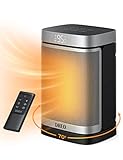
- Faster Heat Than Ever: Powered by DREO Hyperamics Technology, Atom One space heater heats up more efficiently with up to 1500W working power, reaching your desired temperature immediately, letting you feel fast, balmy heat straight away. This electric heater is meant to sit by your feet on the floor, near your hands on a desk, or carry around indoors. Add our heaters for indoors use to your cart & experience our amazing heater and customer service
- Shield360° Protection: DREO Room Heater Heat up your day and night without worries. ETL-listed Shield360° system provides tip-over and overheat protection, as well as an enhanced safety plug. Along with UL94 V-0 flame-retardant materials to ensure ultimate safety in all aspects
- Save More on Energy Bills: ECO Mode adjusts the heat level automatically to reach your desired temperature while saving more on energy bills. Personalize your own comfort with the digital thermostat from 41 to 95 ℉, adjustable in 1℉ increments. Precise Heat, Precise Comfort
- Warm Any Angle: Experience the heat that envelopes you in the widest way possible. 70° wide-angle oscillation sweeps around to cover the whole area, providing wide-reaching heat for your bedroom, garage, basement, office, desktop, etc
- Engineered to be Quieter: Brushless DC motor and 9 aerodynamic blades smooth out airflow and eliminate air turbulence, delivering soft, tranquil warmth. As quiet as 37.5 dB, you can sleep or work with peace of mind
Why should you avoid unvented fuel-burning heaters indoors?
Do not choose an unvented kerosene or gas heater as an “energy-efficient” indoor substitute for an electric space heater. The CPSC’s indoor-air-quality guidance highlights concerns with unvented kerosene and gas heaters, while home-heating equipment can also create fire and carbon-monoxide hazards.
Quick wins for a faster PC:
Fix the driver behind crashes, sound loss and screen glitchesFind Drivers →Repair Windows errors before they cause bigger problemsFix Now →For a portable indoor electric heater, use a listed and labeled product from an appropriate safety-certification body. UL materials identify ANSI/UL 1278 as the standard for movable and wall- or ceiling-hung electric room heaters and describe tip-over testing requirements for listed portable heaters in the UL guidance on electric-heater tip-over protection.
How can you use a portable space heater safely?
Safe placement and electrical connection matter more than the heater’s marketing category. The CPSC advises keeping portable heaters at least three feet from drapes, furniture, bedding, and other combustible materials; plugging electric heaters directly into a wall outlet rather than an extension cord or power strip; and turning heaters off when sleeping.
According to the CPSC’s January 23, 2026 safety guidance, portable heaters, including electric space heaters, were involved in an average of 1,600 fires per year, 70 deaths, and 150 injuries annually from 2020 through 2022. The figures are averages for that period, not a prediction for an individual model.
- Place the heater on a stable floor with its airflow unobstructed.
- Maintain at least three feet of clearance from bedding, curtains, furniture, clothing, and other combustibles.
- Plug an electric heater directly into a wall outlet; do not use a power strip or extension cord under the CPSC’s general guidance.
- Use a model with automatic shutoff and tip-over protection, and verify that the product is properly listed and labeled.
- Turn the heater off when sleeping, and do not claim that quiet operation or a thermostat makes unattended or overnight use safe.
- Follow the manufacturer’s instructions and check the product’s voltage and wattage before connecting it.
These precautions apply to ceramic, infrared, oil-filled, and fan-forced heaters alike. An ECO mode can reduce runtime, but it does not remove fire, clearance, or electrical-connection requirements.
What’s actually slowing this PC down?
Pick the symptom - the matching free tool is one click away.
What should you check before buying an energy-efficient space heater?
- Start with the smallest adequate output. A 500-watt personal heater may be appropriate for one seated user, while a 1,500-watt model may be necessary for broader room heating. A lower wattage is only useful when it can maintain the intended comfort.
- Prefer automatic temperature control. Look for a thermostat, thermal sensor, ECO mode, or automatic climate control rather than a simple always-on switch.
- Check real control features. A timer, low-power setting, automatic shutoff, and tip-over protection are more useful than a generic “energy efficient” label.
- Compare the heat pattern. Choose fan-forced circulation for room distribution, radiant output for direct personal warmth, or an oil-filled radiator for quiet, steady heat.
- Verify electrical specifications. Confirm voltage and maximum wattage for the market where the heater will operate. A U.S. 1,500-watt model is a substantial electrical load.
- Inspect the safety listing. Look for listing and labeling from an appropriate safety-certification body and consult the manufacturer’s instructions.
- Treat room-size claims as conditional. Insulation, ceiling height, air leakage, outdoor temperature, and desired temperature rise determine whether a heater can maintain comfort.
- Consider the whole-home solution. If portable heat is needed every day across multiple rooms, compare a heat pump, energy audit, weatherization, or smart thermostat strategy instead of stacking resistance heaters.
Bottom line
For portable heating, buy control and an appropriate heat pattern rather than a misleading technology label. The Dreo Solaris Max 2nd Gen is the strongest fit for precise ECO-mode adjustment, the Vornado AVH10 for whole-room circulation, the De’Longhi Dragon 4 for quiet steady heat, and the Dr Infrared DR-968 for radiant-plus-forced-air comfort. None is automatically cheaper than another same-wattage resistance heater. Lower wattage, shorter runtime, targeted zone heating, and thermostat control determine practical savings; a heat pump is the better efficiency comparison for whole-home heating.
Frequently Asked Questions
Are ceramic space heaters more energy efficient than oil-filled heaters?
No. Ceramic and oil-filled heaters are generally electric-resistance appliances, so a ceramic heater is not automatically cheaper to run than an oil-filled heater with the same wattage. Thermostat accuracy, ECO mode, heat distribution, and runtime create the practical difference.
What wattage space heater uses the least electricity?
A lower-wattage heater uses less electricity per hour at full output, but the lowest wattage is not always the best choice if it cannot maintain comfort. A 500-watt personal heater uses 0.5 kWh per hour at full output, while a 1,500-watt heater uses 1.5 kWh per hour.
Can you leave an energy-efficient space heater on while sleeping?
Portable heaters should be turned off when sleeping. The CPSC also advises keeping heaters at least three feet from combustibles and plugging electric heaters directly into a wall outlet rather than an extension cord or power strip.
Free tools Windows power users keep installed
One-click scans. No signup required.
Is a heat pump more energy efficient than a portable space heater?
Yes, a properly selected heat pump is generally a more efficient whole-home heating solution than portable electric resistance heaters. The U.S. Department of Energy says heat pumps can reduce electricity use for heating by up to 75% compared with electric resistance, although climate, installation, insulation, and equipment selection affect the result.
When is a portable space heater the wrong energy-saving choice?
A portable resistance heater is usually best for a temporarily occupied room or one person’s zone. If several rooms need heat regularly, compare a heat pump, home-energy audit, weatherization, or smart thermostat strategy instead of relying on multiple portable heaters.
The Bottom Line
Choose the lowest-wattage heater that can maintain the occupied zone, prioritize a thermostat or ECO mode, and connect the heater directly to a wall outlet. Ceramic, infrared, oil-filled, and fan-forced designs mainly change comfort and control; for ongoing whole-home heating, compare a properly selected heat pump instead.

