
Recommended Free Tools
iTechGuides is reader-supported. When you buy through links on our site, we may earn an affiliate commission. As an Amazon Associate I earn from qualifying purchases. Learn more
The best way to prevent coral overheating is layered temperature control: remove avoidable heat, use evaporative fans for moderate heat loads, and install a properly sized marine aquarium chiller when the tank still runs hot or a prolonged summer failure would risk livestock. Keep reef water stable, normally within 24–28 °C (76–82 °F), rather than chasing an exact number. For many coral systems, 24–26 °C is a practical target; EHEIM’s climacontrol+ documentation warns that corals can die above 29.5 °C.
A fan is inexpensive and simple but increases evaporation and cannot reliably hold water below the room’s practical evaporative limit. A chiller provides controlled refrigeration, but it costs more, consumes electricity, adds installation requirements and releases heat into the room. The right choice depends on total water volume, room temperature, lighting, pumps, ventilation, lid design and how much evaporation and maintenance you can accept.
What temperature is too hot for coral?
Temperature stability matters more than selecting one supposedly perfect setpoint. Red Sea’s MAX 250 Temperature Control guide recommends maintaining a reef aquarium at a stable 24–28 °C (76–82 °F), noting that stability is more important than the exact value. A gradual, brief rise can be less damaging than rapid swings around the same average temperature.
Outdated Drivers Are Slowing You Down
One free scan finds every outdated or missing driver and matches the right update for your exact hardware.Free scan · exact hardware matchWindows Errors? Fix Them Before They Spread
Repair common Windows errors and clear accumulated junk for a smoother, more stable PC - no reinstall needed.Free scan · no reinstallEHEIM’s climacontrol+ documentation gives a narrower optimum range of 24–26 °C for corals and states that corals die above 29.5 °C. Treat 29.5 °C as a serious emergency threshold, not a safe operating target. Some aquariums may tolerate a short excursion above the normal range, but prolonged heat, low oxygen and rapid change increase risk. If your thermometer approaches the upper 20s Celsius, begin cooling before the water reaches the documented mortality warning.
#1 Best Overall

- ❄【Efficient, Stable & Precise Cooling】 Featuring a high-efficiency energy-saving compressor, this aquarium chiller supports automatic constant temperature control and efficient circulation refrigeration technology. It utilizes r290 refrigerant, allowing the chiller to effectively maintain the water temperature within the ideal range of 68°F-79°F (20°C-26°C), providing a comfortable habitat for aquatic life.
- ❄【Effective Heat Dissipation】 The chiller is designed with multiple small holes and two built-in efficient cooling fans to ensure excellent heat dissipation. It is recommended to place the water chiller with at least 6 inches of space around it to enhance heat dissipation and cooling efficiency, allowing for optimal cooling performance and a longer service life even under continuous operation.
- ❄【Cooling Temperature】 The cooling capacity of the chiller is influenced by factors such as water volume, tank size, and ambient temperature. If you pursuit a better cooling effect and more rapid cooling speed please reduce water volume.The less water, the better the cooling effect.
- 【Easy Operations】Equipped with an intelligent digital touch screen for easy temperature setting, our aquarium chiller with memory function, after power off and restart, the water chiller continues to cool down at the original set temperature. In addition, the corrosion-resistant pure titanium pump helps to achieve effective heat exchange.
- ❄【Acceptable, Low Noise Operation】 With a compressor cooling system, the aquarium chiller may produce vibrations and noise during operation. However, equipped with silent fans, the noise level is significantly reduced, making it suitable for placement in living spaces without disrupting everyday activities.
- Normal operating band: 24–28 °C (76–82 °F), held as steadily as possible.
- Common coral target: 24–26 °C when your livestock and equipment allow it.
- Emergency territory: approaching or exceeding 29.5 °C, where EHEIM warns of coral death.
- Most important measurement: the water temperature, not the room-air reading or a controller’s nominal setpoint.
Place the probe where it represents the display or sump temperature and verify it periodically with a second, trusted thermometer. A probe that is loose, touching a hot pump, or sitting in a stagnant compartment can produce a reassuring number while the coral area is warmer.
Which cooling method is best for a reef tank?
Use the following comparison to match the method to your heat load and tolerance for evaporation, noise and maintenance. “Cooling below room temperature” is not a realistic expectation for a fan: evaporation can pull water toward the room’s wet-bulb limit, but the result depends on humidity, airflow and exposed surface area.
| Method | Cooling power and temperature control | Evaporation and top-off | Noise and room heat | Installation and saltwater considerations | Monitoring and failure response |
|---|---|---|---|---|---|
| Heat reduction | Prevents heat entering the system; does not actively lower water below the room’s temperature. | No additional evaporation. | Usually silent; may require cabinet or room ventilation. | Lowest complexity. Keep pumps, filters and vents unobstructed. | Temperature monitoring shows whether the changes are sufficient. |
| Evaporative fan | Useful for moderate heat loads; performance varies with humidity and airflow and cannot hold a fixed temperature as reliably as refrigeration. | High. Requires frequent freshwater replacement and stable water level. | Low to moderate fan noise; no refrigeration heat, but humid air increases. | Simple surface or sump installation. Protect electrical connections from salt spray. | Needs a thermometer, high-temperature alarm and preferably an automatic top-off (ATO). |
| Active aquarium chiller | Controlled refrigeration; dependable when heat from the room, lights, pumps or a lid defeats fans. | Low compared with a fan, although any open tank still evaporates. | Compressor and fan noise; the condenser rejects heat into the room. | Marine-rated unit, separate pump, filtered feed water and clear ventilation openings. Allow at least 50 mm from walls for EHEIM units. | Built-in or external temperature control can cycle cooling; add an independent alarm and backup plan. |
| Room air conditioning | Reduces ambient temperature for the entire aquarium and room; effectiveness depends on building and unit capacity. | Usually no direct aquarium evaporation benefit, although cooler air can reduce it. | Room-unit noise and operating cost. | More expensive and broader than tank cooling; useful where several tanks or people share the room. | Still requires a tank thermometer because an air-conditioner failure can overheat water. |
Reduce heat input before adding cooling equipment
Cooling capacity is most effective when the aquarium is not being heated unnecessarily. Red Sea specifically warns that restricted filter flow can overheat pumps and says its cooling fans must operate correctly. Work through these checks before buying a larger chiller.
Rank #2

- 【Necessary Cooler for Aquariums】The summer heat is endangering your axolotl's health, but the AQUASMITH aquarium fan provides the Professional Support. Unlike costly chillers, it offers affordable and efficient aquarium cooling fan. Unlike regular fans,it utilizes the principle of evaporative cooling and features a true temperature control system,with powerful cooling capacity (3°F-7°F), creating an ideal environment for your pets.
- 【Smart Temperature-Control Fan】The Aquarium Chiller features an independent LED display controller and high-precision temperature probe, with dual display of set temperature and real-time temperature for intelligent water temperature stabilization. With an adjustable range of 59°F-93°F, it's suitable for various aquatic plants and animals requiring cooling, delivering visible cooling effects. It 24/7 Protection for Your Aquatic Pets.
- 【High Speed、High Output、Ultra-Quiet】The fish tank fan is equipped with a brushless motor and features a unique pressurized air duct design. Dual fans (3000rpm & 3m/s) ensure quiet operation (<40dB) while concentrating airflow onto the water surface to minimize dispersion and achieve rapid cooling, with performance far surpassing other fish tank cooling fan products. With 30° adjustable airflow angle and 360° rotation capability, it better adapts to aquariums of different sizes.
- 【Auto Start-Stop & Multi-Function】The aquarium cooler system features automatic mode with intelligent start/stop to maintain stable water temperature. It offers 3-Speed Airflow Adjustment,1st gear Ultra-quiet operation;2nd gear for 24/7 operation,3hd gear for extreme temperatures.The Independent Controller Prevents moisture damage to internal components. The ceramic temperature probe is compatible with both saltwater and freshwater environments.
- 【Out-of-the-box/Professional Support】The Aquarium Chiller Fans features simple installation without requiring additional accessories. The package includes a power plug for quick and easy setup. Its adjustable clip (0.2in-0.95in) effortlessly fits aquarium edges of varying thicknesses,Solving compatibility issues. If you have any questions during use, please contact our customer service team via email. We will provide a solution within 24 hours.
Remove sunlight and room heat
- Move the aquarium out of direct sunlight, especially from south- or west-facing windows.
- Keep the tank away from radiators, cooking appliances, hot electronics and enclosed spaces that trap warm air.
- Ventilate the cabinet so warm air from return pumps and power supplies can escape.
- During heatwaves, ventilate the room or use air conditioning if the chiller would otherwise heat the same air it is trying to cool.
Inspect pumps, filters and plumbing
- Confirm that intake screens, filter media and plumbing are not clogged.
- Check that pumps have the flow their manufacturer specifies and are not running dry or against a blocked outlet.
- Remove salt creep from vents and fan guards. Salt deposits can restrict airflow and damage bearings.
- Check the temperature around the pump compartment. A hot, poorly ventilated cabinet can transfer heat directly to the water.
Review lighting and photoperiod
High-intensity reef lighting adds heat, particularly under a closed canopy. Confirm that fans in the light fixture and canopy are working, clean dust from vents and consider shortening the photoperiod or reducing intensity temporarily during extreme weather. Make changes gradually enough to avoid stressing photosynthetic corals with an abrupt light reduction, and restore the normal schedule once temperatures are controlled.
Evaporative fans: the low-cost first step
A surface or sump fan moves air across the water. As water evaporates, it carries heat away. This is often the cheapest way to control a moderate summer rise, but it exchanges heat control for water-management work. Red Sea says its cooling fans can maintain the required range around 22 °C ambient; above 23 °C ambient, a chiller may be necessary for that system.
When a fan is appropriate
- The room is only modestly warmer than your target.
- The aquarium has an open or well-ventilated surface for evaporation.
- You can provide regular freshwater top-off, preferably automatically.
- Humidity is not already so high that evaporation is ineffective or damaging to the room.
- You have an alarm that will reveal a stalled fan or an empty reservoir.
Fan installation procedure
- Choose the evaporation point. Aim airflow across the display surface or sump, not directly into electrical sockets or salt-sensitive electronics.
- Provide a safe mounting position. Secure the fan so vibration cannot make it fall into the aquarium. Use a low-voltage, aquarium-appropriate unit where possible, with a drip loop on every power cable.
- Keep the water level consistent. Evaporation changes salinity and can interrupt skimmer or return-pump operation. ATO systems should draw from a reservoir of fresh, purified water, never saltwater.
- Set the control point conservatively. Use a temperature controller or fan thermostat to start cooling slightly above your normal target rather than switching rapidly on and off around one exact value.
- Test under the hottest expected conditions. Observe the tank through the warmest part of the day and confirm that the fan can hold the water inside your chosen range.
- Clean and inspect regularly. Remove dust and salt deposits, verify the fan starts every time and replace it before a heatwave if bearings are noisy or the airflow has weakened.
Fan limitations and common mistakes
A fan cannot cool indefinitely. In hot, humid weather, evaporation slows while the tank continues receiving heat from lights and pumps. A tightly covered aquarium may also have too little exposed surface area for useful evaporative cooling. Do not compensate by allowing the salinity to drift or by pouring ice directly into the display; both create rapid, uneven changes that can harm livestock. If the fan runs continuously and the temperature still rises, move to a chiller or room-level cooling instead of adding more fans blindly.
Rank #3
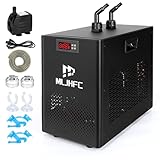
- 【1/10 HP Compressor with Rapid, Stable, and Precise Cooling】Equipped with an energy-efficient 1/10 horsepower compressor, this aquarium cooler delivers fast, stable cooling for tanks up to 42 gallons (approx. 160 liters). Maintains temperatures between 64–79°F (18–26°C), creating an ideal habitat for tropical fish, corals, newts, and hydroponic systems.
- 【Corrosion-Resistant Titanium Evaporator】The built-in titanium evaporator offers exceptional saltwater and chemical resistance, suitable for both freshwater and saltwater environments. Safely maintain sensitive organisms like jellyfish, reef corals, and shrimp.
- 【Ultra-Quiet Operation & Advanced Cooling】Featuring a low-noise compressor, dual silent fans, and enhanced ventilation design, it ensures efficient heat dissipation with operating noise levels of just 30-40 dB(A), making it perfect for bedrooms or offices. Please ensure 6 inches of clearance around the cooler for optimal heat dissipation and long-lasting performance.
- 【Easy Installation】Supports precise temperature control and real-time monitoring. Comes standard with hose clamps and connectors, all using US-standard plugs for hassle-free setup. No wiring required upon arrival—simply plug it in to start cooling your aquarium. During hot periods, maintain water levels at 80% capacity for optimal cooling performance.
- 【One-Year Warranty & Reliable Support】Backed by a one-year warranty and dedicated customer service. This cooler comes fully packaged with all necessary accessories, helping you effortlessly establish a stable and thriving aquatic ecosystem for worry-free operation.
When an aquarium chiller is the better choice
A chiller is active refrigeration. It removes heat from the aquarium water and rejects that heat through a condenser, giving substantially more predictable control than a fan when the room itself is hot. Choose one when the tank remains above target after heat reduction and evaporative cooling, when a lid limits evaporation, or when the livestock value justifies protection from a prolonged summer spike. Red Sea states that, given the cost of livestock, it recommends a chiller as a safeguard against sudden temperature increases.
The Tool Desk
Outbyte Driver Updater FREEScan for outdated or missing drivers - takes under a minuteDriver Scan →Outbyte PC Repair FREEClear out junk files and repair common Windows errorsFree Scan →Size by the whole heat load, not horsepower alone
Chiller requirements depend on total water volume, the room’s ambient temperature, starting water temperature, lighting, pumps, plumbing, lid design and ventilation. A horsepower figure that works for one aquarium is not a universal sizing rule. Red Sea’s MAX 250 guide recommends at least a 1/6 HP chiller for that specific system when ambient temperature is 23 °C or higher. Do not apply that recommendation unchanged to a different tank.
As a practical selection process, calculate the actual water volume after accounting for rock and equipment, identify the highest realistic room temperature, list heat sources that run continuously, and then compare those conditions with the chiller manufacturer’s capacity chart. Select a marine-rated model with some headroom rather than a unit that only meets the load in mild weather. Oversizing excessively can cause short cycling, while undersizing leaves the compressor running continuously without controlling the tank.
Rank #4

- Stable Temperature: Water temp may vary with volume and room temp. Lower settings or reduce water for faster cooling. Please Read details before purchase to ensure it meets your needs (Size, Voltage, Power, Tank Capacity, Cooling Range, Usage). Friendly Note: The cooler's performance depends on water volume, tank size, and ambient temperature, so actual water temperature may differ from the set temperature. After cooling, tank water remains stable
- 1/3 HP High-Efficiency Cooling: The aquarium chiller uses a fluorine-free compressor and R290 refrigerant for efficient cooling. Temperature range: 65-80℉(18-27°C), reducing temperature fluctuations to improve survival rates
- Large Capacity: This 110Gal chiller meets the needs of various tank sizes, with a high water circulation rate of 1200L/H, keeping the tank at an ideal temperature for your fish. If you have any questions, please contact us for assistance
- Protecting Aquatic Life: Featuring a corrosion-resistant titanium evaporator, secure for both freshwater and saltwater conditions. Ideal for keeping aquatic creatures like axolotls, fish, shrimp, corals, and jellyfish at the ideal temperature
- Quick Heat Dissipation: Built-in fan and multiple ventilation holes help dissipate heat from the compressor, ensuring efficient operation. Leave at least 24 inches (60 cm) of space around the chiller for proper airflow and effective cooling
EHEIM climacontrol+ capacity classes
EHEIM documents three climacontrol+ classes: S for aquariums up to 500 litres, M up to 1,000 litres and L up to 2,000 litres. These are published aquarium-volume classes, not a guarantee that every setup in the class has the same cooling performance. The product line provides automatic cooling and heating plus Wi-Fi monitoring, which can be useful where remote alerts matter. Confirm the exact model’s installation instructions, electrical requirements and saltwater suitability before purchase.
How to install a marine aquarium chiller safely
Correct water routing and ventilation are as important as the compressor rating. EHEIM says marine systems should feed the chiller with clean, filtered water from the filter tank through a separate pump. Its documentation also requires clear ventilation openings and at least 50 mm clearance from walls.
What’s actually slowing this PC down?
Pick the symptom - the matching free tool is one click away.
- Position the unit. Place it on a stable, dry surface outside the splash zone. Leave at least 50 mm of clearance around EHEIM equipment and never cover the ventilation openings.
- Provide a separate feed pump. Draw clean, filtered water from the filter tank or sump. Use tubing and fittings rated for saltwater and the manufacturer’s required flow.
- Route the return safely. Secure hoses against siphoning, kinks and salt spray. Add drip loops to electrical cables and keep plugs higher than the outlet where possible.
- Ventilate the room. A chiller transfers aquarium heat into the surrounding air. In a closed cabinet or small room, ambient temperature can rise until the chiller loses efficiency. Open cabinet vents, use room ventilation or run air conditioning during prolonged hot weather.
- Install temperature sensing correctly. Put the probe in moving representative water, away from heater outlets, chiller returns and direct light. Verify the displayed reading with a separate thermometer.
- Set and test control. Choose a stable target within your livestock’s accepted range and a modest cooling differential to prevent rapid compressor cycling. Run the system through a complete cooling cycle while checking for leaks, unusual noise and adequate airflow.
- Plan maintenance. Inspect hoses, clean intake screens and condenser vents, remove salt deposits and follow the manufacturer’s service intervals. A blocked condenser can reduce cooling and raise power use.
Monitoring, alarms and automatic top-off
Cooling equipment is only protective if a failure is detected quickly. Pair a chiller or fan with an accurate thermometer, a high-temperature alarm and an independent way to see whether the device is actually running. EHEIM’s climacontrol+ alerts when temperature is 2 °C above or below the target for more than five minutes. That is a documented product behavior, not a universal alarm setting; configure your own alarm according to the livestock and the normal daily variation of your system.
Best Value

- IMPORTANT ACCESSORIES FOR AQUARIUMS: We’ve always had a heck of a time keeping our kid’s axolotl tank cool in the summer time. The PAIZOO aquarium chiller fan has eliminated that difficulty! Unlike expensive water chillers, if you're looking for a cheap solution, then I believe this is a great option
- HIGH QUALITY: The PAIZOO fish tank cooling fans is designed with dual turbo fans, and the fan is made of ABS plastic, which is sturdy and durable. Dual-drive pure copper motor and double-cap mute bearings, more powerful and efficient while still producing less noise
- 3 MODES ADJUSTEST: The axolotl tank fan has three different air speed modes that you could adjust for different usage scenarios. The soft mode is good for evening use and it runs quieter compared to the other modes. If you need to reduce the temperature quickly, you could turn on the high mode. Standard mode is suitable for any time
- INSTALL IT WHEREVER YOU WANT: The aquarium fan has extra wide sturdy clips, perfect for use on aquarium walls less than 26mm thick. The installation process is simple and easy with no additional tools required. The fan angle is adjustable at 45 degrees and can blow anywhere. And the extra-long 150 cm cable can handle most scenarios
- TIP FOR LARGER TANK: This fish tank fan delivers reliable cooling for tanks up to 20 gallons. For 20+ gallon aquariums, We strongly recommend using two or more fans to achieve a more noticeable cooling effect. Combine with chillers or AC to beat summer heatwaves
Recommended control layers
- Primary temperature controller: Operates the fan or chiller and displays the current water temperature.
- Independent thermometer: Confirms that a failed probe or controller is not falsely reporting a safe reading.
- High-temperature alarm: Sends an audible, visual or remote notification before the tank reaches the coral-mortality warning.
- Automatic top-off: Replaces evaporated freshwater and prevents salinity and water-level swings caused by fans.
- Power-failure notification: Identifies a tripped breaker or unplugged fan, pump or chiller.
- Backup cooling: A spare fan, battery-backed air pump or access to a cooled room can buy time while equipment is repaired.
Do not connect every safety function to one controller without an independent alarm. A single failed probe, stuck relay or lost network connection can otherwise disable cooling and hide the problem.
What to do during a sudden heat spike
- Confirm the reading. Check the display with a second thermometer and inspect the probe location.
- Remove immediate heat. Turn off or reduce nonessential lighting, move the tank away from sunlight and open cabinet or room ventilation.
- Restore circulation. Verify return pumps, circulation pumps, filter flow and cooling fans are operating. A blocked filter can overheat a pump and reduce oxygenation.
- Increase safe evaporation. Use a clean fan across the surface and begin monitored freshwater top-off. Do not allow salinity to change abruptly.
- Start active cooling if available. Check the chiller’s power, water flow, ventilation and alarm state before assuming the compressor has failed.
- Lower temperature gradually. Avoid dumping ice or very cold water into the display. Rapid local temperature changes can be as harmful as the original heat.
- Watch oxygen and livestock. Heat reduces dissolved-oxygen margin. Maintain strong surface agitation and observe corals and fish for abnormal behavior.
- Escalate early. If the temperature continues toward 29.5 °C, arrange a working chiller, room cooling or temporary livestock relocation rather than waiting for the system to recover on its own.
Operating costs, noise and room effects
Fans have the lowest equipment cost and generally consume little electricity, but their hidden cost is freshwater consumption, ATO equipment and increased humidity. The rate of evaporation is not fixed: it rises with airflow, exposed surface area, water temperature and dry room air.
Chillers use more electricity and produce compressor and fan noise. They also reject all removed heat into the room. In a warm, poorly ventilated room, the chiller may run for longer periods and its performance may decline. Room air conditioning can solve that feedback loop but costs more and cools the whole space. Exact prices, energy use and noise levels vary by model and installation; the cited manufacturer material does not establish a universal operating cost.
Quick Recap
Seasonal maintenance checklist
- Before summer, test every fan, controller, alarm, ATO sensor and chiller cycle.
- Clean fan blades, guards, condenser vents and salt deposits.
- Verify the ATO reservoir can last through the longest expected unattended period.
- Confirm that the chiller has at least the required wall clearance and that cabinet vents are open.
- Check tubing, clamps and electrical drip loops for leaks or salt creep.
- Compare the controller probe with a second thermometer.
- Record the normal daytime and nighttime temperature so an alarm can distinguish a fault from ordinary variation.
- Keep a replacement fan and a way to aerate the water during a power outage.
A practical decision path
- Start with prevention. Remove sunlight, improve ventilation, clear pumps and filters, and review lighting heat.
- Measure the real problem. Log water temperature through the hottest part of the day for several days, including the room temperature.
- Try a fan for a moderate load. Install safe airflow across the surface, add ATO and verify that the tank remains in the chosen range.
- Choose a chiller when the fan is marginal. Persistent high readings, high humidity, a closed lid or valuable livestock justify active refrigeration.
- Size from manufacturer data. Use total water volume and worst-case room conditions. Treat the Red Sea 1/6 HP recommendation as specific to the MAX 250 at ambient temperatures of 23 °C and above, not as a general formula.
- Add redundant monitoring. Use an independent thermometer and high-temperature alarm, then test the failure response before the next heatwave.
Bottom-line recommendations by tank situation
| Tank situation | Most sensible approach | Reason |
|---|---|---|
| Open reef, mild seasonal warmth, owner can top off daily | Heat reduction plus evaporative fan and ATO | Lowest complexity and cost when evaporation can keep up with the heat load. |
| Humid room, covered tank or fan runs constantly | Marine-rated chiller, with room ventilation | Evaporation is limited and the fan cannot provide dependable control. |
| Large system or high-value coral collection | Chiller plus independent alarm, ATO and backup fan | Controlled cooling and early fault detection reduce exposure to a prolonged spike. |
| Several aquariums in one hot room | Consider room air conditioning alongside tank-specific monitoring | Cooling the room reduces the heat load presented to every aquarium and chiller. |
Product prices and availability are accurate as of the date/time indicated and are subject to change. Any price and availability information displayed on Amazon at the time of purchase will apply.

