
Atmel and Melexis announced the Yuma+ (AT88SCRF-ADK1) on April 7, 2008, as a development kit for prototyping secure contactless RFID. It paired Atmel CryptoRF tags with an AVR microcontroller and a Melexis reader IC, aiming to make mutual authentication and encrypted communication easier to implement.
What was the Atmel–Melexis Yuma+ kit?
Yuma+ was a development kit, not a standalone RFID reader or a general-purpose cryptography product. Its purpose was to help developers build and evaluate host-to-tag RFID systems using CryptoRF security features and ISO 14443 Type B technology. The announcement described it as a way to deploy systems using mutual authentication and data encryption without requiring developers to master the underlying cryptography or every detail of ISO 14443B.
The historical product name is Atmel Yuma+ AT88SCRF-ADK1 RFID development kit. Atmel Corporation and Melexis Microelectronic Integrated Systems N.V. announced it on April 7, 2008. The launch release listed a price of $99.95 at that time; that is a historical launch price, not evidence of a current price or present-day availability. Atmel–Melexis announcement
What hardware and software did AT88SCRF-ADK1 include?
The kit was organized around a reader module and a USB connection to a PC. The module board combined the main processing, radio interface and antenna-matching components; the accompanying materials supported evaluation and further development.
#1 Best Overall
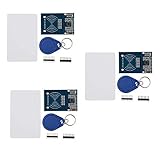
- The MF522-AN module design the circuit of card read by using the original Philips MFRC522 chip.
- Easy to use, low cost, and applicable to equipment development and card reader development etc.
- Applicable for the user who need to design or manufacture the RF card terminal.
- The module can be directly loaded into the various reader molds.
- The module use a voltage of 3.3V, it can connected communication with user's any CPU mainboard through several lines of SPI interface, it can ensure stable and reliable work, and reader distance.
| Part | Role in the kit |
|---|---|
| Atmel AVR ATmega168 | Microcontroller on the reader module. |
| Melexis MLX90121 | RFID transceiver on the module, with SPI connectivity and matching for a 50-ohm antenna. |
| USB interface board | Connected the module to a PC for evaluation. |
| Atmel CryptoRF tags | Secure contactless tags for reader–tag prototyping. |
| Software CD | Included schematics, board-layout files and a firmware binary. |
These were supplied as a development and evaluation package; the announcement does not establish that the kit represented a finished, production-ready reader design.
How was CryptoRF security intended to work?
The security model centered on authenticating the tag and reader to one another and protecting exchanged data with encryption. In contemporaneous reporting, CryptoRF was described as a 13.56 MHz logic-based RFID transponder with a 64-bit embedded cryptographic engine, four sets of non-readable 64-bit authentication keys, four sets of non-readable 64-bit session-encryption keys and up to 64 kilobits of memory. Contemporaneous CryptoRF description
Rank #2

- COMPLETE KIT: Includes Arduino UNO R3 board, RFID module with cards, LCD display, breadboard, jumper wires, LEDs, resistors, and various electronic components in a retail storage box. This product does not contain batteries
- DIMENSIONS: Compact storage case measuring 8.86 inches long, 6.11 inches wide, and 2.36 inches high for organized component storage
- LEARNING FEATURES: Perfect for beginners with comprehensive components for RFID projects, including remote control, digital display, and sensor modules
- CONNECTIVITY: Comes with USB cable for programming, breadboard for prototyping, and various connection cables for easy circuit building
- COMPONENTS: Features LCD screen, digital display module, multiple LEDs in different colors, push buttons, resistors, and professional-grade circuit board
Those figures describe CryptoRF as characterized in the contemporaneous report; they should not be read as independent validation of security against modern threat models. The kit’s announcement explains its intended development workflow, but does not provide a contemporary security assessment or benchmark.
How does the related Melexis EVB90131 prototype differ?
A separate Microchip application note describes a secure RFID prototype using an AT90USBKEY development board, AT88SCxxxxCRF CryptoRF tags and the Melexis EVB90131 RF interface. It presents an ISO 14443 Type B reader–tag system connected to a PC over USB and operated through a graphical interface. Microchip secure RFID prototype application note
Rank #3
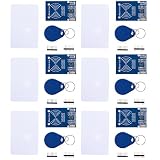
- MF522 - AN Module: Uses original Philips MFRC522 chip to design card reading circuits.
- Usability and Cost: Easy to use, low cost, suitable for device and card reader development.
- User Suitability: For users needing to design or manufacture RF card terminals.
- Module Installation: Can be directly installed in various reader molds.
- Connection and Performance: Operates at 3.3V, connects and communicates with any CPU mainboard via SPI interface, ensures stable and reliable operation and card reader distance.
This is related reference-design material, not evidence that EVB90131 was included in Yuma+ or that the two designs are interchangeable. The Yuma+ announcement identifies the MLX90121 as its reader IC; the application note’s prototype uses EVB90131.
Independent reader supportYour contribution helps us test, update, and keep practical guides available for everyone.Is the Yuma+ kit still available?
The cited announcement is from 2008 and establishes the kit’s name, components and launch details, but it does not establish current production status, remaining stock, vendor support or seller legitimacy. Anyone considering a used or surplus unit should confirm that the boards, CryptoRF tags, software and development files are actually included and usable; a historical product announcement alone cannot confirm present availability.
Quick Recap
Best Value

- The MF522-AN module design the circuit of card read by using the original Philips MFRC522 chip.
- Easy to use, low cost, and applicable to equipment development and card reader development etc.
- Applicable for the user who need to design or manufacture the RF card terminal.
- The module can be directly loaded into the various reader molds.
- The module use a voltage of 3.3V, it can connected communication with user's any CPU mainboard through several lines of SPI interface, it can ensure stable and reliable work, and reader distance.
Rank #4

- Get your next RFID project off the ground with the all-in-one SparkFun RFID Starter Kit. Use it with your computer or microcontroller!
- Includes: 1x RFID USB Reader, 1x ID-12LA RFID Module, and 2x RFID Card - 125kHz
- The RFID USB Reader is a simple to use, USB to serial base unit for the ID-3LA, ID-12LA, and ID-20LA readers.
- Simply plug a reader into the headers and attach a miniUSB cable. Open a terminal program of your choice at 9600bps 8N1, then scan your 125kHz ID tag and the unique ID will be shown on the screen.
- You will also need a USB mini-B cable to connect the USB reader to a computer. Uses FTDI drivers.
Product prices and availability are accurate as of the date/time indicated and are subject to change. Any price and availability information displayed on Amazon at the time of purchase will apply.

