
In 2024, an ESA-led technology demonstrator aboard the International Space Station successfully 3D-printed stainless steel in microgravity for the first time. Its first print was a small S-shaped commissioning line—not a ready-to-use spare part—but the experiment is a significant step toward making metal tools and components on future missions.
What was the first metal object printed in space?
The first commissioning print was a small stainless-steel S-curve made on 30 May 2024. NASA later described it as the first metal 3D print in space. ESA called it a test line that successfully concluded the printer’s commissioning; it was not a finished replacement part.
ESA subsequently reported the first full metal shape from the printer in August 2024. These reference samples were intended for analysis and comparison with matching prints made on Earth.
How did the printer make metal parts in orbit?
The ESA Metal 3D Printer is a bespoke technology demonstrator developed with Airbus and partners. It was launched to the ISS in January 2024 and installed by ESA astronaut Andreas Mogensen in the European Drawer Rack inside the Columbus module.
PC Slower Than It Used to Be?
A free scan shows the junk files, broken settings and background clutter dragging Windows down - then fixes them in one click.Free scan · Windows 10 & 11Outdated Drivers Are Slowing You Down
One free scan finds every outdated or missing driver and matches the right update for your exact hardware.Free scan · exact hardware match#1 Best Overall
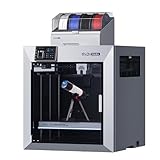
- Ultra-Large Build Volume: QIDI Max4 Combo has a 390×390×340mm printing area, 55% larger than its predecessor MAX3, enables you to print large industrial parts, complex molds and custom prototypes in one go without splitting; full-surface silicone heated bed ensures even temperature distribution and strong first-layer adhesion to avoid warping.
- High Precision & Stability: QIDI Max4 Combo 3D Printer equipped with closed-loop motors on X/Y axes, Achieve a maximum printing speed of 800mm/s and an acceleration of 30,000mm/s²; 2mm lead screw and anti-backlash nut on Z-axis reduce vertical gaps, ensuring smooth and precise printing with excellent surface quality.
- Wide Material Compatibility: 40mm³/s high-flow hotend with hardened steel nozzle supports standard materials (PLA/ABS) and industrial-grade abrasive materials (carbon fiber-reinforced nylon); 65℃ active heated chamber and self-developed Polar Cooler system create ideal printing conditions for high-temperature materials like ABS-CF, PC, PPS-CF.
- Smart Monitoring & User-Friendly Design: Built-in AI camera automatically detects printing abnormalities (e.g., spaghetti-like failures) and pauses printing instantly to save materials and time; large touch screen with optimized interface offers smooth operation, QIDI Max4 Combo suitable for both professionals and enthusiasts.
- Expandable Multi-Color Printing: Seamlessly connect with QIDI BOX to achieve 16-color and multi-material printing and enjoy intelligent filament management (e.g., real-time filament level monitoring, automatic pause when filament runs out); providing you with a worry-free 3D printing experience.
The system uses a laser-based melting and feed process to deposit liquefied stainless steel. Cranfield University contributed the melting-process hardware, laser source, delivery optics, feedstock storage and feeding system.
Why the first prints were small
ESA’s initial reference prints were each smaller than a soda can and weighed less than 250 g. ESA estimated that each would take about two to four weeks to print. Scheduled operation was limited to four hours a day because of noise constraints aboard the station. Those figures describe this demonstrator and its ISS operating conditions, not a general production rate for space manufacturing.
Rank #2

- One-Click Automatic Printing: Experience hassle-free 3D printing with the Adventurer 5M Series. Enjoy automatic bed leveling for flawless first layers, ensuring consistent adhesion and saving time with no manual adjustments required.
- 12X Ultra Fast Printing: Featuring a CoreXY structure with 600mm/s travel speed and 20000mm/s² acceleration, the AD5M maximizes efficiency, reduces production cycles, and ensures high precision, making it ideal for rapid prototyping and mass production.
- Smart and Efficient Design: Quick 3-second nozzle changes, a high-flow 32mm³/s nozzle, and fast 35-second warm-up to 200°C deliver stable high-speed printing. Its dual-sided PEI platform and versatile options provide easy removal and adaptability for various creative projects.
- Superior Print Quality & Adaptability: Combines a 280°C direct drive extruder with dual-fan cooling and vibration compensation. Includes a standard 0.4mm nozzle and accepts optional sizes from 0.25mm to 0.8mm to fit various printing needs.
- Real-Time App Monitoring: Monitor print progress, adjust settings, and receive instant status alerts remotely with the Flash Studio. Smart mobile control ensures a seamless, effortless printing experience anytime, anywhere.
Why metal printing in space matters
For a mission near Earth, crews can often rely on cargo deliveries for equipment and replacement parts. That becomes harder on longer journeys to the Moon or Mars: a needed component may not be available locally, and waiting for resupply may be impractical. An on-demand metal printer could eventually let crews make certain spare parts, repair equipment or create mission-specific tools when they need them.
The key word is could. The 2024 prints demonstrated that the process can produce metal shapes in microgravity; they did not show that crews can already manufacture any required part on demand. A useful flight part would also need to meet its design requirements, be inspected and be suitable for its intended use.
What’s actually slowing this PC down?
Pick the symptom - the matching free tool is one click away.
Rank #3

- 600mm/s Speed & CoreXY Structure — Powered by an all-metal CoreXY frame and 20,000mm/s² acceleration, Adventurer 5M Pro reaches speeds up to 600mm/s. Integrated vibration compensation algorithms eliminate ghosting and ringing for smooth, high-precision surface finishes.
- 3-Second Quick-Swap Nozzle & Auto Leveling — Features a tool-free, quick-release nozzle mechanism for effortless 3-second replacements across multiple sizes (0.25/0.4/0.6/0.8mm). One-click full auto-leveling ensures precise bed calibration and a perfect first layer every time.
- Dual Filtration System & Quiet Enclosure — Built with an integrated dual filtration system and a fully enclosed chamber to ensure a clean printing environment and thermal stability. Powered by low-noise motion control, it operates quietly under 50dB for seamless home, office, or classroom use.
- 280°C High-Temp Extruder & Broad Material Compatibility — With a 280°C max nozzle temperature and a 110°C heated bed, it reliably prints engineering materials like ABS, ASA, and PETG-CF, as well as standard PLA and PETG.
- Smart Camera & Mobile Control — Features a built-in camera for real-time monitoring and time-lapse video creation. Monitor progress, adjust settings, and receive instant status alerts via Flash Studio. Integrated with filament detection, power loss recovery, and a 4.3-inch touchscreen for effortless operation.
How ESA is checking the printed samples
The first full sample returned to Earth in February 2025 and was sent to ESA’s ESTEC laboratory. ESA’s plan was to compare it with an identically shaped Earth-made sample produced on the same printer before it was sent to the ISS. Other samples were assigned to the European Astronaut Centre and the Technical University of Denmark.
ESA’s documented analysis includes microscope inspection and CT scanning to look for internal pores. The sample can then be machined into test pieces for tensile tests on dog-bone-shaped specimens and bending tests on smaller cylinders. These checks help assess how the material formed in microgravity compares with the ground reference.
Rank #4

- [FIVE-TOOL MULTI-MATERIAL SYSTEM] Print with up to five materials or colors in a single job for advanced functional prototypes and full-color visual models.
- [INDUSTRIAL PROTOTYPING PLATFORM] Designed for professional environments requiring maximum flexibility in material and color combinations. Build volume of14.17 × 14.17 × 14.17 inches.
- [HIGH-END COREXY PERFORMANCE] Maintains speed and precision even with frequent tool changes and complex geometries.
- [OPTIMIZED MATERIAL EFFICIENCY] Smart tool management reduces waste while ensuring smooth transitions between multiple materials.
- [SEGMENTED HEATED BED SYSTEM] Intelligent heating zones improve energy efficiency and reduce warping on large prints for reliable first-layer adhesion across the entire platform.
In a later program update, ESA said three samples had returned for analysis and that the team was comparing their quality and material characteristics with ground prints. ESA described the results as a way to improve reliability and guide future in-orbit metal printing—not as certification of routine, flight-ready replacement parts.
Independent reader supportYour contribution helps us test, update, and keep practical guides available for everyone.What this milestone does—and does not—prove
- Demonstrated: an ESA technology demonstrator successfully printed stainless-steel shapes in microgravity aboard the ISS.
- Still being assessed: how the printed material compares with equivalent Earth-made samples and what the results mean for reliability.
- Not established by the demonstration: routine production of certified replacement parts, or the ability to print any part a crew might need.
The milestone is less about an astronaut printing a finished spare part today and more about learning whether metal manufacturing can become a dependable capability beyond Earth. That requires more than getting a shape to print: the parts must also be tested, inspected and shown to meet the demands of their intended application.
Recommended Free Tools
Quick Recap
Best Value

- Multi Color Printing with All-new CFS: K2 Plus Combo multi-color flagship printing, exciting for you to combine. With four CFS units hooked together, it is possible to deliver 16-color 3D prints, saving the need for painting afterward. CFS is intelligent with automatic filament selection, switch, and relay. Upon loading an RFID filament, it can read the color and type instantly. When a filament is running out, it can relay with a similar one installed
- Larger Size to Meet More Needs: Compared to Creality K2 and K2 Pro, the Creality K2 Plus offers an extraordinary 350*350*350mm large build volume, great for handling larger objects or larger batches, large models don‘t require partitions, and small models are printed in batches more calmly, easily satisfying your ever-expanding 3D printing aspiration
- 600mm/s High Speed Printing: Creality 3D Printer K2 Plus Combo adopting industry-grade FOC step-servo motors for the XYZ axis and extrusion, Step-servo Motor System 30000mm/s² accelaration, 40mm³/s High-flow and quiet. For a large-format machine, 600mm/s is pretty fast, but that's not the whole story. Turbocharged by the step-servo motors, it can accelerate at a staggering 30000mm/s²
- Super Master of Materials: The Creality K2 Plus 3d printer actively maintains a constant temperature of up to 60°C, allowing you to easily print high-end filaments like ASA and PPA. Printed models are warp-resistant and high-strength. High-temp nozzle with hardened steel tip, Supports operating temperatures up to 350°C, easily handling a variety of high-melting-point, wear-resistant engineering filaments
- Dual AI Cameras & Automation: K2 Plus features 18 smart sensors. Everything is automated and closely monitored. It has two AI cameras. One is on the chamber side to watch over spaghetti failure, idling, etc. Another is on the toolhead for flow rate optimization. No more underfeeding and overfeeding. With two Z-axis independently motorized, it can auto-adjust bed tilt before auto leveling
Product prices and availability are accurate as of the date/time indicated and are subject to change. Any price and availability information displayed on Amazon at the time of purchase will apply.

