
Quick wins for a faster PC:
Clear out junk files and repair common Windows errorsFree Scan →Fix the driver behind crashes, sound loss and screen glitchesFind Drivers →Aspinity’s AML100 is a production-silicon chip designed to analyze continuous sensor signals in the analog domain and wake a digital processor only when it detects a learned event. That can reduce the energy spent on always-on monitoring, but Aspinity’s power and battery-life figures are vendor claims, not independently verified results. AML100 is the shipping product; the company’s AML200 RF-classification chip is still in development.
What is Aspinity’s AML100?
The AML100 is an analog machine-learning chip for devices that need to monitor sensor signals continuously. Aspinity calls its product family AnalogML. Rather than digitizing every incoming sample and running a processor or digital AI accelerator all the time, the AML100 analyzes a signal before it reaches the analog-to-digital converter (ADC).
When its learned model detects a relevant event, the chip can signal the device’s digital processor to wake and handle the next steps. The aim is not to replace the main processor or perform every task in a device; it is to avoid spending energy on digital processing when the sensor signal is uninteresting.
How does analog AI reduce always-on power?
In a conventional always-on design, a sensor’s output is converted to digital data and processed continuously so the system can notice a sound, vibration, or other event. That approach makes detection straightforward to build around digital components, but it also keeps parts of the digital signal chain active even during quiet or uneventful periods.
Recommended Free Tools
#1 Best Overall
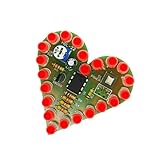
- Heart shaped appearance+practical layout: LEDs form a heart shaped pattern, with clear component layout. The front emit light and the back is soldered, balancing aesthetics and ease of operate
- Low welding difficulty, suitable for beginners: without precised components, complete accessories, low voltages (4-6V) power supply, welding is not easy to damage, friendly for beginners to practice
- Lightweight and cost-effective: compact in size, lightweight (approximately 130g), powered by USB/battery, suitable for or e-learning bulk purchases
- Adjustable breathing rate gameplay activity: equipped with potentiometer, adjustable breathing speed, supports component replacement to explore different effects, and expands learning space
- Easy to learn analog circuits: With LM358 operational amplifier as the cored part, without programming is required, and analog circuits are used to achieve breathing effects, suitable for beginners to learn basic electronic principles
Aspinity’s approach moves the initial inference ahead of the ADC. Its configurable analog blocks (CABs) combine sensor interfacing, feature extraction, and neural-network operations. The AML100 can therefore evaluate the incoming waveform without first converting the entire signal into digital samples. If the model recognizes a configured event, it can wake the digital system; otherwise, the digital processor can remain asleep.
Independent coverage has described Aspinity’s underlying design as its RAMP (Reconfigurable Analog Modular Processor) architecture and an analog compute-in-memory approach. The practical trade-off is that the analog chip is intended for a specific always-on detection role, while the awakened digital processor remains available for more complex work.
What performance and power figures has Aspinity published?
The figures below come from Aspinity’s launch release or current product and technology pages. They describe vendor-reported claims, not independently tested results. They also refer to different measurement boundaries, so a chip-current figure should not be treated as directly equivalent to a whole-system power figure.
Rank #2

- Versatile PCB Board Kit: This circuit board prototype kit includes a variety of PCB board sizes to cater to diverse project requirements: 1 piece of 3.5x5.9 inches (9x15cm), 2 pieces of 2.8x3.5 inches (7x9cm), 3 pieces of 2.0x2.8 inches (5x7cm), and 5 pieces each of 1.6x2.4 inches (4x6cm), 1.2x2.8 inches (3x7cm), and 0.8x3.1 inches (2x8cm).
- Comprehensive Header Pin Set: Includes 6 pieces of male straight pin headers, 6 pieces of female straight pin headers, and 4 pieces of right-angle pin headers. Each row features 40 pins with a 0.1 inch (2.54mm) pin pitch, providing versatile connectivity options.
- Complete Terminal Blocks & Jumpers: This kit comes with 6 pieces of 2-Pin Terminal Blocks, 4 pieces of 3-Pin Terminal Blocks, and 100 pieces of standard 2.54mm pin spacing circuit board jumper caps, ensuring you have the components needed for various connections.
- Sturdy and Durable Construction: Made from high-quality FR4 fiberglass material, these PCB boards are 1.6mm thick, offering robust durability and long-lasting performance for your projects.
- Convenient Design for Easy Assembly: Each board features four mounting holes at the corners for easy assembly. The pre-tinned holes across the circuit board simplify the soldering of components and sensors, facilitating seamless project integration.
| Figure | What Aspinity says it describes | Source and qualification |
|---|---|---|
| 95% reduction in always-on system power | Reduction attributed to the AML100 approach | Aspinity’s February 15, 2022 launch-release claim; not an independent measurement. |
| Under 100 µA | Always-on system power | Statement by Aspinity founder and CEO Tom Doyle in the February 15, 2022 launch release; vendor-reported. |
| Under 20 µA | AML100 always-on operating current | Aspinity’s current product-page figure; vendor-reported and not a whole-system measurement. |
| Under 1 ms | On-device inference latency | Aspinity’s current product-page figure; vendor-reported. |
| 100× lower power than digital AI | Comparison with digital AI | Aspinity’s current product-page claim; the comparison conditions are not stated in the supplied product information. |
| 2–5 mA | Draw for a traditional digital always-on path | Aspinity’s current technology-page figure; vendor-reported. |
| Up to 10+ years | Always-on battery life | Aspinity’s current product-page claim. It is an upper-bound claim, not a guaranteed lifetime; the supplied information does not state the battery capacity or operating conditions behind it. |
The figures should not be collapsed into a single promise. The launch release’s system-level claims, the current product page’s AML100 operating-current figure, and the technology page’s estimate for a traditional digital path are not presented as results from one common test. Actual battery life depends on the battery, sensor, surrounding circuitry, event rate, and how often the digital system wakes.
Windows Errors? Fix Them Before They Spread
Repair common Windows errors and clear accumulated junk for a smoother, more stable PC - no reinstall needed.Free scan · no reinstallOutdated Drivers Are Slowing You Down
One free scan finds every outdated or missing driver and matches the right update for your exact hardware.Free scan · exact hardware matchWhat can AML100 monitor?
Aspinity says AML100 is field-programmable and supports up to four analog sensors. The same core can be configured for different continuous signals, including acoustic, vibration, current, pressure, and biomedical sensing. Named use cases include acoustic-event and drone detection, industrial anomaly and machine-health monitoring, vehicle security, wearable and biological sensing, and other always-on IoT systems.
For example, a vibration-monitoring device could keep the analog detector active to recognize a configured machine anomaly, then wake its digital processor when that pattern appears. Whether a particular installation achieves a useful detection rate or meaningful battery savings depends on the sensor, model configuration, system design, and real-world signal conditions; the published claims alone do not establish performance for every use case.
Rank #3
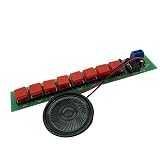
- PCB Dimension:13.5cm × 2.2cm; Wide working voltage range: DC3V~12V, recommended DC5V power supply for louder sound output; Equipped with 8 independent piano keys and onboard small speaker, finished circuit can play 8 different musical notes by pressing corresponding buttons.
- Core circuit adopts classic NE555 timer IC configured as an oscillator; Resistors R2-R9 cooperate with R1 & C2 capacitor to generate 9 different oscillation frequencies; Each key(S1-S8) switches corresponding resistance value to change audio frequency, finally output different tones via built-in speaker, helping users intuitively learn oscillator & resistance-frequency correlation principle.
- All electronic accessories are supplied as loose separate components including PCB, NE555 IC, push buttons, resistors, capacitors and speaker; Users need to complete full soldering assembly by hand, ideal soldering training kit for electronics newbies, and electronic enthusiasts.
- Detailed soldering reminder included to avoid common mistakes: Distinguish 1K & 10K resistors; Electrolytic capacitor long pin = positive(+); Align NE555 chip notch with PCB mark; Red wire for speaker positive & black wire for negative; PCB VCC=Positive, GND=Negative for power wiring.
- Perfect STEM educational accessory for school physics & electronic class, laboratory experiment, maker club project and after-school handmade activity; Fun piano playing function combines theory with practice, greatly improving interest in analog circuit learning.
How is AML100 programmed and integrated?
Aspinity’s software development kit uses Python and PyTorch-oriented machine-learning workflows to define, verify, and compile AnalogML configurations. The company says developers do not need analog-design or firmware expertise to use that workflow. This is a vendor description of the development process, not a guarantee that integration into a finished product requires no hardware, firmware, or validation work.
AML100 is a component for product development and integration, rather than a general-purpose consumer AI accessory. Teams evaluating it should establish that their sensor signal and detection task fit the chip’s analog processing model, then assess the configuration and system-level power in the intended device.
Is AML100 available, and how does it differ from AML200?
Aspinity currently presents AML100 as shipping production silicon. The company’s public product information identifies AML200 as an in-development extension for RF classification before the ADC, not as a shipping alternative to AML100.
Rank #4
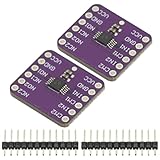
- 2Pcs TS5A23157 Dual Channel 10Ω SPDT Analog Switch Module Development Board
- TS5A23157 Dual 10-Ω SPDT Analog Switch
- The TS5A23157 device is a dual single-pole doublethrow (SPDT) analog switch designed to operate from 1.65 V to 5.5 V. This device can handle both digital and analog signals. Signals up to 5.5 V (peak) can be transmitted in either direction.
| Product | Status and intended role | Published details |
|---|---|---|
| AML100 | Shipping production silicon; configurable analog machine learning for continuous sensor signals. | Supports up to four analog sensors; Aspinity’s current product page lists under 20 µA always-on operating current and under 1 ms on-device inference latency. These are vendor figures. |
| AML200 | In development; intended for RF classification before the ADC. | Aspinity lists 300 TOPS/W (INT8), 5 GHz RF input bandwidth, a 22 nm process, and under 1 µs latency. The company describes the chip as test-chip verified and in development; these are not claims of a shipping production product. |
The figures do not make AML200 a direct upgrade for every AML100 use case: its stated purpose is RF classification, whereas AML100 is the production product described for a range of analog sensor applications.
Aspinity launched AML100 on February 15, 2022, describing it as the first member of its AnalogML family. In March 2024, the company announced AML100 automotive-security algorithms and a dashcam evaluation kit aimed at detecting parked-vehicle security events. In September 2023, Aspinity announced a $5 million Series B, bringing its stated total funding above $19 million, and identified Unitrontech as a strategic investor and automotive semiconductor partner.
Independent reader supportYour contribution helps us test, update, and keep practical guides available for everyone.What should product teams verify before choosing an analog always-on chip?
- Detection fit: Confirm that the target event is represented in the sensor’s analog signal and can be distinguished from normal conditions.
- System-level power: Measure the complete design—including sensors, analog front end, AML100, digital processor, and wake-up behavior—rather than relying on a chip-current figure alone.
- Latency and response: Check how quickly the system must react and whether the published inference-latency claim corresponds to the intended configuration.
- Sensor and channel needs: Check the actual sensor interface and number of sensors; Aspinity states support for up to four analog sensors.
- Development and production status: Evaluate the Python/PyTorch-oriented configuration workflow and distinguish AML100’s stated production status from AML200’s in-development status.
For a direct evaluation or business integration inquiry, the relevant route is Aspinity. The available product information does not establish an Amazon retail SKU or a public reseller listing, so a generic development board or microphone should not be mistaken for an AML100 purchase option.
Best Value
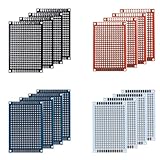
- Package: Double sided PCB Prototype Board 4x6cm; Black Red Blue white 4 Colour. The number of each color is random.
- Durable: High quality of durable glass fiber -FR4 material with 1.6mm thickness makes a very solid and sturdy prototype circuit board.
- Easy installation: 4 mounting holes at the corners of the boards make it very convenient to solder components and install them together.
- Easy to use: Pre-tinned plated holes on the board make it very handy to solder components and sensors for your projects.
- This Double-sided Porotype board is widely used in electronic experiments and point-to-point DIY welding projects,With perfectly designed pre-drilled holes on the board, you can easily install any sensor and component you need,High-quality fiberglass materials and excellent circuit board durability can always meet your requirements in various situations.
“We’ve long realized that reducing the power of each individual chip within an always-on system provides only incremental improvements to battery life.”
— Tom Doyle, Aspinity founder and CEO, February 15, 2022 launch release
Quick Recap
Bestseller No. 1
Product prices and availability are accurate as of the date/time indicated and are subject to change. Any price and availability information displayed on Amazon at the time of purchase will apply.

