
What’s actually slowing this PC down?
Pick the symptom - the matching free tool is one click away.
At SEMICON West in San Francisco in July 2005, ASML unveiled the TWINSCAN XT:1700i, a 193 nm water-immersion lithography scanner with a numerical aperture (NA) of 1.2. ASML positioned it for volume production at the 45 nm process node. Its headline distinction was “hyper-NA”: it pushed immersion NA above 1.0 and exceeded the 1.07 NA reported for Nikon’s competing NSR-S609B.
What ASML announced at SEMICON West
ASML’s July 12, 2005 announcement introduced the TWINSCAN XT:1700i as an immersion scanner intended for 45 nm volume chip production. The company specified a 26 mm × 33 mm maximum exposure field and throughput of up to 122 wafers per hour. Those figures were manufacturer specifications in the launch announcement, not independent measurements of production performance.
Reports around the event help pin down the timing. EE Times previewed the expected unveiling on July 6; EDN reported on July 13 that the scanner had been unveiled at the show. In the launch announcement, ASML said first shipment was planned for Q1 2006. EE Times had previously cited an expectation of Q2 or Q3 2006; in December 2005, ASML again targeted shipment by the end of Q1, after qualification work.
What “hyper-NA immersion” means
Water raises the effective numerical aperture
In immersion lithography, a thin layer of ultra-pure water fills the space between the projection lens’s final element and the wafer. Because water has a higher refractive index than air, using it in that optical path raises the system’s effective NA and can improve the smallest feature the scanner can resolve at a given exposure wavelength.
Quick wins for a faster PC:
Scan for outdated or missing drivers - takes under a minuteDriver Scan →Repair Windows errors before they cause bigger problemsFix Now →#1 Best Overall

- Eisco Concave Slides: Eisco's concave microscope slides feature a recessed well with 15 µL capacity for holding liquid specimens securely. These cavity slides facilitate easy observation of wet mount preparations in both lab and classroom settings
- Smooth Handling Edges: Ground polished edges provide a smoother, more comfortable handling experience compared to rougher cut slides. This meticulous design ensures that users can focus on observing specimens without distraction or discomfort
- Durable Glass Material: Made from reliable glass, these slides are suitable for various applications, including the observation of liquid and wet-mount specimens. Their clear construction supports consistent use in educational environments
- Ample Pack Size: With a pack of 10, these concavity microscope slides provide sufficient supply for extended use in both professional labs and educational settings. They are well-suited for experiments requiring repeated observations
- Precision Dimensions: Each slide measures 75 x 26 mm, providing a standard size that fits most microscope stages. The precise dimensions ensure compatibility and ease of use for both experienced scientists and students alike
NA is a measure of an optical system’s ability to collect and focus light. In the usual lithography terminology, “hyper-NA” describes an NA greater than 1.0. The XT:1700i used 193 nm ArF exposure and reached NA 1.2. ASML said its catadioptric lens combined refractive components with mirrors to create that hyper-NA lens.
Why the NA figure mattered
A higher NA can improve resolution without changing the exposure wavelength, which made immersion a way to extend 193 nm lithography toward smaller process nodes. The figure alone does not establish a scanner’s yield, defect rate, cost, or overall manufacturing performance; those depend on more than the lens aperture.
Rank #2
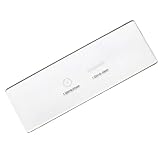
- PRECISE CALIBRATION: The crosshair optical glass microscope slides feature accurate scale markings and calibrated rulers for precise measurement calibration under microscopes
- MULTI-PURPOSE DESIGN: In addition to microscope calibration, the multifunction plate reticle can also be used for laser scanner calibration and as an optical measurement standard for quality control inspections.
- DURABLE CONSTRUCTION: Made from high-quality hardened optical glass with non-fading engraved scales, the calibration slides are built to withstand regular laboratory usage and last for years of accurate measurements.
- CLEAR MARKINGS: The etched centesimal scale markings are easy-to-read
How the XT:1700i compared with Nikon’s NSR-S609B
At the 2005 show, the clearest published comparison was numerical aperture: EE Times reported 1.07 for Nikon’s NSR-S609B, versus ASML’s announced 1.2 for the XT:1700i. That gave ASML the higher headline NA claim. The available reports do not establish a full like-for-like comparison across the other specifications and operational measures.
| Measure | ASML TWINSCAN XT:1700i | Nikon NSR-S609B |
|---|---|---|
| Numerical aperture | 1.2 (ASML, July 2005 announcement) | 1.07 (EE Times, July 2005) |
| Exposure wavelength | 193 nm (ASML, July 2005 announcement) | Not stated in the cited EE Times report (July 2005) |
| Target process node | 45 nm volume production (ASML, July 2005 announcement) | Not stated in the cited reports (2005) |
| Maximum field size | 26 mm × 33 mm (ASML, July 2005 announcement) | Not stated in the cited reports (2005) |
| Throughput | Up to 122 wafers per hour, as specified by ASML in July 2005 | Not stated in the cited reports (2005) |
| Shipment timing | ASML planned first shipment in Q1 2006; its December 2005 update targeted the end of Q1 after qualification work | Not stated in the cited reports (2005) |
| Readiness or qualification status | ASML said in December 2005 that qualification work was under way and the lens was ramping up for production | Not stated in the cited reports (2005) |
What the announcement did—and did not—establish
The XT:1700i announcement established ASML’s specifications and manufacturing target for a 2005 product launch. It did not, by itself, show how many tools shipped, what yields customers achieved, or how the scanner compared on cost or reliability. The stated Q1 2006 shipment date was a target, later reiterated as end-Q1 after qualification work, rather than proof of a completed shipment.
Rank #3
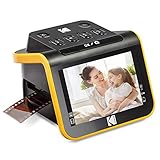
- SAVE OLD PHOTO MEMORIES: 1422MP Digital Film Scanner Lets You View, Edit and Convert Your Old Color and BandW Negatives 135, 110, 126mm and 50mm Slides 135, 110, 126mm to Digital Files and Save Directly to SD Card (NOT INCLUDED)
- 5” LCD DISPLAY WITH GALLERY MODE: Features Large, Crystal-Clear Screen with Wide Viewing Angle for Instantly Previewing and Editing Photos | Great for Sharing with Friends and Family or Using as an Elegant Digital Picture Frame in Home or Office
- CONVENIENT EASY-LOAD FILM INSERTS: Quick-Feeding Tray Technology Allows for Continuous Loading Action, Making Scanning Fast and Simple Includes 50mm Slide Holder, Adapters for 135, 110 and 126 Films, Cleaning Brush, USB and HDMI Cables
- EDITING WITH A SINGLE TOUCH: Advanced Capture Software Enhances, Resizes and Converts Photos Via Easy ‘Scan’ Button—No Complex Screens or Settings | Easy Options Let You Choose Film Type, Adjust ColorBrightness and Assign DateTime
- SUPER CHIC. UBER COMPATIBLE: Device Handles All Your Old Slides and Negatives, Supports SD or SDHC Cards Up to 32GB (NOT INCLUDED) and Connects to Any Type-C USB-Enabled Computer | Gorgeous Design Blends Seamlessly w Your Home Décor
For historical context, ASML’s 2024 materials describe its current DUV immersion platform at NA 1.35. That later figure shows how far the platform’s stated aperture advanced, but it should not be confused with the XT:1700i’s 1.2 NA or taken as evidence that the 2005 scanner is still commercially offered.
Quick Recap
Rank #4

- Ultra-Clear Glass Slides for Microscopy:Crafted from optical-grade glass, these microscope slides offer excellent transparency and distortion-free imaging—ideal for students, teachers, and science enthusiasts working on plant tissue, pond water, or other biological specimens
- Pre-Cleaned and Ready to Use:All blank microscope slides are pre-cleaned, dust-free, and scratch-free. Use them straight out of the box with your favorite microscope accessories or microscope slide covers—no extra prep needed
- Safe for All Ages:Each slide features polished edges and 45-degree clipped corners for safer handling in classrooms, homeschooling, or family STEM projects. Compatible with kids' microscopes, making it safe and accessible for young learners
- Complete Microscope Slide Kit:Includes 50 blank glass slides for microscope and 100 cover slips for microscope slides. Perfect for biology labs, science fairs, and school experiments—an all-in-one solution for learners of any level
- Compatible with Most Microscopes:Designed for monocular, binocular, and trinocular microscopes, and fully suitable for educational models including kids' microscopes. Perfect fit for school or home-based science setups
Product prices and availability are accurate as of the date/time indicated and are subject to change. Any price and availability information displayed on Amazon at the time of purchase will apply.

