
The Tool Desk
Outbyte PC Repair FREERepair Windows errors before they cause bigger problemsFix Now →Outbyte Driver Updater FREEFix the driver behind crashes, sound loss and screen glitchesFind Drivers →Arm introduced Neoverse V1 and Neoverse N2 on April 27, 2021 as partner-oriented infrastructure CPU platforms, not retail processors. V1 emphasizes maximum per-core performance and wide vectors for demanding, highly parallel workloads. N2 is Arm’s first Armv9 infrastructure CPU and takes a more balanced performance-efficiency approach for deployments ranging from cloud data centers to the edge.
What Arm announced on April 27, 2021
Arm’s launch-era infrastructure posts presented two complementary platforms. Each combines a CPU design with system-level IP that partners can implement in their own silicon and servers. Consequently, neither name identifies one fixed commercial processor configuration.
| Platform | Arm’s stated emphasis | Instruction-set and vector focus | Typical deployment goal |
|---|---|---|---|
| Neoverse V1 | Higher per-core performance and throughput | Armv8-era SVE with two 256-bit vector paths and bfloat16 | HPC, scientific workloads, cryptography, packet processing and other vector-intensive services |
| Neoverse N2 | Balanced performance, efficiency and scalability | Armv9, SVE2 and continued NEON support | Cloud, data-center and power-constrained edge systems |
Neoverse V1: a performance-first design
Wide vectors for parallel workloads
V1’s defining feature is a 2×256-bit SVE vector unit. A wide vector datapath can process more elements per instruction when software is written or compiled to use SVE. Arm specifically connects V1 with high-performance computing, scientific computing, cryptography and packet-processing workloads. The benefit is workload-dependent; scalar or poorly vectorized code will not automatically receive the same gain.
Arm also lists bfloat16 support for AI and machine-learning workloads. The platform options named in the launch material include DDR5 and HBM3 memory, PCIe 5 and CXL 2.0, allowing implementation partners to tailor memory capacity, bandwidth and accelerator connectivity.
#1 Best Overall

- 3 Mounting Options - This space saving mini PC mount conveniently secures your thin client or docking station to the back of your computer monitor, clamped to a monitor mount pole (diameter of 3 cm to 4.1 cm), or installed under your desk (at least 1.6 cm in thickness). Fits VESA mounts 75x75mm and 100x100mm.
- Adjustable Width - The solid bracket features 1.8 cm to 7.1 cm of adjustable width and is designed for Intel NUC models (power button must be on the side of the device), Chromebox, Mac Mini, small CPU's, thin clients, USB 3.0 docking stations, USB hubs, Lenovo Tiny Series, Dell OptiPlex Micro, HP ProDesk Mini, and more.
- Sturdy 5 kg Support - Made of solid steel with a powder coated finish for rust prevention, this CPU holder supports up to 5 kg of weight. Adjustable straps keep your device from sliding and rubber pads protect your equipment from scratches.
- Easy Installation - All necessary hardware and instructions are provided for the 3 types of installation methods. Each mounting option gives you unrestricted access to your thin client with an open-frame design for optimal ventilation.
- We've Got You Covered - This product comes with a limited 3-year Manufacturer Warranty, as well as friendly tech support to help with any questions or concerns.
Arm’s V1 performance estimates
Arm reported about a 48% aggregate IPC improvement over Neoverse N1 on a selected workload mix. The comparison used simulation or emulation with CPU frequency and memory bandwidth held at matched settings, so it is a vendor estimate rather than an independent benchmark or a guarantee for every V1-based system. Arm’s microarchitecture summary also refers to a 50% IPC increase over N1; that figure should not be merged with the separate 48% aggregate result because the contexts differ.
Platform scale and controls
Arm described a V1 reference design integrating 32 to 128 V1 CPUs, alongside the CMN-700 mesh interconnect and supporting system IP. It also discussed shared-resource controls, power management, nested virtualization and memory-management features. These figures describe a configurable reference platform, not a single retail server specification.
Rank #2

- All-in-One Enterprise Data Server : The ROSE Data Server combines high-performance networking, enterprise storage, and compute capabilities in a single 1U rackmount platform. Designed for data centers, enterprise IT infrastructure, and high-performance environments that require scalable storage and ultra-fast networking.
- Massive NVMe Storage Capacity : Supports up to 20 U.2 NVMe SSD drives for high-density storage performance. Ideal for demanding workloads such as virtualization, database servers, backup repositories, and high-speed data processing.
- Ultra-Fast Multi-Gigabit Connectivity : Equipped with 2×100G QSFP28 ports, 4×25G SFP28 ports, 4×10G SFP+ ports, and 2×10G Ethernet ports, delivering exceptional bandwidth for data center interconnects, storage networks, and high-performance computing environments.
- Powerful 16-Core ARM Processor : Built with a 16-core 2 GHz ARM64 CPU and 32GB DDR4 RAM, providing strong processing power for routing, storage management, container workloads, and network virtualization.
- RouterOS ROSE Edition with Advanced Storage : Runs RouterOS v7 ROSE edition, enabling enterprise features such as RAID support, NVMe-over-TCP storage sharing, encryption layers, and Btrfs file system capabilities for snapshots, compression, and high data integrity.
Neoverse N2: Armv9 with a broader efficiency target
SVE2 and existing software support
Arm calls N2 its first Armv9 infrastructure CPU. Its SVE2 implementation is intended to make practical vectorization available across a wider range of software, including machine learning, digital signal processing, regular expressions and 5G radio-access-network workloads. N2 retains NEON support so existing NEON-optimized code can continue to run.
Compared with V1, Arm characterizes N2 as having more modest vector and load/store bandwidth. It reuses major front-end features such as branch prediction, prefetching and a micro-op cache while targeting a wider range of system sizes, from low-core-count, power-constrained devices to high-core-count data-center designs.
Rank #3
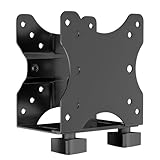
- Product Description:This Adjustable Thin Client Mini PC Stand is suitable for Mini PC, CPU, Thin Client. Also heavy duty steel construction provides extra strength and durability
- Compatibility: The stand supports devices up to 11 lbs(5 kg) and 75 x 75 and 100 x 100 mm VESA mounting patterns. 0.67"-2.8" (17-70 mm) width adjustment fits most device sizes and shapes
- Three Mounting Options: Its mounting ports attach to a variety of surfaces. You can mount the unit under a table, behind a monitor, or clip it to a pole to minimise clutter and save desk space
- Open Frame Design: Can help the device better ventilate and dissipate heat while providing unrestricted port access. Attached back strap for enhanced stability
- Easy Installation: All necessary components and installation manuals are included to help you set up quickly
Resource management, security and power features
- Memory Partitioning and Monitoring (MPAM): helps control and observe access to shared resources.
- CBusy: regulates traffic during congestion. Arm reported a 15% performance uplift from CBusy in its reference design; this is a reference-design result, not a universal N2 figure.
- Performance Defined Power Management: provides a framework for managing performance against power limits.
- Security extensions: pointer authentication, Branch Target Identification, Memory Tagging Extension and Secure EL2.
Arm’s N2 performance estimate
Arm reported a 40% SPECint2006 estimated IPC uplift for N2 over N1. The number is an Arm estimate from the 2021 architecture material, not an independent contemporary test and not a promise for a partner’s final frequency, cache, memory or compiler configuration.
V1 versus N2: which design fits a workload?
There is no defensible universal answer to “which is faster?” The CPU choice is only one part of a partner-configured system, and Arm advises evaluating performance per socket, performance per thread and performance variability per thread.
Rank #4

- Multifunctional Thin Client PC Mount: Our space-saving thin client CPU mount can be installed on the back of a freestanding monitor, between a monitor and VESA mount arm, or used as a freestanding holder on the desk. Fits 75x75mm and 100x100mm VESA mounts
- Compatibility: Holds up to 6.6 lbs and designed for Intel NUC models (power button must be on side of device), Chromebox, Mac Mini, small CPUs, thin clients, USB 3.0 docking stations, USB hubs, Lenovo Tiny Series, Dell OptiPlex Micro, HP ProDesk Mini, etc
- Adjustable Width: The solid bracket features 0.2” to 2.8” of adjustable width, allowing it to support a variety of devices. This space-saving mount is perfect for a wide range of needs
- Lightweight Design: Made of plastic and steel material to provide a lightweight hold for your mini PC. Non-slip silicone pads protect the exterior surface of the CPU and provide a solid hold
- Easy Installation: All hardware and instructions are provided for the 3 types of installation. Each mounting option gives you unrestricted access to your thin client with an open-frame design for optimal ventilation
| Decision factor | V1 is the stronger starting point when… | N2 is the stronger starting point when… |
|---|---|---|
| Vectorization | The workload can exploit wide SVE operations, including HPC, scientific code, cryptography or packet processing. | The software benefits from SVE2 across mixed workloads such as ML, DSP, regular expressions and 5G RAN. |
| Single-thread performance | High per-core throughput is the primary requirement. | You need a balanced result across many services and operating points. |
| Power and area | The system can support a performance-oriented design and its associated memory and I/O resources. | Power-constrained edge or efficiency-sensitive deployments are important. |
| Scaling | A large reference design with substantial memory and I/O is appropriate. | The implementation must scale from small edge systems to large cloud systems. |
| Security and isolation | V1’s virtualization, memory-management and shared-resource controls meet the design need. | N2’s MPAM, CBusy, Secure EL2 and Armv9 security extensions are particularly valuable. |
How to interpret the launch-era numbers
- Keep the baseline: the reported improvements are comparisons with Neoverse N1.
- Keep the metric: IPC is instructions per cycle, not completed application work, benchmark score or server throughput.
- Keep the conditions: V1’s approximately 48% result used simulated or emulated selected workloads at matched frequency and memory bandwidth.
- Keep the attribution: the 40% N2 SPECint2006 figure and 15% CBusy figure were reported by Arm.
- Check the implementation: partner choices for cores, clocks, caches, memory, interconnect, accelerators, software and cooling determine delivered performance.
Availability and what the announcement does not establish
Arm’s N2 launch article anticipated partner silicon sampling by the end of 2021. That historical forecast does not establish the current availability of a particular N2 chip, server or cloud instance. The launch posts likewise do not provide independent present-day test results or identify one standardized V1 or N2 retail system.
For anyone evaluating a product, request the partner’s exact core count, clock range, cache hierarchy, memory channels and type, accelerator and I/O configuration, power envelope, virtualization features, compiler toolchain and measured workload results. Those details matter more than the platform name alone.
Recommended Free Tools
Best Value

- [RK3328 SBC & DDR4 RAM] Powered by Rockchip RK3328 Quad-core CPU and 1GB/2GB DDR4, providing high-performance computing in a 48x48mm tiny size for efficient IoT processing.
- [Gigabit Ethernet Mini Router] Features a Full-speed Gigabit Ethernet port with a Unique MAC Address, ensuring stable, high-speed data transfer and no IP conflicts for secure network applications.
- [USB 3.0 IoT Gateway] Equipped with USB 3.0 Type-A for 5Gbps fast data transmission, making it an ideal Open Source Gateway or mini-server for smart home automation and storage.
- [GPIO Programming & Header] Includes a 26-pin GPIO header (I2C, UART, SPI, I2S) and a 3-pin Serial Debug Port, offering a flexible development interface for rapid DIY prototyping and hardware integration.
- [Ubuntu & FriendlyWrt OS] Optimized for FriendlyWrt (OpenWrt) and Ubuntu Core, this ARM Development Board is ready for building custom soft routers, NAS, and edge computing nodes.
Bottom line for system designers
Choose V1 when the priority is peak per-core capability and the software can make substantial use of wide vectors and high-bandwidth system options. Choose N2 when a deployment needs Armv9, SVE2, stronger resource and security controls, and a scalable performance-per-watt balance from edge to cloud. Arm’s 2021 figures are useful for understanding the intended design trade-offs, but they should not be treated as independent benchmarks or as specifications for every partner system.
Quick Recap
Product prices and availability are accurate as of the date/time indicated and are subject to change. Any price and availability information displayed on Amazon at the time of purchase will apply.

