
Do these 3 things before closing this tab:
1Clear out junk files and repair common Windows errors2Scan for outdated or missing drivers - takes under a minute3Repair Windows errors before they cause bigger problemsiTechGuides is reader-supported. When you buy through links on our site, we may earn an affiliate commission. As an Amazon Associate I earn from qualifying purchases. Learn more
The Antminer S21 Review verdict is straightforward: BITMAIN’s 2023 S21 manual rates the standard air-cooled S21 at 200 TH/s, 3,500 W, and 17.5 J/TH, but the machine is not a plug-and-play home miner. It needs 220–277V power, continuous heat removal, wired networking, and a location that can tolerate industrial fan noise.
This review covers the standard 200 TH/s air-cooled Antminer S21 and separates BITMAIN’s ratings from independent temperature, noise, setup, maintenance, and ownership evidence. It does not treat the S21 Pro, Hydro, Immersion, Slim, or other S21 variants as interchangeable.
Key takeaways
- According to BITMAIN’s 2023 S21 Product Manual, the standard air-cooled Antminer S21 is rated at 200 TH/s, 3,500 W, and 17.5 J/TH, with manufacturer tolerances of up to ±3% for hashrate and ±5% for wall power and efficiency.
- The Antminer S21 requires 220–277V AC input and lists 20A current, so a normal 120V/15A household outlet is not an appropriate deployment assumption.
- According to the 2024 Hashrate Index and Luxor Technology performance review, tested hashrate stayed near 200 TH/s in cooler conditions but fell to approximately 185 TH/s after thermal underclocking around 40°C.
- A continuously operating 3,500 W S21 produces roughly 11,945 BTU/h of heat, while independent review evidence places operating noise around 73–76 dB at one meter.
- The S21 can be potentially attractive with inexpensive electricity and existing industrial infrastructure, but electricity, ventilation, circuit installation, hosting, downtime, and pool fees can make residential ownership uneconomic.
What is the Antminer S21?
The Antminer S21 is a SHA-256 application-specific integrated circuit, or ASIC, designed primarily for Bitcoin mining and also suitable for Bitcoin Cash according to BITMAIN’s product documentation. The standard air-cooled model reviewed here is the 200 TH/s version, not the S21 Pro, S21 Hydro, S21 Immersion, S21 Slim, or lower-hashrate S21 variants.
Free tools Windows power users keep installed
One-click scans. No signup required.
The S21 is best understood as industrial electrical and thermal equipment with a mining controller attached. The 200 TH/s headline is meaningful, but the machine also draws several kilowatts continuously, requires high-voltage AC power, uses wired Ethernet, and exhausts a large amount of heat. Those requirements matter more to many buyers than the nominal hashrate.
Popular on Amazon

- High Efficiency Mining:Bitaxe Gamma 602 equipped with BM1370 chip delivers 1.8TH/s hash rate with only 35W power consumption, energy-saving and low heat. Perfect for beginners, blockchain enthusiasts, or anyone looking to experience solo mining without heavy electricity bills.
- Ultra Quiet & Desktop Friendly:Compact design, low noise operation, perfect for home and office use without disturbing noise.
- WiFi & Web Control:Built-in WiFi management, easy configuration via web browser, real-time hash rate, temperature and status monitoring.
- Open Source & Fully Customizable:Community-driven open source firmware, supports self-tuning and updates, ideal for tech enthusiasts and DIY miners.
- Complete Assembly Ready to Use:Pre-assembled miner with heat dissipation system, just plug in, connect to network and start mining.
BITMAIN’s official specifications and instructions support index is useful when checking the exact hardware revision and documentation before ordering. Product names in the secondary market are not always precise, so the listing should identify the standard air-cooled S21 and its actual hashrate rather than merely using the S21 family name.
Antminer S21 specifications at a glance
BITMAIN’s 2023 manual supplies the nominal specifications below. The manual’s figures are ratings, not guarantees that every unit will produce exactly the same hashrate or draw exactly the same power in every environment.
| Specification | Standard Antminer S21 | What the specification means |
|---|---|---|
| Algorithm | SHA-256 | Suitable for SHA-256 targets such as BTC and BCH. |
| Manufacturer-rated hashrate | 200 TH/s | Actual hashrate may fluctuate by ±3% under the manual’s qualification. |
| Manufacturer-rated wall power | 3,500 W at 25°C inlet | This is a continuous operating load, not a brief peak. |
| Rated efficiency | 17.5 J/TH | Practical efficiency changes with inlet temperature and operating conditions. |
| AC input | 220–277V AC | High-voltage infrastructure is required; the wrong voltage can damage the server. |
| Input current | 20A | The manual describes two AC input wires at 10A per wire. |
| Power-system requirement | 4,000 W adapted AC output requirement | The power system should not be undersized relative to the manual’s requirement. |
| Network interface | RJ45 Ethernet, 10/100M | The documented connection method is wired Ethernet rather than Wi-Fi. |
| Chassis dimensions | 400 × 195 × 290 mm without packaging | Airflow clearance must extend beyond the physical chassis footprint. |
| Net weight | 15.4 kg | Use the revision-specific manual figure because secondary listings can report different weights. |
| Operating temperature | 0–45°C | Higher inlet temperatures increase thermal stress and can reduce performance. |
| Humidity | 10–90% RH | Condensation and corrosive environments should be avoided. |
| Maximum altitude | 2,000 m | Above 900 m, the manual reduces the highest operating temperature by 1°C for each additional 300 m. |
| Noise | Approximately 73–76 dB at one meter in independent evidence | Use the S21 as loud industrial equipment, not as a quiet desktop device. |
The manufacturer specifications in the table come from the S21 Product Manual. The manual’s extracted noise field is inconsistent, so the noise description relies on independent review evidence rather than presenting an uncertain manufacturer number as definitive.
Recommended Free Tools
How does the Antminer S21 perform at different temperatures?
The Antminer S21 performs closest to its nominal rating in cooler intake conditions, while hot intake air raises power demand and can trigger thermal protection or underclocking. A controlled independent test is useful for showing this relationship, but its readings are not a guarantee for every S21 unit, firmware version, installation, or climate.
| Inlet temperature in independent test | Observed hashrate | Observed power draw | Interpretation |
|---|---|---|---|
| 10°C | Approximately 200 TH/s | Approximately 3,470 W | Cool intake supported performance close to the nominal rating. |
| 20°C | Approximately 201 TH/s | Approximately 3,529 W | Hashrate remained near nominal while power increased. |
| 25°C | Approximately 202 TH/s | Approximately 3,620 W | Hashrate remained strong, but measured power was higher than the 25°C headline rating. |
| Around 40°C | Approximately 185 TH/s after underclocking | Approximately 3,700 W | Thermal response reduced hashrate while power remained high. |
The figures above come from the Hashrate Index and Luxor Technology 2024 S21 performance test. The test demonstrates temperature sensitivity rather than establishing a universal performance curve. A miner in a hot, poorly ventilated room may lose both efficiency and effective hashrate even if the machine initially starts near 200 TH/s.
Cool intake air helps, but cooling the room is not automatically efficient. Air conditioning must remove the S21’s heat and also consumes electricity. In many installations, moving hot exhaust outdoors through suitable ventilation is more practical than trying to cool the entire room.
Should you buy an Antminer S21 200T Bitcoin miner?
Buy the standard S21 only after confirming the electrical, thermal, acoustic, and economic requirements. The product is a reasonable candidate for a dedicated mining room, outbuilding, commercial rack, or professional hosting facility; it is a poor fit for a typical bedroom, office, living room, or unmodified garage.
Purchase checkpoint: A marketplace listing for an Antminer S21 200T Bitcoin miner should be checked line by line before payment. Confirm that the listing is for the standard air-cooled 200 TH/s model, identify whether the PSU is included, verify the input-voltage requirement, check P13 power-cable compatibility, and investigate the seller’s reputation, warranty, return policy, shipping, taxes, and condition. A catalog listing does not establish current stock, a reliable seller, or favorable pricing.
How much power does the Antminer S21 need?
The Antminer S21 needs a high-voltage, dedicated power installation capable of supporting its continuous 3,500 W class load. BITMAIN’s 2023 manual specifies 220–277V AC input, 20A current, and a 4,000 W adapted AC output requirement; independent setup guidance commonly recommends a dedicated 240V circuit for North American installations.
| Power consideration | Required or recommended approach | Why it matters |
|---|---|---|
| Input voltage | 220–277V AC | Connecting to an unsuitable voltage can damage the miner. |
| North American deployment | Have a licensed electrician design a dedicated 240V installation | The S21 is not an ordinary 120V appliance. |
| Current | Plan around the manual’s 20A rating and local electrical requirements | The miner runs continuously, so circuit design must account for sustained load. |
| Power capacity | Do not undersize the system below the manual’s 4,000 W adapted-output requirement | PSU and circuit capacity need headroom appropriate to the installation. |
| Cable and connector | Verify the newer P13-style connection and the exact PSU bundle | Older C13/C14 arrangements are not automatically compatible. |
| Outlet accessories | Avoid power strips, improvised adapters, and undersized extension cords | These accessories can be unsuitable for a continuous high-power load. |
The S21’s P13-style power connection is an important buying detail. Do not order a generic “240V cable” based only on voltage or ampacity. The connector type, conductor rating, length, PSU model, and continuous-load suitability must all match the exact S21 revision and installation.
If the site needs a dedicated 240V mining circuit, treat the electrician and circuit design as part of the miner’s acquisition cost. The appropriate circuit, grounding, disconnecting means, and protection depend on local code and the building, so those decisions belong with a licensed electrician rather than an online cable listing.
Quick wins for a faster PC:
Fix the driver behind crashes, sound loss and screen glitchesFind Drivers →Repair Windows errors before they cause bigger problemsFix Now →Scan for outdated or missing drivers - takes under a minuteDriver Scan →At the manufacturer-rated 3,500 W load, a continuously running S21 consumes approximately 84 kWh over 24 hours: 3.5 kW multiplied by 24 hours. BITMAIN allows wall-power variation of ±5%, so the 84 kWh figure is a planning estimate rather than a guaranteed daily meter reading. Electricity cost alone can be estimated as 84 multiplied by the local price per kWh, before pool fees, downtime, cooling, hosting, taxes, or infrastructure.
How much heat and noise does the Antminer S21 produce?
The Antminer S21 converts almost all of its consumed electrical power into heat, so a 3,500 W miner produces roughly 3,500 W of heat, or approximately 11,945 BTU/h using the standard watt-to-BTU conversion. Ventilation is therefore a core installation requirement, not an optional comfort accessory.
Independent evidence reports approximately 73–76 dB at one meter, which is consistent with a roughly 75 dB-class industrial fan system. That acoustic output is unsuitable for most bedrooms, offices, and living rooms. A basic consumer fan in a closet does not solve the combination of heat, exhaust recirculation, and noise.
| Deployment location | Practical verdict | Minimum issue to solve |
|---|---|---|
| Bedroom, living room, or office | Usually unsuitable | Approximately 75 dB-class noise and nearly 12,000 BTU/h of heat are difficult to tolerate safely and comfortably. |
| Garage or dedicated mining room | Possible with proper engineering | Dedicated high-voltage power, intake and exhaust paths, dust control, and temperature monitoring are needed. |
| Outbuilding | Possible if climate and electrical service permit | The structure still needs weather protection, suitable wiring, ventilation, and a plan for hot or cold conditions. |
| Commercial rack or professional facility | Often the cleanest deployment | The facility must provide suitable power, airflow, network connectivity, maintenance, and noise isolation. |
For readers evaluating Antminer S21 ducting, exhaust shrouds, or high-temperature ventilation equipment, the purpose is to move heat away from the intake and occupied space. Ducting does not increase the manufacturer-rated hashrate by itself. Any shroud must preserve adequate airflow and avoid adding excessive back pressure or recirculating hot air.
What’s actually slowing this PC down?
Pick the symptom - the matching free tool is one click away.
Use a location where intake air is reasonably clean and the hot exhaust cannot return to the intake. Plan the exhaust route before powering the miner. A ventilation solution that works during a cool day may fail during summer heat, so the installation should be evaluated against the site’s worst realistic ambient conditions.
How do you set up the Antminer S21?
Set up the Antminer S21 in this order: confirm the hardware and power system, install safe airflow, connect Ethernet, configure the mining pool, and then monitor stock operation before attempting any tuning.
- Verify the exact unit. Record the model name, hashrate rating, hardware revision, PSU model, P13 connector, and included cables. Do not assume that a listing titled “S21” contains the same accessories as another listing.
- Prepare the electrical installation. Have a licensed electrician confirm the 220–277V requirement, circuit design, grounding, protection, and local-code compliance. Keep the miner away from power strips and improvised adapters.
- Choose the airflow path. Place the chassis with clearance beyond its 400 × 195 × 290 mm footprint. Provide a clean intake path and a separate exhaust route so hot air does not cycle back through the fans.
- Connect wired networking. Use the S21’s RJ45 Ethernet interface to connect to a router or switch. Cat5e or Cat6 is a sensible cable choice for a normal Ethernet run, but cable category is not a hashrate or profitability upgrade.
- Find the network address. Use the router or DHCP client list to identify the miner’s assigned IP address, then open the miner’s web interface from a computer on the same network.
- Configure the pool. Enter the mining-pool server details and worker credentials supplied by the pool. Check for stable shares, accepted work, and normal temperatures after the miner begins operating.
- Establish a stock baseline. Record hashrate, wall power, inlet temperature, fan behavior, rejected shares, and network stability before changing firmware or operating parameters.
Independent setup guidance also emphasizes dedicated power, ventilation, Ethernet networking, and pool configuration. The 2026 independent Antminer S21 setup review is useful for practical ownership context, while the manufacturer manual remains the controlling reference for the exact electrical and hardware specifications.
Keep the first operating period conservative. A miner that reaches its nominal hashrate briefly but repeatedly overheats, loses network connectivity, or underclocks is not performing well in that installation. Stable operation over time matters more than a single hashrate reading.
The Tool Desk
Outbyte Driver Updater FREEFix the driver behind crashes, sound loss and screen glitchesFind Drivers →Outbyte PC Repair FREERepair Windows errors before they cause bigger problemsFix Now →Also popular on Amazon
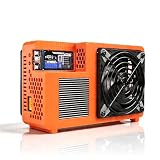
- Professional ASIC Miner for Home: Powered by four advanced BM1370 ASIC chips, this Bitcoin miner delivers a strong 8.0TH/s hashrate with only 170W power consumption. Perfect for solo miner and lottery miner seeking efficient mining at home.
- Two Fans Cooling and Quiet and Home-Friendly: Featuring a two-fan cooling system,this home miner provides superior heat dissipation while maintaining low noise levels.Optimized airflow ensures stable,quiet operation,making this bitcoin miner machine suitable for living rooms,studies,or small home mining environments.
- Plug-and-Play Bitcoin Miner Kit:This all-in-one bitcoin miner kit supports true plug-and-play operation and runs fully independently.With built-in 2.4G Wi-Fi, it connects easily to your network and starts mining crypto currency within minutes—no external controller required.
- Wide Compatibility for Crypto Currency Miners: The bitcoin miner machine (btc miner) supports BTC (Bitcoin) and other SHA-256 coins (BCH, BSV, NMC, XEC, PPC, FB), making it a versatile choice for crypto currency miners. As a complete bitcoin miner kit, it lets you switch coins freely to maximize earnings without extra equipment.
- Beginner-Friendly Nerdminer Design: Built on an open-source Bitaxe platform, this nerdminer features a simple web-based interface for easy setup and monitoring. Whether you are new to mining or upgrading your setup, it is an excellent choice for anyone exploring BTC solo miner solutions.
What maintenance does an air-cooled Antminer S21 require?
The S21’s routine maintenance is concentrated around airflow: dust removal, fan inspection, connection inspection, and corrosion checks. Maintenance frequency depends on dust, humidity, insects, smoke, and the cleanliness of the installation, so a fixed interval should not be treated as a BITMAIN warranty requirement.
- Power the miner down and disconnect it before cleaning or opening any part of the installation.
- Use electronics-safe compressed air or an electric blower to remove dust from fans, heatsinks, and air paths.
- Prevent fans from spinning excessively during cleaning, and never introduce moisture into the chassis.
- Inspect fans for abnormal noise, wobble, scraping, or inconsistent speed; replace a failing fan with a part compatible with the exact S21 revision.
- Inspect power connectors and cables for discoloration, looseness, heat damage, or corrosion.
- Check intake and exhaust paths for blocked filters, dust buildup, or exhaust recirculation.
- Review hashrate, temperature, fan speed, rejected shares, and power readings after maintenance.
The independent 2026 S21 ownership review discusses dust removal, fan replacement, connection inspection, and corrosion as practical service concerns. Those recommendations describe maintenance practice, not a promise that a particular S21 will last for a specified period or remain covered under every warranty condition.
Independent reader supportYour contribution helps us test, update, and keep practical guides available for everyone.Should you use third-party firmware or overclock the S21?
Use the manufacturer configuration first; third-party firmware, autotuning, undervolting, and overclocking are advanced options that can change thermals, stability, power draw, security exposure, and warranty status.
Undervolting or autotuning may be attractive when electricity cost is the primary constraint, but an efficiency result reported for one unit and firmware combination is not guaranteed for another. Overclocking generally raises power and heat and can reduce operating margin. A setting that appears stable in a cool test environment may fail when intake temperature rises.
Before installing third-party firmware, verify current support for the exact S21 hardware and firmware revision, licensing terms, update process, recovery method, security model, and warranty implications. Keep a known-good stock firmware path and record the original configuration. The independent firmware discussion provides context for these options but does not turn a third-party result into a manufacturer specification.
For most buyers, monitoring and airflow improvements are safer first steps than firmware tuning. Establish a stable stock baseline, measure the wall rather than relying only on software estimates, and change one variable at a time if advanced tuning is necessary.
Is the Antminer S21 profitable?
No universal profitability verdict is defensible without the buyer’s electricity rate and current mining conditions. The S21 is potentially attractive with low-cost electricity and existing infrastructure, while ordinary residential electricity rates and new installation costs can overwhelm mining revenue.
At the rated 3,500 W load, the S21 uses approximately 84 kWh per 24 hours before accounting for the manufacturer’s ±5% wall-power tolerance. A credible calculation must combine all of the following:
| Input | Why it changes the result |
|---|---|
| Electricity price per kWh | Determines the largest recurring operating expense for a 3,500 W machine. |
| Current Bitcoin price and network conditions | Mining revenue changes with market price, network difficulty, and block economics. |
| Pool fee | Reduces the amount of mined revenue retained by the operator. |
| Miner purchase price | Changes the capital cost and any break-even calculation. |
| Shipping, taxes, and import costs | Increase the delivered acquisition cost. |
| Downtime and repairs | Reduce the time the miner earns revenue and can add service costs. |
| Electrical and ventilation infrastructure | Adds real cost when the site lacks a suitable circuit, exhaust path, or temperature control. |
| Hosting or facility fees | Can make professional deployment practical but reduces net revenue. |
A simple operating-cost starting point is 3.5 kW × 24 hours × electricity price per kWh. Net economics then subtract pool fees, downtime, repairs, hosting, and the capital cost of the miner and infrastructure. A daily-profit figure without a date and these assumptions is not a reliable buying recommendation. The independent business and profitability discussion likewise treats profitability as dependent on electricity, market, network, and operating inputs.
| Buyer situation | Reasonable conclusion | Main risk |
|---|---|---|
| Low electricity cost with suitable power and ventilation already installed | The S21’s 17.5 J/TH rating can make it a credible SHA-256 mining option. | Bitcoin price and network difficulty can still change economics quickly. |
| Ordinary residential electricity with no existing infrastructure | Often economically unattractive after electricity and installation costs. | The effective cost is much higher than the miner’s sticker price. |
| High electricity cost or severe noise restrictions | Do not assume home mining will work; compare hosting or do not purchase. | Electricity, heat, and noise can remain problems even when hashrate is nominal. |
| Buyer focused only on the highest hashrate | Compare newer or more efficient models rather than assuming 200 TH/s is automatically best. | A higher hashrate can carry higher power and infrastructure costs. |
Is hosting better than running the S21 at home?
Hosting or colocation can be the more practical route when a buyer lacks high-voltage power, heat removal, acoustic tolerance, or suitable space. Hosting does not guarantee profitability; it exchanges some home-installation problems for recurring service fees, contract terms, transport risk, and dependence on a third party.
Readers considering Antminer S21 hosting should compare the provider’s electricity rate, fee structure, uptime policy, repair process, insurance and liability terms, cooling design, network access, contract length, withdrawal conditions, and treatment of hardware failures. The provider should also confirm compatibility with the exact S21 model and PSU rather than quoting a generic ASIC rate.
Home deployment makes more sense when the circuit and ventilation already exist and the marginal electricity cost is favorable. Hosting makes more sense when professional infrastructure costs less than building and operating an appropriate site. The correct comparison includes the full delivered cost in both cases.
What should you check before buying an Antminer S21?
Use this checklist before paying for any standard S21 listing:
- Exact variant: Confirm standard air-cooled S21 rather than Pro, Hydro, Immersion, Slim, or another S21-family model.
- Hashrate: Confirm the advertised 200 TH/s rating and remember that BITMAIN allows actual hashrate to fluctuate by ±3%.
- Power: Confirm 220–277V AC input, the 20A specification, the 4,000 W adapted-output requirement, and the local installation plan.
- PSU: Verify whether the recommended 3,600 W-class Bitmain APW17 supply is included and confirm the exact PSU revision.
- Connector: Verify the P13-style power connection and included cable; do not assume an older C13/C14 cable works.
- Condition: Establish whether the unit is new, used, refurbished, or previously overclocked.
- Seller and terms: Check seller reputation, warranty scope, return policy, shipping, taxes, and who pays return freight.
- Site: Confirm the circuit, grounding, Ethernet connection, intake, exhaust, dust control, and temperature monitoring before delivery.
- Noise: Plan for approximately 73–76 dB at one meter rather than treating the miner as a quiet appliance.
- Economics: Calculate electricity, pool fees, downtime, repairs, hosting, taxes, and infrastructure using current inputs.
- Recovery: Know how the unit will be serviced, reflashed, returned, or replaced if it fails.
Checking the PSU and P13 cable is especially important because a low purchase price can conceal missing power hardware or an installation that cannot safely use the unit. Electrical work, ventilation, and noise treatment should be included in the budget before comparing miner prices.
Who should buy the Antminer S21?
The Antminer S21 is a strong candidate for an operator with low-cost electricity, a suitable 220–277V installation, reliable Ethernet, industrial heat removal, and a location where approximately 75 dB noise is acceptable. The S21 is not a sensible plug-and-play purchase for a typical home user who has only a 120V outlet and a spare room.
Buyers without suitable infrastructure should compare a professional hosting facility, a newer or more efficient ASIC, or lower-power equipment. A lower-power miner may produce less hashrate, but it may be easier to deploy and cheaper to operate once electrical and cooling constraints are included.
Crashes, No Sound, or Screen Glitches?
Random freezes, missing sound and display glitches usually trace back to one bad driver. Find and replace yours safely.Free scan · under a minutePC Slower Than It Used to Be?
A free scan shows the junk files, broken settings and background clutter dragging Windows down - then fixes them in one click.Free scan · Windows 10 & 11For buyers who can meet the infrastructure requirements, the standard S21’s 200 TH/s and 17.5 J/TH ratings remain compelling for its class. For buyers who cannot meet those requirements, the same 3,500 W power draw, heat output, and noise level are reasons to stop before ordering rather than problems to solve after delivery.
The Bottom Line
Bottom line: The standard air-cooled Antminer S21 is an efficient, high-performance SHA-256 ASIC, but it is infrastructure-heavy. Treat the 200 TH/s and 17.5 J/TH figures as qualified manufacturer ratings, budget for continuous 220–277V power and roughly 3.5 kW of heat, and calculate profitability from current electricity and mining conditions before buying.

