
The Threadripper 1900X is still a specialized buy, not a default gaming recommendation. Its eight cores and 16 threads remain useful for encoding, compiling, streaming, and workstations that need 64 PCIe lanes and quad-channel memory. The trade-offs are substantial: an X399/TR4 motherboard, a capable TR4 cooler, high platform cost, 180W processor power, and NUMA/cache behavior that can reduce its appeal for lightly threaded software. In the hands-on system tested for this review, DDR4-3200 and a moderate overclock improved encoding, but memory beyond 3200 did not.
What the Ryzen Threadripper 1900X is
AMD launched the 1900X on August 31, 2017, with a suggested price of $549. That is a historical launch price, not a current street-price guarantee.
| Specification | 1900X detail | Source and qualification |
|---|---|---|
| CPU configuration | 8 cores, 16 threads | AMD launch specification |
| Frequencies | 3.8 GHz base, up to 4.0 GHz boost, up to 4.2 GHz XFR | AMD launch specification; boost and XFR depend on workload, temperature and firmware |
| PCI Express | 64 PCIe 3.0 lanes | AMD launch specification |
| Memory | Quad-channel DDR4; DDR4-2666 support; ECC UDIMMs supported; up to 512 GB reported | Tom’s Hardware and TechSpot historical product data; motherboard and DIMM support still apply |
| Cache | 4 MB L2 and 16 MB L3 | TechSpot historical product database |
| Process and graphics | 14 nm; no integrated graphics | TechSpot historical product database |
| Socket and chipset | Socket TR4 with X399 | Tom’s Hardware |
| Thermal design power | 180 W | AMD launch specification |
| Box contents | No boxed cooler | TechSpot historical product database |
The chip uses two dies, with one four-core CCX active on each die. That arrangement preserves the platform’s large I/O budget but leaves 16 MB of shared L3 active. AMD’s Game Mode can disable one die and expose a four-core/eight-thread configuration, reducing die-to-die latency for software that benefits from a simpler topology.
The tested system and method
Paratus’s semi-formal forum review used a self-built system consisting of an MSI X399 Gaming Pro Carbon AC motherboard, an Enermax Liqtech TR4 360 liquid cooler, 32 GB of DDR4-3200 and a Vega 56 graphics card. The test plan varied CPU clocks and DDR4 speeds, then measured:
The Tool Desk
Outbyte Driver Updater FREEScan for outdated or missing drivers - takes under a minuteDriver Scan →Outbyte PC Repair FREEClear out junk files and repair common Windows errorsFree Scan →#1 Best Overall

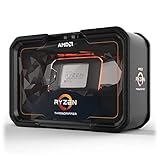
- Incredible 8 Cores and 16 Threads of processing power
- 4.0 GHz Precision Boost (up to 4.2 GHz with XFR)
- 20MB of Cache Memory
- 64 PCIe Gen3 Lanes
- Quad-Channel DDR4
- Prime95 stability and temperature behavior
- CPU-Z and Cinebench R15 processor performance
- 3DMark Fire Strike and Time Spy
- HandBrake H.265 video encoding
Because this is one configuration and one processor sample, its temperatures, acoustics and overclock should be treated as evidence from that build rather than a guarantee for every 1900X.
Stock thermals, power and noise
| Measurement | Observed result | Context |
|---|---|---|
| Prime95 CPU temperature | About 67.8 °C Tdie | Stock settings in the reviewed system |
| Peak whole-system power | About 262 W | Measured for the complete Vega 56 system, not the CPU alone |
| Acoustics | About 45 dB | Specific cooler, fan curve, case and graphics card used in the review |
Those figures show why cooler selection matters. The processor has no bundled heatsink, and a buyer must choose a cooler explicitly rated for the large TR4 heat spreader. A generic AM4 mounting kit is not enough unless the cooler manufacturer confirms TR4 coverage.
What memory speed changed
DDR4-2133 to DDR4-3200
In the HandBrake H.265 run, moving from DDR4-2133 to DDR4-3200 cut encode time by about 4 percent. That is a measurable gain for a machine that encodes frequently, although it is not a transformation in every workload.
Rank #2

- Incredible 12 Cores and 32 Threads of processing power
- 4.0 GHz precision boost (up to 4.2 GHz with XFR)
- 38MB of cache memory
- 64 PCIe Gen3 Lanes
- Quad channel DDR4 with support for ECC for reliable throughput
DDR4-3200 to DDR4-3333
Increasing memory from DDR4-3200 to DDR4-3333 produced no measurable HandBrake improvement in the forum test. DDR4-3200 was therefore the practical point of diminishing returns for that workload and sample.
Overclocking results and limits
4.0 GHz target
Tom’s Hardware reported a stable 4.0 GHz overclock with DDR4-3200. A fixed all-core 4.0 GHz setting can, however, give up the processor’s 4.2 GHz XFR behavior in lightly threaded work, so an overclock is not automatically faster in every application.
4.1 GHz and the tested 4.15 GHz run
Tom’s Hardware could not stabilize 4.1 GHz on its sample. In the forum system, raising the clock to 4.15 GHz reduced HandBrake encode time by about 9 percent. That result demonstrates the potential benefit for sustained all-core encoding, but it should not be read as a guaranteed, daily-stable setting for every chip; voltage, cooling, firmware and silicon quality determine the limit.
Rank #3
- Game, Stream, and Create with 12 Cores and 24 Processing Threads
- Incredible 4.3 GHz Max Boost Frequency, with a huge 38MB Cache
- Unlocked, with automatic overclocking via the new Precision Boost Overdrive (PBO) feature
- Quad-Channel DDR4 and 64 PCIe lanes, the most bandwidth and I/O you can get on Desktop Processor
- 180W TDP, CPU Cooler Not Included
Encoding, streaming and production workloads
The 1900X’s 16 threads suit parallel workloads. The measured HandBrake gains show that CPU frequency mattered more than moving from DDR4-3200 to DDR4-3333 in this test. AMD’s launch description specifically targeted rendering, high-quality game streaming, encoding, compiling and encryption performed in parallel.
This review did not report a separate live-stream frame-rate or dropped-frame experiment. It supports the narrower conclusion that the 1900X is a capable CPU encoder and multitasking processor when properly cooled, not a universal claim about every streaming preset or graphics card.
Motherboard, cooler and memory requirements
Motherboard
You need an X399 motherboard with Socket TR4 firmware support. The platform’s value comes from its I/O: up to 64 PCIe 3.0 lanes can serve multiple graphics cards, capture hardware, add-in controllers and several NVMe devices without the lane constraints of mainstream desktop platforms.
Rank #4

- 24 Cores and 48 Processing Threads for Professional Processing Power
- Incredible 5.3 GHz Max Boost Frequency, with a huge 152MB Cache
- Unlocked, with automatic overclocking feature
- Quad-Channel DDR5 RDIMM support up to 1TB, and 80 usable PCIe lanes for serious bandwidth and I/O
- 350W TDP, Cooler Not Included
Cooling
Choose a cooler with a genuine TR4 mounting system and coverage for the Threadripper heat spreader. The reviewed Enermax Liqtech TR4 360 is evidence of the class of cooler used in testing, not a requirement to buy that exact model.
Memory
Populate the board’s four memory channels with a matched DDR4 kit. ECC UDIMM support and the reported 512 GB ceiling depend on the motherboard’s validated memory list and firmware, so confirm those details before building a workstation.
Graphics and storage
Because the CPU has no integrated graphics, a discrete graphics card is required. Its lane budget is most useful when the system actually contains multiple GPUs, capture cards, high-speed storage or other PCIe devices; a single-GPU, single-drive build leaves much of the platform advantage unused.
Best Value

- This Certified Refurbished product is tested and certified to look and work like new. The refurbishing process includes functionality testing, basic cleaning, inspection, and repackaging. The product ships with all relevant accessories, a minimum 90-day warranty, and may arrive in a generic box. Only select sellers who maintain a high performance bar may offer Certified Refurbished products on Amazon.com
- Incredible 16 Cores and 32 Threads of processing power
- 4.0 GHz Precision Boost (up to 4.2 GHz with XFR)
- 40MB of Cache Memory
- 64 PCIe Gen3 Lanes
1900X versus mainstream Ryzen 7
The meaningful comparison is the complete platform, not just core count. Exact Ryzen 7 model benchmarks and prices were not established in the cited material, so the table avoids inventing numerical differences.
| Decision area | Threadripper 1900X/X399 | Mainstream Ryzen 7/AM4 context |
|---|---|---|
| Platform cost | Higher: X399 board and TR4-class cooling are required | Tom’s Hardware recommends cheaper AM4 parts for strictly gaming systems; exact prices vary by model and date |
| PCIe connectivity | 64 PCIe 3.0 lanes, suited to several expansion devices | Exact lane counts depend on the Ryzen 7 model and AM4 motherboard; not stated in the cited material |
| Memory topology | Quad-channel DDR4 | Exact channel and bandwidth comparison was not stated in the cited material |
| Heavy parallel work | Eight cores/16 threads with Threadripper I/O; useful for encoding, rendering and compiling | Exact benchmark deltas were not stated; choose by the software and platform features you need |
| Lightly threaded and gaming work | NUMA and die-to-die latency can complicate optimization; Game Mode can expose four cores/eight threads | AM4 is the simpler, lower-cost choice for a primarily gaming build according to Tom’s Hardware |
| Upgrade path | Bound to the older TR4/X399 ecosystem | Exact upgrade comparison was not stated in the cited material |
Who should still consider one?
A sensible fit
- You need many PCIe lanes for GPUs, capture cards, storage controllers or several NVMe drives.
- Your workload keeps many CPU threads busy for long periods, such as H.265 encoding, rendering, compiling or encryption.
- You can buy the complete TR4 platform at a price that reflects its age and have appropriate cooling.
A poor fit
- Your priority is gaming with one graphics card and ordinary storage.
- You would need to purchase an expensive X399 board and cooler solely to obtain eight cores.
- You cannot provide a discrete graphics card or adequate TR4 cooling.
The practical verdict is conditional: the 1900X makes sense as an I/O-heavy workstation or an inexpensive used-platform project, but a mainstream AM4 Ryzen system is the more rational starting point for a gaming-first computer. The $549 launch price should not be used as a current buying target; check the complete CPU, motherboard and cooler cost together.
Scope of this first part
This part documents the platform, the reviewed system and the reported scaling behavior. The measured numbers are valuable for understanding trends—especially the modest memory gain and larger clock gain in HandBrake—but they are not a replacement for testing your own application, motherboard firmware, cooling setup and processor sample.
Quick Recap
Product prices and availability are accurate as of the date/time indicated and are subject to change. Any price and availability information displayed on Amazon at the time of purchase will apply.
Quick wins for a faster PC:
Fix the driver behind crashes, sound loss and screen glitchesFind Drivers →Repair Windows errors before they cause bigger problemsFix Now →Scan for outdated or missing drivers - takes under a minuteDriver Scan →
