
Crashes, No Sound, or Screen Glitches?
Random freezes, missing sound and display glitches usually trace back to one bad driver. Find and replace yours safely.Free scan · under a minutePC Slower Than It Used to Be?
A free scan shows the junk files, broken settings and background clutter dragging Windows down - then fixes them in one click.Free scan · Windows 10 & 11Short answer: the Radeon RX 9070 GRE is not consistently faster than the RX 7900 GRE. In TechSpot’s 15-game raster suite, both cards averaged 84 fps at 1440p and 48 fps at 4K. The 9070 GRE wins some games, ties in others and loses in others, so “a bit better” describes selected results rather than an overall generation-wide lead.
What the independent benchmarks show
The fairest comparison is between cards tested in the same games, at the same settings and on the same test system. TechSpot’s 2026 15-game raster average puts the two Radeon models at parity:
| GPU | 1440p raster average | 4K raster average |
|---|---|---|
| Radeon RX 9070 GRE | 84 fps | 48 fps |
| Radeon RX 7900 GRE | 84 fps | 48 fps |
Those are TechSpot’s results, not a claim that every game will produce the same ordering. The newer card’s game-level results move in both directions, which is why the suite average matters more than a cherry-picked win.
Against the standard RX 9070 and RTX 5070
In the same TechSpot suite, the RX 9070 GRE was approximately 5% behind the GeForce RTX 5070 at 1440p and 6% behind it at 4K. It was 16% behind the standard RX 9070 at 1440p and 17% behind at 4K. These percentages apply only to that test suite and its conditions.
Recommended Free Tools
#1 Best Overall
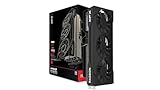
- Chipset: AMD RX 9070 GRE
- Memory: 12GB GDDR6
- XFX Sift Triple Fan Cooling Solution
- Boost Clock: Up to 2790 MHz
A separate Tom’s Hardware test averaged 120 fps at 1080p and 86.6 fps at 1440p across 11 rasterized games. Because the game selection and test platform differ, those figures should not be combined with TechSpot’s averages or treated as a consensus benchmark.
Which resolution is the RX 9070 GRE for?
1080p high refresh
The Tom’s Hardware average indicates that the card is well suited to high-refresh 1080p, particularly when your monitor runs at 144 Hz or faster. Actual headroom depends on the game, CPU, presets and whether ray tracing is enabled.
Rank #2

- System Compatibility Note: 2.5-slot card, 290x123x51mm, two 8-pin power, recommended 700W PSU. Verify chassis clearance before purchase.
- Dedicated Support: Please contact us directly through Amazon for any product questions or assistance you may require.
- AMD RDNA 4 Architecture: RX 9070 GPU with 56 CUs, 3584 stream processors, 3rd gen RT and 2nd gen AI accelerators – built for 1440p/4K gaming.
- Factory Overclocked Performance: Boost clock up to 2520 MHz, game clock 2070 MHz – delivers smooth, high-framerate gaming out of the box.
- 16GB GDDR6 on 256-Bit Bus: High-speed 20 Gbps memory provides exceptional bandwidth for 4K textures, ray tracing, and demanding workloads.
1440p
1440p is the card’s most natural target. The independent 1440p results show strong raster performance, but the 12GB frame buffer can become a constraint in demanding games using high-resolution textures or heavy ray-tracing effects.
4K
At 4K, TechSpot measured 48 fps on average in its raster suite. That is playable with sensible settings and upscaling, but it is not the same as guaranteeing a locked 60 fps in every new release.
Rank #3

- Chipset: AMD RX 9070 XT
- Memory: 16 GB GDDR6
- XFX SWFT Triple Fan Cooling Solution
- Boost Clock Up to 2970 MHz
Ray tracing changes the decision
Raster performance and ray-tracing performance should be judged separately. Tom’s Hardware specifically cautioned that the RX 9070 GRE’s cut-down GPU and 12GB of VRAM can hold it back in ray-traced gaming above 1080p. If you regularly use path tracing, demanding reflections or ultra ray-tracing presets, expect to reduce settings or use an upscaler sooner than you would with a faster, higher-tier card.
For a mostly raster workload—traditional rendering in competitive games, simulation titles and many modern AAA games—the card’s 1080p and 1440p results are more representative of its strengths.
Rank #4

- OC mode (GPU Tweak III): Up to 2880 MHz (Boost Clock)/ up to 2300 MHz (Game Clock)
- OC mode (GPU Tweak III): up to 2880 MHz (Boost Clock)/up to 2300 MHz (Game Clock) Default mode: up to 2860 MHz (Boost Clock)/up to 2280 MHz (Game Clock)
- Axial-tech fans now feature a smaller fan hub that facilitates longer blades and a barrier ring that increases downward air pressure
- Phase-change GPU thermal pad helps ensure optimal heat transfer, lowering GPU temperatures for enhanced performance and reliability
- 2.5-slot design allows for greater build compatibility while maintaining cooling performance
RX 9070 GRE versus RX 7900 GRE: what actually improved?
- Average frame rate: no gain in TechSpot’s 15-game average: 84 fps at 1440p and 48 fps at 4K for both cards.
- Game-by-game behavior: the 9070 GRE wins some titles, ties some and trails in others.
- Feature generation: the 9070 GRE is a newer design, but newer branding does not guarantee a higher raster average.
- Memory capacity: the 12GB configuration remains a practical consideration for ray tracing and future high-resolution workloads.
If you already own an RX 7900 GRE, the benchmark evidence does not show a straightforward upgrade. A replacement makes more sense when you need a new card, find the 9070 GRE at a substantially better local price, or value its newer platform features.
Independent reader supportYour contribution helps us test, update, and keep practical guides available for everyone.How it compares as a purchase
| Alternative | What the evidence says | Best fit |
|---|---|---|
| RX 7900 GRE | Statistical tie with the 9070 GRE in TechSpot’s raster average. | Buy whichever is better priced and available; upgrading solely for average fps is difficult to justify. |
| RX 9070 | About 16% faster at 1440p and 17% faster at 4K in TechSpot’s suite. | Gamers who can pay for more performance or want more 4K headroom. |
| RTX 5070 | About 5% faster at 1440p and 6% faster at 4K in TechSpot’s raster suite. | Compare local pricing and prioritize this option if your workload emphasizes ray tracing or NVIDIA-specific features. |
No current retailer price or stock position was established by these reviews. The FPS Review reported a $549 MSRP for global availability beginning in June 2026, after an earlier China-only release, and identified XFX Swift and Sapphire Pulse examples. That is launch context, not a current street price; verify the exact board-partner model, region and warranty before buying.
What AMD’s published figures mean
AMD’s product page lists selected 1440p Ultra game figures. They are manufacturer-published results, so treat them as AMD’s advertised measurements rather than independent confirmation. Differences in drivers, CPUs, settings and game versions can materially change results.
Bottom line for buyers
The RX 9070 GRE is a competent high-refresh 1080p and 1440p raster card, but the available evidence does not support calling it broadly faster than the RX 7900 GRE. TechSpot found exact average parity, while Tom’s Hardware found strong absolute performance in a separate suite. Choose it when its local price and availability are compelling, you mainly play rasterized games, and 12GB of VRAM is sufficient. Step up to the RX 9070 for meaningful extra performance, and compare the RTX 5070 carefully if ray tracing is a major priority.
Quick Recap
Product prices and availability are accurate as of the date/time indicated and are subject to change. Any price and availability information displayed on Amazon at the time of purchase will apply.

