
For a compact USB-C or laptop adapter, GaN is usually the best fit: it can switch quickly and reduce switching losses, helping designers make high-power chargers smaller and lighter. Silicon remains a sensible low-cost choice for simpler, lower-power adapters. SiC is generally aimed at high-voltage, high-power equipment such as fast EV chargers—not ordinary wall adapters.
How do silicon, GaN and SiC differ in an AC adapter?
These materials are used in power-conversion switches. Their properties affect how a designer balances size, efficiency, heat, voltage capability and cost. The material alone does not determine how cool or efficient a finished adapter will be: circuit design, components, enclosure and cooling all matter too.
| Technology | Where it makes sense | Main advantage | Trade-off or limit |
|---|---|---|---|
| Silicon (Si) | Simple, low-to-moderate-power adapters where compact size is not the priority | Mature, widely manufactured and generally the least expensive option | Typically less suited than GaN to very compact, higher-power designs; exact size and efficiency depend on the implementation. |
| Gallium nitride (GaN) | Compact USB-C and laptop adapters | High switching speed can reduce switching losses and the size of magnetic components, supporting smaller, lighter designs. | A GaN label does not establish a particular adapter’s sustained-load temperature, efficiency at everyday loads, port behavior or safety. |
| Silicon carbide (SiC) | High-voltage, high-power applications, including some EV charging equipment | High voltage capability and stronger thermal conductivity than ordinary silicon make it useful under demanding power and thermal conditions. | Its advantages are generally not needed in an ordinary consumer USB-C adapter; SiC substrate cost and integration complexity can be higher. |
Should you buy a GaN charger?
Choose GaN when you want substantial charging power in a compact travel adapter, particularly for a laptop or for one charger shared across devices. Power Integrations describes its PowiGaN switches as replacing primary-side silicon transistors to reduce switching losses and enable more efficient, smaller and lighter supplies. Its USB-PD adapter documentation reports up to 95% efficiency across the full load range and enclosed adapter implementations up to 100 W. These are vendor-reported figures for its solutions, not a guarantee for every GaN charger.
Texas Instruments reports that its TIDA-050074 140 W reference design achieved greater than 94% efficiency at 115 VAC and greater than 95.5% at 230 VAC, with a power density of 27.33 W/in³. Those figures describe that specific reference design. TI also says its GaN technology can enable consumer AC/DC solutions up to 50% smaller with system efficiency exceeding 95%; that is a technology-page claim, not a promise that any particular retail charger will be that much smaller.
#1 Best Overall

- Faster & Cooler Choice: This UGREEN USB C Charger Block supports a max power transmission of 30W. Within 30 minutes, it can charge your iPhone 17 or Galaxy S26 to about 60%. Not only that, the Always-On Temperature Detection also ensures that it will not overheat during the fast charging process.
- Spend Less, Charge More: This USB C Charger has 3 interfaces, including 2 USB C and 1 USB A interface, which ensures its wide compatibility and can be used with different devices. You can charge three of your devices at the same time. Just enjoy the convenience of multiple interfaces.
- Real safety is safe inside and out: The charger features an upgraded GaN II chip, offering efficient heat dissipation and faster response to over-voltage, over-current, and short-circuit protection. Its housing is made of flame-retardant matte PC material, ensuring complete safety both inside and out for this compact charger.
- Compact and lightweight: This charger easily fits into your bag or pocket, making it perfect for travel, office, or daily carry. Its small size doesn’t just save space — it also keeps your desk tidy, reduces clutter, and lets you charge multiple devices anywhere without hassle.
- Multi-Protocol Charging: Supports PD, QC, and PPS fast-charging protocols. Tip: When using multiple ports simultaneously, single outputs up to 15W. For original Mag Safe accessories, use a single port.
If a larger, lower-cost adapter is acceptable and the power requirement is modest, silicon may be the more economical choice. SiC is not an automatic upgrade for a USB-C wall charger: its particular strengths matter most in higher-power, higher-voltage equipment.
Do you need SiC for an AC adapter?
For a normal phone, tablet or laptop charger, usually not. SiC is more relevant where high voltage, high power and thermal stress make its properties valuable, such as fast EV charging. Microchip Technology’s Wayne Liang described GaN as well suited to exceptionally high switching speeds and SiC as particularly useful in high-power applications such as EV motors and fast EV chargers in a technical blog dated 18 July 2024.
Rank #2
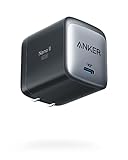
- The Only Charger You Need: Say goodbye to your old power bricks. Anker 715 Charger (Nano II 65W) has the power you need to fast charge your phone, tablet, and USB-C notebook from a single tiny charger.
- High-Speed Charging: Charge a 2020 MacBook Air in less than 2 hours, a MacBook Pro 13ʺ at full speed, an iPhone 13 up to 3× faster than with an original 5W charger, and charge the latest Samsung phones at full speed with Samsung Super Fast Charging.
- Downsized Design: At 58% smaller than an original 61W USB-C charger, and with a foldable plug, Anker Nano II takes up less space while giving you just as much power.
- Powered by GaN II Technology: With a 100% increase in operating frequency, an innovative stacked design, and an upgraded circuit board structure, GaN II technology makes our latest charger smaller without sacrificing a drop of power.
- What You Get: Anker 715 Charger (Nano II 65W) / Anker Nano II 65W, welcome guide, our worry-free 18-month warranty, and friendly customer service (cable not included).
There is also an important materials distinction: GaN devices can be made on different substrates. Infineon reports approximate substrate thermal conductivity of 150 W/m·K for GaN-on-Si and 370–490 W/m·K for GaN-on-SiC. These substrate figures do not mean that every GaN-on-SiC consumer adapter will run cooler; product temperature depends on the complete design, and Infineon notes the higher SiC substrate cost and more complex integration.
Independent reader supportYour contribution helps us test, update, and keep practical guides available for everyone.What wattage USB-C charger do you need for a laptop?
Start with the laptop’s required USB Power Delivery (USB-PD) wattage and voltage profile, rather than choosing by semiconductor label. For example, a 65 W laptop may require a 20 V, 3.25 A profile. Confirm the exact requirement for your laptop; a charger’s advertised maximum wattage is not enough if its output profiles do not match what the device needs.
Rank #3

- Ultra-Compact USB C Charger: Experience the power of GaN technology with this 30W Anker 5Charger (Nano 3), delivering 70% smaller size than original chargers while maintaining high-speed charging for devices like iPhone 15/Pro/Pro Max/Pro/Pro Max, Galaxy, and iPad.
- Versatile USB C Charging Solution: Designed for various devices, this USB C charger can power up earbuds, phones, tablets, and even MacBook Air, making it a must-have accessory for all your charging needs.
- Fast and Efficient Charging: With 30W output, this USB C charger provides full-speed charging for iPhone Pro and Pro Max, charges iPad Air (5th Generation) to 50% in just 45 minutes, and supports Samsung Super Fast Charging (25W) for a seamless charging experience.
- Advanced Safety Features: Equipped with ActiveShield 2.0 technology, this USB C charger intelligently monitors temperature over 3 million times per day, offering twice the protection of ActiveShield 1.0 and ensuring the safety of your devices during charging.
- Comprehensive Package: The Anker 511 Charger (Nano 3, 30W) comes with a welcome guide, a worry-free 24-month warranty, and friendly customer service (cable not included), making it a reliable and convenient choice for all your USB C charging needs.
For a phone, the required power may be much lower. If one adapter will serve several devices, check how much power it can deliver when multiple ports are used at once. A charger that advertises a high single-port maximum may allocate less power to each output during simultaneous charging.
Quick Recap
Best Value
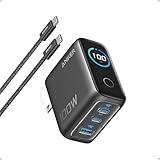
- Full-Speed 100W Max Power: Advanced GaN technology delivers a steady 100W output on any USB-C port and sustains peak performance up to twice as long compared to the average 100W charger.
- See Charging in Motion: The high-definition smart display shows real-time details on charging status, temperature, and port performance, giving you instant visibility and control.
- Travel-Sized for Daily Carry: With a foldable plug and a 330% smaller frame, it measures just 2.72 x 2.17 x 1.34", making it easy to slip into a backpack, shoulder bag, or even a coat pocket.
- Adapts to Low-Power Devices: USB-C2 or USB-A automatically switches to 95W + 5W Low-Current Mode when output remains at or below 5W for 1 minute, safely charging earbuds and other low-power devices.
- What You Get: Anker Charger (100W, 3 Ports, Smart Display, Non-Battery), 4.9 ft USB-C to USB-C cable, welcome guide, 18-month warranty, and our friendly customer service.
Rank #4

- Fast charging: 65-watt USB Power Delivery PD 3.0 for high-speed charging of compatible devices, like iPhone, iPad Pro, Samsung Galaxy, MacBook Air, MacBook Pro, and more
- GaN technology: GaN components waste less power and produce less heat (compared to silicon), which results in a more efficient charge
- Compact size: small but powerful thanks to innovative GaN technology; design includes a foldable plug for travel-friendly portability
- Safety features: integrated over-voltage, overheating, and short-circuit protection to keep connected devices safe
- No PPS support: Charging for Samsung / Google Pixel phones is limited at 9V max. and will NOT achieve Super Fast Charging speeds.
How to compare actual adapters
- Match output requirements. Check the device’s USB-PD wattage and voltage profiles. For a 65 W laptop, one possible requirement is 20 V at 3.25 A; verify the laptop’s own specifications.
- Check real-world size and heat. GaN often helps when a given wattage must fit a small enclosure, but look for sustained-load temperature reviews of the specific model. The semiconductor label by itself does not tell you how well the enclosure handles heat.
- Look beyond peak efficiency. Prefer measurements at 25%, 50% and 100% load, plus no-load standby consumption, over a single peak figure. IEA 4E’s 18 March 2024 report says its charger measurements covered different load conditions and found maximum efficiency generally at higher power. Efficiency at a high load therefore may not represent performance when charging a small device.
- Check ports and cables. Count the USB-C and USB-A ports, confirm the cable’s current rating is suitable, and check whether using two or more outputs reduces the power available to each.
- Verify protection and support. Confirm regional safety marks, over-temperature and over-current protection, warranty terms and the seller’s return policy.
Product prices and availability are accurate as of the date/time indicated and are subject to change. Any price and availability information displayed on Amazon at the time of purchase will apply.

