
Crashes, No Sound, or Screen Glitches?
Random freezes, missing sound and display glitches usually trace back to one bad driver. Find and replace yours safely.Free scan · under a minuteWindows Errors? Fix Them Before They Spread
Repair common Windows errors and clear accumulated junk for a smoother, more stable PC - no reinstall needed.Free scan · no reinstallThe STM32F4 is a family of high-performance 32-bit microcontrollers from STMicroelectronics, not a single device with one set of specifications. ST describes the family as Arm Cortex-M4 MCUs with DSP and floating-point instructions; clock speed, memory, peripherals, and package options vary by product line and exact part. The right starting point is the datasheet for the specific ordering code you plan to use.
What the STM32F4 datasheet review tells you
ST organizes STM32F4 into eight compatible product lines spanning entry/access, foundation, and advanced devices. The lines share the family identity but differ in performance, memory, and peripheral integration. That makes “STM32F4” a useful family label, but not enough information to select a component or validate a design.
ST’s family overview gives top-end figures of up to 180 MHz and up to 225 DMIPS / 608 CoreMark for select STM32F4 variants. These are ST-published series maxima, not specifications that apply to every STM32F4, and they should not be read as an independent benchmark comparison. ST attributes the family’s performance to its non-volatile memory technology and ART Accelerator. See ST’s STM32F4 family overview.
What the STM32F405/F407 datasheet specifies
The STM32F405xx/STM32F407xx datasheet covers a particular device group within the wider family. ST specifies this group at up to 168 MHz, with up to 1 MB of Flash and up to 192 KB of SRAM, plus up to 4 KB of backup SRAM. Those are group maxima: check the exact device and ordering code for its actual memory configuration and package.
Recommended Free Tools
#1 Best Overall

- Experience the power of the ARM Cortex M4 with this STM32F411CEU6 Development Board, featuring a blazing fast 100Mhz frequency and zero-wait state access to 512KB ROM and 128KB RAM for seamless programming
- Unlock endless possibilities with the STM32F4 Core STM32F411CEU6 Module System Board, equipped with FPU floating-point unit for efficient calculations and a plethora of interfaces including USART, I2C, SPI, and USBFS for versatile connectivity options
- Dive into the world of embedded systems with this Learning Board, boasting 20 Pin 2.54mm I/O interfaces, 4 Pin 2.54mm SW debugging interface, and user-friendly buttons like KEY (PA0), NRST, and BOOT0 for convenient operation and development
- Stay powered up and connected with the 3.3V-5V power input, 3.3V LDO with a maximum output current of 100mA, and a USB-C interface with built-in diode to prevent power backflow, along with high-speed and low-speed crystal oscillators for reliable performance
- Elevate your programming projects with the STM32F411CEU6 Development Board, featuring a SPI Flash for additional storage options, 12-bit ADC, 12-bit 5 S for accurate measurements, and 32.768K 6pF low-speed crystal oscillator for precise timing control
The datasheet describes a Cortex-M4 with FPU and lists capabilities including USB, timers, ADCs, communication interfaces, and camera features; Ethernet is present on applicable devices. Do not assume that every listed peripheral is included on every F405/F407 part or exposed in every package. Read ST’s STM32F405xx/STM32F407xx datasheet.
How STM32F4 product lines differ
ST’s product selector shows why the family name alone is not a sufficient specification. STM32F407/417 foundation products reach up to 168 MHz, while advanced STM32F4 lines reach up to 180 MHz. Other family lines emphasize different combinations of graphics, external memory, USB, Ethernet, audio, or low-power features. The exact balance depends on the product line and device.
Rank #2

- High-performance foundation line, ARM Cortex-M4 core with DSP and FPU, 512 Kbytes Flash, 180 MHz CPU, ART Accelerator, Dual QSPI
- On-board ST-LINK/V2-1 debugger/programmer with SWD connector
- Can be powered from USB
- Three LEDs, Two Push-buttons
- Support of wide choice of Integrated Development Environments (IDEs) including IAR, ARM Keil, GCC-based IDEs
ST describes STM32F407/417 as intended for medical, industrial, and consumer applications that need integration and performance. That is the manufacturer’s stated application context, not evidence that a specific part is certified or suitable for a particular system. View ST’s STM32F407/417 product page.
What to verify before choosing a part
Use the product selector to narrow the family to candidate ordering codes, then validate the selection against the corresponding datasheet. Compare the actual device and package rather than relying on the family’s headline figures.
Rank #3
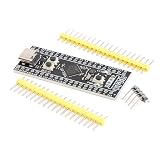
- Frequency up to 84 MHz
- 512 bytes of OTP memory
- Up to 256 Kbytes of Flash memory
- Frequency up to 84 MHz
- STM32F401 development board
- Part identity: Record the full part number, suffix, and package.
- Performance: Check the maximum core frequency for that device; distinguish its stated specification from family-level DMIPS or CoreMark maxima.
- Memory: Confirm Flash, SRAM, and backup SRAM capacities for the selected ordering code.
- Peripherals: Verify each required interface or feature is present on the device and available in its package.
- Design constraints: Compare power, security, external-memory, and display capabilities if the project depends on them.
- Document versions: Check the applicable datasheet revision and errata for the device group.
Browse ST’s STM32F4 product selector; treat it as a way to find candidates, not as a replacement for the matching datasheet.
Independent reader supportYour contribution helps us test, update, and keep practical guides available for everyone.Which ST documents to consult
A datasheet gives device-specific electrical, memory, package, and feature specifications. For implementation details, use the reference manual that covers the device’s peripherals. ST also lists PM0214 for the Cortex-M4 programming model and errata sheets for known device-group issues. Check all documents applicable to the exact part before depending on a peripheral behavior.
Rank #4

- STM32F405RG Development Board ARM STM32F4 USB Programmable MCU Controller STM32 Cortex-M4 System Board
- Identify the complete ordering code and package in the product selector.
- Open the datasheet matching that device or device group and confirm its specifications.
- Consult the relevant reference manual for peripheral operation and configuration.
- Use PM0214 for the Cortex-M4 programming model, and check the applicable errata before relying on device behavior.
ST’s STM32F4 documentation index links the family’s datasheets, reference manuals, programming manual, and errata sheets.
Quick Recap
Best Value

- Ultra-low-power with FPU ARM Cortex-M4 MCU 80 MHz with 1 Mbyte Flash, LCD, USB OTG, DFSDM
- On-board ST-LINK/V2-1 debugger/programmer with SWD connector
- Can be powered from USB
- Three LEDs, Two Push-buttons
- Support of wide choice of Integrated Development Environments (IDEs) including IAR, ARM Keil, GCC-based IDEs
Product prices and availability are accurate as of the date/time indicated and are subject to change. Any price and availability information displayed on Amazon at the time of purchase will apply.
Quick wins for a faster PC:
Clear out junk files and repair common Windows errorsFree Scan →Fix the driver behind crashes, sound loss and screen glitchesFind Drivers →Repair Windows errors before they cause bigger problemsFix Now →
