
DIY generator shoes can turn repeated foot pressure or motion into a small amount of electricity, but they are better suited to demonstrating energy harvesting or powering a small LED or sensor than charging a phone. A practical prototype needs more than a generator element: it also needs circuitry to make the output usable and, if needed, a way to store it.
How a generator shoe works
The basic energy path is footstep → generator → power conditioning → small load or storage. Pressure or motion in the sole drives a generating element. Its electrical output can vary with each step, so a circuit may be needed to rectify it into a usable form and store energy in a capacitor.
There are three main ways a shoe harvests that movement:
- Piezoelectric: Stress on a piezoelectric material produces electrical output. Piezoelectric elements are the most direct route for a small DIY demonstration, though a loose disc is not equivalent to a purpose-designed insole.
- Electromagnetic: Relative movement between a magnet and a coil induces electricity. The moving parts make this approach more mechanically involved to package in a shoe.
- Triboelectric: Repeated contact and separation generate charge through contact electrification and electrostatic induction. A reported footwear system used a full-bridge diode rectifier and load capacitor to condition and collect its output.
Research prototypes also combine these methods. A hybrid design can be more complex than a classroom build, and high voltage alone does not mean a generator can deliver substantial usable power.
What’s actually slowing this PC down?
Pick the symptom - the matching free tool is one click away.
#1 Best Overall

- DIY hand crank generator--made of wood material, funny and creative, which is durable and lasting for use,hand crank generator science kit
- Hand-cranked generator--diy assemble wooden projects for is happy and easy to learn, exercise your practical ability,electrical generator for science project
- Manual generator --manual assembly model, which will help your developmental skills and learning mind,hand crank generator
- Generator science experiment --you can send it to your families and friends as a , they will be happy for this creative and practical product,center pice electricity mini generator
- educational -- DIY hand generator , train your observation capability, thinking and analytical skills, science power generator
A simple DIY demonstration: what you need to build around
A piezoelectric disc or transducer can serve as the generator element in a basic demonstration. Mechanically couple it to a shoe sole or, preferably for an initial test, a removable fixture that can be pressed without modifying footwear. Connect the output to a suitable rectification and storage circuit, then use a small load such as an LED to show that energy has been collected.
This is a prototype concept, not a validated universal parts list. The cited work does not establish a single suitable disc, shoe geometry, wiring arrangement, safe pressure limit, or guaranteed output for a home build. A generic retail disc should not be assumed to behave like an engineered insole.
Rank #2
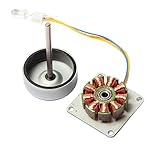
- This is a Micro 3 phase Brushless AC Generator Model
- This is a great way to teach or learn about generating electricity or as an experiment starting place for larger projects.
- Output voltage : 3V-24V; Output current : 0.1A-1A;
- Rated speed : 300-6000 rev/min; Rated power : 0.5-12W;
Build the system in stages
- Start with a removable test fixture. Arrange the generator element so it is mechanically stressed by a press or controlled step without creating a hard spot underfoot.
- Condition the output. The generator’s raw output is not automatically steady DC. A rectifier can direct the output into one polarity; the cited triboelectric footwear design used a full-bridge diode rectifier.
- Collect energy before demonstrating a load. A capacitor can accumulate charge from repeated steps, after which a small load can be connected. The result depends on the generator, circuit, and stepping conditions.
- Check mechanical integration before wearing it. A component in the sole must not create a pressure point or compromise the shoe. The cited studies do not establish general comfort, durability, or long-term-wear performance for DIY modifications.
A regulated output for electronics is a separate engineering step. The cited footwear studies do not validate a simple USB phone-charging circuit for a home-built shoe.
What published prototypes have demonstrated
The figures below come from different designs and test setups. They are not a head-to-head comparison, and modeled results are not measured DIY performance.
Do these 3 things before closing this tab:
1Repair Windows errors before they cause bigger problems2Scan for outdated or missing drivers - takes under a minute3Clear out junk files and repair common Windows errorsRank #3

- This is a multi-functional learning kit,three power generation modes, energy conversion, circuit learning, and understanding of the conversion between sound, light and electricity.
- Solar power generation, using solar panels to convert the solar energy into electrical energy.
- Hand-cranked generator, kinetic energy is converted into electrical energy to light an LED or turn the fan
- The windmill generator,harness wind power and light an LED
- An excellent Family & Kids program,great for Primary and secondary schools projects,With Paper Instructions
| Study or design | Reported result | What the result means |
|---|---|---|
| Turkmen and Celik, modeled PZT-5H and steel-frame shoe design (2018) | 1.43 mW for the specified 90 kg case | A result for that modeled design and case, not a general output estimate. Study |
| Piezoelectric footwear harvester, simulation results (2018) | 14 mW per shoe at 3.0 mph; 20 mW per shoe at 3.5 mph | Simulation values, not measurements from a DIY build. Study |
| Hybrid insole prototype, 43.3 g (Iqbal et al., 2022) | Charged a 100 μF capacitor to 2.4 V in approximately 10 minutes of slow jogging | A specific capacitor-charging demonstration under the reported activity conditions. Study |
| Parallel-link piezoelectric safety-shoe prototype (Asano et al., 2020) | Reported 1.29 mW; a trial powered an LED | A small-load demonstration in that prototype. Study |
| Triboelectric-electromagnetic-piezoelectric hybrid system (Rodrigues et al., 2019) | Reported a 20% increase in charging capacity versus its TENG system alone | A comparison within that study, not a universal improvement for hybrid shoes. Study |
Can shoes charge a phone while you walk?
The cited evidence supports low-power demonstrations and wearable-electronics research, not a promise that a simple DIY shoe can charge a phone. The published examples include an LED powered by a safety-shoe prototype and a capacitor charged during slow jogging. Those results do not establish a practical phone-charging rate or validate a USB charger for an arbitrary build.
Performance depends on the generator design, how well it couples to foot motion, walking conditions, and the electrical load. Treat a shoe harvester as an experiment in converting movement into electricity, rather than a dependable source of everyday charging.
Quick Recap
Best Value

- Educational toys - Through this DIY package, children can exercise their own hands, thinking, exploring, creating ability,Build a toy that light up the LED by hand and the drive motor to learn the principle of conversion between energies.
- Hands on fun - The Hand Cranked Power Generator sets come with complete accessories ,tools and instruction manuals,kids can learn to solve and think about issue while reading the manuals.
- Learn through playing - Kids will learn from the mechanics of the hand-crank generator and how the kinetic energy is used to generate electricity. The Dynamo Lantern is a safe and interactive experience that keeps kids engaged, which makes it one of the most unique electricity learning toys available.
- Safe to play - A great and practical gift for children to enjoy and learn. Popular among schools and teachers for an interactive, hands-on learning experience as well as being one of the safest electricity learning toys in the classroom. Our kids STEM toys contain small parts, not for children under the age of 3.
Rank #4
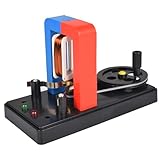
- Educational model - This is an assembled hand-cranked generator model that can be disassembled with tools to give student a better understanding of the model's construction.Through this package, They can exercise their own hands, thinking, exploring, creating ability,Build a project model that light up the LED by hand and the drive motor to learn the principle of conversion between energies.
- Learn through playing - Student will learn from the mechanics of the hand-crank generator and how the kinetic energy is used to generate electricity. The Dynamo Lantern is a safe and interactive experience that keeps student engaged, which makes it one of the most unique electricity learning available.
- Safe to Learn- A great and practical teaching equipment for student to enjoy and learn. Popular among schools and teachers for an interactive, hands-on learning experience as well as being one of the safest electricity learning model in the classroom.
- Hands on fun -The hand crank generator is already assembled and comes with an English manual. After you receive the items, you only need to install the pulley and adjust the brush to use.Student can learn to solve and think about issue while reading the manuals.
- This is an assembled hand-cranked generator model, primarily intended for teachers or middle school students (Recommended Age 14+). It is mainly used for educational demonstrations, showcasing how kinetic energy is converted into electrical energy through our model, and then transformed into light energy via an LED. This process enhances our understanding of textbook knowledge.
What to keep in mind before modifying footwear
- Output is design-specific. Published power figures come from different systems and conditions, so they cannot be ranked as if produced in one controlled comparison.
- Mechanical design matters. Research designs often use structures to transmit or amplify forces within limited shoe space; simply placing a component underfoot does not reproduce those designs.
- Comfort and durability are unproven for a DIY build. The cited studies do not establish universal comfort, safe long-term wear, or durability for modified shoes.
- Use a small, appropriate load. An LED or wearable sensor is a more credible demonstration target than a phone.
Product prices and availability are accurate as of the date/time indicated and are subject to change. Any price and availability information displayed on Amazon at the time of purchase will apply.

