
Roger Mueller’s homemade scanner turns a sequence of 2D photographs into a 3D coin model. It does not measure depth with the camera: a stepper-driven carriage moves the coin along one axis while partially blocked white light casts a profile shadow, and software combines the images into a point cloud and mesh. The approach is a practical maker project, but its results depend on lighting and post-processing, and the project does not report a numerical scan resolution.
How does the scanner make a 3D model from 2D photos?
The scanner uses light sectioning. A white light source is partially blocked so it casts a shadow across the coin. As the carriage moves the coin along the X axis, the camera records successive views of the changing surface profile. The images supply shape information across the other dimensions; no single frame contains a complete 3D scan.
Mueller’s design favors a single mechanical axis as a comparatively straightforward homemade build. He notes that faster and better methods exist, but describes this arrangement as easier to implement. The project’s examples include Swiss, US, and euro coins, rather than a controlled test covering all coin materials or finishes. Mueller’s project page; Hackster.io’s report.
What hardware does the build use?
The project combines a Raspberry Pi 3B+ and Raspberry Pi HQ Camera with a 28YBJ-48 geared stepper motor, ULN2003 driver, LEDs, and linear rails and bearings. Most of the prototype housing is 3D printed. The camera also needs a suitable lens: Mueller tested two CCTV lenses and chose one with decent macro capability.
Outdated Drivers Are Slowing You Down
One free scan finds every outdated or missing driver and matches the right update for your exact hardware.Free scan · exact hardware matchPC Slower Than It Used to Be?
A free scan shows the junk files, broken settings and background clutter dragging Windows down - then fixes them in one click.Free scan · Windows 10 & 11#1 Best Overall

- 360-degree scanning range sensor module for YDLIDAR X4PRO provides accurate and stable ranging with high precision, making it perfect for Arduino Raspberry pi car navigation and obstacle avoidance scanning
- With a wide 10 meters scanning radius, this LiDAR 360-degree 2D laser range scanner is capable of resisting environmental light interference and has low power consumption, small size, and long lifespan, ideal for small car navigation and obstacle avoidance scanning
- The YDLIDAR X4PRO ranging sensor module features a Class I level laser power, adjustable motor speed, and a scanning frequency of 6-12Hz, allowing for high-speed ranging with a frequency of up to 5kHz, perfect for robot navigation and obstacle avoidance
- Whether it's for robot ROS teaching and research, area security, environment scanning, or 3D reconstruction, this LiDAR 360-degree 2D laser range scanner is versatile and suitable for various applications
- This LiDAR 360-degree 2D laser range scanner is designed for high-performance applications, providing a wide range of applications such as robot navigation, obstacle avoidance, and household service robots' navigation and obstacle avoidance
The Raspberry Pi High Quality Camera was announced on 30 April 2020 with a 12.3-megapixel Sony IMX477 sensor and interchangeable C- and CS-mount lens support. Those specifications do not make every lens suitable for coin photography: check mount compatibility, close-focus capability, focus range, and working distance for the intended setup. Raspberry Pi’s announcement listed a $50 launch price for the camera module and lenses starting at $25; those are historical launch prices, not current retail quotes. Raspberry Pi’s announcement.
Mueller’s undated project page estimates that the parts, including the Pi, camera, and lens, cost “a little over $100.” Treat that as the author’s estimate for the build, not a current parts budget; availability and prices may differ now.
Rank #2

- [ 12M TOF Lidar] The FHL-LD19 LiDAR Kit has used the Time-of-flight ranging technology. Using time-of-flight technology, the distance is measured according to the flight time of the laser pulse. Within the effective detection range of 12 m, the radar ranging accuracy will not change with the distance, and the average ranging accuracy of ±45 mm can be achieved.
- [ Resistant to bright light ] 30K lux resistant. It is able to achieve high frequency and high precision distance measurement and accurate map building indoors and outdoors.
- [ 360 all-around laser scanning ] Complete 360-degree silent scanning with up to 10,000 lifespans using a brushless motor.
- [ Walnut Size ] FHL-LD19 lidar sensor only 54*46*35mm size , less than 50g weight ,Lightweight and compact, can be built into the machine.
- [ Widely used ] FHL-LD19 Lidar provide ROS/ROS2/C/C++ SDK and a tutorial for raspberry pi, It can be easily integrated into a robot or drone. Application scenario: home service special commercial service Industrial robot .
How are the photographs processed?
- Capture a sequence: a Python script controls image capture as the coin is moved along the carriage.
- Generate a point cloud: a separate Python program processes the sequence into a set of 3D points.
- Create a mesh: import the point cloud into MeshLab or CloudCompare to form a surface.
- Refine the result: use Blender for additional processing. Mueller presents these scans as a starting point for reverse-engineering coins into CAD surfaces, a task that would require more specialized software.
The camera images therefore are not a finished 3D model by themselves. The reconstruction and cleanup stages are part of the workflow.
Why does lighting affect coverage and detail?
Lighting angle is a tradeoff. A larger incidence angle can improve vertical resolution, but if the light is too steep, some parts of the coin may remain unlit and go unscanned. The project uses adjustable lighting, and its carriage is moved manually. Mueller’s guidance is that “a good compromise is required in order to capture a maximum of the surface in one pass.”
Rank #3
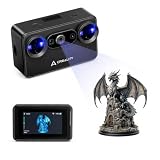
- Pocket-Sized & Wireless Freedom: At only 260g and 1006035mm, Pika fits in your palm. Features Wi-Fi 6 wireless PC mode, 3-inch HD touchscreen (500 nit), dual swappable 3350mAh batteries for extended sessions, and supports outdoor scanning up to 110,000 lux - scan anywhere, anytime without cables
- Dual-Mode Scanning with Blue Laser & NIR Structured Light: Switch between 7-line blue laser mode for fine detail capture and NIR structured light mode for full-body scanning with 24-bit true color. Scan objects from 101010mm to 200020002000mm - from tiny miniatures to life-size body scans - all with one device
- Ultra-High Precision 0.03mm Accuracy: Equipped with 7 parallel blue laser lines, Creality Pika delivers up to 0.03mm scanning accuracy and 0.1mm 3D resolution, capturing intricate details on small parts, figurines, mechanical components, and collectibles with professional-grade precision for 3D printing and reverse engineering
- AI-Powered Smart Features: Built-in AI Body Completion generates full-body 3D models from just a face scan and photos in as little as 10 seconds (10 faster). AI Retexturing maps real photo textures onto scanned models for lifelike results. AI Hole Filling automatically repairs incomplete scans for cleaner, print-ready output
- Scan Black & Metal Without Spray and Multi-Platform Export: Directly scans dark and metallic surfaces without scanning spray. Exports STL/OBJ/PLY/ASC formats compatible with all major 3D printing and CAD software. Works with Windows, macOS, iOS, and Android via CrealityScan app. Includes tripod, turntable, calibration board, and full accessories
In practice, the goal is not simply to maximize the angle: the shadow must provide a useful profile while enough of the surface remains illuminated for the image sequence. Poor coverage at capture time cannot be reliably recovered by meshing alone.
Independent reader supportYour contribution helps us test, update, and keep practical guides available for everyone.What are the scanner’s limitations?
- Relief depth: Mueller reports that very shallow or deep relief can be difficult to capture accurately.
- Color and surface variation: color variation can introduce image noise and produce rough-looking surfaces.
- Resolution is not quantified: although the project is framed as high-resolution and provides sample scans, it gives no numeric resolution or controlled accuracy benchmark.
- Not a numismatic assessment: a model depicts captured shape; the project does not establish coin authenticity, grade, or market value.
These constraints mean the sample models demonstrate the method on several coins, not guaranteed performance across every coin design, relief, finish, or lighting condition. The project does not publish numerical speed or accuracy comparisons with other scanning methods.
Quick Recap
Best Value
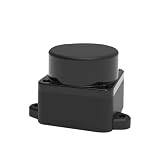
- [360° Omnidirectional Scanning] The STL-19P LiDAR scanner features a high-performance brushless motor that rotates clockwise to achieve comprehensive 360-degree environmental perception, ensuring zero blind spots for your robot's obstacle avoidance.
- [12M Measurement Radius & 5000Hz] Powered by advanced DToF (Direct Time-of-Flight) technology, this laser distance sensor delivers a stable 12-meter detection range and a rapid 5000Hz sampling rate, capturing precise point cloud data in real-time.
- [High Precision & Anti-Interference] Designed to perform exceptionally well indoors and in complex environments. The optimized optical system resists ambient light interference, providing highly accurate distance data for reliable SLAM mapping.
- [Compact Design & Long Lifespan] Built with a slim, space-saving profile, this Lidar module easily integrates into small-scale robots, vacuum cleaners, and smart home devices. The durable brushless motor guarantees an extended operational lifespan of up to 10,000 hours.
- [Complete Developer KIT & Ecosystem] Plug and play out of the box. Fully compatible with mainstream development platforms including ROS, ROS2, Raspberry Pi, and Arduino. Comprehensive SDKs and technical documentation are provided to accelerate your robot navigation projects.
Rank #4

- ENTRY-LEVEL 3D SCANNING: The Fox 3D Scanner by 3DMakerpro offers an accessible medium-format scanning solution for beginners and hobbyists
- PRECISION YOU CAN SEE: At 0.07mm accuracy and 0.10mm resolution, handheld 3d scanners Fox outperforms typical entry-level scanners. It captures the kind of detail that makes your 3D scans truly useful — holding up under the closest scrutiny for effortless 3D printing, modeling, precise 3D measurement, and quality inspection.
- SCAN WITH CONFIDENCE: The Fox 3D Printing Scanner + JMStudio 3D scanning software handle the hard parts — so you don't have to. Built on the same proven ecosystem trusted by tens of thousands of 3DMakerpro users.
- MARKERLESS AI VISUAL TRACKING: Moved too fast during a handheld 3D scan? No problem. Fox's markerless AI feature recognition relocks onto your object in seconds. Just point the scanner back at the area you've already scanned — the software picks up where you left off. No need to start over.
- INTELLIGENT PRE AND POST DATA PROCESSING: JMStudio scanning software integrates scanning, editing, and optimizing into one seamless process.
Product prices and availability are accurate as of the date/time indicated and are subject to change. Any price and availability information displayed on Amazon at the time of purchase will apply.

